Last March, a Singaporean executive found herself paralyzed at a Tokyo boardroom table, wondering if her business card was facing the wrong direction. It’s a common struggle for many of us who travel from the Lion City, especially since mastering japanese culture etiquette is vital for building trust. Recent data shows that 82% of international professionals admit to feeling anxious about unintentionally causing offense in foreign settings. You likely feel that same pressure to get every bow and gift-giving gesture exactly right because you want to respect the local traditions while still being your authentic self.
This guide empowers you to handle your 2026 travels or business ventures with total confidence. We’ll show you the hidden rules that turn a stressful interaction into a seamless connection, from understanding the logic of silent pauses to streamlining your gift-giving process. If you’re looking for personalized guidance, our team is located at 10 Anson Road, level 22, International Plaza, Singapore 079903, right above Tanjong Pagar MRT. Let’s simplify these complex rituals and give you the spark you need for your next big trip.
Key Takeaways
- Empower your social interactions by understanding the core principles of “Wa” and “Omotenashi” to avoid friction and embrace authentic Japanese hospitality.
- Navigate public spaces like a local by mastering “manner mode” on trains and adjusting your japanese culture etiquette for escalator use in Tokyo versus Osaka.
- Streamline your professional engagements with a step-by-step guide to the “Meishi Koukan” business card ritual and the subtle seating hierarchies expected in corporate settings.
- Simplify dining rituals by learning the proper use of the “Oshibori” and the essential phrases that demonstrate your respect for Japanese culinary traditions.
- Discover how a deeper understanding of “Keigo” and cultural context can transform your next trip from a standard visit into a meaningful cross-cultural connection.
The Core of Japanese Etiquette: Understanding Wa and Omotenashi
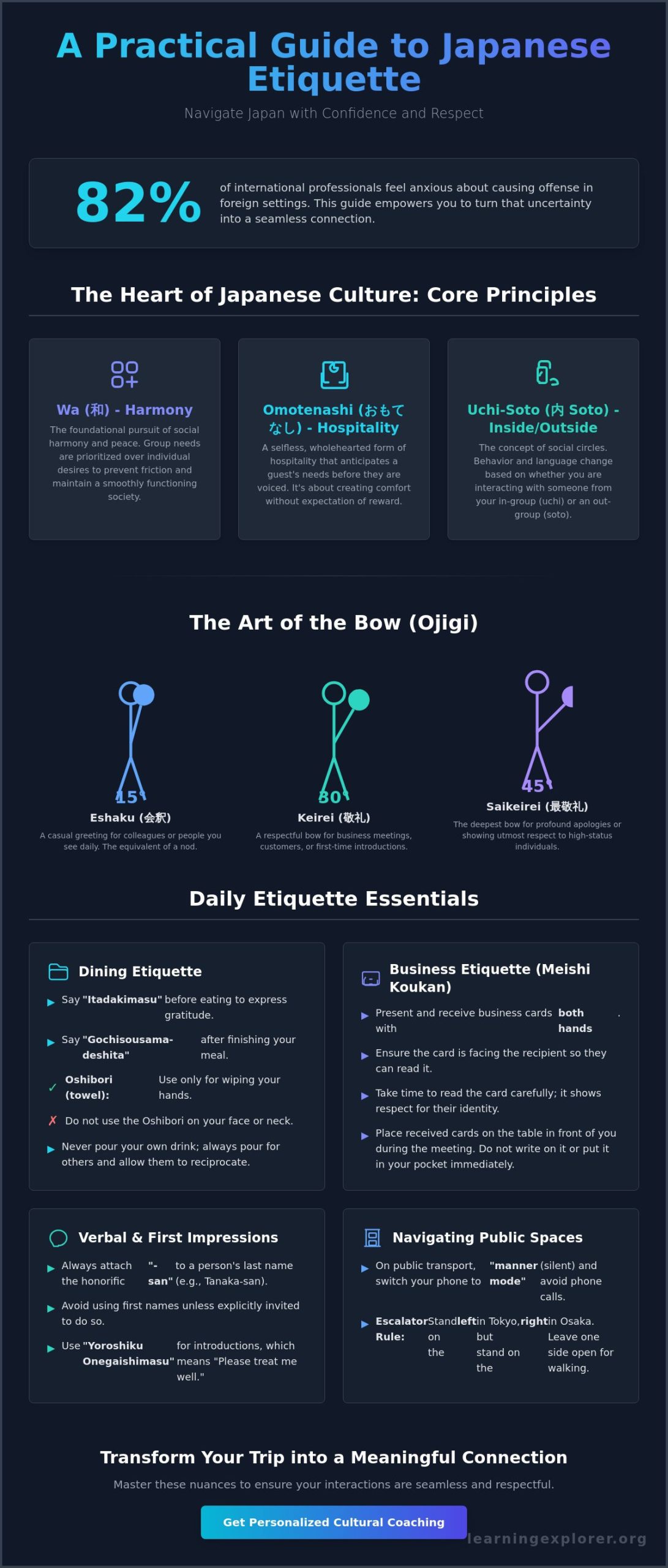
Discover the heartbeat of Japan through its social code. For Singaporeans planning a 2026 trip, mastering Japanese etiquette is about more than just being polite. It’s about Wa, the foundational pursuit of social harmony. This concept ensures that the group’s needs always come before individual desires, preventing friction in a crowded society. Alongside Wa sits Omotenashi, a form of hospitality that anticipates a guest’s needs before they’re even voiced. It’s not just service; it’s a selfless dedication to another person’s comfort that defines japanese culture etiquette.
To better understand this concept, watch this helpful video:
Understanding your place in a social circle is equally vital. The Uchi-Soto (Inside-Outside) concept dictates how you speak and act based on your relationship with others. You’ll treat your family or close colleagues (Uchi) differently than a stranger or a customer (Soto). This distinction helps maintain the delicate balance of Wa across all interactions, ensuring everyone feels respected and secure in their role.
The Art of the Japanese Bow (Ojigi)
Bowing is the most visible part of japanese culture etiquette. It signals respect and acknowledges social hierarchy. Your back should stay straight while you lean from the hips, keeping your eyes down. This simple physical act communicates your status and intentions without saying a word.
- Eshaku: This 15-degree bow serves as a casual greeting for people you see daily or when passing someone in a hallway.
- Keirei: Use this 30-degree respectful bow for business meetings or when meeting someone for the first time. It shows standard professional respect.
- Saikeirei: Reserved for profound apologies or meeting high-status individuals, this 45-degree deep bow demonstrates the highest level of sincerity.
Verbal Etiquette and First Impressions
Your first words set the tone for your entire encounter. Always attach the honorific “-san” to a person’s last name to show respect. Avoid using first names until you’re specifically invited to do so. The phrase “Yoroshiku Onegaishimasu” is your best tool. It roughly translates to “Please treat me well” and works for introductions, starting a business deal, or asking for a favor. Aisatsu is the essential ritual of greetings in Japanese society.
If you’re preparing for a professional relocation, our training center at 10 Anson Road, level 22, International Plaza, Singapore 079903, located right above Tanjong Pagar MRT, offers cultural coaching to help you transition smoothly. Master these nuances to ensure your interactions are seamless and respectful.
Dining Etiquette: More Than Just Chopstick Rules
Mastering japanese culture etiquette at the dinner table transforms a simple meal into a bridge for deeper connection. Start your meal by saying “Itadakimasu,” which translates to “I humbly receive.” This phrase honors the plants, animals, and people involved in the meal’s journey. Once you finish, express your gratitude with “Gochisousama-deshita.” This shows you’ve enjoyed the feast and respect the effort provided by the kitchen staff.
When you sit down, you’ll receive an “Oshibori,” or wet towel. Use this strictly for your hands. Avoid the temptation to wipe your face or neck, as this is considered poor form in polite society. If you’re attending a meal to discuss Japanese business customs, these small details signal your preparation and respect for their traditions.
Drinking is a communal activity. Never pour your own drink. Instead, watch your companions’ glasses. When a glass is less than 25% full, offer to refill it. Your host or colleague will then reciprocate. When it’s time to settle the bill, look for the “Okaikei,” or check. In most Japanese restaurants, you take the bill to the counter near the entrance rather than paying at the table. Tipping isn’t required in Japan, and offering extra cash can sometimes cause confusion.
The “Hashi” (Chopstick) Taboos You Must Avoid
Chopstick mistakes can be jarring for Japanese hosts. Never pass food directly from your sticks to another person’s sticks. This action mirrors a specific funeral rite where bones are passed after cremation. Similarly, don’t stick your chopsticks vertically into a bowl of rice. This resembles incense offerings at a grave. Avoid “Mayoibashi,” which is hovering your sticks over various dishes while deciding what to eat. It’s better to choose with your eyes first and then move your hand directly to the food.
Noodle Slurping and Soup Protocols
In Japan, slurping your ramen or soba isn’t rude. It’s a compliment. The sound indicates you’re enjoying the meal and helps cool the hot noodles while enhancing the flavor. For Miso soup, put down the spoon. Lift the bowl with both hands and sip directly from the rim. When sharing food from communal plates, use the “clean” or thick end of your chopsticks to move food to your own plate. This keeps the dining experience hygienic for everyone at the table.
If you want to sharpen your cultural awareness before your next trip, you can discover curated resources at our training center. We are located at 10 Anson Road, level 22, International Plaza, Singapore 079903, right above Tanjong Pagar MRT.
Navigating Public Spaces: From Singapore Buzz to Japanese Silence
Transitioning from the energetic hum of Orchard Road to the serene order of Tokyo requires a shift in your social frequency. Mastering japanese culture etiquette starts with observing how locals move through their shared environments. While Singaporeans are used to a certain level of background noise, Japan prioritizes a collective silence that feels both intentional and respectful. This discipline transforms every commute and walk into a lesson in mindfulness.
Switch your phone to “Manner Mode” the moment you board a train. Unlike the MRT where a quick phone call might be tolerated, Japanese commuters expect absolute quiet. Speaking on a mobile phone is strictly prohibited on public transport. If you must use your device, stick to silent messaging. This practice reduces administrative stress for everyone in the carriage, creating a commute that feels surprisingly calm even during rush hour.
Movement in Japan follows precise regional logic. Stand on the left side of the escalator in Tokyo to let others pass on the right. If your journey takes you to Osaka, the rule flips; you must stand on the right. Observe the crowd for a few seconds before stepping on to ensure you maintain the flow. This small adjustment simplifies navigation and shows respect for the local rhythm.
Managing waste is another area where your preparation pays off. You will notice a distinct lack of street bins. Following the 1995 sarin gas attacks, Japan removed most public trash cans for security. Most locals carry a small plastic bag to store their litter until they return home or find a designated recycling station at a convenience store. Expect to see complex sorting systems for PET bottles, cans, and combustibles. Precision here is mandatory.
When visiting a shrine or temple, pause at the Temizuya (water pavilion). This purification ritual involves washing your left hand, then your right, and finally rinsing your mouth. It is a beautiful way to ground yourself before entering a sacred space. If you want to dive deeper into these cultural nuances before your flight, visit our experts at 10 Anson Road, level 22, International Plaza, Singapore 079903. Our center is located right above Tanjong Pagar MRT, making it easy to drop in and sharpen your travel skills.
Silence and Space Awareness
Discover the power of Kuki wo Yomu, which translates to “reading the air.” This cultural concept encourages you to sense the atmosphere and adjust your behavior without being told. Avoid Tabeluki, or eating while walking. In Japan, food is something to be appreciated while stationary. Walking while eating is often viewed as messy and inconsiderate to those sharing the sidewalk. By focusing on your surroundings, you create a seamless experience for yourself and those around you.
Tattoos and Onsen Etiquette
Public baths, or onsens, have specific protocols that empower you to relax without worry. Many facilities still restrict entry for guests with tattoos due to historical associations with organized crime. Always check for “tattoo-friendly” signs or use waterproof bandages to cover small ink pieces. Before entering the communal water, you must perform a mandatory pre-bath scrub at the provided stations. Enter the water only when you are perfectly clean. When dressing in a Yukata afterward, always fold the left side over the right. Folding the right side over the left is a significant mistake, as that style is strictly reserved for funerals. Understanding these details, along with Japanese dining etiquette, ensures you move through Japan with the confidence of a seasoned traveler.
Japanese Business Etiquette for Singaporean Professionals
Mastering japanese culture etiquette transforms a standard business trip into a successful partnership. For Singaporeans used to the fast-paced, direct nature of local commerce, the ritualistic approach in Tokyo or Osaka requires a shift in mindset. It’s about showing respect through precise, intentional actions that signal your reliability as a partner.
Mastering the Business Card Exchange
The “Meishi Koukan” is more than a swap of contact details; it’s an introduction of your professional identity. Follow these steps to ensure a flawless exchange:
- Two-Handed Delivery: Always present your card with both hands, holding the top corners so you don’t cover the text. Ensure the writing faces the recipient so they can read it immediately.
- The Order of Rank: The highest-ranking person from the visiting party initiates the exchange. If you’re meeting a group, start with the person of the highest seniority.
- Zero Defacement: Never write on a business card you’ve received. Don’t fidget with it or slide it across the table. These actions are viewed as disrespectful to the person’s status.
- Strategic Placement: During the meeting, place the received cards on the table in front of you. Arrange them to match the seating order of your Japanese counterparts. It’s a practical way to remember names while showing continued respect.
Gift Giving (Omiyage) in a Corporate Context
Bringing “Omiyage” is a powerful way to build “Giri,” or the sense of mutual obligation and relationship-building. Singaporean snacks are excellent choices because they’re unique and shareable. Items like Irvins Salted Egg fish skin or premium cookies from Bengawan Solo are consistently popular in 2026. Presentation is 50% of the value; ensure your gifts are wrapped in high-quality, understated paper. Present the gift at the very end of the meeting with both hands, downplaying its value to remain humble.
Hierarchy and the Power of Silence
Seating arrangements follow a strict logic known as Kamiza (upper seat) and Shimoza (lower seat). The Kamiza is the spot furthest from the door, reserved for the most senior person. This rule applies in meeting rooms, taxis, and even elevators. In a taxi, the most senior person sits directly behind the driver, while the most junior sits in the front passenger seat to handle directions and payment.
Communication also requires a nuanced ear. You’ll encounter “Tatemae,” the polite public face, and “Honne,” the private opinion. A Japanese partner might not say “no” directly; instead, they might say a proposal is “difficult.” Pay attention to silence. In Singapore, we often rush to fill a quiet gap in conversation. In Japan, silence during a meeting signals deep contemplation. Don’t interrupt. Let the silence breathe while they process your proposal.
Refine your professional presence at our training center located at 10 Anson Road, level 22, International Plaza, Singapore 079903. We’re situated right above Tanjong Pagar MRT for your convenience. Empower your team to navigate japanese culture etiquette with confidence and precision.
Bridging the Gap: How a Japanese Language Course Enhances Your Etiquette
Mastering japanese culture etiquette requires more than just memorizing a list of do’s and don’ts. It demands a deep understanding of how language shapes social interactions. Learning “Keigo,” or honorific speech, serves as the ultimate sign of respect in Japan. It isn’t merely about using fancy words; it’s about acknowledging social hierarchy and showing genuine humility. When you use the correct honorifics, you signal to your hosts that you value their customs and their time. This linguistic bridge transforms you from a typical tourist into a respected guest.
Native-speaker teachers play a vital role in this journey. They provide the real-world cultural context that textbooks often miss. These instructors share nuances about regional differences, such as the distinct social vibes between the fast-paced streets of Tokyo and the traditional atmosphere of Kyoto. You’ll learn to “read the air,” a concept known as Kuuki wo yomu. This skill allows you to sense the mood of a room and adjust your behavior accordingly. Practicing these social cues in a controlled environment ensures you feel prepared before you ever step foot in Japan. We invite you to experience our Conversational Japanese Course at our Singapore center to build this vital foundation.
Classroom Learning vs. Real-World Application
Role-playing business scenarios helps bridge the gap between theory and practice. For Singaporean learners, these simulations reduce the anxiety of making social blunders in high-stakes environments. Our bilingual, native instructors understand the Singaporean perspective, making it easier to translate local cultural habits into appropriate Japanese behavior. To sharpen these skills further, you can find various ways to practice japanese speaking singapore and immerse yourself in the local community. This consistent practice builds the muscle memory needed for authentic interactions.
Visit Our Center in the Heart of the CBD
Our training center is conveniently located at 10 Anson Road, level 22, International Plaza, Singapore 079903. We are situated right above Tanjong Pagar MRT, which makes it easy for busy professionals to join a session after work. You’ll find that our learn japanese language modules integrate etiquette into every single lesson. We focus on practical skills that empower you to communicate with confidence and grace. Discover how a structured curriculum can simplify your learning process and deliver the results you need for your 2026 travels. Start your journey with us today and transform your experience into something truly exceptional. As you build your language foundation, understanding the difference between kanji vs kana will help you decode menus, signage, and business materials you’ll encounter throughout Japan.
Embrace the Spirit of Omotenashi Today
Mastering japanese culture etiquette goes beyond memorizing table manners; it’s about fostering respect and harmony in every interaction. By 2026, over 450,000 Singaporeans are expected to visit Japan annually according to recent tourism trends, and those who understand the core values of Wa and Omotenashi will enjoy a significantly deeper experience. From navigating quiet public spaces to excelling in high-stakes business environments, your cultural fluency acts as a bridge between Singapore’s buzz and Japan’s refined traditions.
Don’t let the fear of a cultural faux pas hold you back. Our native-speaker bilingual instructors deliver a curriculum that’s strictly aligned with JLPT standards to ensure you gain practical, real-world skills. We’ve simplified the learning process at our CBD center located at 10 Anson Road, level 22, International Plaza, Singapore 079903, which sits right above Tanjong Pagar MRT. It’s time to transform your curiosity into confidence and deliver the respectful presence that Japanese hosts truly appreciate.
Book a Trial Japanese Class at our Tanjong Pagar Center and discover how seamless language learning can be. We’re here to help you find the spark that makes every lesson one you’ll love.
Frequently Asked Questions about Japanese Culture & Etiquette
Is it really offensive if I don’t bow perfectly in Japan?
No, Japanese people don’t expect foreigners to master the perfect bow immediately. They appreciate your sincere effort to respect their customs. A simple 15 degree incline is sufficient for most daily interactions. Focus on maintaining eye contact after the bow rather than during it. This small gesture shows you’ve studied japanese culture etiquette and value their social standards, which is more important than technical perfection.
What should I do if I have tattoos and want to visit an Onsen?
Cover small tattoos with waterproof bandages or seek out one of the 500+ tattoo-friendly facilities now listed on major travel directories. Many traditional inns still maintain a “no ink” policy to preserve a specific atmosphere. If your tattoos are large, book a private bath known as a kashikiriburo. This ensures you enjoy the hot springs without any social friction or discomfort during your stay.
Can I eat while walking on the streets in Japan?
Avoid eating while walking as it’s traditionally seen as poor manners in most Japanese cities. Stand near the vending machine or stall where you purchased the snack to finish your meal. This practice keeps the streets clean and reflects a deep respect for the food prepared. In 2024, several districts in Kyoto even introduced signs to remind tourists of this local preference to keep sidewalks clear.
How do I address a Japanese business partner for the first time?
Address your partner using their family name followed by the suffix San. This neutral and respectful title works for all genders in professional settings. Avoid using first names until your partner explicitly invites you to do so. Following this standard helps you build a bridge of trust and shows you’ve mastered essential japanese culture etiquette for the workplace. It simplifies communication and reduces social anxiety during your first meeting.
Is slurping noodles actually polite in Japan?
Yes, slurping your ramen or soba is a sign that you’re enjoying the meal and it helps cool the hot noodles. It’s a functional habit that also lets the chef know their work is appreciated. While it feels loud to Singaporeans, it’s a standard part of the dining experience. Just ensure you don’t splash broth on your neighbors while you eat. This small adjustment makes your meal feel more authentic.
What are the most important chopstick rules for beginners?
Never pass food directly from your chopsticks to another person’s pair. This resembles a funeral rite and is considered a major taboo. Also, don’t stick your chopsticks vertically into a bowl of rice for the same reason. These two rules are the most critical to follow. Use a chopstick rest whenever you aren’t eating to keep the table organized and clean. It shows you respect the tools provided.
Do I need to tip at restaurants or hotels in Japan?
Tipping is not required and is often politely refused in Japan. Exceptional service is already included in the price of your meal or stay. If you leave extra cash on the table, staff will likely chase you down to return it, thinking you forgot your change. Instead, offer a sincere Arigato gozaimasu to show your gratitude for their hard work. This keeps the transaction simple and avoids awkwardness.
How can I practice Japanese etiquette before my trip?
Enroll in a structured cultural workshop to gain hands-on experience before you fly. You can visit our training center at 10 Anson Road, level 22, International Plaza, Singapore 079903, located right above Tanjong Pagar MRT. Discover the nuances of social interaction and plan your trip with confidence. Our experts help you streamline your learning, providing the spark for a journey filled with lessons your students will love when you share your stories. If you’re also building your reading skills, our guide on kanji vs kana for beginners in Singapore is an excellent next step to complement your cultural preparation.