Could a single misplaced honorific be the invisible barrier stalling your next big deal in Tokyo? For many Singaporean professionals, the pressure to get Japanese business communication exactly right feels like walking a high-wire without a net. You likely spend far too much time overthinking every draft, fearing that a mistake in Keigo might strain your relationship with a key partner. Finding a dedicated Japanese business email etiquette course is often the missing link to gaining the confidence you need to communicate effectively.
We understand that your time is valuable and that business moves fast in the Singapore-Japan corridor. This guide unlocks the secrets of professional correspondence with actionable templates and cultural insights tailored for our local market. Learn to write polished Japanese emails quickly, allowing you to build deep trust and secure a competitive edge. If you’re ready to move beyond the stress of drafting, join our Conversational Japanese Course at 10 Anson Road, level 22, International Plaza, Singapore 079903, located right above Tanjong Pagar MRT, to elevate your professional impact.
Key Takeaways
- Understand why professional correspondence acts as a vital first impression in the high-stakes Singapore-Japan trade corridor.
- Master the precise anatomy of a Japanese email, including the strict hierarchy required for recipient details and subject lines.
- Learn to navigate the complexities of honorific language (Keigo) to ensure you always signal the correct level of respect to external partners.
- Discover how a specialized Japanese business email etiquette course provides the expert guidance needed to avoid common cultural pitfalls.
- Gain access to actionable templates for daily business scenarios that help you draft professional emails faster and with total confidence.
Table of Contents
- Why Japanese Business Email Etiquette Matters for Singaporean Professionals
- The Anatomy of a Professional Japanese Business Email
- Navigating Keigo: Internal vs. External Communication Nuances
- Essential Japanese Email Templates for Daily Business Scenarios
- Elevate Your Career with a Japanese Business Email Etiquette Course in Singapore
Why Japanese Business Email Etiquette Matters for Singaporean Professionals
Japan remains one of Singapore’s most significant trading partners, creating a vibrant economic bridge that local professionals navigate daily. In the Singapore CBD, mastering communication isn’t just a soft skill; it’s a strategic necessity. In Japanese corporate culture, your email is often your first handshake. A single message can signal deep respect or a lack of professionalism, setting the tone for every future interaction you have with your counterparts. Understanding Japanese etiquette fundamentals is the first step toward building lasting partnerships that thrive on mutual respect.
To better understand this concept, watch this helpful video:
Relying on English or AI translation tools often leads to “lost in translation” moments that can be hard to repair. While AI can translate basic vocabulary, it frequently misses the critical nuances of hierarchy and sentiment. This gap leads to misunderstandings that strain business relationships before they even begin. By investing in a japanese business email etiquette course, you bridge this cultural divide. You’ll learn to build Shinrai (trust) through disciplined, culturally aware communication habits that resonate with Japanese executives. If you prefer face-to-face guidance, our training center is located at 10 Anson Road, level 22, International Plaza, Singapore 079903, situated directly above Tanjong Pagar MRT.
The Singapore-Japan Business Connection
Japanese MNCs are a cornerstone of the Singapore business landscape, with a heavy concentration of offices in the Tanjong Pagar area. As regional headquarters continue to manage diverse portfolios across Southeast Asia, language proficiency becomes a key differentiator for career advancement. Many local executives are now enrolling in a Learn Japanese Language Course to ensure they can navigate these high-stakes interactions with total confidence and precision.
Common Pitfalls for Non-Native Writers
One of the biggest hurdles is the “Politeness Gap.” Standard professional English often feels too direct or blunt to a Japanese recipient. Without the right training from a japanese business email etiquette course, writers might accidentally ignore hierarchical structures, which is often perceived as a lack of respect. A well-structured email does more than deliver information; it provides psychological comfort to the recipient. It shows that you value their time and deeply respect their cultural norms, which is essential for long-term success.
The Anatomy of a Professional Japanese Business Email
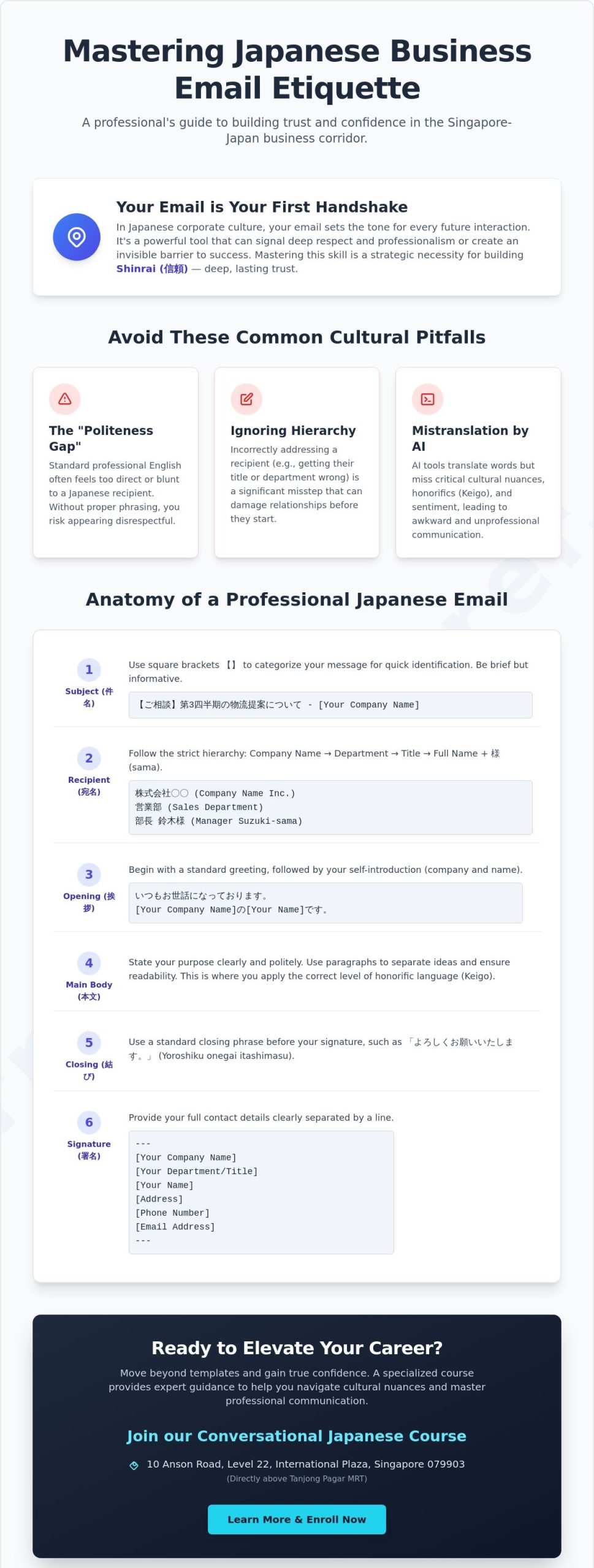
Structuring a Japanese business email requires more than just translating your thoughts; it demands a specific architecture that signals your professionalism and respect for hierarchy. Every element, from the first bracket in your subject line to the final character of your signature, serves a purpose in building relationships in Japan. When you follow this established anatomy, you remove the guesswork and ensure your message is received with the gravity it deserves. If the technicalities of these structures feel overwhelming, a japanese business email etiquette course provides the hands-on practice needed to make these habits second nature.
Crafting the Perfect Subject Line
Busy executives in Japan often decide which emails to open based on the clarity of the Kenmei (subject line). Use square brackets 【 】 to categorize your message immediately. This helps the recipient prioritize their inbox at a glance. For example, use 【相談】 for a consultation or 【重要】 for something urgent. A strong subject line balances brevity with enough context to be useful without being wordy. It respects the recipient’s time by clearly stating the email’s intent before they even click. Effective examples include “【Inquiry】 Q3 Logistics Proposal – Singapore Branch” rather than a vague “Hello.”
The Standard Opening Sequence
The Atesaki (recipient details) must follow a strict downward order: Company Name, Department, Job Title, and finally the recipient’s surname followed by “Sama.” Skipping any of these layers can appear dismissive of the person’s role within their organization. Once the recipient is addressed, you must use the standard opening greeting: Osewa ni natte orimasu. This phrase acknowledges the ongoing relationship and is a non-negotiable pillar of Japanese business communication because it establishes a baseline of mutual respect before any data is shared. Always identify yourself by stating your company name before your personal name to prioritize your organization’s identity.
The Honbun (main body) should get to the point quickly while maintaining appropriate levels of Keigo. Avoid overly long paragraphs. Instead, use clear, logical breaks to keep the text scannable. For Singaporean professionals balancing multiple regional roles, mastering this efficiency is a huge time-saver. Conclude with a standard sign-off like Yoroshiku onegaishimasu, which roughly translates to “I look forward to your kind cooperation.” Your signature should include your full contact details, ensuring your Japanese partners can reach you easily. If you want to refine these skills further, consider exploring a Conversational Japanese Course to practice these nuances in a supportive environment right here in Tanjong Pagar.
Navigating Keigo: Internal vs. External Communication Nuances
Mastering Keigo is often the most daunting part of professional Japanese, yet it’s the very thing that sets expert communicators apart in the Singapore business landscape. At the heart of this system lies the “Uchi-Soto” (Inside-Outside) concept. In a corporate setting, your colleagues and your company are considered “Uchi” (Inside), while clients and external partners are “Soto” (Outside). This distinction dictates whether you should elevate the recipient or humble yourself to show respect. Navigating these layers correctly is a core focus of any high-quality japanese business email etiquette course, as it transforms your writing from merely functional to culturally resonant.
There are three primary levels of Keigo you must balance to maintain professional harmony:
- Sonkeigo (Honorific): This level elevates the client or external partner. Use it when the subject of the action is the person you’re writing to.
- Kenjougo (Humble): This involves lowering your own status or your company’s status. It shows respect by creating a humble gap between you and the recipient.
- Teineigo (Polite): This is the baseline “Desu/Masu” form. It provides a general level of professionalism suitable for everyday interactions.
Understanding when to switch between these forms ensures you don’t accidentally offend a senior partner or sound overly stiff to a close teammate. If you’re looking for personalized guidance on these nuances, our instructors help you practice these skills in real-world scenarios, ensuring you feel prepared for every high-stakes interaction.
Writing to External Clients and Partners
When communicating with those outside your organization, precision is vital. Always use “Sama” after the recipient’s name and ensure their job title is accurate. When referring to your own company, use the humble term “Heisha” instead of your company’s actual name. This subtle shift signals that you understand the “Uchi-Soto” boundary. Standard phrases for requesting a meeting should always utilize Kenjougo to show you value the client’s time and authority.
Internal Communication with Japanese Management
Internal emails require a different balance. While you must still respect hierarchy, emailing a “Shacho” (CEO) vs. a “Bucho” (Manager) in the Singapore office often allows for slightly more direct language to favor efficiency. However, never skip the “Hou-Ren-So” (Report-Inform-Consult) framework. Reporting updates via email to Japanese superiors should be structured, frequent, and clear. Enrolling in a japanese business email etiquette course helps you identify exactly when to drop extreme formality for the sake of speed without losing the respect required in a Japanese corporate environment.
Essential Japanese Email Templates for Daily Business Scenarios
Drafting every message from scratch is a significant time drain for busy Singaporean professionals. Having a set of vetted templates doesn’t just save time; it ensures you’re consistently using the correct Keigo levels we explored in the previous section. These situational guides provide the creative catalyst you need to communicate with precision and ease. If you find yourself struggling to adapt these frameworks to complex scenarios, joining a japanese business email etiquette course provides the personalized feedback required for true mastery.
Template for Business Introduction
A first-time contact requires a careful balance of humility and clarity. Start with a standard opening like Hajimete renraku sasete itadakimasu (I am contacting you for the first time). If you have a mutual connection, mention their name early to establish immediate trust. Always attach your company profile or portfolio as a PDF to provide context without cluttering the email body. This approach respects the recipient’s limited time while offering a professional gateway to your business. It transforms the labor of seeking a connection into a moment of professional discovery.
Template for Meeting Requests
When proposing a meeting, clarity is your best ally. Propose three specific time slots using the Japanese date format (Year/Month/Day) to avoid any confusion. Since you’re operating in the Singapore-Japan trade corridor, always specify the time zone clearly to avoid scheduling mishaps. For example, “14:00 (Singapore Time)” helps your Japanese counterpart adjust their schedule accordingly. Clarify the agenda in a few bullet points to respect the recipient’s time and conclude with a request for their kind consideration.
The Art of the Professional Apology
Errors happen, but in Japanese business culture, how you handle them defines your reputation. Use Moushiwake gozaimasen for serious errors and Shitsurei itashimashita for minor lapses in etiquette. Explain the cause briefly and focus on the immediate solution rather than making excuses that might sound defensive. A prompt and sincere apology can actually strengthen a business relationship by demonstrating your accountability and commitment to the partnership. Follow-up emails after a discussion or politely declining a proposal should follow a similar logic: prioritize the relationship over the transaction.
Ready to put these templates into practice and gain a competitive edge? Sign up for our Conversational Japanese Course and start communicating with total confidence today. Our training center is conveniently located right above Tanjong Pagar MRT, making it accessible for professionals working across the CBD.
Elevate Your Career with a Japanese Business Email Etiquette Course in Singapore
Navigating business Keigo requires more than just a textbook. While self-study apps are great for memorizing basic vocabulary, they often fall short when you need to navigate the high-stakes nuances of executive-level correspondence. Learning on your own doesn’t provide the real-time feedback necessary to catch subtle errors in tone that could accidentally offend a senior partner. A dedicated japanese business email etiquette course bridges this gap by offering professional guidance that self-study simply cannot match. You’ll move beyond the labor of second-guessing yourself and transition to the satisfaction of clear, confident communication.
Our program features bilingual native instructors who deeply understand the unique dynamics of the Singapore-Japan business corridor. They don’t just teach the language; they provide the creative catalyst for better outcomes through interactive role-playing and live drafting sessions. You’ll receive immediate corrections on your writing, ensuring your emails reflect the highest standards of Japanese corporate culture. We offer flexible learning formats to suit your schedule, including private one-on-one sessions, collaborative group classes, and intensive corporate training for entire teams. This tailored approach ensures you gain the specific skills needed for your daily professional tasks.
Learning Explorer: Your CBD Partner for Japanese Mastery
Success in the regional headquarters of the Singapore CBD often depends on your ability to connect with international stakeholders. Our training center is conveniently located at 10 Anson Road, level 22, International Plaza, Singapore 079903. Situated directly above Tanjong Pagar MRT, it’s the perfect stop for busy professionals looking to upskill without a long commute. We don’t believe in a one-size-fits-all approach. Instead, we offer a customized curriculum designed to meet the specific demands of your industry, whether you’re in finance, logistics, or technology. This focus on practical application makes every lesson immediately useful in your workplace.
Investment in Your Professional Future
Mastering the art of the Japanese business email is a powerful investment that opens doors to regional leadership roles. When you demonstrate a command of Keigo and cultural etiquette, you signal that you’re ready for high-level responsibilities and cross-border collaborations. You can start your journey from a beginner and grow into a confident communicator with our Learn Japanese Language pillar course. Don’t let communication barriers hold back your career potential. Take the first step toward increasing your professional impact and reducing administrative stress. Book your consultation at Learning Explorer today!
Secure Your Competitive Edge Today
Mastering the nuances of Keigo and the specific structural requirements of Japanese correspondence is more than a linguistic exercise; it’s a strategic career move. By applying the anatomy and templates shared in this guide, you’ll reduce the time spent overthinking drafts and start building stronger, more reliable partnerships across the Singapore-Japan trade corridor. The right japanese business email etiquette course transforms these complex cultural rules into intuitive habits that signal your professionalism from the very first line.
With over 10 years of professional language training experience, our team is ready to help you succeed. Our certified native-speaker instructors provide the real-world insights needed to excel in any corporate setting. We make learning accessible and efficient at our training center situated directly above Tanjong Pagar MRT. Don’t let communication gaps hold you back from regional leadership opportunities or strain your business relationships.
Enroll in our Japanese Business Email Etiquette Course at International Plaza Today!
We look forward to being your partner in professional growth and helping you communicate with total clarity and respect.
Frequently Asked Questions
Is it okay to use ‘San’ instead of ‘Sama’ in a Japanese business email?
You should use ‘Sama’ for all formal business correspondence with external partners and clients. While ‘San’ is common in spoken Japanese or casual settings, it lacks the necessary level of respect required for professional emails. Using ‘Sama’ ensures you’re addressing the recipient with the appropriate honorific, which is essential for maintaining a positive business relationship.
How do I write a professional subject line in Japanese?
A professional subject line must be clear and categorized using square brackets 【 】. This allows busy executives to understand the email’s purpose immediately. For example, use 【相談】 for a consultation or 【重要】 for urgent matters. Keep the rest of the subject line concise, providing just enough context so the recipient can prioritize their response without opening the message first.
What are the most common mistakes in Japanese business emails?
The most frequent errors include misusing Keigo (honorifics) and neglecting the strict hierarchy of recipient details. Many writers also forget to include their company name before their personal name in the opening. These small lapses can signal a lack of cultural awareness. Enrolling in a japanese business email etiquette course helps you identify and correct these habits before they impact your professional reputation.
Do I need to use seasonal greetings if I am emailing from Singapore?
Seasonal greetings are not strictly mandatory for daily operations, but they are highly appreciated in formal or first-time correspondence. Using them demonstrates a deep respect for Japanese culture and traditions. While standard business greetings like ‘Osewa ni natte orimasu’ are usually sufficient, a professional japanese business email etiquette course will teach you when a seasonal reference can help build stronger rapport.
How long does it take to learn basic Japanese business email etiquette?
You can master the fundamental structures and common templates in approximately 16 hours of focused training. Many professionals in Singapore find that a short, intensive module provides enough confidence to handle daily emails independently. This timeframe allows for practical exercises and feedback on your writing, ensuring you can apply what you’ve learned immediately in your workplace at Tanjong Pagar or beyond.
Can I use Google Translate for my Japanese business correspondence?
You should avoid relying on automated translation tools for formal business emails. These tools often fail to distinguish between the various levels of Keigo, which can lead to messages that sound accidentally rude or robotic. While they might help you understand an incoming message, drafting your own response ensures the tone is culturally appropriate and professionally accurate for your specific audience.
Is there a specific way to sign off a Japanese business email?
The standard professional sign-off is ‘Yoroshiku onegaishimasu’. This versatile phrase roughly translates to ‘I look forward to your kind cooperation’ and is used to conclude almost every business interaction. It signals your desire for a continued positive relationship. Ensure your full signature follows this, including your company name, department, and contact information, so the recipient knows exactly how to reach you.
What is the best way to address a group of people in a Japanese email?
Use the term ‘Ochuu’ after the department or company name when you’re addressing an entire organization or team rather than a specific individual. For example, you would write ‘Sales Department Ochuu’ to address everyone in that section. If you’re addressing multiple specific individuals, list them in order of their rank within the company to respect the internal hierarchy.