Imagine stepping off a 24-hour flight from Changi into the vibrant, bustling streets of Buenos Aires, only to realize your textbook phrases don’t quite match the local rhythm. For many Singaporeans, the dream of exploring the majestic Andes or the Amazon rainforest is often shadowed by the fear of being stranded or misunderstood. Mastering spanish for travel to south america is the vital bridge between being a confused tourist and an empowered traveler who can navigate transport, order a meal, and handle arrival logistics with total confidence.
We understand that the administrative weight of a transcontinental trip is taxing enough without the added anxiety of a language barrier. You likely feel a mix of excitement and hesitation regarding the regional nuances that distinguish Latin American Spanish from the version spoken in Spain. This essential 2026 guide promises to reduce that burden by equipping you with the specific vocabulary and cultural etiquette needed to foster authentic connections. We will preview the must-know phrases for transport, explain regional slang, and provide the logistical clarity you need for a seamless journey. If you want to start your preparation conveniently, our training center is located at 10 Anson Road, level 22, International Plaza, Singapore 079903, situated directly above Tanjong Pagar MRT.
Key Takeaways
- Bridge the “English Gap” by mastering a functional toolkit designed for survival and authentic connection in local markets and rural areas.
- Differentiate between Castilian and Latin American Spanish to adopt the correct regional pronunciation and avoid common linguistic myths.
- Gain the confidence to navigate complex transport systems and “Terminal Terrestres” using specific, high-impact navigation phrases.
- Realize why structured learning for spanish for travel to south america is far more efficient than gamified apps for developing real-world conversational skills.
- Prepare for your journey with native-speaker instructors who bring Latin American culture and etiquette directly into the classroom.
Why Spanish for Travel to South America is a Game-Changer
Think of travel Spanish as a functional toolkit rather than a classroom burden. It’s a set of high-impact tools designed for survival, navigation, and genuine human connection. When you embark on a journey across this continent, you aren’t just moving through space; you’re moving through a complex social fabric where language is the primary currency. Learning spanish for travel to south america isn’t about achieving perfect grammar or literary fluency. It’s about having the confidence to ask for a pharmacy, negotiate a taxi fare, or find the right platform at a chaotic bus station without the paralyzing fear of being stranded.
To better understand how language changes your travel experience, watch this helpful video:
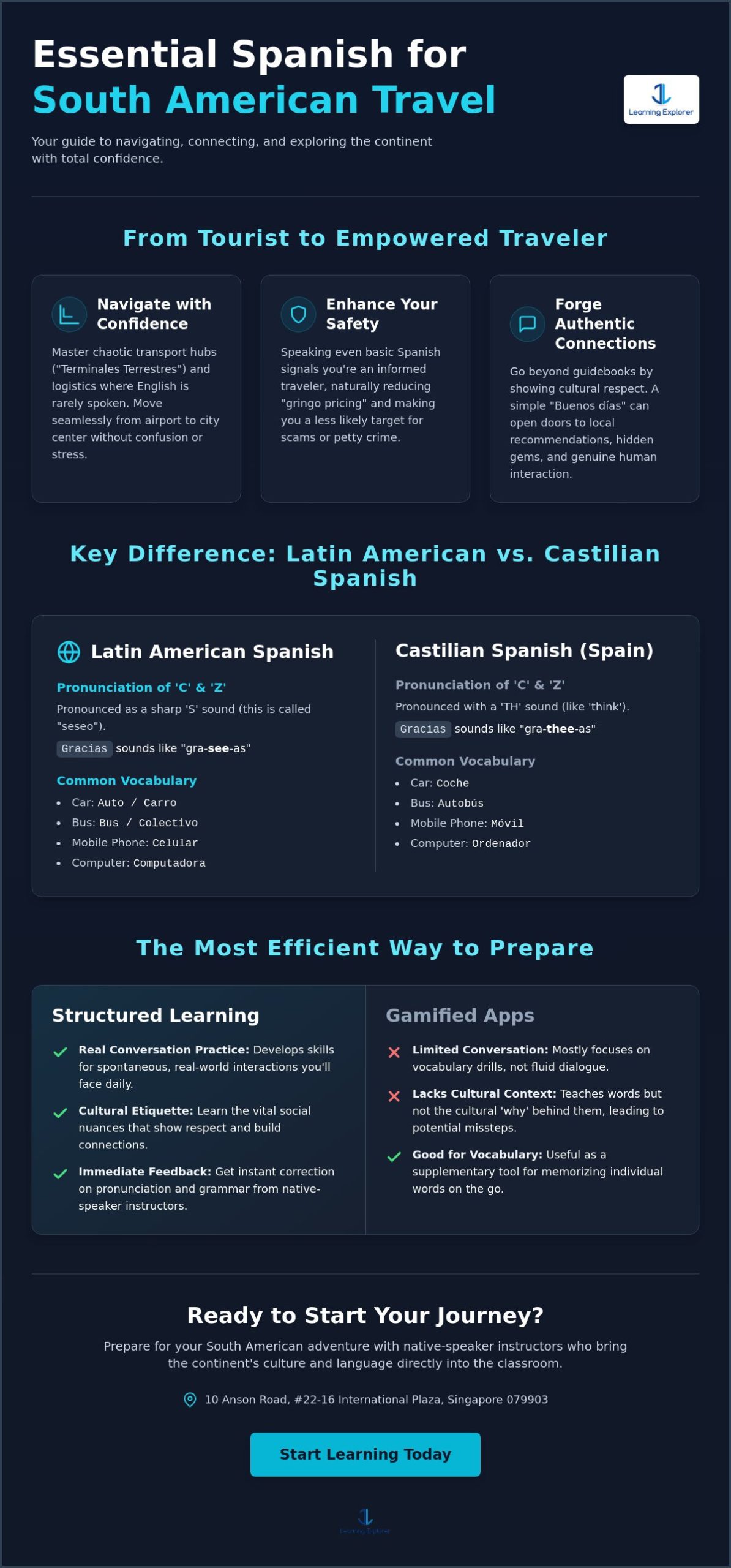
Preparation reduces the mental load of arrival logistics. Instead of fumbling with translation apps while juggling luggage, you’ll have the phrases ready to go. This linguistic readiness also acts as a safety shield. Scammers often target those who appear most confused or disconnected from the local environment. By speaking even basic Spanish, you signal that you’re an informed traveler, which naturally reduces “gringo pricing” and makes you a less likely target for petty crime. Understanding the various Spanish dialects in the Americas ensures you’re prepared for the local flavor of each country you visit.
The Reality of English Proficiency in South America
Major tourist hubs like Buenos Aires or Santiago have pockets of English speakers, but this proficiency disappears quickly once you head into remote areas like the Sacred Valley or local markets in Quito. Transport hubs are particularly challenging. Bus stations, or “Terminales Terrestres,” rarely have English signage or staff. In a medical or logistical emergency, being able to describe symptoms or explain a lost passport in Spanish is the difference between a minor hiccup and a full-blown crisis. Relying on English in these moments is a gamble you don’t want to take.
From Tourist to Traveller: The Connection Factor
A simple “Buenos días” does more than just greet; it acknowledges the local social hierarchy and shows respect. Latin American culture places a high value on the effort you put into social etiquette. When you try to speak the language, you open doors to authentic experiences that aren’t listed in guidebooks. Locals are far more likely to share a hidden restaurant recommendation or a piece of local history with someone who respects their culture enough to learn its tongue. This transition from a passive observer to an active participant is the true reward of spanish for travel to south america.
Regional Nuances: Latin American vs. Castilian Spanish
One common myth among beginners is that South American Spanish is a single, uniform block. In reality, it’s a vibrant mosaic of dialects that shift as soon as you cross a border. Mastering spanish for travel to south america requires recognizing these subtle changes so you don’t feel lost when a local’s accent shifts. While the core grammar remains the same, the “flavor” of the language changes through pronunciation and local slang.
The most immediate difference you’ll notice is the pronunciation of ‘c’ and ‘z’. In many parts of Spain, these letters are pronounced with a “lisp” or a ‘th’ sound. In the Americas, we use the seseo, where these letters are pronounced as a sharp ‘s’. Words like gracias or cerveza sound much more familiar to English speakers in the Americas than they do in Madrid. This practical guide to South American Spanish explains why relying on European textbooks can sometimes lead to confusion when you’re on the ground.
Vocabulary shifts are equally important for your daily logistics. If you’re looking for a car, ask for an auto rather than a coche, which can mean a baby carriage in some regions. Similarly, your phone is a celular, never a móvil. Even social etiquette varies by geography. In the Andean highlands of Peru and Ecuador, using Usted (the formal ‘you’) is the standard for showing respect to strangers. Conversely, on the Caribbean coasts of Colombia or Venezuela, the atmosphere is more relaxed, and people jump to the informal tú much faster. If you’re feeling overwhelmed by these variations, a Conversational Spanish Course can help you distinguish between these regional styles before you depart.
Understanding the Argentine ‘Voseo’ and ‘Ll’ Sound
If your itinerary includes Buenos Aires or Montevideo, prepare for the voseo. In this region, the pronoun vos replaces tú, coming with its own unique verb conjugations. The accent is also strikingly rhythmic. The double ‘ll’ and ‘y’ sounds, which are usually a ‘y’ sound elsewhere, are pronounced as a soft ‘sh’. A street (calle) becomes a ca-she. Adapting your ear to this Italian-influenced cadence is essential for navigating the Rio de la Plata region confidently.
Colombian and Mexican Influence on Travel Spanish
Many travelers find the Bogotano accent from central Colombia to be the clearest and easiest to understand. It’s often recommended for beginners because of its neutral tone and crisp articulation. However, you’ll still encounter plenty of regionalisms. You might hear chévere or bacán to describe something cool, or the famous pura vida if you venture toward Central American borders. Learning these markers helps you move beyond basic survival and into real conversation.
Must-Know Phrase Categories for Your South American Itinerary
Equipping yourself with a targeted toolkit of phrases transforms your journey from a series of stressful transactions into a smooth, enjoyable adventure. When you prioritize spanish for travel to south america, you focus on high-utility language that solves immediate problems. Start with the ‘Golden Five’ of politeness: por favor (please), gracias (thank you), perdón (pardon me), disculpe (excuse me, to get attention), and con permiso (with your permission, used when passing through a crowd). These simple words act as social lubricants, instantly warming up any interaction with a local.
Navigation is where your preparation truly pays off. In South America, long-distance travel usually centers on the Terminal Terrestre (land terminal). You’ll need to ask, “¿A qué hora sale el próximo bus para…?” (What time does the next bus for… leave?). In the market, don’t settle for the first price offered. Use the local favorite, “¿Cuánto es lo mínimo?” (What is the minimum/best price?), to start a friendly negotiation. For safety, memorize emergency basics: “¡Ayuda!” (Help!), “Me robaron” (I was robbed), and “Necesito un médico” (I need a doctor). Having these ready reduces the panic of unexpected situations.
The Art of the Latin American Greeting
In South American culture, jumping straight into a question without a greeting is considered rude. Always lead with a “Buen día” (Good day) or “Buenas tardes” (Good afternoon) before asking for directions or a price. While “Hola” is common, using the time-appropriate greeting shows a higher level of respect. Physical etiquette is also key. In professional settings, a firm handshake is standard. However, in social situations, don’t be surprised by a beso (a light cheek-to-cheek kiss). Observe the locals first to see if they lean in or offer a hand.
Dining Out: From Street Food to Fine Dining
Look for signs advertising an Almuerzo Ejecutivo or Menú del Día. These are fixed-price lunch sets that offer the best value and most authentic local flavors. If you have dietary restrictions, clarity is vital. Tell your server “Soy alérgico al maní” (I am allergic to peanuts) or “No como mariscos” (I don’t eat shellfish). When you’re finished, remember that servers will rarely bring the bill unless you ask. Catch their eye and say, “La cuenta, por favor.” It’s a relaxed social ritual that respects your time to linger over coffee without being rushed out the door.
Developing Conversational Confidence Before You Fly
Success in spanish for travel to south america depends on efficiency. While gamified apps are popular, they often fail to prepare you for the rapid-fire speech of a Lima taxi driver or the social pressure of a crowded market. Many learners find that 10 hours of structured, goal-oriented learning provide more functional confidence than 100 hours of passive swiping. You need to move beyond matching words to pictures; you need to practice the physical act of speaking and responding in real time.
Overcoming the fear of sounding silly is your biggest hurdle. Practicing with native speakers allows you to make mistakes in a safe environment before you land. This interaction trains your brain to process regional accents and helps you build a personal phrasebook tailored to your interests, whether you’re hiking the Inca Trail or exploring the wine regions of Mendoza. Building this foundation early reduces the administrative stress of your trip, allowing you to focus on the joy of discovery rather than the frustration of being misunderstood.
The Role of Structured Classes in Singapore
Learning in a group setting mimics the social dynamics you’ll encounter abroad. A bilingual instructor is invaluable here; they can explain the “why” behind grammar in a way that makes sense to a Singaporean learner. If you’re looking for a language school that prioritizes conversational outcomes over rote memorization, visit us at 10 Anson Road, level 22, International Plaza, Singapore 079903, located right above Tanjong Pagar MRT. We focus on the practical skills that matter most to travelers.
Leveraging Your Singapore Commute for Immersion
Your daily MRT ride is a prime opportunity for ear training. Listen to South American Spanish podcasts or regional music to get used to different cadences. Use digital flashcards for high-frequency travel nouns like servilleta (napkin) or aduana (customs). For a high-stakes immersion tactic, set your phone’s language to Spanish. It forces you to recognize common commands and icons, building a level of comfort that will serve you well when you’re using local navigation apps in a foreign city.
Ready to start your journey? Sign up for our Conversational Spanish Course and gain the skills to travel South America with ease.
Prepare for South America at Learning Explorer Singapore
Your journey to the peaks of Patagonia or the vibrant streets of Medellín starts long before you board the plane. At Learning Explorer, we specialize in spanish for travel to south america by stripping away academic fluff and focusing on the real-world skills you’ll need on the ground. Our Conversational Spanish Course is designed specifically for adventurers who want to do more than just survive; they want to thrive and connect. We transform the labor of language seeking into the satisfaction of discovery, ensuring you’re ready for every logistical challenge your itinerary presents.
Our team of native-speaker instructors brings the heart of Latin American culture directly into our Singapore classroom. They don’t just teach you how to conjugate verbs; they explain the nuance of a Colombian greeting and the specific rhythm of an Argentine conversation. This cultural immersion ensures you’re prepared for the social cues that generic textbooks often overlook. We understand that busy professionals have tight schedules, so our center is conveniently located in the CBD. This central hub at International Plaza, situated directly above Tanjong Pagar MRT, makes it easy to drop in for a session after work or during a lunch break.
Why Our Spanish Course is Different
We prioritize high-frequency travel scenarios that matter to you. You won’t spend weeks learning classroom objects you’ll never use. Instead, you’ll engage in interactive role-playing for navigating transport hubs, checking into boutique hotels, and haggling in local markets. This hands-on approach builds the confidence to speak from your very first day. We address regional dialects specifically, so you’re never caught off guard by the local variations discussed earlier in this guide. Our goal is to reduce your administrative burden by making communication the easiest part of your trip.
Join a Community of Adventurous Learners
Learning is more effective when you’re surrounded by like-minded people. When you join our classes, you’re entering a community of fellow Singaporean travelers who share your passion for South America. You’ll gain access to a library of high-quality, vetted materials that go far beyond unorganized external sources. This collaborative environment provides the creative catalyst you need to master spanish for travel to south america while networking with others heading to similar destinations. Ready to start? Explore our Conversational Spanish Course today and turn your travel dreams into a reality.
Empower Your South American Adventure
Navigating the diverse landscapes of the Americas requires more than just a passport; it requires the linguistic tools to build genuine human connections. By understanding the regional nuances of spanish for travel to south america, you move beyond being a passive observer and become an active participant in local culture. Whether you’re negotiating a fare in a bustling market or asking for directions in the Andean highlands, your preparation ensures a journey defined by confidence rather than confusion.
At Learning Explorer, we provide the creative catalyst for your travel goals. Our native-speaker bilingual instructors focus on strategic conversational fluency, ensuring you can handle real-world scenarios with ease. Our training center is conveniently located in the CBD, situated directly above Tanjong Pagar MRT. We understand the taxing nature of travel logistics and are here to reduce that burden through high-quality, vetted instruction that prioritizes your success.
Don’t let a language barrier hold you back from the trip of a lifetime. Book Your Conversational Spanish Course at Learning Explorer today and start your journey toward authentic connection and discovery. We can’t wait to see where your new skills take you!
Frequently Asked Questions
Is Spanish in South America different from Spanish in Spain?
South American Spanish differs significantly from the version spoken in Spain, primarily through pronunciation and vocabulary. While the core grammar remains consistent, you won’t hear the “th” sound for ‘c’ and ‘z’ in the Americas. Regional vocabulary, such as using “celular” instead of “móvil,” is also vital. Learning these distinctions ensures you sound more like a local and less like a textbook, making your interactions feel more natural and respectful.
How long does it take to learn enough Spanish for a trip to South America?
You can achieve basic conversational fluency for spanish for travel to south america in approximately 10 to 16 hours of structured instruction. This timeframe allows you to master essential greetings, navigation phrases, and dining etiquette. While complete fluency takes years, focusing on high-utility travel scenarios allows you to navigate daily logistics confidently. Consistently practicing for just a few hours a week before your flight makes a massive difference in your arrival experience.
Can I get by with just English in South America?
Relying solely on English is a significant risk once you leave major tourist hubs or high-end hotels. In local markets, rural areas, or regional bus terminals, English proficiency is often very limited. Even basic spanish for travel to south america shows respect and helps you avoid “gringo pricing” while ensuring you can handle logistical emergencies. Having a small toolkit of Spanish words transforms your trip from a series of struggles into a seamless adventure.
What is the best way to practice Spanish in Singapore?
The best way to practice is through structured conversational classes that mimic real-world social pressure. At Learning Explorer, we provide a supportive environment where you can practice speaking with native instructors and fellow travelers. Our center is conveniently located right in the CBD, offering an accessible hub for busy professionals. Combining these classes with Spanish language podcasts during your commute creates an immersive learning habit that builds lasting confidence.
Are there specific dialects I should focus on for Peru or Colombia?
Focus on the relatively neutral and clear accents found in Lima, Peru, or Bogotá, Colombia, as they are ideal for beginners. These regions are known for their crisp articulation, making them easier to understand than the faster-paced coastal dialects. While slang like “chévere” or “bacán” varies, mastering the standard Latin American pronunciation will serve you well across both countries. This clarity helps you build a strong foundation before tackling more complex regional variations.
Is it safe to travel to South America if I only speak basic Spanish?
Traveling with basic Spanish is not only safe but actually enhances your security by making you appear more informed and less vulnerable. Scammers often target travelers who seem disconnected or unable to communicate. Being able to explain a problem or ask for help in the local tongue allows you to navigate tricky situations with authority. It also ensures you can read safety signs and understand local advice, providing peace of mind throughout your journey.
Does Learning Explorer offer private Spanish lessons for travellers?
Yes, Learning Explorer provides tailored instruction options for travelers who prefer a more personalized learning pace. Our instructors can customize the curriculum to match your specific itinerary, whether you’re heading to the Galapagos or the salt flats of Bolivia. Our training center is situated directly above Tanjong Pagar MRT at International Plaza, making it easy to fit private sessions into a busy schedule. This focused approach ensures you master the exact phrases you need for your unique adventure.