What if you could decode the visual puzzles of Japanese street signs without feeling like you’re staring at an impossible code? It’s completely natural to feel overwhelmed by the sheer volume of characters or the confusing shift between On-yomi and Kun-yomi pronunciations. Many learners struggle to tell similar-looking characters apart, which can make your study sessions feel more like a taxing chore than a discovery. You deserve a learning path that replaces the labor of seeking with the satisfaction of understanding.
This guide is here to change your experience by focusing on the most essential basic kanji for beginners. We’ll break down complex characters into logical radicals and share proven memorization strategies to build your reading confidence. You’ll gain the foundation needed for the JLPT N5 exam on December 6, 2026, and finally start recognizing the world around you in Japanese. We’re dedicated to helping you turn these symbols into familiar friends, transforming your frustration into the creative catalyst for your fluency.
Key Takeaways
- Understand how Kanji functions within the three-script system to make reading Japanese sentences more intuitive and logical.
- Master the most essential basic kanji for beginners by prioritizing high-frequency characters found in daily signs and menus.
- Use the 214 radicals as your secret weapon to decode complex characters and understand their underlying meanings.
- Implement modern memorization tools like Spaced Repetition Systems (SRS) to ensure your progress remains consistent and permanent.
- Learn the benefits of moving beyond self-study into a supportive classroom environment to accelerate your professional impact in Singapore.
Understanding the Role of Kanji in Japanese Writing
Kanji are logograms, which means each character represents a concept or a word rather than just a sound. This distinguishes them from the phonetic scripts of Hiragana and Katakana. The History of Kanji shows that these characters were adapted from Chinese Hanzi centuries ago, forming the backbone of the Japanese writing system. While the task of memorizing them might seem daunting, think of each character as a visual building block that adds layers of meaning to your reading.
To better understand this concept, watch this helpful video:
The Japanese language uses a sophisticated three-script system where Kanji works in harmony with Hiragana and Katakana. Kanji provides the “anchor” for a sentence, identifying the core meaning of nouns, verbs, and adjectives. Without these characters, Japanese sentences would be a long, unbroken string of phonetic sounds, making it incredibly difficult to distinguish between homophones. For example, the word “kami” can mean paper, hair, or god. Using the correct character removes all ambiguity instantly, allowing for much faster reading and comprehension.
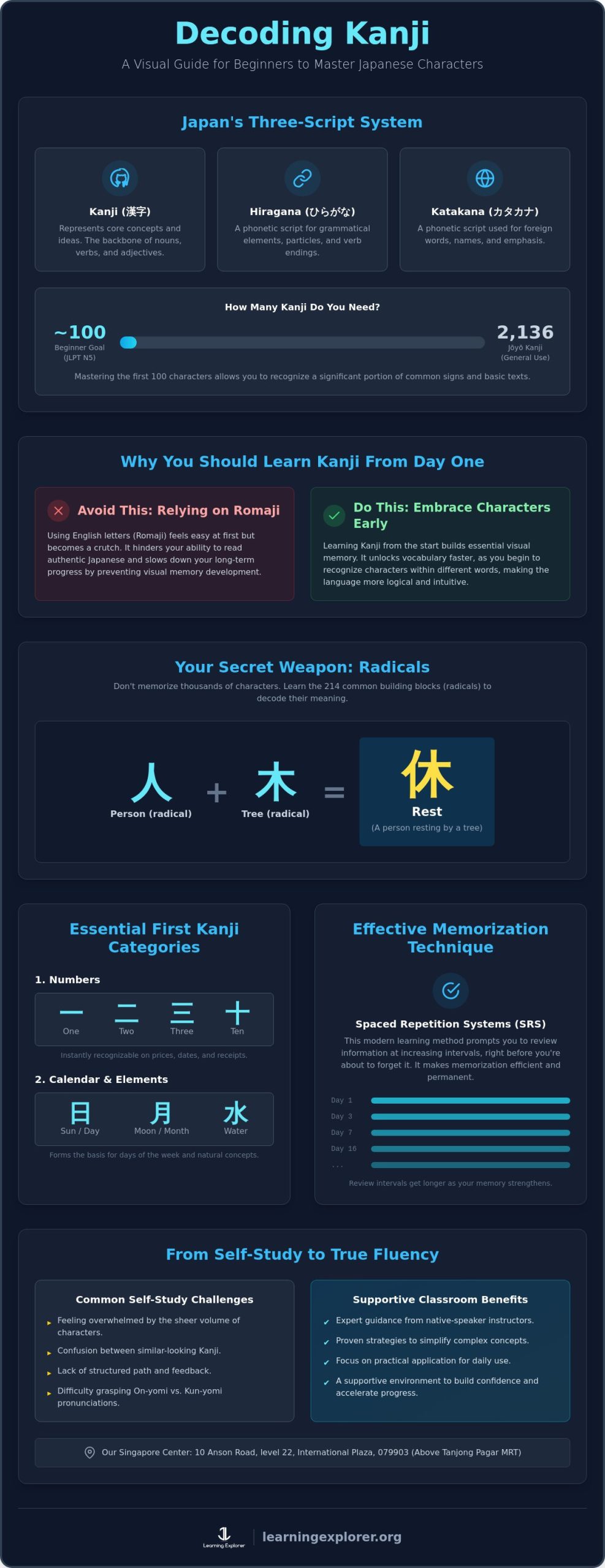
While the official list of Jōyō kanji consists of 2,136 characters for general use, your journey with basic kanji for beginners doesn’t need to start with such a high number. In fact, mastering the first 100 characters will already allow you to recognize a significant portion of common signs and basic texts. This approachable goal reduces your administrative burden and lets you focus on the satisfaction of discovery rather than the weight of the entire dictionary.
Kanji vs. Hiragana and Katakana
Kanji identifies the root meaning of words, while Hiragana is often used for grammar. You’ll frequently see Kanji paired with Hiragana suffixes known as Okurigana. In a word like “to see” (見る), the Kanji provides the concept of vision, while the Hiragana suffix handles the conjugation. This clear division helps you scan sentences quickly to find the main action. It’s a highly efficient system once you stop viewing characters as obstacles and start seeing them as helpful guides.
Why Beginners Should Start Kanji Early
Don’t wait to start your basic kanji for beginners study. Relying on Romaji (the English script) might feel easier at first, but it often becomes a crutch that hinders your progress. Learning characters from day one builds essential visual memory and helps you understand the logic of the language. It also accelerates your vocabulary growth; once you know the character for “water,” you’ll start recognizing it in words for “Wednesday” or “juice,” making new terms much easier to remember.
At our center, we help you bridge the gap between self-study and true fluency. Our native-speaker instructors understand the beginner’s struggle and provide the expert guidance you need to master these characters with confidence. By focusing on practical application, you’ll find that what once felt like an administrative burden becomes an inspiring part of your daily routine.
The Essential First 50: Basic Kanji Categories for Beginners
Approaching a list of thousands of characters can feel like standing at the foot of a mountain. However, the secret to steady progress lies in thematic grouping. By organizing your study into logical categories, you transform a massive memorization task into a series of achievable wins. This systematic approach to basic kanji for beginners ensures that you aren’t just memorizing lines; you’re building a network of meanings that support one another.
Numbers are your first point of entry. Characters for one (一), two (二), and three (三) consist of simple horizontal strokes that provide an immediate sense of accomplishment. Once you master the cross shape of ten (十), you’ve already unlocked the ability to read prices and dates. These foundational characters appear everywhere, from train platforms to restaurant receipts, making them the most practical starting point for any new learner.
Numerical and Calendar Kanji
Writing numbers 1 through 10 requires a focus on balance and stroke length. While they look simple, the precise length of each line matters. These characters also form the basis of the Japanese calendar. The days of the week are uniquely tied to elements: Sunday is Sun (日), Monday is Moon (月), and Tuesday is Fire (火). Learning these early allows you to navigate schedules with confidence. Using an interactive kanji study tool can help you perfect the stroke order for these essential characters while providing clear visual guides.
Pictograms: Kanji as Pictures
Many of the most common characters began as literal drawings of the physical world. Mountain (山) clearly resembles three peaks, while River (川) mimics the flow of water between banks. These pictograms are often the favorite of new students because they tap into our natural visual memory. Instead of seeing abstract symbols, you begin to see a landscape. Using mnemonics to “see” the person in 人 or the eye in 目 creates a creative catalyst that makes retention much easier than traditional rote learning.
Beyond nature and numbers, you’ll soon encounter essential markers for people and movement. Characters like “Person” (人) and “Child” (子) act as frequent building blocks for more complex words. Directional markers such as North (北) and South (南) are vital for navigation, while common verbs like “Go” (行) and “Eat” (食) help you identify the core action in a sentence. This small set of 50 characters provides the satisfaction of discovery every time you step into a Japanese environment.
Mastering these basics is the first step toward true engagement with the language. If you’re ready to transition from individual characters to fluent sentences, joining a Conversational Japanese Course can provide the supportive atmosphere and expert guidance you need to succeed.
Decoding the System: Radicals and Stroke Order Rules
Think of radicals as the DNA of the Japanese writing system. Instead of viewing each character as a chaotic mess of random lines, you’ll soon recognize that most characters are built from a set of 214 recurring components called Bushu. Mastering these building blocks is a game changer for anyone studying basic kanji for beginners. It transforms the labor of memorization into a logical process of assembly, allowing you to guess the meaning or even the pronunciation of a character you’ve never seen before.
These radicals act like an alphabet. For instance, if you see the “fire” radical (灬), the character likely relates to heat, cooking, or light. This structural logic is a core part of our curriculum. To explore how these components fit together in a digital environment, Kanji Alive from the University of Chicago provides an excellent database that categorizes characters by their radical origins, helping you build a professional foundation from day one.
Common Radicals Every Beginner Should Know
Focusing on the most frequent radicals will yield the fastest results. While we’ve looked at standalone characters like “water” (水), the “Water” radical (氵) looks different when it’s a component. Represented by three splashes on the left, it’s found in almost every word involving liquids, like “sea” (海) or “swim” (泳). The “Person” radical (亻) often appears in human activity verbs like “rest” (休). Finally, the “Speech” radical (言) identifies words involving communication, such as “talk” (話) or “language” (語).
Beyond meaning, you must understand the logic of Hitsujun, or stroke order. While it might seem like an unnecessary administrative burden, correct stroke order is essential for three practical reasons. First, it ensures the character is balanced and legible. Second, modern handwriting recognition on smartphones and tablets relies on stroke order to identify what you’re writing. Third, traditional dictionaries are organized by stroke count and radical, making lookups impossible if you don’t know where a character begins and ends.
The 4 Golden Rules of Stroke Order
While there are exceptions, following these four rules will help you write almost any character correctly:
- Top to Bottom, Left to Right: This is the most fundamental rule of Japanese writing. Always start at the top-left corner and work your way down and across.
- Horizontal Before Vertical: When strokes cross, you’ll usually draw the horizontal line first. Think of the character for “ten” (十) as a perfect example.
- Center Before Wings: For symmetrical characters like “small” (小), draw the central stroke first, then the left and right sides.
- Enclosures Before Contents: If a character has a box around it, like “country” (国), draw the outer frame first, then the inside, and finally the bottom stroke to close the box.
Applying these rules consistently creates a sense of momentum in your writing. You’ll stop second-guessing every pen movement and start focusing on the satisfaction of discovery as your basic kanji for beginners practice becomes second nature.
Effective Memorization Techniques for Adult Learners
Adult learners often face the challenge of limited time and the pressure of professional responsibilities. To succeed, you need a system that reduces the administrative burden of tracking your progress and focuses on high-impact results. Spaced Repetition Systems (SRS), such as Anki or Wanikani, are transformative tools for mastering basic kanji for beginners. These platforms use smart algorithms to show you characters just as you’re about to forget them, ensuring your study sessions are efficient and your retention is permanent.
Instead of relying on rote memorization, embrace the mnemonic method. This technique turns the 214 radicals we discussed earlier into a creative catalyst for memory. By creating a short, vivid story that links the components of a character together, you anchor the meaning in your mind. For example, if a character contains the radicals for “sun” and “moon,” you might imagine a bright sky where both are visible, representing the concept of “bright” (明). This shift from the labor of seeking to the satisfaction of discovery makes the learning process feel like a series of small wins.
Mastering On-yomi and Kun-yomi
The confusion over multiple pronunciations is one of the most common struggles for new students. You can simplify this by following two reliable rules of thumb. The “Compound Rule” suggests that when two or more Kanji are joined together to form a word, you should typically use the On-yomi (Chinese-derived reading). Conversely, the “Standalone Rule” applies when a character sits by itself, often followed by Hiragana; in these cases, use the Kun-yomi (native Japanese reading). While exceptions exist, these rules provide a solid foundation for reading basic kanji for beginners with confidence.
Practical Daily Practice
Frequency always beats intensity when it comes to language acquisition. A 10-minute daily habit is far more effective than a three-hour cram session once a week. You can integrate practice into your daily routine by labeling household items with Kanji sticky notes or reviewing your SRS deck during your MRT commute in Singapore. This consistent engagement keeps the characters fresh in your mind without feeling like an overwhelming task. To accelerate your progress and receive personalized feedback, consider enrolling in a Conversational Japanese Course where native-speaker instructors can guide you through these complexities in real-time.
Never learn a character in isolation. Always study Kanji within the context of common sentences or vocabulary pairs. This approach ensures you understand not just what a character means, but how it actually functions in the real world. By building these contextual bridges, you’ll find yourself recognizing signs and menus with ease, turning your daily environment into a living classroom.
Advancing Your Japanese Mastery in Singapore
Learning Japanese in Singapore opens doors to a vast network of multinational corporations and local firms with strong ties to Japan. While mastering basic kanji for beginners is a personal milestone, it’s also a professional asset that sets you apart in the competitive CBD job market. Being able to read names on a business card or navigate a Japanese report without digital assistance demonstrates a level of commitment and cultural competence that employers value. It transforms your resume from a list of skills into a story of dedication and impact.
Apps and solo study are excellent for building an initial habit, but they often lack the interactive feedback needed for true fluency. Transitioning to a professional classroom environment allows you to test your knowledge in real-time. You’ll move beyond the labor of seeking translations to the satisfaction of active discovery through conversation. When you focus on basic kanji for beginners within a supportive group, you benefit from shared mnemonics and immediate corrections that solo apps simply can’t provide. Group settings provide the creative catalyst for better retention, as you learn from the questions and insights of your peers.
Professional Japanese Courses at Learning Explorer
Our Conversational Japanese Course is designed specifically for busy professionals. We keep our class sizes small to ensure you receive personalized attention from our native-speaker instructors. Our curriculum simplifies the complexities of characters, breaking them down into manageable chunks that respect your limited time. This expert guidance helps you avoid common pitfalls and builds the confidence you need to use your skills in professional settings.
Join Us in the Heart of the CBD
Finding the right support shouldn’t be an administrative burden. Our center at International Plaza is conveniently located directly above Tanjong Pagar MRT, making it easy to attend sessions before or after your workday. We’re here to act as your reliable ally in your language journey, providing the organized and visionary environment you need to succeed. Book a trial lesson and start your learn japanese language journey today. By surrounding yourself with practitioners who understand the beginner’s struggle, you’ll find the satisfaction of discovery is just a few stops away.
Ready to Transform Your Japanese Reading Skills?
Mastering characters isn’t about memorizing thousands of abstract lines; it’s about understanding the logic of radicals and using modern tools like SRS to build lasting memory. By focusing on the most essential basic kanji for beginners, you’ve already started the transition from the labor of seeking to the satisfaction of discovery. You now have the strategies to decode common signs, understand stroke order, and navigate complex readings with confidence.
The next step is moving beyond solo study into a supportive environment that accelerates your growth. Our interactive and fun group classes provide the creative catalyst you need to achieve fluency. You’ll learn from professional native-speaker teachers who understand your daily professional challenges and can guide you toward success in the heart of the CBD. We’re conveniently located directly above Tanjong Pagar MRT, ready to help you unlock the secrets of Japanese writing.
Your path to mastery starts with a single character. Let’s take that next step together. Start your Japanese journey at Learning Explorer today!
Frequently Asked Questions
How many kanji do I need to know for the JLPT N5 exam?
You should aim to master approximately 100 characters for the N5 level. These represent the most essential basic kanji for beginners, focusing on daily necessities like numbers, directions, and time. Mastering these characters alongside a vocabulary of roughly 800 words will provide the foundation you need for the upcoming exam on December 6, 2026.
Can I learn Japanese without learning Kanji at all?
You can learn to speak conversational Japanese, but you’ll remain illiterate in a society where Kanji is used everywhere. Reading menus, train signs, and basic documents becomes an impossible task without it. Kanji also helps you distinguish between homophones that sound identical in Hiragana, making it a vital tool for true comprehension and faster reading speed.
What is the best way to remember the difference between On-yomi and Kun-yomi?
The most reliable method is the “Compound vs. Standalone” rule. If a character is part of a multi-kanji word, it usually takes the On-yomi. If it sits alone or has Hiragana suffixes attached, use the Kun-yomi. Practicing these in context during our group sessions helps transform this confusing rule into a natural part of your reading process.
Is it better to learn Kanji by writing them or by using flashcards?
A hybrid approach is the most effective strategy for adult learners. Flashcards are excellent for recognition and spaced repetition, while writing helps build muscle memory and a deeper understanding of character structure. Using both ensures you don’t just recognize the character but can also reproduce it accurately when you’re away from your digital tools.
Why does stroke order matter if the final character looks the same?
Correct stroke order ensures the character is balanced and legible to native readers. It’s also critical for using digital dictionaries and handwriting recognition on your phone. Without the right order, software often fails to recognize your input, turning a simple search into a frustrating administrative burden that slows down your discovery.
How long does it typically take to learn the first 100 basic kanji?
Most students master the first 100 basic kanji for beginners in about three to four months with consistent daily practice. Spending just 10 to 15 minutes a day using mnemonics and SRS tools makes this goal very achievable. Our curriculum is specifically designed to help busy professionals reach this milestone without feeling overwhelmed by the process.
Are there any specific kanji that are unique to Japanese and not Chinese?
Yes, these are known as Kokuji, or “national characters,” which were created in Japan. Examples include characters for “mountain pass” (峠) and “work” (働). While the vast majority of Kanji originated in China, Japan developed these specific logograms to represent concepts or objects unique to its own culture and environment over the centuries.
Should I learn Kanji alongside Hiragana and Katakana or after?
You should start learning Kanji as soon as you have a solid grasp of Hiragana. Waiting too long often creates a phonetic crutch that makes the eventual transition to reading real Japanese much harder. Integrating basic characters early on builds your visual memory and provides the satisfaction of recognizing real-world signs much sooner in your journey.