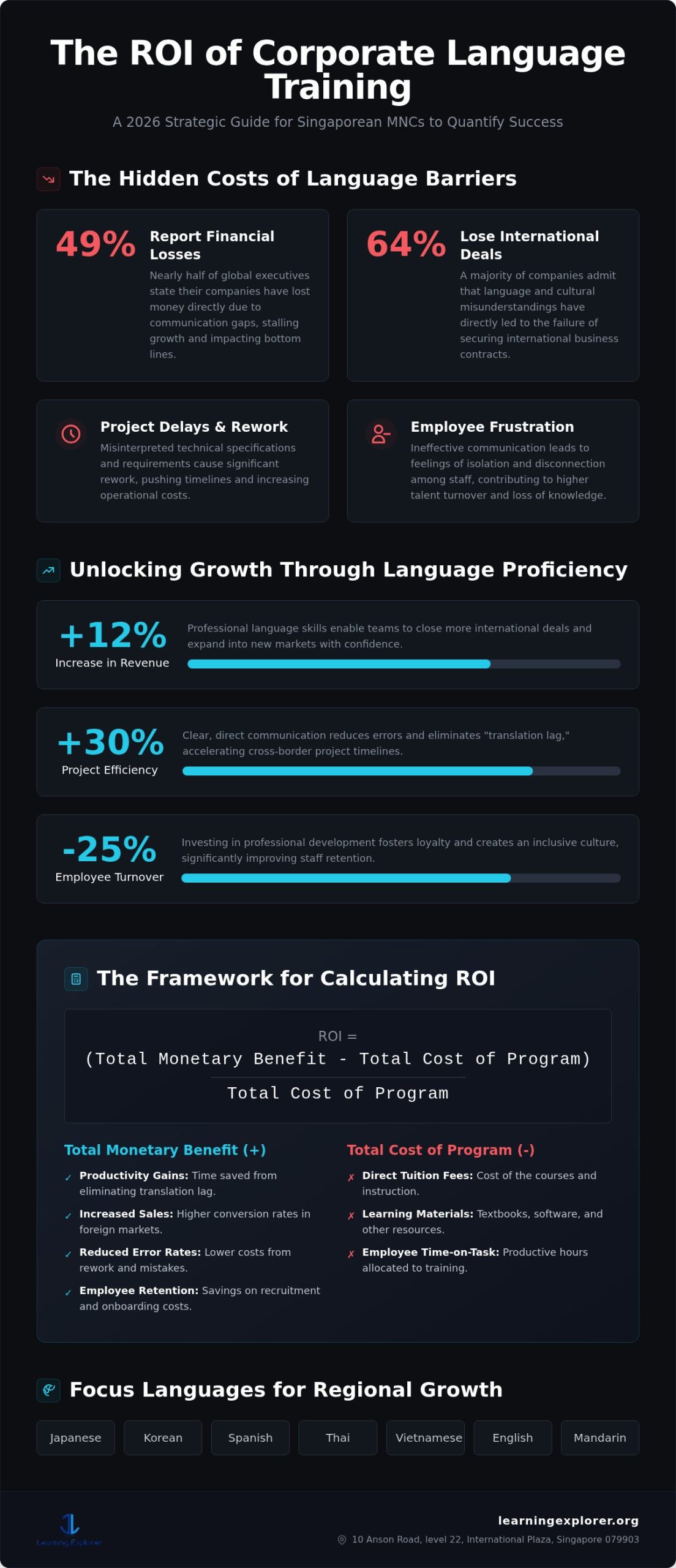
49% of global executives reported that their companies have experienced financial losses due to language barriers. In a high-stakes market like Singapore, these communication gaps do more than cause confusion; they actively stall regional expansion and lead to lost international deals. If you’ve faced hurdles while calculating ROI on corporate language programs singapore to satisfy a skeptical CFO, you aren’t alone. It’s notoriously difficult to pin a specific dollar value on what many mistakenly dismiss as a soft skill.
We understand the daily challenge of justifying training costs when budgets are tight. You need your team to lead confidently across Southeast Asia, and that requires more than just a basic translation app. This 2026 guide provides the exact ROI formula and evidence you need to secure budget approval, showing how professional language training can increase revenue by 12% and reduce employee turnover. We’ll walk you through quantifying project efficiency and finding a reliable training partner at 10 Anson Road, level 22, International Plaza, Singapore 079903, conveniently located above Tanjong Pagar MRT.
Key Takeaways
- Master the specific formula for calculating ROI on corporate language programs singapore to justify training budgets to your CFO with confidence.
- Uncover the hidden “friction costs” of language barriers that lead to financial losses and project delays in regional expansion.
- Follow a step-by-step guide to conducting a departmental needs analysis to align language training with your 2026 growth targets.
- Learn why structured courses with native-speaker instructors outperform digital apps for corporate accountability and professional skill development.
- Quantify the operational benefits of multilingual teams, including a potential 12% increase in revenue and significant improvements in employee retention.
The Hidden Costs of Language Barriers in Singaporean MNCs
In the fast-paced Singapore CBD, “communication friction” acts as a silent tax on your daily operations. It isn’t just about a missed word or a slight accent; it’s about the cumulative weight of misunderstood requirements in technical sectors like semiconductors or finance. When a project manager in Singapore misinterprets a technical spec from a regional partner, the resulting rework can delay timelines by weeks. These inefficiencies are often buried in general administrative overhead, making a clear Return on Investment (ROI) difficult to track without a structured approach.
When you begin calculating ROI on corporate language programs singapore, you must look beyond the invoice price of the lessons. Consider that 64% of companies admit to losing international business deals because of language barriers. A single cultural faux pas during a high-stakes negotiation in Tokyo or Seoul can end a multi-million dollar partnership before it even starts. Language gaps also lead to significant employee frustration. When talented staff can’t communicate effectively with regional counterparts, they feel isolated. This disconnect contributes to higher turnover rates and the loss of institutional knowledge.
Friction in Regional Growth Markets
Singapore firms often lose their competitive edge in emerging markets like Thailand or Vietnam because of language gaps. Relying solely on external translation for sensitive business contracts is both risky and expensive. It creates a bottleneck that slows down decision-making and project momentum. By investing in language courses in Singapore, your firm builds internal regional expertise. This allows your team to navigate nuances directly, ensuring that your 2026 growth strategy isn’t hampered by a lack of local linguistic agility.
The Impact on Local Workplace Culture
Managing a diverse, multilingual team in the city center requires more than just technical oversight. Language proficiency fosters inclusivity and psychological safety at work. When employees can express complex ideas clearly, it reduces the administrative burden caused by misaligned internal communication. A 2026 report indicates that businesses addressing these challenges saw a 30% increase in project efficiency. Improving these interactions leads to a 25% reduction in employee turnover, proving that calculating ROI on corporate language programs singapore is a vital step for any visionary leader.
A Framework for Calculating ROI on Language Training
Securing budget approval often hinges on your ability to translate “soft skills” into hard data. When calculating ROI on corporate language programs singapore, you must treat language training like any other strategic asset. The fundamental formula is: ROI = (Total Monetary Benefit – Total Cost of Program) ÷ Total Cost of Program. By applying this math, you move from vague assumptions to a concrete business case that speaks the language of your finance team.
To start, define your “Total Costs” accurately. This includes direct tuition fees and materials, but don’t forget to account for employee time-on-task. While your team is learning, they aren’t at their desks; this time must be factored into the investment to maintain a transparent balance sheet. Conversely, “Total Benefits” should include productivity gains, reduced error rates, and increased sales conversion. Working with the best language school Singapore allows you to access detailed attendance and proficiency reports, which are essential for feeding accurate data into your ROI model.
Tangible Metrics: Productivity and Time Savings
Productivity is the most immediate area where you’ll see a return. Consider the time saved when an executive no longer spends hours drafting a single email in Spanish or clarifying points from a Mandarin-led meeting. If your team can communicate directly with partners in Japan or China, you eliminate the “translation lag” that often stalls regional deals. Linguistic Efficiency is a quantifiable 2026 KPI that measures the reduction in time required to complete cross-border business tasks. You might find that a tailored Business Mandarin Course provides the specific vocabulary needed to accelerate these workflows. For teams choosing where to begin, comparing a Mandarin course in Singapore by format and level can help match training to each employee’s goals.
Intangible Metrics: Retention and Brand Equity
Beyond the immediate clock-watching, look at long-term human capital value. There is a proven correlation between professional development and staff loyalty. Providing language training helps retain top talent in the competitive Singapore CBD market, saving you the significant cost of recruiting and onboarding new hires. Additionally, having a multilingual sales force enhances your brand equity. It signals to international clients that your firm is a visionary partner. This fosters the kind of deep rapport that leads to long-term contract renewals, especially since 40% of global consumers will not buy from a business that doesn’t speak their native language.
Case Study: Enhancing Cross-Border Efficiency for a Singapore CBD Firm
In the heart of the CBD, a prominent logistics firm faced a common growth pain. While expanding into North Asia, they realized their regional reporting was consistently lagging by 15%. This wasn’t a failure of their supply chain software; it was a linguistic bottleneck. Misunderstandings between the Singapore headquarters and partners in Seoul and Tokyo were causing significant “communication friction.” When calculating ROI on corporate language programs singapore, this firm looked directly at these delays as a primary metric for improvement.
The Challenge: Scaling Operations in North Asia
The team initially tried to bridge the gap with free translation apps. They soon found that these tools failed to capture the nuances required for complex corporate governance and legal compliance. Sensitive contracts were being misinterpreted, leading to costly errors and repeated clarifications. Before starting the training, the firm set baseline KPIs: total time spent on translations, frequency of reporting errors, and the speed of project approvals. They realized that relying on external support was a temporary fix that didn’t build the internal regional expertise needed for their 2026 strategy.
The Solution and Measurable Outcomes
The firm partnered with a local expert to implement a customized Business English Course alongside specialized Japanese Keigo training. To avoid disrupting daily operations, they opted for flexible evening group classes. This structured approach allowed staff to practice real-world scenarios they encountered in their daily workflows. Post-training assessments showed a 2-level proficiency jump across the participating team, proving that professional instruction yields faster results than self-study.
The impact on the bottom line was immediate and verifiable. Reporting cycles became 20% faster as staff gained the confidence to communicate directly with regional offices without second-guessing their grammar or tone. Stakeholder confidence surged, particularly in the Japanese market where honorific language is vital for building rapport. The firm estimated an annual saving of $50,000 in operational efficiency by drastically reducing rework and the need for external translation services. This scenario proves that calculating ROI on corporate language programs singapore isn’t just about tuition costs; it’s about reclaiming lost time and securing your firm’s reputation in the competitive global market.
Building the Business Case for Language Training Budgets
Securing executive buy-in for training requires more than just enthusiasm; it demands a data-driven strategy. When calculating ROI on corporate language programs singapore, you must move beyond the “nice-to-have” sentiment and present language as a mission-critical tool. Start by conducting a thorough needs analysis across your departments. While the sales team might require advanced negotiation skills in Japanese, your operations team may benefit more from technical fluency in Vietnamese to manage regional supply chains. Identifying these high-impact languages for your specific 2026 growth strategy ensures that every dollar spent is an investment in your firm’s competitive edge. For firms targeting the Americas, investing in business spanish for trade with Latin America has become equally critical, particularly following the entry into force of the MERCOSUR-Singapore Free Trade Agreement.
Aligning Language Goals with Corporate KPIs
Map your training objectives directly to existing business goals to show immediate value. If your expansion strategy involves capturing a larger slice of the North Asian market, link Mandarin proficiency levels to your “Market Share Growth in China” targets. Similarly, linking a Conversational English Course to customer satisfaction scores provides a clear line of sight between training and revenue. Global Fluency directly supports Singapore’s “Smart Nation” workforce initiatives by equipping local talent with the cross-border communication skills necessary for a digital, interconnected economy. Service-driven sectors can take this further; for example, corporate language training for hospitality industry singapore has become a strategic necessity as tourist arrivals are projected to reach up to 18 million in 2026, making guest-facing multilingual competency a direct driver of CSAT scores and revenue.
Presenting the Data to Your CFO
When you sit down with your CFO, focus on “Cost Avoidance” rather than just “Learning Outcomes.” Highlight how a 25% reduction in employee turnover saves the company thousands in recruitment and onboarding fees. Emphasize the efficiency of choosing a partner located in the heart of the Tanjong Pagar business district. Training at a centre situated directly above a major MRT station minimizes employee travel time, ensuring that training doesn’t eat into productive work hours or increase administrative burdens.
Present your data alongside a “Risk of Inaction” analysis. Show the financial cost of missed deals and the potential for project delays if communication gaps persist. By partnering with a provider that offers detailed progress reports and proficiency certificates, you give your finance team the measurable accountability they crave. To start building your customized business case and see how we can support your team, contact our corporate training consultants to explore tailored solutions.
Selecting a Professional Language Partner in Singapore
Choosing the right training partner is the final, most critical step when calculating ROI on corporate language programs singapore. While low-cost self-study apps might seem attractive for a budget-conscious firm, they often lack the accountability and depth required for professional environments. You need more than just vocabulary lists. You need a partner that provides a structured framework, native-speaker instructors, and measurable progress tracking that satisfies both the learner and the CFO. A professional school acts as a reliable ally, ensuring that the training aligns with your high-level business objectives.
Effective corporate training requires instructors who understand the nuances of bilingual business contexts. Certified native speakers don’t just teach words; they teach the cultural intelligence needed to navigate regional markets. This expertise is what distinguishes a high-quality, vetted curriculum from the unorganized nature of external sources. When you evaluate providers, prioritize those that offer curriculum flexibility and ease of access for your busy team.
Bespoke Curriculum for Modern Business Needs
Modern business doesn’t happen in a vacuum. Your team needs language skills tailored to specific sectors like finance, legal, or regional trade. Generic courses often miss the mark. For instance, learning Japanese language through a business-first lens ensures your executives master honorifics and negotiation etiquette, which are vital for closing deals in Tokyo. We specialize in creating interactive and fun learning environments that increase employee engagement. This high level of involvement is a key driver of ROI, as it ensures the skills are actually retained and applied in daily workflows.
Convenient CBD Location and Facilities
Logistics shouldn’t be a barrier to professional development. One of the biggest silent costs of training is the “time-off-desk” spent traveling to a distant facility. We address this by positioning our training centre in a strategic CBD location at International Plaza. Being situated directly above Tanjong Pagar MRT means your team can transition from their workstations to the classroom in minutes, significantly reducing administrative burdens and scheduling conflicts.
This accessibility supports various flexible learning formats, including private coaching, evening group classes, and intensive modules. By choosing a partner that understands the taxing nature of your professional tasks, you ensure that your investment in language training delivers the maximum possible impact. Ultimately, calculating ROI on corporate language programs singapore becomes a straightforward process when you have a partner dedicated to your success. Learning Explorer is committed to providing the creative catalyst for better business outcomes, helping you bridge language gaps while simultaneously enhancing your team’s professional impact across Southeast Asia.
Empower Your Team for Regional Success in 2026
Investing in your team’s linguistic agility is a strategic move that pays dividends across every department. By moving away from “soft skill” assumptions and actively calculating ROI on corporate language programs singapore, you transform training into a predictable driver of growth. You’ve seen how reducing communication friction can accelerate reporting cycles and secure high-stakes deals in North Asia. The risk of inaction is simply too high in a market as competitive as Singapore.
A structured approach ensures that every lesson translates into real-world efficiency. Whether you’re expanding into the Japanese market or streamlining operations in Thailand, the right training partner makes all the difference. Our certified native-speaker instructors provide the expert guidance your team needs to lead with confidence and precision. We focus on high-quality, vetted materials that ensure your investment delivers measurable results.
Ready to bridge the gap and boost your firm’s efficiency? Book a corporate language needs assessment with Learning Explorer today to discover customized solutions for your MNC or SME. Your path to regional mastery starts right here in the heart of the CBD. Let’s build a more connected, productive, and visionary workforce together.
Frequently Asked Questions
How long does it take to see a measurable ROI from language training?
Measurable gains typically appear within three to six months as staff begin drafting regional reports faster and with fewer errors. While initial soft gains like improved confidence are immediate, financial returns usually materialize within a full fiscal year. This timeline is a crucial factor when calculating ROI on corporate language programs singapore, as it allows leadership to align training milestones with quarterly performance reviews and regional expansion targets.
Which languages offer the highest ROI for Singaporean companies in 2026?
Mandarin, Japanese, and Vietnamese currently offer the highest returns due to Singapore’s projected 4.3% regional trade growth in 2026. These languages bridge the gap between local headquarters and high-growth markets in Southeast and North Asia. Investing in these specific competencies ensures that your team can navigate local business customs and complex negotiations, turning linguistic ability into a strategic asset that drives measurable market share gains. Singapore firms with Latin American ambitions should also consider how business spanish for trade with Latin America can open doors in the rapidly expanding MERCOSUR trade corridor.
Can language training help with employee retention in a competitive market?
Language training is a powerful retention tool in Singapore’s highly competitive talent market. Providing high-quality professional development demonstrates a commitment to your team’s long-term growth, which fosters deeper organizational loyalty. Research indicates that companies investing in these skills can experience a 25% reduction in employee turnover. This helps maintain institutional knowledge and avoids the significant costs associated with frequent recruitment and onboarding of new staff.
How do I choose between group classes and private lessons for my team?
Choose group classes to foster collaboration and a shared learning culture among departments like sales or operations. This format is ideal for building a consistent baseline of proficiency across a team. Conversely, private lessons are best for senior executives who require a bespoke curriculum tailored to specific high-stakes negotiations. Private sessions offer the flexibility to focus on niche industry terminology while accommodating the demanding schedules of corporate leadership.
What metrics should I track to monitor the success of a language program?
To monitor success effectively, track metrics such as “Linguistic Efficiency,” which measures the reduction in time spent on cross-border communication tasks. You should also monitor proficiency jumps through structured assessments and track the speed of project approvals in foreign markets. Using these data points simplifies the process of calculating ROI on corporate language programs singapore, providing your finance team with the objective evidence they need to justify continued investment.
Is it better to have training on-site or at a language centre in the CBD?
A dedicated language centre offers a focused environment that minimizes office distractions while remaining highly accessible for city-based staff. Our centre at International Plaza is located directly above Tanjong Pagar MRT, allowing your staff to transition from work to training with minimal travel time. This convenience ensures higher attendance rates and better engagement compared to off-site locations, ultimately protecting your team’s productive work hours and reducing administrative overhead.
How does language proficiency impact cross-cultural negotiations in Southeast Asia?
Proficiency transforms negotiations by building trust and cultural rapport that a digital translator cannot replicate. In Southeast Asian business cultures, speaking the local language signals respect and a long-term commitment to the partnership. This capability allows your team to interpret non-verbal cues and subtle nuances, leading to smoother deal closures and more resilient international relationships that are less prone to the friction caused by linguistic misunderstandings.
What is the “Risk of Inaction” when ignoring language gaps in a multinational firm?
The risk of inaction is significant, with 49% of global executives reporting financial losses due to language barriers. Ignoring these gaps leads to project delays, misunderstood requirements, and the erosion of your firm’s competitive edge in regional markets. In a multinational setting, these inefficiencies act as a silent drain on resources, making it harder to scale operations effectively while competitors with multilingual capabilities capture market share more rapidly.