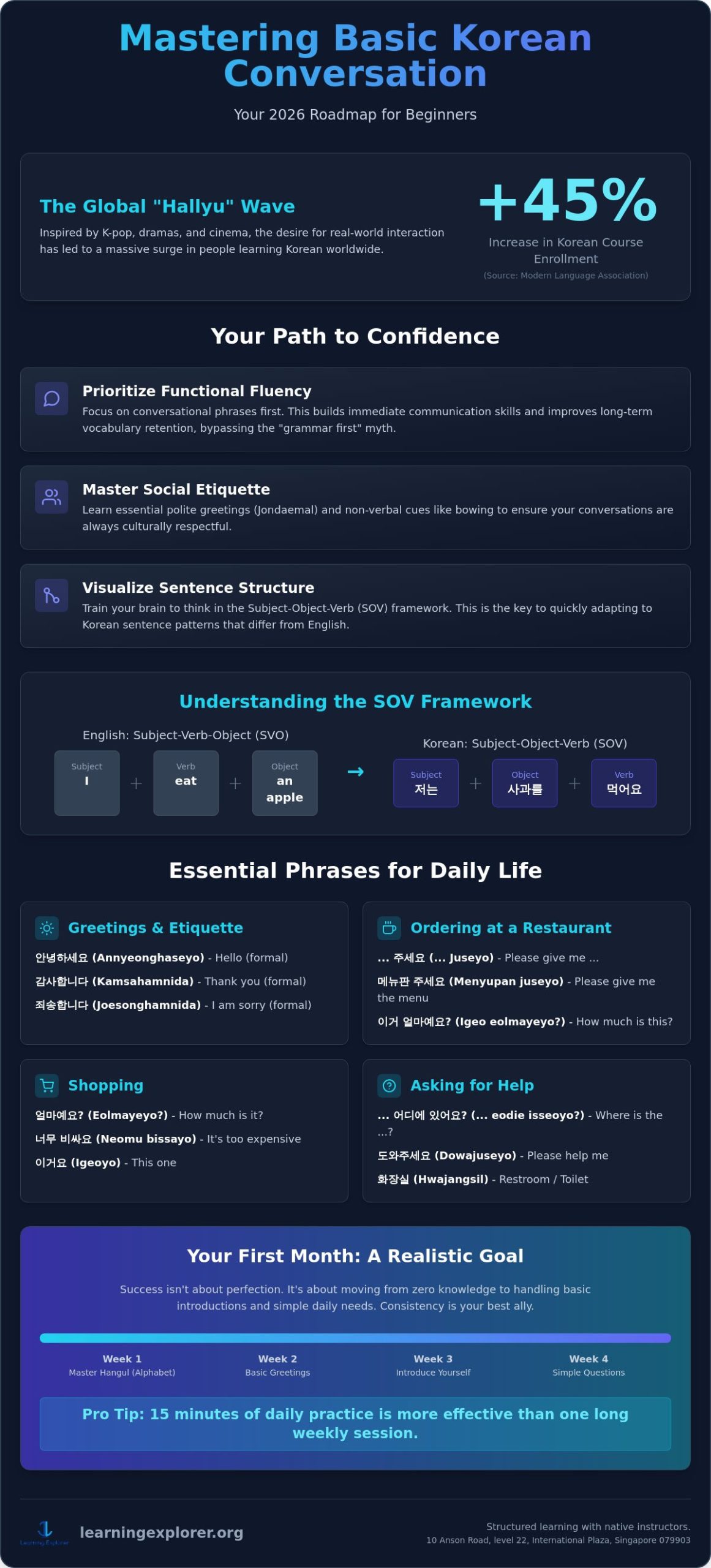
Did you know that enrollment in Korean language courses has surged by nearly 45% in recent years? This data from the Modern Language Association shows that the global “Hallyu” wave is inspiring more people than ever to start their linguistic journey. If you feel overwhelmed by the unique shapes of Hangul or the nuances of formal honorifics, you aren’t alone. It’s completely normal to worry about sounding impolite or getting lost in unfamiliar sentence structures. We understand these hurdles, and we are here to help you clear them with ease.
This guide provides a clear roadmap for mastering basic korean conversation for beginners so you can stop scrolling through subtitles and start speaking. You’ll learn how to introduce yourself properly, order your favorite dishes at a restaurant, and understand the core dialogue in your favorite media. We’ll break down essential social etiquette and functional sentence patterns to ensure you feel confident in every interaction. Whether you’re visiting our training center at 10 Anson Road, level 22, International Plaza, Singapore 079903, or practicing at home, this 2026 guide is your first step toward real fluency.
Key Takeaways
- Prioritize functional fluency to build immediate confidence and improve your long-term retention of new vocabulary.
- Master essential greetings and social etiquette to ensure your basic korean conversation for beginners is always polite and culturally respectful.
- Learn to visualize the Subject-Object-Verb (SOV) framework to quickly adapt to sentence structures that differ from English.
- Acquire practical phrases for daily scenarios, such as ordering food with “Juseyo” or asking “Eolmayeyo?” while shopping.
- Discover how structured learning with native instructors provides the professional guidance and peer interaction needed to overcome self-study plateaus.
Why Basic Korean Conversation is Your Best Starting Point in 2026
In 2026, the approach to language learning has undergone a significant transformation. Traditional methods often buried students under mountains of grammar textbooks, leading to a phenomenon of “silent” learners who can read text but struggle to speak. Today, the focus has shifted toward functional fluency. This means prioritizing basic korean conversation for beginners to build immediate communication skills. According to the Modern Language Association, enrollment in Korean courses has increased by nearly 45% in the last decade, driven by a desire for real-world interaction. For a deeper understanding of the linguistic foundations, you can consult this Korean language overview.
Don’t let the unique script of Hangul intimidate you. It’s widely considered one of the most logical and scientific writing systems ever created. Most learners can master the alphabet in just a few hours, clearing the first major hurdle quickly. The “Hallyu” wave continues to be a massive motivator for 2026 learners. Whether you are a fan of K-pop or cinema, the emotional connection to the culture makes the learning process feel less like a chore and more like a discovery. Starting with conversation allows you to tap into this inspiration immediately.
To better understand this concept, watch this helpful video:
Breaking the ‘Grammar First’ Myth
Memorizing complex rules without context often leads to frustration and stagnation. When you learn through high-frequency conversational phrases, you develop an intuitive feel for the language’s rhythm. This mimics natural language acquisition, where listening and speaking precede formal study. By focusing on basic korean conversation for beginners, you bypass the administrative burden of over-analyzing particles and jump straight into engagement. Balancing speaking practice with reading ensures your progress is well-rounded and practical.
Setting Realistic Goals for Your First Month
Success in your first thirty days isn’t about achieving perfection. It’s about transition. Aim to move from zero knowledge to handling basic introductions and simple daily needs. Consistency is your best ally; practicing for fifteen minutes daily is often more effective than one long, exhausting session per week. If you want to accelerate your progress, consider enrolling in language courses in Singapore. Our training center at 10 Anson Road, level 22, International Plaza, Singapore 079903, provides the expert guidance needed to turn these goals into reality. Native-speaker instructors act as your cultural guides, helping you discover the satisfaction of real conversation while reducing the labor of seeking quality resources on your own.
Essential Korean Greetings and Social Etiquette for Beginners
Mastering basic korean conversation for beginners involves much more than just memorizing words; it requires an understanding of the deep-seated respect woven into the language. Korean society places immense value on social hierarchy and age, which is reflected through Jondaemal, or polite speech. Using the correct level of formality isn’t just about being “nice.” It’s about acknowledging the person you’re speaking to. For those seeking official guidance on these cultural standards, Korean government language resources offer excellent insights into the state-promoted educational frameworks that define modern usage.
Standard greetings serve as your first bridge to connection. While you likely know Annyeonghaseyo (Hello), knowing when to bow is equally vital. A slight bow of the head or waist should accompany most greetings, showing sincerity and respect. Avoid direct, prolonged eye contact with elders or superiors, as this can be perceived as a challenge rather than a sign of confidence. When you need to express gratitude, Kamsahamnida is your essential phrase. If you make a mistake, a quick Joesonghamnida (I’m sorry) goes a long way in smoothing over social friction and showing your commitment to cultural etiquette.
Navigating Formal and Informal Speech
The easiest way to remain polite is by using the “-yo” ending. This suffix turns a standard sentence into a respectful one suitable for almost any daily interaction. Beginners should stick to this polite form with everyone until specifically invited to use casual speech. Common mistakes often involve using informal language too early, which can sound jarring or even rude to native ears. If you’re ever unsure, always default to the polite version. Practicing these nuances in a structured Conversational Korean Course can help you build the muscle memory needed to switch levels naturally.
Essential Phrases for Daily Interactions
Starting a conversation is simpler than you might think. Use these building blocks to navigate your first few meetings with confidence:
- Introducing yourself: “Jeoneun [Name] imnida” (I am [Name]).
- Asking how someone is: “Jal jinaesseoyo?” (Have you been well?).
- Polite responses: “Ne” (Yes), “Aniyo” (No), and “Mollayo” (I don’t know).
Confidence grows when you know you aren’t accidentally offending your listener. By focusing on these etiquette-driven phrases, you’ll find that native speakers are incredibly appreciative of your effort to respect their cultural norms. This respectful foundation makes every subsequent step in basic korean conversation for beginners much more rewarding and effective.
Understanding Korean Sentence Structure: The SOV Framework
One of the most transformative moments in your journey toward mastering basic korean conversation for beginners is the shift in how you visualize a sentence. While English follows a Subject-Verb-Object (SVO) pattern, Korean utilizes a Subject-Object-Verb (SOV) structure. Imagine saying “I apples eat” instead of “I eat apples.” This simple inversion is the foundation of the language. Because the verb always comes last, Korean requires a different type of active listening. You must wait until the very end of a person’s sentence to understand the action they are taking, which naturally encourages deeper focus and engagement during dialogue.
Another unique feature is the “droppable subject.” In English, we almost always specify who is performing an action. In Korean, if the context is clear, speakers often omit “I” (jeo) or “You” (neo). This efficiency reduces the administrative burden of repetitive pronouns and makes your speech sound much more natural. By focusing on the object and the verb, you can communicate faster and with greater ease.
The Power of Korean Particles
Think of Korean particles as anchors that hold your sentence together. These small suffixes, like topic markers (eun/neun) and subject markers (i/ga), tell the listener exactly what role each word plays. For example, adding neun after your name identifies you as the topic of the conversation. While these can feel confusing at first, the basic rule is simple: use eun or i after a consonant, and neun or ga after a vowel. Mastering these “labels” ensures your basic korean conversation for beginners remains clear and professional.
Building Simple Sentences with Action Verbs
To start speaking today, focus on high-frequency action verbs that appear in almost every daily interaction. Common essentials include kada (to go), mokda (to eat), boda (to see), and hada (to do). To make these polite for general use, you will conjugate them into the “-ayo” or “-eoyo” endings. For instance, the verb gongbuhada (to study) becomes gongbuhaeyo. If you want to say “I study,” you simply say “Gongbuhaeyo.” The subject is implied, and the polite verb ending ensures you remain respectful. Practicing these simple structures allows you to build confidence through discovery rather than the labor of memorizing abstract rules.
Practical Daily Scenarios: From Ordering Food to Asking Directions
Applying the SOV framework we discussed earlier turns abstract rules into powerful tools for real-world interaction. In 2026, the focus of basic korean conversation for beginners is on achieving immediate results in common social settings. Whether you are exploring a bustling market in Seoul or navigating the MRT in Singapore, these functional phrases reduce the stress of navigation. You don’t need to be a linguist to get what you need; you just need the right building blocks.
Ordering at a restaurant is often the first “win” for a new learner. The magic word is Juseyo, which translates to “please give me.” Simply point to an item on the menu and say “[Item] juseyo.” It’s efficient, polite, and universally understood. When you’re ready to shop, asking Eolmayeyo? (How much is it?) helps you navigate transactions with confidence. These small interactions build the momentum necessary to tackle more complex dialogues, such as asking where someone is from or discussing your occupation.
Ordering Food Like a Local
To place an order, first get the server’s attention by saying Yeogiyo! (Over here!). It’s a standard and polite way to call for service in Korea. Once they arrive, specify the quantity of items using basic numbers like hana (one) or dul (two). After enjoying your meal, you can ask for the bill by saying Gyesanseo juseyo. Always conclude with Jal meogeossumnida (I ate well) to show your appreciation. If you want to master these interactions through roleplay with native experts, join our Conversational Korean Course today.
Asking for Help and Directions
Getting lost is part of the adventure, but knowing how to ask for help makes it much less taxing. Use Jeogiyo to politely grab a stranger’s attention before asking for a location. For transportation, phrases like Yeogi-e sewo-juseyo (Please stop here) are essential for taxis. Memorize these key landmarks to make your queries effective:
- Toilet: Hwajangsil
- Station: Yeok
- Pharmacy: Yak-guk
- Hotel: Hotel
When someone gives you directions, listen for oenjjok (left), oreunjjok (right), or jjik-jin (straight). Even if you don’t catch every word, these directional anchors will guide you. Practicing these scenarios in a supportive environment ensures you feel ready for your next trip or professional encounter. Visit our center at International Plaza, situated directly above Tanjong Pagar MRT, to start your journey toward confident communication.
Join a Structured Conversational Korean Course in Singapore
Self-study often starts with high energy but can stall when you encounter complex grammar or pronunciation hurdles. While digital tools provide a convenient foundation, they frequently lack the interactive feedback essential for mastering basic korean conversation for beginners. Without an expert guide, it’s easy to develop habits that are difficult to correct later. A structured environment replaces the labor of seeking quality resources with the satisfaction of a clear, expert-led path. Our native teachers act as guides to cultural nuance, helping you understand not just what to say, but why it’s said in a specific way.
The benefits of group learning extend far beyond simple instruction. Engaging with peers allows for authentic roleplay, where you can practice real-world scenarios in a supportive atmosphere. This social dynamic increases engagement and builds the confidence needed to speak in public. Our approach to Conversational Korean focuses on functional fluency, ensuring that every lesson translates into a skill you can use immediately. You’ll find that the transition from a silent learner to a confident speaker happens much faster when you have a reliable ally by your side.
What to Expect in Our Beginner Classes
Our classes feature certified native-speaker instructors who understand the unique journey of the bilingual learner. They provide the creative catalyst for better outcomes by bridging the gap between textbook theory and actual spoken language. You can expect interactive modules that prioritize high-frequency phrases and social etiquette. By focusing on high-quality, vetted materials, we ensure that your time is spent on the most relevant content, maximizing your efficiency. We offer flexible formats, including private sessions for personalized attention and intensive group workshops for those who want to accelerate their progress quickly. This user-centric style ensures your learning experience remains both efficient and inspiring.
Convenient Learning in the Heart of the CBD
We understand that working professionals have limited time. That’s why our training center is situated at International Plaza, directly above Tanjong Pagar MRT. This prime CBD location makes it easy to attend classes right after office hours without the administrative burden of a long commute. You can step off the train and into a world of discovery in just a few minutes. Whether you are aiming to order food, introduce yourself, or understand K-media, our curriculum is designed to deliver these outcomes with momentum and ease. Start your journey toward fluency today by contacting Learning Explorer for a consultation. Our team is ready to help you enhance your professional impact through the power of language.
Take Your First Step Toward Korean Fluency
Mastering basic korean conversation for beginners is an achievable and rewarding goal when you have the right support. We’ve explored how focusing on functional sentence patterns and cultural etiquette allows you to bypass the frustration of rote memorization. By understanding the SOV framework and practical daily scenarios, you’ve already begun to build a foundation for real-world interaction. The transition from seeking resources to discovering your own voice is a powerful experience that enhances both your personal and professional impact. You don’t have to navigate this path alone.
Our certified native-speaker instructors provide the expert guidance you need to navigate linguistic nuances with ease. We offer a fun, interactive learning environment designed specifically for the modern learner. Located in the heart of the CBD at Tanjong Pagar, our center is the perfect hub for working professionals to upskill after hours. Don’t let the fear of complex grammar or honorifics hold you back any longer. Enroll in our Conversational Korean Course today! We are excited to be your partner in this journey and help you speak with the confidence you deserve.
Frequently Asked Questions
Is Korean hard to learn for English speakers?
Korean presents unique challenges due to its Subject-Object-Verb (SOV) structure, but its writing system is incredibly logical. The alphabet, Hangul, is phonetic and scientific, making it much easier to master than character-based languages. While the grammar differs from English, the consistent rules allow you to build a foundation quickly once you understand the core patterns.
How long does it take to learn basic Korean conversation?
Most dedicated learners can achieve functional fluency in simple greetings and daily needs within three to six months. Consistently practicing basic korean conversation for beginners for just twenty minutes a day helps solidify your retention. This steady engagement ensures you move beyond passive listening to active, confident speaking in real-world scenarios.
Do I need to learn Hangul before I start speaking?
Yes, you should prioritize learning Hangul to avoid the pitfalls of romanization. Romanized text often fails to capture the true sounds of the language, which can lead to poor pronunciation habits that are difficult to correct later. Since the alphabet is designed to be learned in a few hours, it’s the most efficient starting point for any serious student.
What is the best way to practice Korean conversation in Singapore?
Joining a structured group class is the most effective way to practice because it provides a safe space for peer roleplay. Interactive environments allow you to test new phrases and receive immediate feedback from native instructors. This reduces the administrative burden of self-correcting and helps you build the confidence needed for public interactions.
Is it possible to learn Korean just by watching K-dramas?
While K-dramas are excellent for hearing natural rhythm and slang, they don’t replace the need for active production practice. Media is a fantastic supplementary tool for immersion, but it’s a passive form of learning. You need structured lessons to turn that “heard” vocabulary into speech you can use during a real conversation.
What are some common mistakes beginners make in Korean?
Beginners often struggle with the complex system of honorifics or accidentally use informal language with superiors. Another common hurdle is forgetting that the verb must always come at the end of the sentence. These mistakes are a natural part of the discovery process and are easily corrected through consistent practice with a knowledgeable guide.
How can I improve my Korean pronunciation as a beginner?
Listen to native speakers and try to mimic their intonation and mouth movements as closely as possible. Recording yourself and playing it back next to native audio helps you identify subtle differences in pitch or aspiration. Focus specifically on double consonants, as these sounds don’t exist in English and require targeted practice to master.
Are there professional Korean classes for adults in Singapore?
Yes, Learning Explorer provides specialized sessions designed for working professionals and adult learners. Our Conversational Korean Course focuses on basic korean conversation for beginners through high-quality, vetted materials. These classes prioritize real-world engagement and cultural nuance, ensuring you gain practical skills that enhance your personal and professional impact.