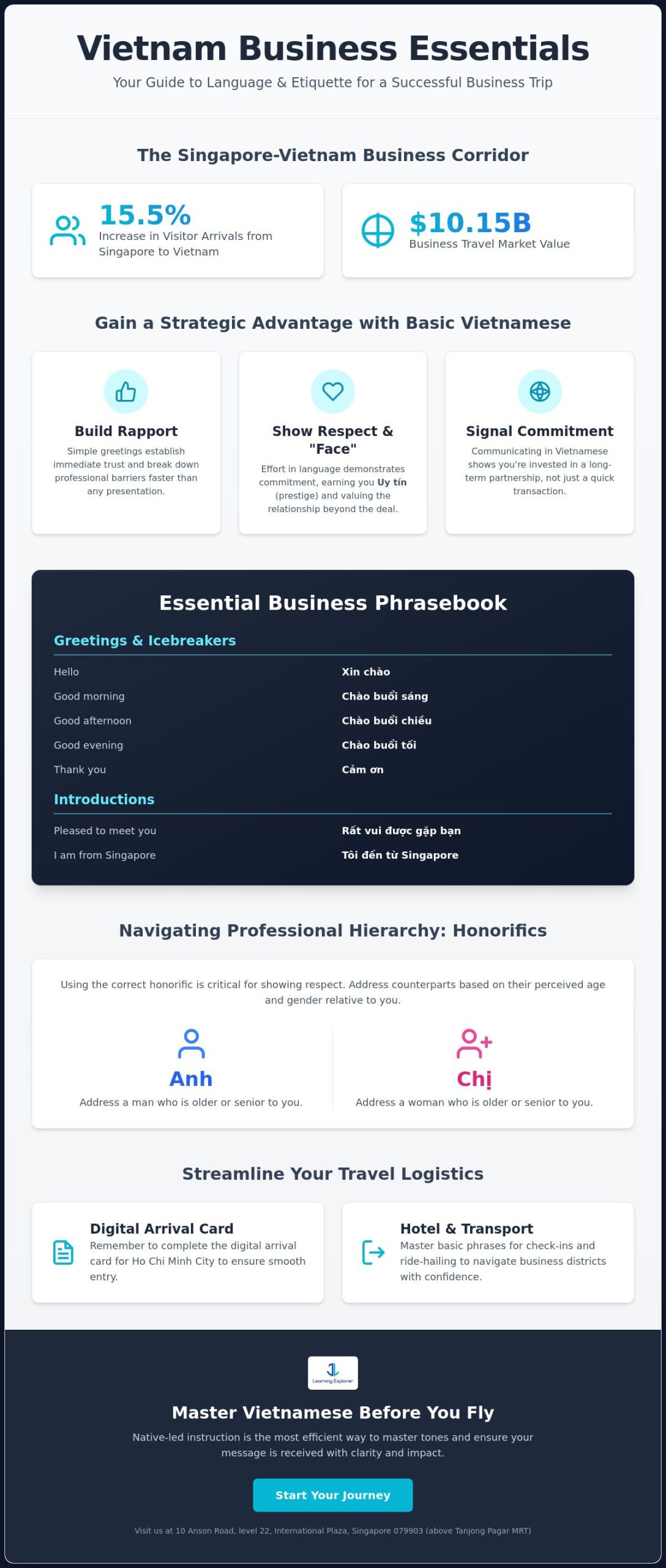
With visitor arrivals from Singapore to Vietnam increasing by 15.5% in 2025, the competition for market share in this growing USD 10.15 billion business travel landscape is more intense than ever. You likely feel the pressure to perform while worrying about the complexities of a tonal language or the risk of causing accidental offense during a formal signing. It is stressful to navigate Hanoi or Ho Chi Minh City without a clear grasp of local etiquette. This guide to your business trip to vietnam language basics is designed to bridge that gap, transforming your anxiety into a professional advantage.
For organizations that prefer a fully digital approach for their regional teams, reviewing Online Language Training Fees offers a clear path to integrating high-quality, native-led instruction into a busy corporate schedule.
Mastering a few key phrases and understanding the right honorifics will help you build immediate rapport with your Vietnamese partners. We will show you how to handle formal introductions, navigate business dinners with confidence, and stay updated on the latest travel requirements like the digital arrival card for Ho Chi Minh City. By the end of this article, you will have the tools to move beyond the tourist label and present yourself as a committed, respectful partner. If you are looking to sharpen these skills before you fly, visit us at 10 Anson Road, level 22, International Plaza, Singapore 079903, located right above Tanjong Pagar MRT, to start your journey toward seamless cross-border communication.
Key Takeaways
- Learn how simple greetings like “Xin chào” serve as powerful icebreakers to establish trust and professional respect in Hanoi and Ho Chi Minh City.
- Build immediate rapport by mastering a survival kit of greetings and introductions tailored for your next business trip to vietnam language basics.
- Navigate complex professional hierarchies with confidence by understanding the critical use of honorifics like “Anh” and “Chị” based on age and seniority.
- Streamline your travel logistics in Vietnam’s central business districts with practical phrases for hotel check-ins and navigating local ride-hailing services.
- Discover why native-led instruction is the most efficient way to master Vietnamese tones and ensure your message is received with clarity and impact.
Why Basic Vietnamese is a Strategic Asset for Singaporean Executives
The economic ties between Singapore and Vietnam are reaching new heights in 2026. As Singapore remains a top foreign investor, the corridor between our CBD and the industrial hubs of Hanoi and Ho Chi Minh City has never been busier. While English is common in high-level boardrooms, relying solely on it can limit your reach. Knowing the business trip to vietnam language basics isn’t just about utility; it’s a strategic move to signal your commitment to a long-term partnership. It shows you’re ready to engage with the local market on its own terms.
To get started with the sounds of the language, watch this helpful video:
Simple phrases like “Xin chào” (hello) and “Cảm ơn” (thank you) act as essential icebreakers. In a culture that values hospitality, these small efforts break down barriers faster than any PowerPoint deck. For a deeper understanding of the linguistic roots you’ll be navigating, this Vietnamese language overview provides excellent context on the history and dialects of the region. Showing that you’ve done your homework before landing at Tan Son Nhat Airport sets a professional tone for every meeting that follows.
The Singapore-Vietnam Business Connection
Singaporean capital is currently fueling massive growth in Vietnamese manufacturing and technology sectors. For Singaporean SMEs, the ability to communicate directly with local managers or factory supervisors is a massive differentiator. It reduces the administrative burden of constant translation and shows that you aren’t just there for a quick transaction. Many professionals now start their preparation right in the heart of the Singapore CBD. Training at 10 Anson Road, level 22, International Plaza, Singapore 079903, allows executives to pivot from their daily tasks into a mindset of regional expansion during their lunch hour or after work.
Building “Face” Through Language Effort
In Vietnamese professional life, the concept of “Face” or Uy tín is foundational. When you attempt to speak the local language, even if your tones aren’t perfect, you gain immense respect. It shows you’ve invested time to understand their world. This effort reduces friction during initial networking sessions and business dinners. It transforms you from a visiting “foreigner” into a “partner.” By moving beyond an English-only mindset, you demonstrate that you value the relationship as much as the deal itself. This psychological bridge is often what separates a successful negotiation from a missed opportunity in a competitive market.
Essential Vietnamese Business Phrases: A Survival Kit
Preparation is the key to confidence. While “Xin chào” gets you through the door, having a structured survival kit of phrases allows you to drive the conversation forward. For a Singaporean executive, these business trip to vietnam language basics serve as a bridge between a cold introduction and a warm professional relationship. They help you navigate the nuances of a new market with poise and clarity.
Adapt your greetings to the time of day to show extra attention to detail. Use “Chào buổi sáng” for the morning, “Chào buổi chiều” for the afternoon, and “Chào buổi tối” for the evening. These subtle shifts demonstrate a higher level of linguistic awareness that local partners truly appreciate. If you want to refine your pronunciation before your flight, exploring a Conversational Vietnamese Course can give you the vocal confidence needed for high-stakes meetings.
Meeting and Greeting Etiquette
First impressions are often permanent. Start by using “Rất vui được gặp bạn” (Pleased to meet you) to set a formal yet welcoming tone. Clearly stating your origin is equally important. Use “Tôi đến từ Singapore” (I am from Singapore) to establish your context immediately. In Vietnamese business culture, the exchange of business cards is a ritual of respect. Always use both hands to offer and receive cards. As you do so, saying “Cho tôi xin danh thiếp” (May I have your business card) shows you value the professional connection you’re building.
The Art of the Vietnamese Business Lunch
Networking doesn’t end in the boardroom; it often peaks at the dinner table. Understanding the social dynamics of a business lunch is vital for closing deals. You’ll likely encounter the phrase “Một, hai, ba, dô!” (1, 2, 3, cheers!). It’s more than a toast; it’s a collective moment of camaraderie. Participating heartily shows you’re part of the team. When ordering, be clear about your needs. Use “Tôi không ăn…” followed by the specific food if you have dietary restrictions. Once the meal concludes, always offer a compliment. Saying “Món ăn rất ngon” (The food is delicious) is a simple way to show gratitude to your host.
Beyond the social aspects, keep your meeting vocabulary sharp. Use “Vâng” or “Dạ” for yes, “Không” for no, and “Tôi hiểu” for I understand. Adding “Làm ơn” (Please) to your requests maintains a level of professional courtesy that resonates deeply with local partners. These business trip to vietnam language basics ensure you aren’t just a passenger in the meeting but an active, respectful participant in every negotiation.
Navigating Honorifics: Anh, Chị, and Professional Hierarchy
In Vietnam, the way you address someone is as important as the message itself. While Singaporean offices often favor a casual first-name basis, Vietnamese professional culture is built on a solid foundation of respect for age and seniority. Understanding these nuances is a core part of your business trip to vietnam language basics. It prevents the coldness of generic pronouns and builds the “Face” we discussed earlier, signaling that you value the person behind the title.
The most common honorifics you’ll use are “Anh” for a man who is slightly older than you and “Chị” for a woman who is slightly older. If you’re speaking to someone younger, use “Em.” Use this term carefully; “Em” is a sign of respect within a hierarchical structure, not a way to look down on subordinates. In very formal settings, combine these with professional titles like “Giám đốc” (Director) or “Chủ tịch” (Chairman) to show you recognize their authority and hard-earned position.
The Addressing Framework for Meetings
Select the correct honorific by estimating if the person is older or younger than you, then adjust based on their professional rank. Many Singaporeans mistakenly use “Bạn” (friend) in meetings, which can feel overly casual and even disrespectful in a high-stakes negotiation. If you’re unsure, don’t guess. Simply ask, “Tôi nên xưng hô với bạn thế nào cho đúng?” (How should I address you correctly?). This question shows humility and a genuine desire to follow local customs, which often impresses Vietnamese partners more than perfect grammar.
Business Card (Danh Thiếp) Protocol
Treat the exchange of a Danh Thiếp as your first physical interaction in a meeting. Always use two hands to offer your card and receive theirs, as this is a universal sign of respect across Vietnam. Take a moment to read the card before putting it away; look specifically for their title and surname. This pause allows you to connect the title on the card to the spoken honorific you’ll use throughout the session. Practicing these physical gestures alongside your verbal greetings ensures your body language matches the professional respect you’re aiming to convey.
Travel Logistics: Navigating Vietnam from a Business Perspective
Moving from the boardroom to the bustling streets of Ho Chi Minh City or Hanoi requires a different set of business trip to vietnam language basics. While your executive presence carries weight in a formal meeting, navigating the local economy or checking into a hotel in the District 1 business hub requires practical, on-the-ground communication. Understanding these logistics ensures you remain punctual and focused on your strategic objectives without getting bogged down by administrative friction.
Cash remains a significant part of daily life in Vietnam, especially for smaller expenses. While major hotels and upscale restaurants in the CBD accept international credit cards, you’ll need Vietnamese Dong (VND) for local transport or quick lunches. As of June 2026, the exchange rate is approximately 1 Singapore Dollar to 20,318 Vietnamese Dong. Carrying a mix of denominations is a smart move to avoid delays when settling small bills or tipping service staff. To ensure you’re fully prepared for every scenario, consider enrolling in a Conversational Vietnamese Course before your next departure.
Getting Around the City
Grab is the dominant ride-hailing service in both major cities and is generally the most efficient way for Singaporean professionals to travel. Even with a digital map, knowing basic directions helps if there is a GPS lag or a sudden road closure. Use “Rẽ trái” to turn left, “Rẽ phải” for right, and “Đi thẳng” to go straight. When you enter a vehicle, confirm your destination by saying “Đến [Location], làm ơn.” While translation apps are helpful, they can be slow in heavy traffic; vocalizing these directions keeps you in control of your schedule and ensures you arrive at your appointments on time.
The Professional “Safety Net”
Even the best-planned trips can encounter unexpected hiccups. If you find yourself in a situation where your Vietnamese fails, ask “Bạn có nói tiếng Anh không?” (Do you speak English?) to locate a bilingual staff member. Knowing how to find the nearest pharmacy or business center is equally crucial for maintaining your productivity. Having a physical business address written down on a card or paper serves as a vital backup if your phone battery dies or local data connectivity fails in a high-rise building. These small preparations act as a safety net, allowing you to navigate the city with the same confidence you bring to your negotiations.
Mastering Vietnamese in Singapore: Professional Training at International Plaza
While digital tools offer a convenient starting point, they often fall short when it comes to the phonetic precision required for Vietnamese. Relying on a self-study app for your business trip to vietnam language basics can lead to unintended confusion during critical negotiations. Vietnamese is a musical, tonal language where the pitch of your voice completely changes the meaning of a word. Without a guide to correct your delivery, you risk miscommunicating your intentions to your partners.
Professional training provides the feedback loop that software simply cannot replicate. Our instructors understand the specific challenges Singaporean professionals face when transitioning from English or Mandarin to Vietnamese. We focus on high-impact communication that reduces administrative friction and builds immediate trust. Whether you’re leading a team or expanding a business, investing in a structured language course ensures that your first impression is one of competence and cultural awareness.
Why Native Instruction Matters for Tones
Vietnamese utilizes six distinct tones. A single syllable like “ma” can mean six different things, ranging from “mother” to “ghost” or “tomb,” depending on the rise or fall of your voice. Learning these nuances requires real-time feedback from native bilingual instructors who can identify and correct subtle errors before they become habits. In our sessions, we move beyond rote memorization. We use role-playing scenarios focused on business card exchanges and formal introductions to build your vocal confidence. This practical approach ensures you’re ready to speak with clarity the moment you land.
Flexible Learning Options at Learning Explorer
We recognize that busy executives have limited time. That’s why we offer a variety of formats, from private one-on-one coaching to intensive group workshops designed for corporate teams. Our Conversational Vietnamese Course is tailored to fit into a demanding schedule, allowing you to master the business trip to vietnam language basics without disrupting your daily operations. By choosing a partner that understands the taxing nature of regional expansion, you gain more than just vocabulary. You gain a reliable ally dedicated to your professional success in Vietnam.
Unlock New Opportunities in the Vietnamese Market
Mastering the business trip to vietnam language basics is your first step toward deeper regional integration. You’ve seen how simple greetings and the correct use of honorifics can open doors that English alone cannot. These linguistic efforts build the trust necessary to navigate complex negotiations and social dinners with ease. By focusing on these essentials, you transform from a visiting executive into a valued local partner.
Prepare for your next expansion with the support of a reliable ally. Our native-speaker bilingual instructors provide a tailored curriculum specifically for corporate professionals. We help you move beyond the labor of seeking information to the satisfaction of discovery and professional impact. By refining your tones and etiquette before you depart, you ensure every interaction adds value to your business objectives.
Master Business Vietnamese at Learning Explorer – Join Our CBD Classes Today!
Your commitment to learning is the catalyst for better outcomes. We look forward to helping you make your next trip a resounding success.
Frequently Asked Questions
Do I really need to learn Vietnamese for a business trip, or is English enough?
English is common in high-level corporate boardrooms, but learning Vietnamese basics is a strategic asset that sets you apart. It signals professional respect and a genuine commitment to the local partnership. Even a few phrases can break the ice during social dinners or help you navigate local logistics in Hanoi and Ho Chi Minh City more efficiently.
What is the most important Vietnamese phrase for a business meeting?
“Xin chào” (Hello) and “Cảm ơn” (Thank you) are fundamental, but “Rất vui được gặp bạn” (Pleased to meet you) is the most impactful phrase for a professional first impression. Using this phrase while exchanging business cards with both hands demonstrates a high level of cultural awareness. It immediately builds rapport and shows you’ve prepared specifically for this regional engagement.
How do I correctly address a senior Vietnamese business partner?
Address a male partner as “Anh” and a female partner as “Chị” if they are older or more senior than you. Pair these honorifics with their professional title, such as “Giám đốc” (Director), to show maximum respect in formal settings. Avoid using only their first name until you’ve established a close, long-term relationship, as hierarchy is central to Vietnamese professional life.
Is the Southern or Northern dialect better for business travelers?
The best dialect depends on your primary destination, as Hanoi and Ho Chi Minh City have distinct accents and vocabulary. Most professionals focus on the dialect of the city where their main partners are located to ensure maximum clarity. If you travel between both hubs, focusing on clear, neutral tones is the most effective approach for your business trip to vietnam language basics.
How long does it take to learn basic Vietnamese business phrases?
You can master a functional survival kit of phrases in approximately 10 to 18 hours of focused, professional study. This timeframe allows you to handle introductions, basic meeting vocabulary, and essential dining etiquette. Because Vietnamese is a tonal language, practicing with a native speaker is vital to ensure your pronunciation is understood by local partners.
Can I use my Singaporean business card in Vietnam, or should I print local ones?
You can use your Singaporean card, but having one side translated into Vietnamese is a highly recommended practice. This gesture shows you are serious about the local market and respect your partners’ language. Ensure your professional title is clearly translated, as understanding your place in the hierarchy is a priority for Vietnamese executives during the initial meeting.
What should I avoid saying or doing in a Vietnamese business setting?
Avoid being overly casual or aggressive during negotiations, as protecting “Face” is critical for both parties. Don’t use your left hand to offer business cards or point at people with a single finger; use your whole hand instead. In conversation, it’s best to avoid sensitive political topics and focus on building personal rapport through discussions about food, travel, or family.
Where can I find a Vietnamese language school in Singapore CBD?
You can find professional training at 10 Anson Road, level 22, International Plaza, Singapore 079903. Our center is located directly above Tanjong Pagar MRT, providing a convenient hub for professionals to master business trip to vietnam language basics. We offer tailored courses that fit into a busy corporate schedule, helping you prepare for regional expansion with confidence.