Did you know that enrollment in Japanese language classes across Singapore has surged by 280% since 2024? While thousands of local learners are diving in, many feel stuck before they even begin because the debate of kanji vs kana feels like an impossible mountain to climb. You might worry that memorizing thousands of characters is a feat reserved for the superhuman, or perhaps you find yourself constantly mixing up the curves of Hiragana with the sharp angles of Katakana.
We understand that the grit of starting a new language can feel overwhelming, but we’re here to provide the spark you need to succeed. This guide will empower you to see the logic behind the scripts, where Kanji provides the core meaning and Kana acts as the vital grammatical glue. Discover how to streamline your study routine and gain the confidence to join the learners preparing for the July 5, 2026, JLPT. We’ll provide a clear roadmap to master the writing system so you can start your journey with us at 10 Anson Road, level 22, International Plaza, Singapore 079903, located right above Tanjong Pagar MRT.
Key Takeaways
- Understand the unique partnership of kanji vs kana to see how symbols represent deep concepts while phonetic scripts manage sounds and grammar.
- Learn to identify Hiragana for native Japanese words and use Katakana to decode foreign names or modern loanwords.
- Explore the logic of the 2,136 Joyo Kanji characters and how they serve as the essential building blocks for daily literacy.
- Discover how Furigana acts as a helpful guide for pronunciation, making it much easier to read complex characters as you start your journey.
- Implement a streamlined roadmap that prioritizes Hiragana as your gateway script, helping you build confidence in just seven days.
What is the Difference Between Kanji and Kana?
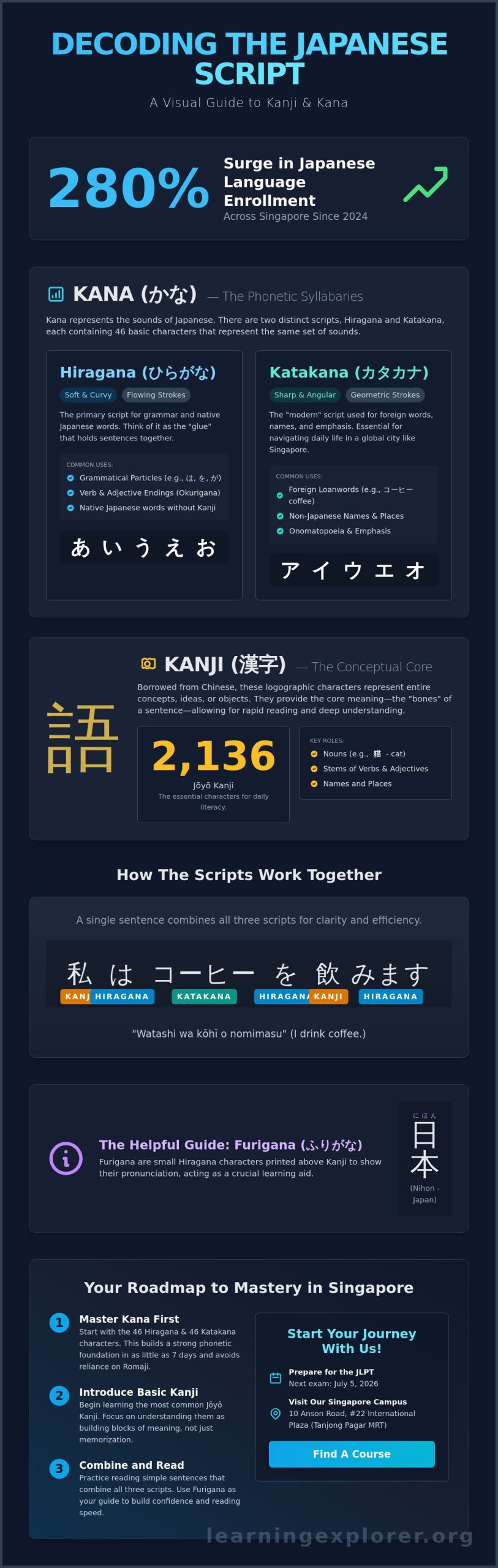
Understanding the balance of kanji vs kana is the first hurdle every student faces. Kanji characters are logographic symbols borrowed from China centuries ago. Each character represents a specific concept, object, or idea rather than just a sound. In contrast, Kana is the collective term for two phonetic syllabaries: Hiragana and Katakana. While Kanji provides the core meaning of a sentence, Kana acts as the functional engine that tells you how to pronounce words and how they relate to one another grammatically.
The modern Japanese writing system is unique because it uses all three scripts simultaneously. A single sentence might use Kanji for the noun, Hiragana for the verb ending, and Katakana for a foreign loanword. This combination ensures high reading speeds and eliminates the ambiguity often found in purely phonetic languages. By using these scripts together, the language achieves a visual clarity that allows readers to scan and understand complex ideas at a glance. Mastering the relationship of kanji vs kana is the spark that transforms a beginner into a confident reader.
The Origins of Nihongo Writing
Japan didn’t have a native writing system until the 4th or 5th century. Scholars adapted Chinese characters to fit the Japanese spoken tongue, creating a complex hybrid. Over time, they realized that Kanji alone couldn’t capture the nuances of Japanese grammar, such as verb conjugations or particles. This necessity led to the development of Kana, which simplified complex Kanji into easy-to-write phonetic symbols. This evolution was a transformation that allowed the language to express both abstract ideas and specific grammatical tenses with seamless precision. Today, these systems work as a partnership where one provides the “bones” of meaning and the other provides the “connective tissue” of grammar.
Why Singaporean Learners Should Start with Kana
If you’re beginning your journey in Singapore, we recommend mastering the 46 basic Hiragana characters first. This provides an immediate psychological win. You’ll move from “searching” for meaning to “finding” it on every page. Focusing on Kana creates a solid foundation for learning Japanese language without the crutch of Romaji. While the Latin alphabet seems easier at first, it often leads to poor pronunciation and slows down your eventual transition to reading real-world materials. Mastering the phonetic scripts early streamlines your progress and builds the grit needed for more complex characters later. It’s the most efficient way to empower your learning and prepare for the 2026 JLPT exams.
The Phonetic Foundations: Hiragana vs. Katakana
Before you tackle the visual complexity of kanji vs kana, you must build a foundation with the two phonetic scripts. Think of Hiragana and Katakana as two sides of the same coin. They represent the exact same 46 sounds, but their visual personalities and roles in the language are distinct. Hiragana is defined by its soft, flowing curves. Katakana is characterized by sharp, angular strokes. Learning to distinguish them is much like learning to recognize the difference between print and cursive in English. Both are essential for daily life in Singapore, from reading menus to understanding business emails.
Every beginner should start by mastering these 46 sounds. It’s the most effective way to empower your studies and stop relying on Romaji. As emphasized in Tae Kim’s Guide to Learning Japanese, these phonetic foundations allow you to pronounce any word in the language with perfect accuracy. Once you grasp the sound system, the transition to more complex characters becomes a logical next step rather than a confusing hurdle.
When to Use Hiragana: Grammar and Native Roots
Hiragana is your primary tool for daily communication. It handles the grammatical “glue” of the language. You’ll use it for particles like ‘wa’, ‘ga’, or ‘no’, which act as vital signposts in a sentence. It also appears in ‘Okurigana’, which are the phonetic suffixes attached to Kanji stems that change a word’s tense. Because it’s the most fundamental script, Japanese children’s books are printed almost exclusively in Hiragana. It’s the first step toward literacy and provides the grit needed to start forming your first sentences. If you’re ready to dive in, you can start learning Japanese language with us to master these basics quickly.
When to Use Katakana: Loanwords in the Singapore Context
Katakana is the “modern” script of the Japanese language. In the busy streets of Tanjong Pagar, you’ll see it everywhere. It’s used for foreign loanwords and names. If your name is Tan or Lee, you’ll always write it in Katakana. You’ll also spot it on cafe menus for ‘Koohii’ (Coffee) or ‘Keeki’ (Cake). Beyond loanwords, Katakana serves as the language’s version of italics. Writers use it for emphasis, onomatopoeia, or scientific names of animals and plants. This versatility makes it indispensable for professional communication. Understanding this functional split in kanji vs kana helps you decode everything from MRT signs to tech terms like ‘Konpyuuta’ (Computer) with ease.
The Power of Kanji: Why Symbols Matter
Many beginners feel a wave of anxiety when they see their first page of Kanji. It’s the “grit” of the language that often makes people hesitate, but these characters are actually your greatest allies. Unlike phonetic scripts, Kanji characters are ideograms. They convey a concept or an idea before you even “read” the sound. This is a vital distinction in the kanji vs kana debate; while Kana tells you how to say a word, Kanji tells you what the word means at a glance. When you see the character for “mountain” (山), you instantly visualize the object, regardless of whether you know the pronunciation is “yama” or “san.”
To reach daily literacy, you’ll eventually aim to master the “Joyo Kanji.” This is a curated list of 2,136 characters used in official documents, newspapers, and the JLPT. While that number might seem high, the system is surprisingly logical. Most characters are built from smaller “radicals” that provide clues to the meaning. You’ll also learn that most Kanji have dual readings: On-yomi (derived from Chinese) and Kun-yomi (native Japanese). Mastering these readings is the spark that transforms your understanding of the language, allowing you to decode complex vocabulary with ease.
How Kanji Improves Reading Speed
Japanese text doesn’t use spaces between words. This makes a sentence written entirely in Hiragana difficult for adults to parse quickly. Kanji acts as a visual anchor. It creates natural breaks in the text, allowing your brain to identify nouns and verb stems instantly. This visual “word-breaker” effect is why adults in Japan find all-Kana children’s books frustratingly slow to read. Kanji streamlines the reading process, helping you move from “searching” for the start of a word to “finding” the meaning immediately. It turns a wall of text into a series of recognizable landmarks.
Kanji and the JLPT in Singapore
If you’re planning to take the JLPT in Singapore on July 5, 2026, understanding the Kanji requirements is essential. The progression starts at N5, which requires about 100 basic characters, and moves up to N1. You should explore the JLPT N5 vs N4 distinction to see how the complexity of Kanji increases as you advance. To practice, look around you in Singapore. Visit Japanese supermarkets or check the signage in Tanjong Pagar. Many restaurants near our center at 10 Anson Road, level 22, International Plaza, use authentic Kanji on their menus. These real-world examples provide the perfect opportunity to test your skills right above Tanjong Pagar MRT.
Kanji vs. Kana: A Functional Comparison
Discover the synergy of the Japanese writing system by looking at how the scripts interact. The most effective way to view the kanji vs kana relationship is through a functional framework. In a typical sentence, Kanji represents the “solid” parts like nouns and verb stems. Hiragana handles the “flexible” parts, including grammar, particles, and tense endings. Katakana steps in for foreign terms, loanwords, and emphasis. This division of labor isn’t just a tradition; it’s a streamlined method for delivering clear, unambiguous communication that educators and students alike can appreciate.
As you progress, you’ll encounter “Furigana.” These are small Kana characters written above or beside Kanji to help with pronunciation. It’s a supportive tool used in manga and textbooks to ensure students never feel lost. You may also occasionally see “Ateji,” which are Kanji characters chosen solely for their sounds rather than their meanings. While rare, understanding these nuances shows the depth of the system. You might wonder if you can just write everything in Kana to save time. While technically possible, doing so creates a wall of text that’s exhausting to read and prone to misunderstanding. It’s like writing an English sentence without spaces or punctuation; the meaning gets lost in the noise.
Anatomy of a Japanese Sentence
Let’s break down a practical example: “I am going to the office by taxi.” In this sentence, the word for “office” is written in Kanji to anchor the core meaning. “Taxi” is written in Katakana because it’s a loanword from English. The particles indicating the subject and direction, along with the verb ending for “going,” are all written in Hiragana. This mix allows you to identify the action, the destination, and the mode of transport at a glance. It’s an efficient structure that saves time and reduces mental fatigue once you know the code.
Differentiating Homophones
Kanji serves as the ultimate clarifier for the many homophones in the Japanese language. Take the word “hashi,” for instance. Without Kanji, “hashi” could mean bridge, chopsticks, or even an edge. When you see the specific Kanji for each, the confusion vanishes instantly. This visual distinction is why kanji vs kana is a partnership of necessity. Relying purely on sound would require constant backtracking to understand the context. By using symbols, you empower your reading speed and accuracy. If you’re ready to master these distinctions and speak with clarity, join our Japanese language course to start your journey today.
Mastering the Japanese Writing System in Singapore
Mastering the balance of kanji vs kana requires a clear roadmap rather than a sprint. We recommend starting with a “Hiragana-first” strategy. Commit to learning the 46 basic characters in just seven days to build immediate momentum. This allows you to read basic sentences and particles almost instantly, providing a psychological win. Once you’ve secured this gateway script, pivot to Katakana. You’ll find it easier to memorize by linking characters to common loanwords you see daily in the CBD. From there, begin integrating basic N5-level Kanji into your vocabulary. Focus on high-frequency characters that appear in common verbs and nouns. Consistent input is the secret to retention; spend 15 minutes each morning reading short sentences or writing out new characters to build muscle memory. To truly accelerate your progress, join a structured Learn Japanese Language Course that provides the professional accountability you need to succeed.
Learning Near Tanjong Pagar MRT
Our training center is conveniently located right above Tanjong Pagar MRT, making it an ideal choice for busy professionals. A physical classroom environment offers a supportive space where you can practice Japanese speaking in Singapore with peers who share your goals. This face-to-face interaction is vital for reinforcing script recognition and improving pronunciation. Our native-speaker instructors provide the spark that digital apps often lack, offering personalized feedback on your writing and speaking. They understand the specific bilingual challenges Singaporeans face when navigating the nuances of kanji vs kana, ensuring you don’t feel overwhelmed by the transition from phonetic sounds to conceptual symbols.
Resources for Singaporean Learners
Take your learning beyond the classroom to see rapid results. Singapore offers a wealth of immersion opportunities, from Japanese supermarkets like Meidi-Ya to the many authentic restaurants in the Tanjong Pagar area. Use these visits to practice reading labels and signage in the wild. This real-world application turns a standard grocery run into a valuable study session, helping you recognize scripts in different fonts and contexts. Remember that language is more than just symbols on a page; mastering Japanese culture & etiquette is just as vital for your success in professional or social settings. Studying in a professional CBD environment helps you stay consistent and focused. It transforms the grit of daily practice into a seamless part of your professional lifestyle, helping you reach your goals for the 2026 JLPT exams with confidence.
Empower Your Language Journey Today
You now have the roadmap to navigate the Japanese writing system with clarity. We’ve explored how Hiragana and Katakana provide the phonetic foundation while Kanji adds the necessary depth of meaning. Mastering the relationship of kanji vs kana is no longer an impossible task; it’s a series of logical steps that build your confidence one character at a time. By prioritizing the phonetic scripts first and gradually layering in conceptual symbols, you’ll find that your reading speed and comprehension improve naturally.
Our team is ready to help you transform that initial spark into lasting fluency. We offer interactive learning environments designed for busy adults and corporate clients who need results without the stress. With certified native-speaker instructors and a convenient CBD location at International Plaza, we provide the expert guidance needed to master these scripts. Discover our Conversational Japanese Courses right above Tanjong Pagar MRT! Your path to understanding Nihongo starts with a single stroke. We’re here to ensure every lesson is one you’ll love.
Frequently Asked Questions
Can I learn Japanese without learning Kanji?
You can start with basic conversation, but you cannot achieve full literacy or professional fluency without Kanji. In the kanji vs kana dynamic, Kanji is essential for distinguishing homophones and reading real-world materials like menus, signs, or business documents. Relying solely on phonetic scripts will eventually limit your progress and keep you stuck at a beginner level.
How long does it take to learn Hiragana and Katakana?
Most dedicated learners master Hiragana in about seven days and Katakana in another week. This timeframe assumes you spend at least 30 minutes daily on active recall and writing practice. By the end of 14 days, you’ll be able to read almost any phonetic text you encounter in our classrooms, providing a massive boost to your confidence.
Is Kanji the same as Chinese characters?
Kanji characters share historical roots with Chinese Hanzi, but they’ve evolved into a unique Japanese system over centuries. While many meanings remain identical, the pronunciations and specific stroke styles often differ. Some characters were even invented in Japan, known as Kokuji, to represent concepts unique to Japanese culture that don’t exist in the Chinese language.
Which script should I learn first as a beginner?
You should always learn Hiragana first as your foundational script. It serves as the gateway to Japanese grammar and allows you to read children’s books or beginner textbooks immediately. Once you’re comfortable with these 46 sounds, moving on to Katakana and basic Kanji becomes a much more streamlined and logical process for your brain to handle.
Why does Japanese have two different phonetic alphabets?
Japanese uses two phonetic scripts to provide visual clarity and distinguish the origin of words. Hiragana handles native vocabulary and grammatical particles, while Katakana is reserved for foreign loanwords and names. This functional split in the kanji vs kana system allows readers to scan a sentence and instantly identify which words are imported and which are native.
How many Kanji do I need to know to be fluent?
To be considered fully literate, you need to master the 2,136 Joyo Kanji designated by Japan’s Ministry of Education (MEXT). For the JLPT N5 level, you only need about 100 basic characters. As you advance toward N1, you’ll reach the full 2,000 characters required for reading professional documents and high-level literature in a corporate setting.
Is it better to learn to write Kanji by hand or just type it?
You should practice writing Kanji by hand during the initial learning phase to reinforce muscle memory and stroke order. While typing is more common in modern business environments, the grit of physical writing helps you recognize complex radicals more accurately. This balanced approach ensures you can both produce the language and read it fluently on digital screens.
What is Furigana and why is it used?
Furigana consists of small Hiragana or Katakana characters placed above or beside Kanji to indicate its pronunciation. It’s an essential learning object for beginners and is frequently used in manga, newspapers, and textbooks to aid readers. This feature provides a seamless bridge for students who are still building their character recognition skills and want to read more advanced material.