Could a single misplaced vowel or the wrong choice between tú and usted cost you a major partnership in Madrid or Mexico City? You’ve likely felt that sharp spike of anxiety before hitting send on a high-stakes proposal, worrying if your gender agreement is off or if your punctuation looks unprofessional. It’s a common struggle for many professionals who want to project confidence but feel held back by the linguistic nuances required for high-level deals. Mastering the specific spanish grammar rules for business writing is the key to closing that gap and building lasting trust with your international partners.
We’re here to help you trade that hesitation for total clarity and professional impact. In this guide, you’ll learn how to navigate the hierarchy of address, apply the latest 2026 RAE updates for digital terms like loguearse, and eliminate the messy punctuation that distracts from your message. We’ll preview the essential shifts in professional Spanish so you can write error-free correspondence that increases your influence. If you’re ready for more intensive practice, visit us at 10 Anson Road, level 22, International Plaza, Singapore 079903, located directly above Tanjong Pagar MRT. Let’s transform your business writing into a powerful tool for your global career.
Key Takeaways
- Learn when to default to “usted” and how to identify the subtle cues that signal a shift to more casual business relationships.
- Master the essential spanish grammar rules for business writing to ensure noun and adjective agreement, giving your proposals a polished and professional visual finish.
- Discover the specific roles of “por” and “para” to avoid confusion when setting deadlines or discussing project fees and logistics.
- Implement correct Spanish punctuation standards, including inverted question marks and minimalist capitalization, to meet the expectations of modern digital correspondence.
- Understand why professional guidance from native speakers is the most efficient way to capture the cultural etiquette required for high-impact international deals.
Mastering Formal Address: When to Use Usted vs. Tú in Professional Settings
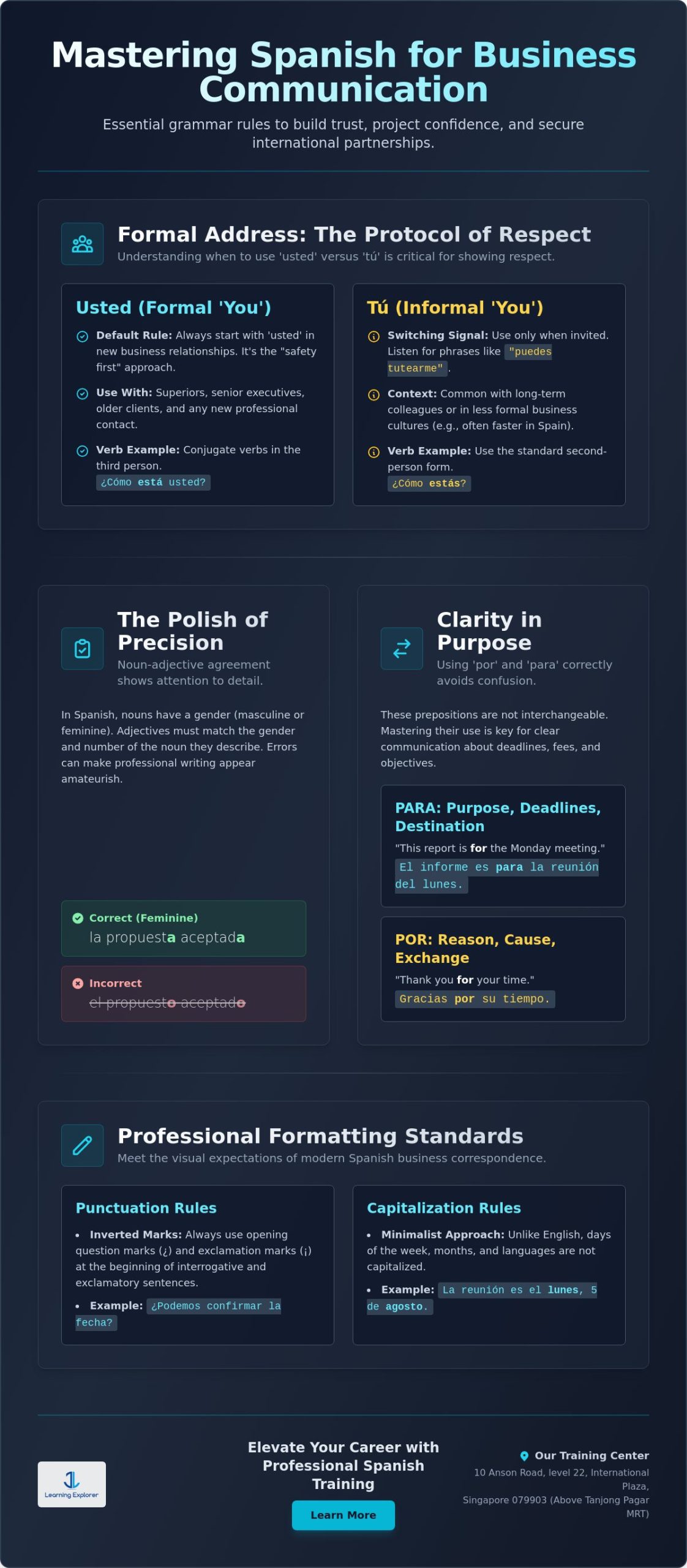
For Singaporean professionals expanding into Spanish speaking markets, the distinction between usted and tú isn’t just about grammar; it’s about respect. Think of it as the linguistic equivalent of a firm handshake and a formal business card exchange. In most Latin American regions, starting with the formal usted is the “safety first” rule that prevents you from appearing prematurely familiar or disrespectful. It’s the foundation of effective communication that builds long term trust.
Regional variations add another layer of complexity to your writing. In Spain, colleagues often move to tú quickly, sometimes even during the first meeting. However, in Mexico or Colombia, using usted remains the standard for a much longer period, especially when speaking with senior executives or older clients. Understanding these nuances is a core part of the spanish grammar rules for business writing that help you build influence across borders.
To better understand this concept, watch this helpful video:
How do you know when to switch? Usually, the person with the higher status or the client will invite you to “tutear,” which means to use the tú form. If they say “puedes tutearme” or start using your first name without a title like Señor or Doctora, it’s a green light. Until then, stay formal. If you’re looking to refine these skills in person, our team at 10 Anson Road, level 22, International Plaza, Singapore 079903, situated directly above Tanjong Pagar MRT, can guide you through these cultural shifts.
The Corporate Hierarchy Rule
Hierarchy is vital in Spanish business culture. You should always use usted for superiors, elders, and any new external clients. Using tú prematurely often signals a lack of professional boundaries, which can be fatal in a high stakes negotiation. In a first contact business email, using usted acts as a strategic signal that you respect the recipient’s position and the gravity of the potential partnership. It’s always better to be seen as slightly too formal than significantly too casual.
Conjugation Shift for Professionalism
The transition to formal address changes how you conjugate verbs. When using usted, you drop the “s” ending that characterizes the informal tú form. For example, instead of asking “¿Cómo estás?” in a LinkedIn message, you would write “¿Cómo está usted?” to maintain a professional distance. This is a fundamental aspect of Spanish grammar that ensures your tone remains consistent. Mixing formal and informal address in the same paragraph is a common mistake that makes your writing look disorganized. Stay disciplined with your verb endings to project a polished and expert image.
Ensuring Agreement: Noun-Adjective Precision for Polished Proposals
The “Visual Polish” effect is a silent deal-breaker in international commerce. When a potential partner opens your proposal, they aren’t just scanning your profit margins; they’re evaluating your attention to detail. A single slip in gender agreement, like writing el propuesta instead of la propuesta, can make an otherwise brilliant strategy look amateur. Applying consistent spanish grammar rules for business writing creates a sense of reliability and respect for your recipient’s language. It’s the difference between looking like a temporary visitor and an established professional in the market.
Precision in agreement is just one part of the puzzle. You’ll also need to navigate complex prepositions to ensure your logic holds up under scrutiny, which is why reviewing a Por vs. Para guide can help you avoid common pitfalls when setting project expectations. To refine your skills further, exploring a Conversational Spanish Course can provide the hands-on practice needed to make these linguistic rules second nature.
Gendered Business Terminology
In a corporate environment, nouns are the building blocks of your message. You’ll find that most business terms follow a predictable gender pattern, but memorizing high-frequency exceptions is vital. Common masculine nouns include el contrato (the contract), el informe (the report), and el presupuesto (the budget). Conversely, feminine nouns like la empresa (the company), la factura (the invoice), and la reunión (the meeting) are staples of daily office life. When you’re dealing with professional titles, many are gender-neutral. For instance, you would use el gerente for a male manager and la gerente for a female manager. The definite article (el/la) provides the necessary clarity to define who you’re talking to or about.
The Adjective Placement Strategy
Sentence structure in Spanish differs significantly from English, particularly regarding adjectives. In formal writing, the standard rule is to place the adjective after the noun. Writing una propuesta innovadora (an innovative proposal) is correct and sounds professional. If you mistakenly place the adjective first, as in una innovadora propuesta, you risk sounding overly poetic or literary, which can feel out of place in a technical report. Matching plural adjectives to plural nouns is equally important to avoid clunky sentence endings. For example, el contrato firmado (the signed contract) must agree in both gender and number, shifting to los contratos firmados if you’re discussing multiple documents. This consistency ensures your writing flows logically and maintains its authoritative tone from the first page to the last.
Navigating Prepositions and Verbs: Por vs. Para for Deadlines and Objectives
Precision is the currency of professional trust. While many language learners treat prepositions as interchangeable, the distinction between por and para is a critical pillar of spanish grammar rules for business writing. Using the wrong one doesn’t just look messy; it can lead to missed shipments, misunderstood fees, or failed negotiations. When you master these nuances, you signal to your partners that you’re a detail-oriented professional who respects the cultural norms in Spanish business writing. It’s about moving from simple communication to high-impact influence.
When you’re setting objectives for a meeting, remember that para is your primary tool for stating the “why.” If you write that a meeting is para discutir el presupuesto (to discuss the budget), you’re clearly defining the goal. This level of clarity reduces administrative friction and ensures everyone arrives on the same page. It’s a small shift that creates a significant ripple effect in your daily productivity and professional reputation.
Deadlines and Project Milestones
Para is your best friend for deadlines. If a report is due by Friday, you must write para el viernes. Using this preposition signals a hard stop or a final delivery date, which helps prevent the ambiguity that often plagues cross-border project management. Conversely, use por when you’re describing the duration of a contract or a commitment. For instance, a partnership lasting “for six months” is por seis meses. Mistaking these two can lead to serious logistical errors, such as a client thinking a project is due in six months when you actually meant it’s due by the sixth of the month. Clear spanish grammar rules for business writing eliminate this risk entirely.
Describing Your Business: Ser vs. Estar
Identity matters just as much as timing. In Spanish, you’ll use two different versions of the verb “to be” depending on the context. Use ser to describe permanent traits of your organization. You might say, “Nuestra empresa es innovadora” (Our company is innovative), because innovation is part of your core identity. Use estar for temporary states or current physical locations. For example, you would write “Estamos interesados en su propuesta” (We are interested in your proposal) to describe your current state of mind. You also use estar to mention that your team is currently situated in the Tanjong Pagar district. Using the correct verb of state shows you understand the deeper logic of the language, instantly increasing your professional authority.
Formatting and Punctuation: The Visual Standards of Spanish Business Correspondence
Visual presentation is the dress code of your digital correspondence. In English, we often rely on context to signal a question’s start. In Spanish, the grammar demands you signal it immediately. Neglecting these visual cues tells your reader that you haven’t fully committed to their professional standards. By following the updated 2026 RAE guidelines, you can ensure your documents look modern and authoritative. These spanish grammar rules for business writing act as the final polish that separates a casual email from a high-impact corporate document.
Punctuation for Clarity
Inverted punctuation marks like the ¿ and ¡ are non-negotiable in formal digital communication. Missing the opening ¿ in a formal inquiry looks like a typo to a native speaker and disrupts the reading flow. It’s about accessibility. These marks allow the reader to adjust their tone of voice before they even reach the end of the sentence. When drafting corporate reports, use the guion (hyphen) for compound terms and comillas (quotation marks) for specific citations or translated terms. Always format your dates as Day/Month/Year, such as 15 de julio de 2026, to ensure your colleagues don’t mistake a July deadline for an October one.
Capitalization and Titles
Spanish is minimalist. While English speakers are accustomed to capitalizing every word in a job title, Spanish grammar dictates a more restrained approach. A title like director de marketing is not capitalized in the middle of a sentence. It only takes a capital letter if it starts a paragraph or is part of a formal address line. When you’re writing to a professional with a degree, address them as Licenciado or Ingeniero with proper grammatical respect. This level of detail is especially important if you’re using our Spanish for Business Travel to South America guide to prepare for an upcoming trade mission.
The Standard Business Email Structure
Professional Spanish emails follow a rigid, respectful structure. Start with a formal greeting followed by a colon, such as Estimado Sr. Rodriguez:. Using a comma here is a common English-influenced error. The body should be concise, utilizing the formal usted forms we discussed in previous sections. For your sign-off, Atentamente remains the gold standard for formal letters, while Saludos cordiales works well for ongoing digital threads. If you want to master these templates and write with total confidence, consider enrolling in a Business Spanish Course to get expert feedback on your specific industry documents. This structured approach ensures your message is received with the professional gravity it deserves.
Elevating Your Career with Professional Spanish Training in Singapore CBD
Mastering the technicalities of spanish grammar rules for business writing is a journey that requires more than just a translation app. While digital tools can help with basic vocabulary, they often fail to capture the cultural weight of a formal greeting or the subtle shift in tone needed for a high stakes negotiation. You’ve already seen how a misplaced preposition or a casual pronoun can change the entire dynamic of a proposal. Professional training is the most efficient way to turn these complex rules into second nature, allowing you to focus on your deal making rather than your dictionary.
Our native speaker instructors don’t just teach you verbs; they provide the cultural context that makes your communication effective. They understand the corporate etiquette of Madrid and Mexico City, helping you avoid the “textbook” traps that make many learners sound amateur. By enrolling in a structured conversational Spanish course Singapore, you’ll gain the confidence to lead meetings and draft complex documents without the fear of offending a client. It’s about moving from basic comprehension to professional influence.
Interactive Learning for Busy Professionals
We’ve designed our curriculum to meet the specific demands of the busy Tanjong Pagar workforce. Whether you prefer private coaching or small group sessions, our classes focus on real world business application rather than rote memorization. You’ll move quickly from basic sentence structure to mastering the specific spanish grammar rules for business writing required for your industry. Our teaching methodology aligns with global standards, ensuring your language skills are recognized and respected by international partners across the globe.
Your Gateway to Global Markets
Singaporean entrepreneurs are increasingly prioritizing Spanish for their 2026 expansion plans. With the Real Academia Española’s latest dictionary updates incorporating modern tech terms like comercio electrónico, the language is more business ready than ever. Investing in these skills offers a significant long term ROI, positioning you as a visionary leader who can bridge the gap between Singapore and the vast markets of Latin America and Spain. It’s a strategic move for any professional looking to increase their marketability in a competitive landscape.
We invite you to take the next step in your professional development and experience the satisfaction of clear communication. Visit our training center at International Plaza, conveniently located directly above Tanjong Pagar MRT. Our team is ready to help you reduce administrative burdens and increase your global engagement. Let’s work together to turn your linguistic potential into a powerful career asset that opens doors to new international opportunities.
Transform Your Global Business Communication
Mastering the nuances of professional address and precise agreement is more than a linguistic exercise. It’s a strategic move to build lasting trust in international markets. We’ve covered how the latest updates to spanish grammar rules for business writing can eliminate the friction in your digital correspondence. By refining your use of prepositions and punctuation, you ensure that your project milestones and objectives are never lost in translation. These skills help you project an image of total competence to your global partners.
You don’t have to navigate these complexities alone. Our native-speaker instructors provide the bilingual expertise and real-world corporate etiquette you need to succeed. We offer an interactive, fun, and high-quality learning experience that fits your busy schedule. Visit us at our convenient CBD location at International Plaza, Tanjong Pagar, to start your journey toward fluency with a team that understands your professional needs.
Enroll in a Business Spanish Course at Learning Explorer Today and turn your language skills into a powerful catalyst for your career expansion. We’re here to support your mission of becoming a truly global professional and look forward to seeing your impact grow.
Frequently Asked Questions
Is Spanish grammar harder to learn than English for business writing?
Spanish grammar is often considered more consistent but more complex than English due to verb conjugations and gender agreement. While English relies heavily on word order and auxiliary verbs, Spanish uses specific endings to convey tense and mood. Mastering these spanish grammar rules for business writing requires dedicated practice, but the logical structure often makes it easier to predict once you understand the core patterns.
Do I really need to use inverted question marks in professional emails?
Yes, you must use inverted question marks (¿) to maintain professional standards in formal Spanish correspondence. Leaving them out signals a lack of attention to detail and can make your email look like a casual text message. In a corporate setting, following these punctuation rules demonstrates your respect for the language and ensures your reader can identify the tone of a sentence from the very beginning.
How do I start a formal business email in Spanish?
Begin with “Estimado” or “Estimada” followed by the recipient’s title and last name, ending with a colon. For example, use “Estimado Sr. García:” for a male recipient. If you don’t know the person’s name, “A quien corresponda:” is the standard equivalent of “To whom it may concern.” Avoid using a comma after the greeting, as this is a common English habit that doesn’t align with Spanish business norms.
What are the most common grammar mistakes English speakers make in Spanish?
English speakers frequently struggle with the “por vs. para” distinction and noun-adjective gender agreement. Another common error is literal translation, such as using “en” for “on” when discussing dates. These slips can undermine your authority in a report. Focusing on specific spanish grammar rules for business writing helps you avoid these pitfalls and ensures your message remains clear and professional in every document you send.
Can I use ‘Tú’ with my Spanish-speaking colleagues?
You should only use “tú” once a colleague specifically invites you to do so or starts using it with you first. In many Latin American business cultures, the formal “usted” remains the default for years, even between coworkers who see each other daily. Jumping to “tú” prematurely can feel invasive. It’s always safer to remain formal until the relationship naturally shifts toward a more casual tone.
How long does it take to master business-level Spanish writing?
Most professionals can achieve basic proficiency in business writing within six to twelve months of consistent, structured study. Mastery depends on your starting level and the frequency of your practice. Engaging with native instructors who focus on corporate terminology accelerates this process. This targeted approach helps you move beyond basic conversation and into the nuanced world of professional reports and high-stakes email negotiations.
Are there specific grammar rules for writing Spanish business proposals?
Proposals require strict adherence to the passive voice and formal “usted” conjugations to maintain an objective tone. You should also pay close attention to the placement of adjectives, which usually follow the noun in technical descriptions. Using the future tense correctly is vital for outlining project milestones and deliverables. These specific structures help present your company’s capabilities with the necessary gravity and professional polish expected in global markets.
Why is gender agreement so important in Spanish business documents?
Gender agreement is crucial because it ensures clarity and prevents your writing from looking amateur. In Spanish, every noun has a gender that must match its accompanying articles and adjectives. A mistake here, like “el empresa,” is immediately noticeable to a native reader. Consistent agreement shows you possess a high level of linguistic competence, which directly translates to perceived reliability and professional competence in your field.