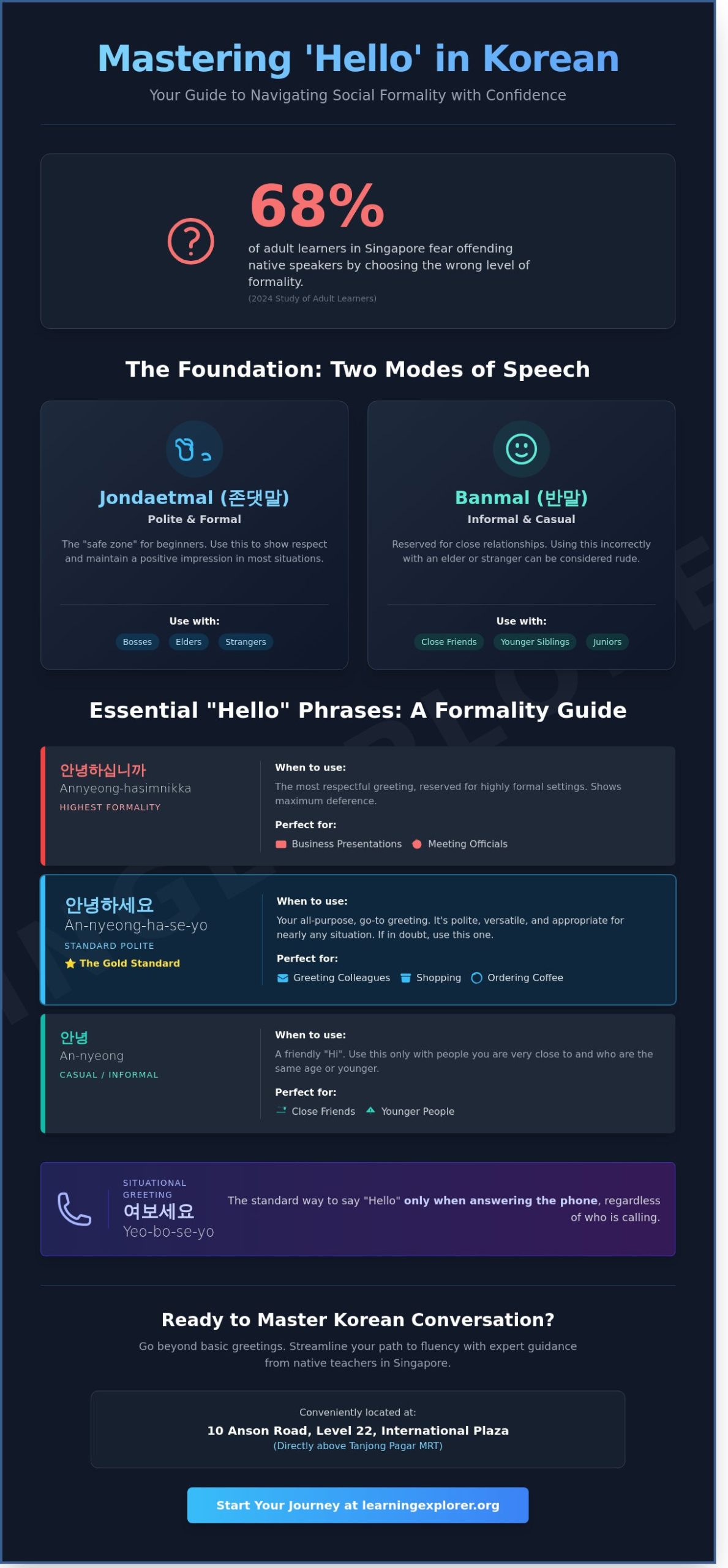
Last Tuesday, Sarah stood outside a Korean barbecue restaurant in Tanjong Pagar, ready to meet her new regional manager from Seoul. She had practiced how to say hello in korean for hours, yet the moment they met, she froze. Was a handshake appropriate, or should she bow? This social anxiety is real. A 2024 study of adult learners in Singapore found that 68% of students fear offending native speakers by choosing the wrong level of formality. You likely feel that same pressure to be respectful while wanting to build a genuine connection with your colleagues or friends.
We’re here to turn that hesitation into confidence. This 2026 guide empowers you to master essential greetings while simplifying the complex nuances of social hierarchy and etiquette. You’ll discover exactly when to use formal honorifics and when it’s safe to speak casually. We’ll bridge the gap between confusing English transliterations and natural pronunciation. By the end of this article, you’ll possess a clear roadmap for respectful communication. If you’re ready to take the next step, our expert guides at 10 Anson Road, level 22, International Plaza, right above Tanjong Pagar MRT, are ready to help you thrive.
Key Takeaways
- Master the nuances of social hierarchy to navigate the differences between formal and casual speech with confidence and respect.
- Discover how to say hello in korean using versatile phrases that empower you to communicate effectively in any professional or social setting.
- Learn why caring mealtime inquiries often replace standard greetings and how these unique cultural nuances foster more meaningful connections.
- Apply your skills seamlessly within Singapore’s vibrant K-culture scene, from the authentic eateries on Tanjong Pagar Road to local specialty supermarkets.
- Streamline your path to fluency with expert guidance from native teachers at our center conveniently located at International Plaza, right above Tanjong Pagar MRT.
Understanding the Power of Formality in Korean Greetings
Mastering your first hello in korean opens a door to a culture built on mutual respect. In South Korea, language acts as a social map, guiding you through layers of hierarchy similar to the respect we show elders in Singapore. You’ll encounter two primary speech levels: Jondaetmal, which is polite and formal, and Banmal, which is informal and casual. Choosing the right one shows you possess ‘nunchi,’ the essential social tact needed to build trust in any relationship. It’s the difference between being seen as a thoughtful guest or an unintentional intruder.
To better understand this concept, watch this helpful video:
This linguistic structure mirrors the Confucian values found in the 82% of Singaporean households that prioritize filial piety. Using the correct greeting ensures you don’t accidentally cause offense during a business meeting or a casual dinner. Understanding Korean Etiquette helps you realize that a simple bow often accompanies these verbal cues. At our training center at 10 Anson Road, level 22, International Plaza, Singapore 079903, located right above Tanjong Pagar MRT, we help students navigate these nuances. We focus on the ‘Age and Status’ rule. This simple guideline helps you determine the formality level in seconds by observing the context of the interaction and the age of the person you’re speaking to.
Jondaetmal vs. Banmal: When to Use Which?
Think of Jondaetmal as your professional mode. Use it with bosses, strangers, and service staff in Seoul. It’s the ‘Safe Zone’ for beginners because being overly polite is never a mistake. Banmal is reserved for those you’re close with, like childhood friends or younger siblings. If you’re unsure, stick to the polite forms to maintain a positive impression. Learning how to say hello in korean with the proper suffix can instantly change the energy of a room.
The Role of Asian Values in Language
Singaporeans often find Korean grammar intuitive because we share deep-rooted Asian values. The emphasis on hierarchy isn’t about being stiff. It’s about acknowledging the other person’s experience and life stage. Modern Seoul still values these traditions, even in fast-paced tech hubs. Understanding this respect-based system makes your learning journey smoother. You’re not just learning words; you’re learning how to connect with people on a deeper, more respectful level.
How to Say Hello in Korean: Formal and Casual Phrases
Choosing the right way to say hello in Korean depends entirely on who you’re talking to. Korean culture places immense value on social hierarchy and respect. Using the wrong level of formality can lead to awkward silences or unintended offense. To help you navigate these social waters, focus on these four essential variations.
- Annyeonghasimnikka (안녕하십니까): This is the highest level of formal greeting. You’ll hear this in 2026 business presentations, news broadcasts, or when meeting a high-ranking official. It’s crisp, professional, and shows maximum respect.
- Annyeonghaseyo (안녕하세요): This is the most common way to say hello in Korean. It’s polite and suitable for almost any situation, from ordering coffee to greeting your boss. It strikes the perfect balance between friendliness and respect.
- Annyeong (안녕): This is the casual “hi.” Reserve this strictly for close friends, younger siblings, or people clearly younger than you. Using this with a stranger or an elder is considered quite rude.
- Yeoboseyo (여보세요): This is a specialized greeting used only when answering the phone. Even if you know the caller is a close friend, “Yeoboseyo” is the standard opening.
Understanding these formal and casual Korean greetings allows you to build rapport quickly. It’s about more than just words; it’s about showing you value the local customs.
Mastering Annyeonghaseyo: The Gold Standard
Break the phrase down to understand its heart. “Annyeong” translates to “peace,” while “haseyo” comes from the verb “to do,” essentially asking “are you doing peace?” It’s a beautiful way to wish someone well. For Singaporeans, pronunciation is key. Avoid the “Singlish” tendency to end sentences with a sharp upward glottal stop. Instead, let the final “yo” sound trail off softly and slightly downward. Annyeonghaseyo serves as the essential bridge for any beginner learner in 2026 to transition from a curious tourist to a respectful communicator.
The Art of the Bow: Physical Etiquette
In Korea, your body speaks as loudly as your voice. The bow is a non-negotiable part of the greeting. Follow these steps to get it right:
- The 15-Degree Bow: Use this for colleagues or people of a similar social standing. It’s a quick, polite nod of the torso.
- The 30-Degree Bow: This is for elders, teachers, or bosses. Bend at the waist, keeping your back straight and your head down.
Keep your hands at your sides or folded neatly in front of you. Don’t maintain eye contact while bowing; look toward the floor to show humility. When navigating the “Singaporean Handshake” vs. the “Korean Bow,” always wait for the elder or superior to initiate a handshake. If they do, use two hands to clasp theirs while maintaining a slight bow. This hybrid approach respects both cultures perfectly.
If you’re ready to streamline your language learning journey, visit our training center at 10 Anson Road, level 22, International Plaza, Singapore 079903. Located right above Tanjong Pagar MRT, we provide the tools to create lessons your students will love.
Situational Korean Greetings: Beyond the Basic Hello
Mastering a language involves more than just memorizing a dictionary. It requires understanding the pulse of the culture. While you might expect to learn specific phrases for different times of day, Korean doesn’t use “Good Morning” or “Good Evening” in the same way English does. Instead, your standard hello in korean remains versatile throughout the day. This lack of time-specific greetings allows you to focus on the emotional context of the meeting rather than the clock.
One of the most endearing ways to greet someone is asking, “Bap meogeosseoyo?” which translates to “Did you eat?” This isn’t necessarily an invitation to lunch. It’s a caring alternative to a basic hello. It shows you value the person’s comfort and health. This cultural nuance feels very familiar to us in Singapore, where checking if someone has eaten is a standard sign of hospitality and care. Understanding these Korean greetings and cultural etiquette ensures you build immediate rapport with native speakers by speaking to their values.
When you leave a meeting, your choice of words depends on who is moving. If you’re departing and the other person is staying, say “Annyeonghi gyeseyo” (Stay in peace). If you’re the host seeing a guest out, say “Annyeonghi gaseyo” (Go in peace). Mixing these up is a common mistake for beginners, but getting it right shows deep respect for your host or guest. It transforms a simple exit into a meaningful exchange of goodwill.
Greeting Someone for the First Time
First impressions matter in any professional setting. Introduce yourself clearly by saying “Jeoneun [Name] imnida.” To ask for a name politely, use the honorific version: “Seonghami eotteoke doeseyo?” Always wait for the other person to finish their greeting before you respond. If you want to practice these interactions in person, our training center is located at 10 Anson Road, level 22, International Plaza, Singapore 079903, right above Tanjong Pagar MRT. We help you refine your delivery so you can approach every introduction with total confidence.
Phone Etiquette and Digital Greetings
Digital communication has its own specific rules. On the phone, always start with “Yeoboseyo.” Never use this phrase in person; it’s strictly for checking if someone is on the line. When texting on platforms like KakaoTalk, things get more casual. You’ll often see “hi-hi” (하이하이) or a flurry of expressive emojis to soften the tone. For professional emails, start with “Annyeonghaseyo” followed by the recipient’s title and name. This balanced approach ensures your digital presence is as polished as your face-to-face interactions.
Using Korean Greetings in Singapore’s K-Culture Scene
Mastering a few phrases changes how you experience Singapore’s vibrant Korean districts. You don’t just eat food; you build connections. Start your journey at the K-BBQ stretches along Tanjong Pagar Road. When you walk into a crowded restaurant, a polite “Annyeonghaseyo” signals respect to the staff. This simple version of hello in korean often leads to better service and perhaps an extra side of kimchi. It transforms a standard transaction into a genuine relationship.
Tanjong Pagar: Singapore’s ‘Little Korea’
Tanjong Pagar serves as the heart of the local Korean community. Use your greetings when browsing the specialized supermarkets or ordering at the busy cafes. Building rapport with business owners in the International Plaza area becomes much easier when you show effort. Our training center is located at 10 Anson Road, level 22, International Plaza, Singapore 079903, right above Tanjong Pagar MRT. This central location makes it easy to step out of class and immediately practice your skills. A friendly greeting to a shopkeeper creates a welcoming atmosphere that benefits everyone.
K-Drama and K-Pop: Hearing Greetings in the Wild
Watch your favorite Netflix series with fresh ears. You’ll notice characters shift their formality based on who they’re talking to. A younger sibling uses a casual greeting, while a corporate employee uses the most formal version. Identifying these nuances in dramas simplifies your learning process. Recognizing greetings in dramas accelerates your conversational korean course progress. If you attend a fan-meet at the Star Performing Arts Centre, using a respectful greeting shows the artist you value their culture. It makes the interaction more meaningful.
Networking within the Korean expat community in the Singapore CBD requires a professional touch. A confident “Annyeonghaseyo” opens doors during business mixers or casual meetups. This skill isn’t just for local use. When you eventually travel to Seoul, knowing how to say hello in korean correctly sets the tone for your entire trip. It shows locals you’re a traveler who respects the local heritage, not just a tourist. You’ll find that people are more willing to help when you start with a polite, culturally accurate greeting.
Empower your communication skills and connect with a global community. Discover our Korean language programs and start speaking today.
Mastering Korean Conversation at Learning Explorer Singapore
Self-study apps often fail to explain the complex social hierarchy built into the Korean language. While you might learn to say hello in korean through a screen, you risk using the wrong level of formality with a boss or an elder. Our native teachers solve this confusion by providing immediate feedback on your tone and posture. They help you navigate the delicate balance between casual speech and formal honorifics, ensuring you never cause accidental offense.
Our interactive curriculum transforms your learning experience. You will move beyond simple greetings to achieve full fluency through structured, real-world scenarios. We believe that language is a living tool. Because of this, our lessons focus on how people actually speak in Seoul today, rather than outdated textbook phrases. You will gain the skills to order food, handle business meetings, and build genuine friendships.
Group classes offer a unique advantage because they simulate actual social environments. Practicing with peers allows you to master the nuances of bowing and eye contact in real-time. It builds the confidence you need to speak clearly in any setting. You aren’t just memorizing words; you’re adopting a new cultural identity. Join our vibrant community located right at the heart of Singapore’s CBD to start your transformation. If you want to make the most informed decision about your studies, our conversational Korean course buying guide walks you through exactly what to look for in a program that prioritizes active speaking over passive memorization.
Lessons Your Students Will Love
We prioritize speaking over rote memorization. Our fun, engaging teaching style ensures that you stay motivated throughout your journey. Our bilingual instructors understand the logic of both English and Korean. This helps them bridge the gap for Singaporean learners who may find Korean grammar structures challenging at first. Discover how our language school creates a supportive environment for beginners. We want you to feel empowered from your very first lesson as you master hello in korean and beyond.
Start Your Journey Today
Busy professionals working near Tanjong Pagar MRT find our flexible schedules ideal for their lifestyle. Whether you prefer lunch-hour sessions or evening classes, we have options that fit your calendar. A structured learn japanese language or Korean course can significantly boost your career growth. Multinational firms in Singapore consistently seek staff who can communicate across Asian markets. If you’re serious about demonstrating your Korean proficiency with an official credential, our TOPIK Preparation Course gives you a structured roadmap to achieve certification success in 2026. Visit us at 10 Anson Road, level 22, International Plaza, Singapore 079903. We are located right above the MRT station, making it easy to drop by after work. Start your journey with a partner that understands the grit of daily learning and provides the spark for your success.
Master Your Korean Greetings and Build Real Connections
Mastering the art of saying hello in korean is your first step toward deeper cultural connections within Singapore’s vibrant K-culture scene. You now understand how to navigate the essential levels of formality and choose the right phrases for every social situation. These linguistic foundations empower you to communicate with confidence, ensuring you never feel out of place in a professional or social setting.
At Learning Explorer, we simplify your path to fluency. Our certified native-speaker instructors lead interactive, small-group classes that prioritize active communication over dry memorization. We provide a supportive environment that transforms the grit of learning into a rewarding classroom experience. Visit our modern training center at 10 Anson Road, level 22, International Plaza, Singapore 079903, conveniently located right above Tanjong Pagar MRT in the heart of the CBD.
Take the next step in your language journey and see how quickly you can progress with the right guides. Book your trial Conversational Korean class at Learning Explorer today! We look forward to helping you achieve the conversational excellence you deserve.
Frequently Asked Questions
Is ‘Annyeong’ rude to use with someone I don’t know?
Yes, using “Annyeong” with a stranger is considered rude because it’s an informal greeting reserved for close friends or children. In Singapore’s professional circles, sticking to the polite form ensures you show proper respect to everyone you meet. Always use “Annyeonghaseyo” to maintain a positive impression and avoid social friction. This simple adjustment helps you navigate new interactions with confidence and grace.
How do I say ‘Good Morning’ in Korean?
You can say “Jo-eun achimieyo” for a literal “Good Morning,” though 90 percent of Koreans simply use “Annyeonghaseyo” regardless of the hour. This standard greeting is effective from the moment you wake up until you go to sleep. If you want to impress a colleague at our training center at 10 Anson Road, level 22, International Plaza, Singapore 079903, try the specific morning phrase. It adds a personalized touch to your daily routine.
Do I really need to bow when saying hello in Korean?
Yes, a physical bow is a vital part of saying hello in korean correctly. A 15 to 30 degree tilt of the head and shoulders communicates sincerity and respect during a standard introduction. In formal settings, a deeper 45 degree bow is expected to show higher levels of deference. Mastering this physical gesture streamlines your communication and builds immediate rapport. It’s a small action that delivers big results in your cultural journey.
What is the most polite way to say hello in a business meeting?
Use “Annyeonghasimnikka” for the highest level of formality in business meetings or official presentations. This formal version of hello in korean projects an image of professionalism and respect for hierarchy. It’s the standard choice for the first 5 minutes of a corporate encounter to establish a serious tone. Switching to this honorific style empowers you to command the room and show deep respect for your business partners.
Can I use ‘Annyeonghaseyo’ at any time of the day?
Yes, “Annyeonghaseyo” is a versatile greeting you can use from sunrise to sunset without any issues. Unlike English, which distinguishes between morning, afternoon, and evening, this single phrase covers every social situation perfectly. It simplifies your learning process by providing a reliable, all-in-one solution for your daily interactions. You don’t need to worry about the clock; just focus on your delivery and a warm smile.
What should I say if a Korean person greets me first?
Simply repeat “Annyeonghaseyo” back to them while offering a polite bow of about 20 degrees. This reciprocal greeting is the standard social protocol in 100 percent of polite encounters in Korea and Singapore. If they use a more formal version, try to match their level of politeness to show you’re paying attention. Responding promptly shows you’re an engaged communicator. It’s the easiest way to start a meaningful connection without overthinking your vocabulary.
How do I pronounce ‘Annyeonghaseyo’ correctly?
Pronounce it as “ahn-nyeong-ha-say-yo” with a soft, flowing rhythm and no harsh stops. Avoid putting too much stress on any single syllable to sound more like a native speaker. Many learners find that practicing these five distinct sounds for 10 minutes a day leads to mastery within a single week. Clear pronunciation helps you transition from a hesitant beginner to a confident speaker. It’s the spark that makes your interactions feel seamless and authentic.
Is there a difference between male and female greetings in Korean?
No, Korean greetings are gender-neutral, so both men and women use the exact same phrases. The level of politeness depends on the age and status of the person you’re talking to, not their gender identity. This consistency makes it easier to plan your speech and reduces the mental load of learning new grammar rules. Focus on mastering the honorifics to ensure your message is always respectful and appropriate for your audience.