Finding the right Korean language school in Singapore shouldn’t feel like a second job. Yet for most working professionals, that’s exactly what the search becomes: an exhausting scroll through options that either demand rigid weekday schedules, pack you into oversized classes, or leave you more confused about grammar than when you started.
You already know what you want. Conversational fluency you can actually use, whether that’s navigating Seoul with confidence, closing a deal with a Korean partner, or finally passing your TOPIK exam. The frustration isn’t the goal; it’s the getting there that feels out of reach.
This guide cuts through the noise. It’s built specifically for Singapore professionals who need a smarter way to learn Korean in 2026, and it addresses the questions that matter most: class size, teacher quality, scheduling flexibility, and location convenience. By the end, you’ll know exactly what to look for in a Korean language school in Singapore and why the right combination of native-speaker expertise and a CBD-based learning environment can make all the difference to your progress.
Key Takeaways
- Choosing the right korean language school in Singapore comes down to four non-negotiable factors: certified native-speaker teachers, bilingual instruction, small class sizes, and a location that fits your working schedule.
- Not all native speakers make great teachers — look for instructors who are both certified and bilingual, so complex grammar concepts are explained clearly in English rather than lost in translation.
- Your learning format matters as much as your teacher: group classes build conversational confidence through peer interaction, while private lessons give professionals with unpredictable schedules the flexibility they need to stay consistent.
- The path from Hangul to real conversation is faster than most professionals expect — with the right structure, you can move from alphabet mastery to functional sentences within the first few weeks.
- Location is a strategic advantage: a CBD-based school directly above a major MRT station removes the biggest barrier working adults face — the commute that kills motivation after a long day.
Why Learning Korean is a Strategic Move in Singapore for 2026
Korean isn’t just a language anymore. For Singapore professionals, it’s becoming a genuine career asset, a cultural bridge, and a cognitive workout all wrapped into one. The question isn’t whether Korean is worth learning in 2026. It’s whether you can afford to keep putting it off.
South Korea and Singapore share deepening economic ties across tech, finance, and advanced manufacturing. Korean multinationals like Samsung, LG, Hyundai, and Kakao have established significant regional footprints in Singapore, and that presence continues to grow. Professionals who can engage Korean counterparts in even basic conversational Korean aren’t just being polite; they’re signalling cultural investment, and that signal carries real weight in relationship-driven Korean business culture.
There’s also a cognitive dimension that often gets overlooked. Learning Hangul, a non-Latin script with its own phonetic logic, activates different neural pathways than mastering a European language. Research in bilingualism consistently points to improved working memory, sharper pattern recognition, and stronger executive function in multilingual adults. For professionals operating in high-stakes environments, those gains translate directly into clearer thinking under pressure.
The Professional Advantage of Korean Fluency
Korean MNCs operating in Singapore increasingly value local hires who can communicate without a translator in the room. Beyond job applications, Korean fluency reshapes the dynamic of cross-cultural negotiations. Korean business relationships operate on a concept of trust-building that parallels the Chinese concept of guanxi: rapport first, deal second. Speaking even functional Korean signals that you’ve made a genuine effort, and that effort is rarely forgotten. In a competitive Singapore job market, that kind of differentiator is hard to replicate on a CV.
Cultural Enrichment and Personal Growth
The Hallyu wave has done something quietly remarkable in Singapore: it’s created a shared cultural vocabulary across professional circles. K-dramas, Korean cuisine, and K-pop have become genuine conversation starters at networking events, client dinners, and team socials. Professionals who move beyond passive consumption and into active fluency gain something more valuable than small talk. They gain authentic connection.
Practically, that fluency means navigating Seoul on a business trip without leaning on a translation app, reading a menu, giving a taxi driver directions, or catching the nuance in a client’s tone during a call. These aren’t small wins. They’re the moments that build real confidence.
Building that fluency also opens unexpected social doors. Joining language courses in Singapore connects you with a community of motivated peers who share your goals, creating a social circle that extends well beyond the classroom. For working adults who feel their networks have grown stale, that’s a genuinely refreshing bonus. Finding the right Korean language school in Singapore is where that transformation begins.
Key Criteria for Choosing the Best Korean Language School
Not all Korean language schools are built the same. Some prioritise volume over quality, packing classrooms with students who rarely get a chance to speak. Others hire native speakers without checking whether those speakers can actually teach. Before you commit your time and money, know the five criteria that separate a school worth attending from one that wastes both.
The Importance of Bilingual Native Teachers
Native speaker status is a starting point, not a qualification. A teacher born and raised in Seoul understands authentic pronunciation, natural rhythm, and cultural context. But if they can’t explain why Korean sentence structure places the verb at the end, or draw a clear analogy between English and Korean grammar patterns, beginners hit a wall fast.
Bilingual teachers bridge that gap precisely. They understand how English speakers think and can anticipate the exact moments where confusion tends to surface. Korean syntax is almost the inverse of English: subject, object, then verb. That’s not just a grammar rule; it’s a rewiring of how you construct thought before you speak. A certified, bilingual instructor can make that shift feel logical rather than arbitrary, and correct your pronunciation in real time with feedback you actually understand.
This is where many schools fall short. Long-established institutions often lean on textbook prestige without addressing whether their teachers can explain complex grammar in plain English. For adult professionals learning Korean in Singapore, that bilingual clarity isn’t a bonus. It’s essential.
Evaluating the Learning Environment
Small class sizes directly determine how much speaking time you actually get. In an oversized group, passive listening fills most of the hour. Real fluency builds through repetition and immediate correction, and that only happens when a teacher can hear you, not just the loudest voice in the room.
Beyond class size, look for these markers of a quality environment:
- Interactive lesson design: Adult learners retain language through use, not memorisation. Role-play, dialogue practice, and scenario-based exercises matter far more than rote drills.
- Supplementary digital resources: Access to materials outside class hours keeps momentum going between sessions, which is critical for busy professionals.
- Professional atmosphere: A language school that takes adult learners seriously creates an environment that matches the professional mindset you bring to it.
- Curriculum alignment: Courses structured around recognised frameworks like TOPIK give you measurable milestones, not just a vague sense of progress.
Location is a practical criterion that professionals often underestimate until they’ve missed three classes in a row. A Korean language school in Singapore based in the CBD, directly above an MRT station, removes the single biggest motivation killer for working adults: the commute that feels impossible after a demanding day. Learning Explorer’s location at 10 Anson Road, Level 22, International Plaza, directly above Tanjong Pagar MRT, is a deliberate advantage, not just a convenience.
If you’re ready to evaluate your options against these criteria, exploring the conversational Korean courses available at Learning Explorer is a practical next step.
Comparing Learning Formats: Which Class Suits Your Lifestyle?
The format you choose matters as much as the school you choose. Two professionals can enrol at the same Korean language school in Singapore, study with the same teacher, and have completely different outcomes based on whether their learning format matched their actual lifestyle. Before you book your first class, understand what each format is genuinely built for.
Four formats cover most professional learners’ needs: group classes, private tuition, intensive courses, and corporate training. Each serves a different combination of schedule, budget, and goal.
- Group classes suit social learners who thrive on peer interaction and benefit from hearing others make mistakes alongside them.
- Private lessons serve professionals with unpredictable calendars or specific business objectives that a standard curriculum won’t address.
- Intensive courses are designed for learners with a hard deadline, a TOPIK exam, an upcoming Seoul posting, or a client pitch that’s closer than they’d like.
- Corporate training delivers tailored solutions for teams where Korean communication has become a business need, not just a personal interest.
When to Choose Private Korean Tuition
Private tuition earns its premium through precision. Your instructor can build lessons around the vocabulary your industry actually uses, whether that’s finance, logistics, or tech. There’s no waiting for the group to catch up on concepts you’ve already mastered, and no glossing over the specific grammar gaps that keep tripping you up. When a last-minute client meeting forces you to reschedule, a private arrangement adapts. That flexibility is genuinely difficult to replicate in a group setting, and for professionals whose weeks rarely look the same twice, it’s often the difference between consistent progress and a course that quietly stalls.
The Benefits of Structured Group Learning
Group learning offers something private tuition can’t replicate: the unpredictability of real conversation. When you practice a Korean dialogue with a classmate who’s also figuring it out in real time, you’re building the same tolerance for ambiguity that actual communication demands. You’ll encounter different accents, different pacing, and different vocabulary choices, all of which sharpen your listening comprehension faster than scripted drills alone.
The cost advantage is real too. Group classes deliver high-quality instruction at a lower cost-per-hour, making consistent attendance sustainable over the months it takes to build genuine fluency. Finding the best language school Singapore has to offer means looking for one where group classes stay small enough that every student still gets speaking time and real-time correction, not just a seat in a room.
The social dimension compounds over time. A motivated cohort creates accountability, shared momentum, and occasionally, a study group that meets outside class hours. For working adults whose professional networks have grown narrow, that community aspect is a quiet but meaningful benefit.
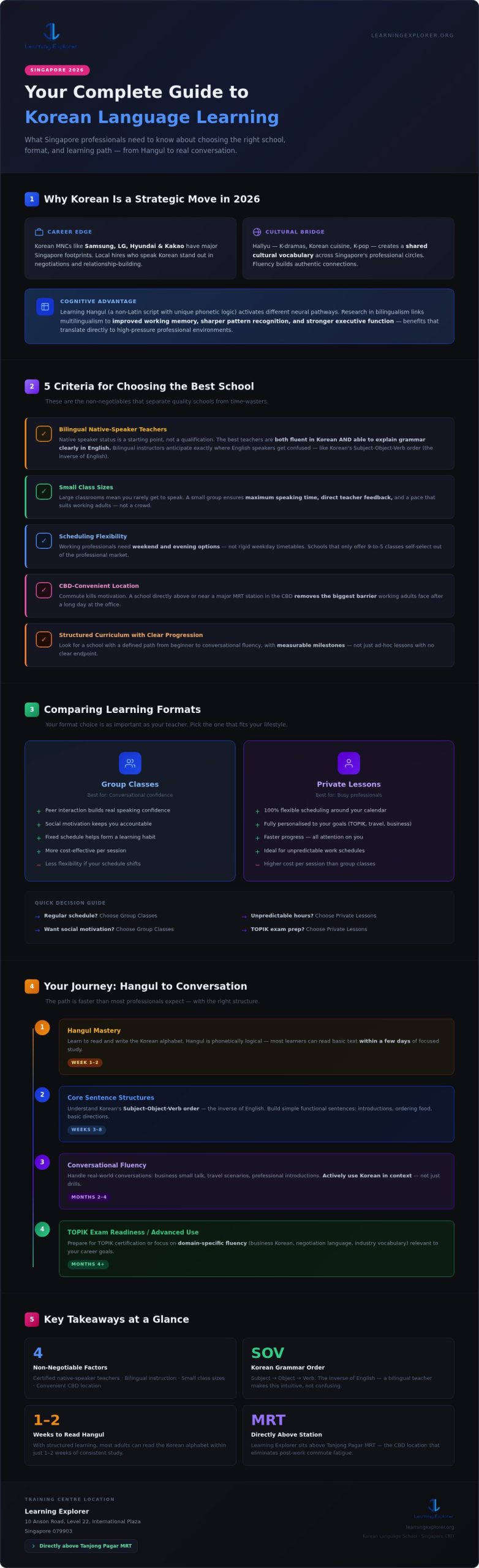
What to Expect: Your Journey from Hangul to Conversation
Most professionals assume learning Korean will take years before they can say anything useful. The reality is more encouraging. With structured teaching and consistent attendance, the journey from complete beginner to functional conversationalist follows a clear, predictable path. Understanding that path before you start removes the anxiety of not knowing where you’re headed.
Mastering the Korean Script (Hangul)
Hangul is widely regarded by linguists as one of the most deliberately logical writing systems ever created. Unlike Chinese characters or Japanese kanji, Hangul was designed in the 15th century with a single purpose: to be learnable. Each character is a phonetic block built from a small set of consonants and vowels, and the shapes themselves carry clues about how your mouth forms the sound. That intentional design means most adult learners can read basic Korean words within their first two sessions.
Certified bilingual teachers accelerate this further by drawing direct parallels between Korean phonetics and sounds English speakers already produce naturally. The visual hurdle of seeing an unfamiliar script dissolves quickly once you realise you’re not memorising symbols; you’re decoding a system. By lesson two, most students are sounding out real words. That early win builds the momentum that carries you into the harder phases.
Developing Conversational Confidence
Once Hangul clicks, the learning journey moves through three overlapping phases:
- Foundation building: Essential verbs, basic sentence structures, and the subject-object-verb pattern that defines Korean grammar. This is where a bilingual teacher earns their value, making the logic of Korean syntax feel intuitive rather than alien.
- Survival Korean: Practical vocabulary for daily interactions, ordering food, asking for directions, managing a Seoul business trip without relying on translation apps. This phase connects classroom learning to real-world utility fast.
- Intermediate expression: Nuanced grammar, honorific speech levels, and the kind of natural phrasing that separates textbook Korean from how people actually speak in Seoul. Listening comprehension becomes critical here. A classroom where you hear different voices, different pacing, and unscripted dialogue trains your ear in ways that scripted audio tracks simply can’t.
Speaking in a new language feels vulnerable. That’s not a personal weakness; it’s a universal experience. The most effective antidote is a low-stakes environment where mistakes are expected and corrected without judgment. Overcoming your fear of speaking in a new language accelerates dramatically when your classroom feels like a practice space rather than a performance stage. Small group sizes make that possible in ways that larger classes simply can’t replicate.
At a quality Korean language school in Singapore, this progression isn’t left to chance. It’s built into the curriculum from day one, giving you visible milestones to measure your progress against rather than a vague sense of gradual improvement. If you’re ready to start that journey, explore the conversational Korean courses at Learning Explorer and find the format that fits your schedule.
Mastering Korean at Learning Explorer: Your CBD Training Partner
Everything covered in this guide, the bilingual teacher advantage, the small class sizes, the structured progression from Hangul to real conversation, comes together at one address. Learning Explorer sits at 10 Anson Road, Level 22, International Plaza, Singapore 079903, directly above Tanjong Pagar MRT. That combination of academic quality and strategic location isn’t accidental. It’s built around how Singapore professionals actually live and work.
The courses themselves are designed for adult learners who don’t have patience for passive classroom experiences. Lessons are interactive, structured around real conversational scenarios, and taught by certified native-speaker instructors who are also bilingual. That means complex grammar gets explained clearly in English, cultural nuances get contextualised for a Singaporean audience, and you leave every session with something you can actually use.
Why Our CBD Location Makes a Difference
Time is the resource Singapore professionals guard most carefully. A training centre that requires a 25-minute commute after a full working day doesn’t stay on your calendar for long. International Plaza changes that equation entirely. Step off the MRT at Tanjong Pagar, take the lift to Level 22, and you’re in class. No transfers, no walking in the heat, no arriving flustered.
That accessibility opens up formats that simply aren’t practical at schools further from the CBD. Lunch-hour intensives become viable when your training centre is a short walk from your office. Evening group sessions don’t feel like a punishment when the commute is measured in minutes rather than MRT stops. For companies with Korean-facing teams nearby, the location also makes corporate training straightforward to integrate into the working week without pulling staff across the island.
Start Your Korean Journey Today
Enrolling in a conversational Korean module at Learning Explorer is a straightforward process. Upcoming intakes are available across group and private formats, so you can choose the structure that fits your schedule and learning style. A one-time registration fee covers your course materials, so there are no hidden costs to factor in after you’ve committed.
Beyond the classroom, you’re joining a community. The learners at this Korean language school in Singapore are working professionals with the same goals: practical fluency, cultural confidence, and a credential they can point to. That shared motivation creates accountability that’s hard to manufacture on your own.
If 2026 is the year you stop putting Korean on the back burner, this is where that decision becomes real. Explore the conversational Korean courses at Learning Explorer and find the intake that works for you.
Your Next Step Toward Korean Fluency Starts Now
Korean is no longer a niche skill for Singapore professionals. It’s a genuine career differentiator, a cultural bridge, and a goal that’s far more achievable than most people assume when they first look at Hangul. The path is clear: find a korean language school in singapore with certified bilingual instructors, small classes, and a location that actually fits your working life.
That’s exactly what Learning Explorer delivers. Native-speaker teachers who can explain grammar in plain English, an interactive learning environment built for busy adults, and a location directly above Tanjong Pagar MRT at International Plaza that removes every excuse to skip a session.
The professionals who’ll look back on 2026 as the year their Korean clicked aren’t waiting for a perfect moment. They’re booking their first class.
Start your journey to Korean fluency at Learning Explorer today and find the intake that fits your schedule. You’re closer to that first real conversation than you think.
Frequently Asked Questions
How long does it take to become conversational in Korean for a beginner?
Most beginners reach basic conversational ability within three to six months of consistent study, assuming regular attendance and practice between sessions. Korean’s logical structure actually works in your favour: once Hangul clicks and core sentence patterns become instinctive, vocabulary acquisition accelerates quickly. The biggest variable isn’t the language itself; it’s consistency. Learners who attend every session and review outside class move significantly faster than those who don’t.
Are the Korean teachers at Learning Explorer native speakers?
Yes. Learning Explorer’s Korean instructors are certified native speakers who are also bilingual, meaning they teach in both Korean and English. That bilingual qualification matters more than native-speaker status alone. It ensures grammar explanations land clearly in English, cultural context gets properly framed for a Singaporean audience, and you’re never left puzzling over an instruction you couldn’t follow. It’s the combination of authenticity and clarity that drives faster progress.
Where is the Korean language school located in Singapore?
Learning Explorer is located at 10 Anson Road, Level 22, International Plaza, Singapore 079903, directly above Tanjong Pagar MRT. For working professionals, that positioning is a genuine advantage. There’s no cross-town commute after a full working day; you step off the train and you’re there. This Korean language school in Singapore sits squarely in the CBD, making lunch-hour sessions and after-work classes equally practical to fit into your week.
Do I need to know Hangul before joining a beginner Korean class?
No prior knowledge is required. Beginner courses start from zero, with Hangul introduced in the earliest sessions as the foundation for everything that follows. Most adult learners can read basic Korean words within their first couple of classes, which builds early momentum. Arriving with no background isn’t a disadvantage; it’s exactly the starting point the beginner curriculum is designed for.
Can I switch between physical and online Korean classes if my schedule changes?
Scheduling flexibility is something worth confirming directly with Learning Explorer, as format availability can vary by intake and course type. Group classes, private lessons, and intensive formats are all offered, and private tuition in particular tends to offer the most scheduling adaptability for professionals with unpredictable calendars. Reach out to the team to discuss which format best matches your current situation before you enrol.
What is the average class size for Korean group lessons in the CBD?
Learning Explorer keeps group classes intentionally small to ensure every student gets genuine speaking time and real-time correction from the instructor. Oversized classes are a common complaint at other schools, where passive listening fills most of the session. Smaller cohorts change that dynamic entirely: you speak more, get corrected more, and build conversational confidence faster. For specific current class size limits, contact Learning Explorer directly to confirm availability for upcoming intakes.