More Korean study materials aren’t always the answer. Feeling stuck in my Korean language learning journey can mean I need a clearer plan, not another app or textbook. Choose one main learning path, use other resources to support it, and make regular time for reading, writing, speaking, and listening.
It’s understandable to feel frustrated when familiar lessons stop feeling rewarding or new words don’t seem to stick. Progress can be uneven, and mistakes are part of learning to use Korean, not proof that you’re failing. A simple routine combining focused study, varied practice, and patience can help you regain momentum.
In this guide, you’ll find four practical ways to move forward: combine resources without getting overwhelmed, practise every core language skill, treat mistakes as useful feedback, and build a beginner path from Hangul and pronunciation to sentence building. Use these steps to make your next session clearer and more manageable, then adjust your routine as your Korean develops.
Key Takeaways
- Choose one main Korean study path, then use extra resources to reinforce it instead of scattering your attention.
- Build a steady routine that gives reading, writing, speaking, and listening a place in your practice.
- Use mistakes as feedback: notice what needs work, then try again with a new sentence or conversation.
- Develop your beginner foundation in a clear sequence, from Hangul and pronunciation to sentence building and comprehension.
- Assess what you can understand and produce without prompts to identify a useful next learning goal.
1. Combining learning resources with a main study plan
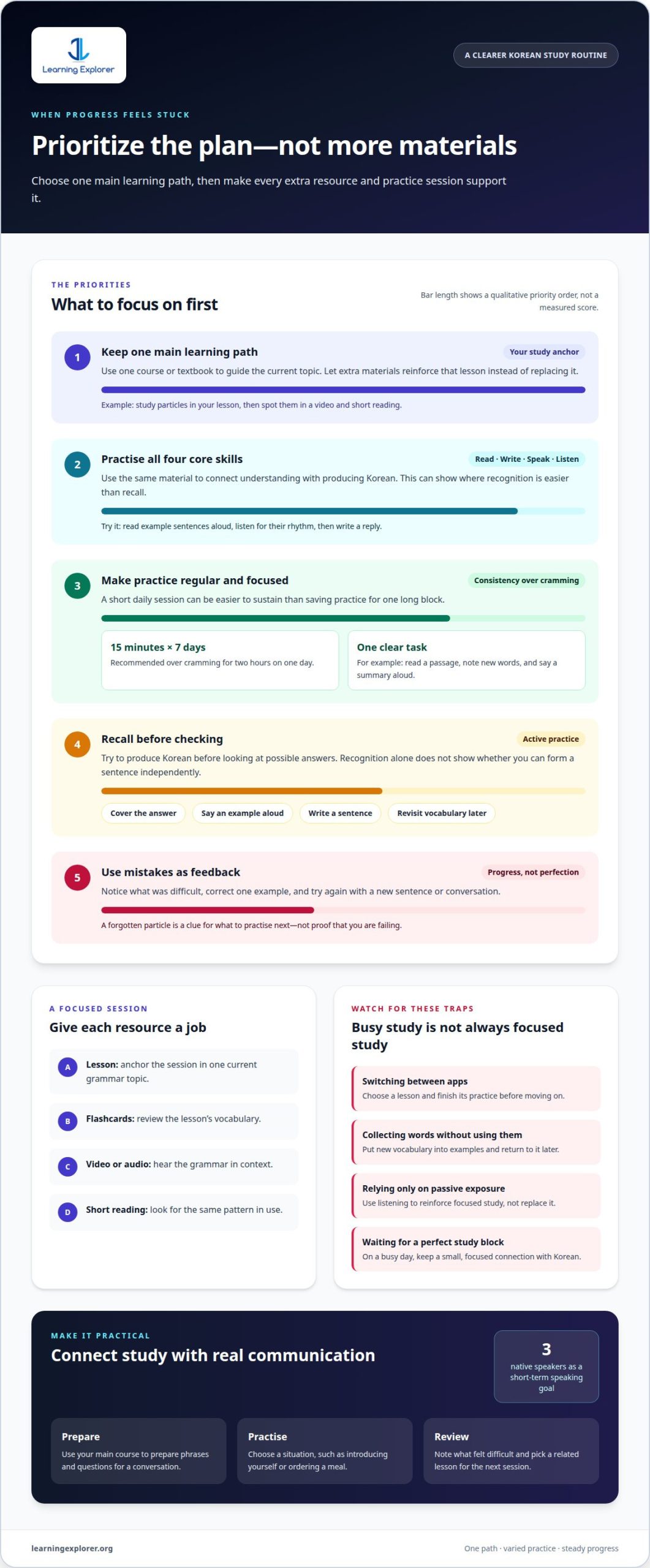
If you’re feeling stuck in your Korean learning journey, more resources may not solve the problem. Motivation can dip when lessons feel repetitive, vocabulary is slow to retain, or every session demands a new decision. Choose one main learning path first. Then use extra materials to support its current topic rather than switching methods each week.
For example, if your main course introduces Korean particles, use that lesson as your study anchor. Review its vocabulary with flashcards, watch a video to hear the grammar in context, and read a short passage to spot the same particles. Each resource then has a clear purpose. Varied practice can reinforce learning and keep study engaging, while a central plan prevents resource-hopping from replacing focused work.
Which Korean learning resources and apps are best for intermediate learners? Choose resources that support your current goal: flashcards for vocabulary review, videos or audio for listening, and graded reading for context. Keep one structured course or textbook as your main path, and add only tools that help you practise its material.
Set a regular study time that fits your Singapore routine, such as before work or after dinner. If feasible, set aside an hour every day for Korean. A 30-minute grammar lesson can anchor that session; use other study time for vocabulary review, listening, or reading. On a busy day, preserve a small, focused contact with Korean rather than waiting for a perfect uninterrupted block.
What common study mistakes slow down Korean language progress? Switching between apps without finishing lessons, collecting vocabulary without using it, and relying only on passive exposure can leave gaps. Cramming for two hours on one day instead of studying 15 minutes per day across 7 days also makes consistency harder. Pick one lesson, practise its material, and return to it regularly.
Vary the activity while keeping the learning goal steady. After a grammar lesson, listen for that pattern in Korean audio, then write a few original examples. Passive exposure, such as hearing Korean during a familiar routine, can reinforce what you’ve studied and help new vocabulary become more familiar over time. Treat it as reinforcement, not a replacement for focused practice.
Give your routine a measurable short-term outcome. For example, set a goal to speak with 3 native speakers, then use your main course to prepare phrases and questions. Review what felt difficult after each conversation and choose a related lesson next. This connects study materials to real communication, making the next session purposeful without adding another unrelated resource.
2. Practising reading, writing, speaking, and listening
Build each practice session around understanding and producing Korean, not just recognising answers. Read five Korean example sentences aloud, then listen for their rhythm and pronunciation. Write a short reply using one of the sentence patterns. This connects reading, speaking, listening, and writing through the same material, and reveals where recognition comes more easily than recall.
For writing practice, choose a familiar subject, such as your lunch or commute in Singapore. Write three Korean sentences using a grammar pattern without looking at examples. Compare them with your lesson notes and revise one sentence. Change a time, place, or person to test whether you can use the pattern flexibly. Keep both versions to see what improved.
Short, focused sessions can make regular practice easier to sustain. Studying 15 minutes per day across 7 days is recommended over cramming for two hours on one day. A 10-15 minute daily session can still include one focused task. For example, read a short passage, note unfamiliar vocabulary, and say a summary aloud. Give each session a clear finish point.
Use spaced repetition to revisit vocabulary over time rather than reviewing every word in one sitting. Put new words into example sentences, then return to them later and recall their meanings before checking. If you forget a word, review it sooner; if you remember it easily, leave it longer before revisiting. This keeps practice focused on what still needs attention.
How can you tell whether practice is active? Try producing Korean before looking at possible answers. Choosing the correct answer from four options can test recognition, but it doesn’t show whether you can form a sentence independently. Cover the answer, speak aloud, write an example, or combine new grammar with a pattern you already know. Review vocabulary in context, not as isolated translations.
Finding conversation partners or tutors in Singapore can start with a clear practice goal. Use a Korean class or language exchange to practise specific situations, such as introducing yourself or ordering a meal. Set a short-term goal of speaking with 3 native speakers, and prepare questions beforehand. Lesson costs depend on the case and are given after a quote request.
Keep the practice balanced: read a short text, listen for a phrase, write your own example, and say it aloud. A Conversational Korean Course can provide a structured setting for speaking practice when independent study isn’t giving you enough conversation. Whichever format you use, finish by noting one expression you could use again. That small record gives your next session a practical starting point.
3. Accepting mistakes and aiming for progress rather than perfection
Trying to make every Korean sentence flawless can turn practice into a test. Instead, treat each mistake as information about what to work on next. If you forget a particle while describing your lunch, note the sentence and identify what’s missing. Then rewrite it with the same idea. Focus on learning a useful pattern, not judging your ability by one imperfect attempt.
Sort errors by type before correcting them. A forgotten vocabulary word needs a different response from a sentence structure you haven’t learned yet. For example, if you can’t express a plan, identify whether you lacked a verb or weren’t sure how to arrange the sentence. Review the relevant lesson, then express the plan again. A specific diagnosis gives your next study session a clear purpose.
During a conversation, keep going when a word doesn’t come to mind. Replace it with a simpler expression, describe the idea another way, or ask your partner to repeat a phrase. If you lose the thread while discussing a meal, say you’re talking about food and continue with words you know. These strategies let you practise communicating without waiting for perfect recall.
Use a correction log to turn repeated mistakes into manageable practice. After speaking or writing, record one difficult sentence, its correction, and the reason. For instance, note that a sentence about yesterday needs a past-tense form. At your next review, cover the correction and rebuild the sentence from memory. Keep each entry short enough to revisit in a focused session.
Set a process goal alongside a learning goal. Learning 20 new verbs can give your study a clear target, but using those verbs in original sentences shows whether they’re becoming usable. Choose a few verbs from your current material and write about familiar routines, such as commuting or preparing dinner. If a sentence feels difficult, simplify it first, then add detail after the basic meaning is clear.
Measure progress against your earlier work, not an imagined standard of perfection. Revisit a short paragraph you wrote and notice whether you can now express an idea more clearly, correct an old error, or add a detail. Keep the original beside your revision. Comparing the two makes improvement visible and shows which grammar or vocabulary to focus on next.
4. Building a structured beginner Korean learning path
A beginner path works best when each new skill builds on the last. Start with Hangul and pronunciation so written forms connect with spoken sounds. Then study basic sentence structure before adding particles. This order helps you understand how Korean words fit together and gives new grammar a foundation, rather than leaving each lesson isolated.
After sentence structure, learn common verbs and adjectives, then add tense expressions. Use each step to build complete, simple sentences. Choose a familiar subject, add a verb, and practise changing its tense. Once the pattern feels usable, bring in particles to show relationships between sentence parts. Revisit earlier vocabulary so new grammar works with words you already know.
Keep the sequence manageable by focusing on one language point for one to two weeks before moving on. While focusing on particles, look for them in beginner reading passages and listen for them in simple audio. Practise one pattern at a time, then combine it with a familiar verb. If a sentence still feels difficult, simplify it while keeping the same grammar goal.
Sentence building turns separate lessons into usable Korean. Take a simple pattern from your current material and change one part, such as the subject or verb. Then combine it with a tense expression you learned earlier. This small variation tests whether you can use the structure beyond its original example. Read and listen to beginner material to find the pattern in different contexts.
Set both weekly and monthly mini goals. A weekly goal could be completing one lesson and writing down its key grammar point. A monthly goal might focus on finishing a stage of your learning path, such as practising Hangul and pronunciation or strengthening sentence building. Make each goal specific enough to guide your next session, then review what you can understand and produce.
Your plan should also show how to revisit earlier material. After a lesson on common verbs, use those verbs again while studying tense expressions. After learning particles, practise them in sentences with familiar vocabulary. This keeps your learning path from becoming a stack of disconnected topics. A short note after each lesson can identify what to revisit and what to study next.
For a clear beginner sequence, map your learning in stages: Hangul and pronunciation; sentence structure and particles; common verbs and adjectives; tense expressions and sentence building; then beginner reading and listening. Keep your current stage visible, and mark a lesson complete only after using its material in an example. This gives each session a destination and makes progress easier to recognise.
5. How can I assess my current Korean proficiency level?
Assess your Korean through tasks you can perform, not confidence alone. Test reading, listening, writing, and speaking separately. For reading, try a short passage about an everyday topic. Note whether you understand the main point, recognise key words, and follow how the sentences connect. For listening, use a short audio clip and summarise its meaning without reading a transcript first.
Check what you can produce independently. Write a short message about a familiar subject, such as your weekend plans, then explain the same idea aloud. Notice whether you can form sentences without copying a model. If you can respond only after seeing choices or notes, record that. Recognition and spontaneous use are different skills, so assess both.
Use a simple evidence log instead of guessing your level. Record the task, what you understood, where you paused, and what support you needed. For example, note that you followed a spoken introduction but missed details about time and place. Another entry might show that you wrote a clear message but hesitated when speaking. These observations reveal useful patterns.
Compare your performance across situations. A familiar dialogue about ordering food may feel easier than an unfamiliar conversation about work. That difference doesn’t mean your overall ability has suddenly changed. It shows which vocabulary and contexts you’ve practised. Try a familiar and a less familiar task, then identify what carries over, such as recognising a verb ending or understanding the general topic.
Separate knowledge gaps from performance pressure. If you understand a grammar pattern in writing but can’t use it aloud, practise recalling it in speech. If you can’t understand it in a new passage, revisit its meaning and examples. Write down one specific next step, such as reviewing a tense expression or listening for a familiar phrase. A targeted goal is more useful than labelling yourself “bad at Korean.”
Repeat a similar task after focused study, keeping the conditions alike. Compare your new attempt with the earlier entry: did you understand more, need fewer prompts, or express the idea more clearly? This gives you a practical view of progress without relying on one test or a vague feeling of being stuck. Choose the next task based on the gap you observed.
If you want structured speaking feedback, explore guided Korean conversation practice and use it to identify which real-life tasks need more practice.
Learning Explorer: Conversational Korean Course
Learning Explorer’s Conversational Korean Course is a natural next step when independent study isn’t giving you enough speaking practice. Use it to bring your vocabulary and sentence patterns into Korean conversation, especially when you can recognise material in lessons but hesitate to use it aloud. A structured course can help you make speaking an active part of your learning, alongside the reading, listening, and writing you already practise. It’s a practical option if you want guided learning rather than building every session from separate resources. Keep your current learning goals in view, so practice connects with the situations you want to handle. To discuss learning Korean with Learning Explorer, contact Learning Explorer.
Make your next Korean step intentional
If you’re feeling stuck in your Korean language learning journey, choose one action that brings the language closer to daily life. Prepare a short introduction, describe a familiar routine, or practise answering a question aloud. Keep the task small enough to begin today, then use any difficulties to shape your next learning goal.
When you want guided support with speaking, Learning Explorer’s Conversational Korean Course offers a structured next step. Learning Explorer also offers Conversational English, Business English, and Conversational Mandarin courses. Focus on the Korean situations you want to handle and bring those goals into your learning conversations. A steady next step can help turn study into more confident communication over time.
Contact Learning Explorer to discuss your Korean learning goals. Keep moving at a pace you can sustain, and let each new conversation open the way to the next.
Frequently Asked Questions
Why do Korean learners reach a plateau, and how can they overcome it?
Korean learners can feel stalled when lessons don’t match their weakest skill or everyday goals. Identify a difficult task, such as following a café conversation or explaining a workday, then practise language for that situation. Keep a record of what you can do without notes. This helps distinguish a genuine knowledge gap from material you understand but haven’t used in that context.
What study routine helps improve Korean speaking, listening, reading, and writing?
Use one topic to connect all four skills. Choose a short Korean article about food, listen to a related audio passage, write a brief response, then explain your view aloud. A shared topic makes vocabulary easier to reuse across activities. Note which transition felt hardest, such as turning a written phrase into spontaneous speech, and make that your next practice focus.
How can I build a realistic Korean study plan for a busy schedule?
Anchor Korean practice to a regular part of your routine in Singapore, such as a commute or lunch break. Decide in advance what fits that window: review a short dialogue, listen to a familiar recording, or draft a message. Save a longer task for a less crowded day. If work disrupts your plan, resume with the next scheduled activity instead of trying to make up every missed session.
How can I stay motivated and set measurable goals for learning Korean?
Choose goals that describe what you can demonstrate, not simply how long you study. For example, aim to explain a familiar route in Korean or understand the main point of a short announcement. Save a recording or written sample, then compare it with a later attempt. Visible evidence of what you can express gives motivation a practical anchor, even when improvement feels gradual.
How can I improve Korean listening comprehension and speaking confidence?
Listen to a short Korean exchange more than once, with a different purpose each time. First identify the situation, then listen for key details, and finally repeat a useful phrase aloud. Use that phrase in a new sentence about your own plans. Practising familiar topics, such as ordering lunch or arranging to meet, can help you focus on meaning instead of worrying about every word.