You don’t need to sound like a textbook to reconnect with Mandarin. Mandarin for Singaporeans who have lost touch can start with familiar local expressions, then build confidence with pronunciation, tones and everyday conversation.
It’s understandable if words that once felt natural now take longer to find, especially when Mandarin has had little place in your daily life. Singaporean Mandarin reflects contact with languages such as Hokkien, Cantonese and Malay, so reconnecting isn’t simply about memorising formal vocabulary. This article explores how local influences shape the words and speech you may hear, why tones can feel challenging after a break, and how adult Mandarin lessons can help you practise in a supportive, structured setting. You’ll also learn what to look for in lessons designed for returning learners, so you can choose an approach that connects classroom learning with real conversations. Whether your goal is to speak more comfortably with family, friends or colleagues, a practical path back to Mandarin can begin with the language as it’s used around you.
Key Takeaways
- Recognise how Hokkien, Cantonese and Malay influences contribute to the Mandarin you hear in Singapore.
- Notice how local vocabulary can differ from formal Mandarin, and learn to use expressions in context.
- Explore how practical adult lessons can reconnect classroom learning with everyday conversations.
- Understand why tones and pronunciation affect clarity, and what focused speaking practice can strengthen.
- See how a language school can assess your speaking, listening and existing knowledge to recommend a suitable course.
Hokkien, Cantonese and Malay influences
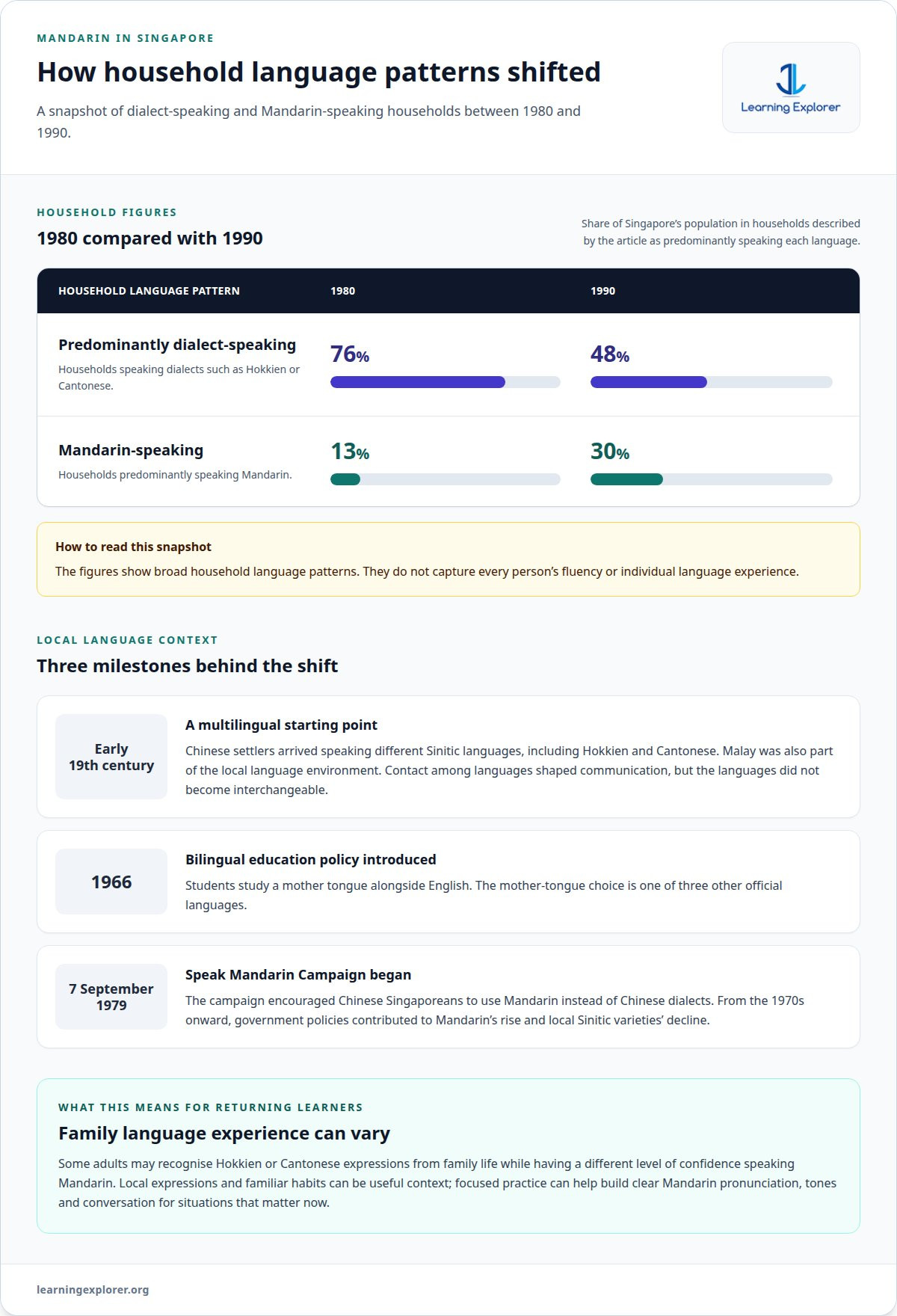
Singaporean Mandarin developed in a multilingual setting, not in isolation. Chinese settlers first arrived in Singapore in the early 19th century, speaking different Sinitic languages, including Hokkien and Cantonese. Malay was also part of the local language environment. These languages did not become interchangeable, but their contact shaped how communities communicated. Recognising that history helps explain why Mandarin heard in Singapore can sound different from Mandarin encountered elsewhere.
National language policies also influenced which languages people used daily. Singapore introduced its bilingual education policy in 1966. Under that policy, students study a mother tongue alongside English. The mother-tongue choice is one of three other official languages. The Speak Mandarin Campaign began on 7 September 1979, encouraging Chinese Singaporeans to use Mandarin instead of Chinese dialects. From the 1970s onward, government policies contributed to Mandarin’s rise and local Sinitic varieties’ decline.
The household figures show that changing language habits happened quickly. Predominantly dialect-speaking households made up 76 percent of Singapore’s population in 1980, falling to 48 percent in 1990. Over the same period, Mandarin-speaking households rose from 13 percent to 30 percent. Household figures can show broad language patterns, but they do not capture every person’s fluency. They help explain why adults may recognise Hokkien or Cantonese expressions from family life while having different levels of confidence speaking Mandarin.
For adults seeking mandarin for singaporeans who have lost touch with the language, Singapore’s multilingual context offers a useful starting point. A family may use Hokkien at home and Mandarin in another setting, while everyday conversation may include Malay-influenced expressions. These patterns can make formal Mandarin phrases feel unfamiliar, even when their meaning is clear. Group expressions by context, such as family conversations, work discussions or service interactions, then practise the Mandarin wording that suits each setting.
Pronunciation deserves the same attention. Hokkien and Cantonese have their own sound systems, so familiar habits can carry over into Mandarin and affect tones or syllables. That does not make local speech wrong; it means learners benefit from practising Mandarin distinctions deliberately. A teacher can model a phrase, isolate its tones, then place it in a short conversation. This connects sound practice with meaning instead of treating every word as a standalone drill.
A learning path in mandarin for singaporeans who have lost touch can use local history as context, not as a shortcut or rigid template. The 1979 campaign and the household changes between 1980 and 1990 help explain why generations may have different language experiences. A practical goal is to recognise local speech patterns, then build clear Mandarin for situations that matter now. That balance respects Singapore’s Hokkien, Cantonese and Malay influences while supporting confident communication.
Local Singaporean Mandarin vocabulary
Local vocabulary becomes easier to understand when you connect each expression with its setting. In Singapore, a conversation at home may use familiar family terms, while a workplace discussion calls for more formal wording. The same idea can be expressed differently depending on who is speaking and what they need. For returning learners, the useful question is not just, “What does this word mean?” Ask whether it suits the relationship, place and purpose. This helps you understand local Mandarin without assuming every informal expression fits every conversation.
Build vocabulary around situations you actually encounter. A conversation with a relative might involve arranging a meal, while a work exchange might involve clarifying a task. Practise key phrases for each situation in short exchanges, not isolated word lists. A teacher can model a phrase, explain its level of formality, then invite you to use it in a similar dialogue. This gives each new word a clear purpose and helps you retrieve it when speaking Mandarin.
Keep spoken vocabulary distinct from written recognition. Singaporean Mandarin uses simplified Chinese characters, so reading practice may involve recognising characters alongside their spoken forms. A learner who remembers how a phrase sounds may still need time to identify it in writing. Conversely, recognising a character does not always make it easy to recall the phrase in conversation. Linking a written example to a spoken exchange helps develop both skills without treating them as identical.
- At home: Practise a greeting, a family update and an invitation to eat.
- At work: Rehearse asking for clarification and confirming the next task.
- In public: Practise asking for an item or explaining a simple need.
These examples are practice contexts, not a fixed list of Singaporean expressions. Chinese-speaking households differ, and bilingual learners may have grown up hearing different words from relatives, classmates or colleagues. In class, compare the expression you remember with a clear Mandarin alternative. Then practise both the meaning and the situation where each fits. This preserves useful familiarity while expanding the vocabulary you need for current conversations.
Strong vocabulary practice also includes changing a phrase to fit the listener. Take a request: practise a direct version for a close relative, then a more courteous version for someone you do not know well. The words may overlap, but tone and context affect how the request sounds. Focused conversational Mandarin lessons can help you work through these everyday exchanges and rebuild confidence using vocabulary that fits your needs.
Practical Mandarin lessons for adults in Singapore
Adult Mandarin learning works best when practice matches the situations you want to handle. Compare learning formats, course focus and ways to track progress before choosing how to continue.
Choosing a Learning Format
A learning format shapes how you practise Mandarin. Professional classes provide guided instruction and opportunities to speak with others; a private tutor can focus on individual needs; self-study apps support independent review. Someone preparing for family conversations may value regular dialogue practice, while an app can help review vocabulary between sessions. Compare feedback, interaction and learning structure, not just convenience.
When comparing course costs, consider what the fee covers, such as lesson format, instructor feedback, learning materials and speaking practice. Match these factors to your goals and preferred schedule rather than comparing a class, tutor and app as though they offer identical support.
Rebuilding Vocabulary and Confidence
Structured lessons reconnect familiar words with active speaking through guided practice. Recognising a phrase is different from retrieving it in conversation. A lesson might move from revising a greeting to role-playing a short exchange with a neighbour. A teacher can identify words that need review, model a natural response and give you another chance to use it.
Regular conversation practice also gives you a clear setting for trying new language. Rehearse ordering a meal, describing your day or asking someone to repeat a point. These exchanges let you practise listening and responding together, instead of studying vocabulary without using it. Each useful exchange can become a practical measure of growing confidence.
Finding Courses for Local Needs
A course focused on local needs connects Mandarin practice to familiar parts of life in Singapore. This matters when you want to use the language with relatives, colleagues or people you meet in everyday situations. For family conversations, practise sharing news and asking follow-up questions. For workplace communication, rehearse introducing a point, clarifying instructions and responding courteously.
Consider how lessons connect language learning with your intended context. A useful class can build a dialogue around a workplace meeting or family meal, then help you adapt it to your situation. Local context gives practice a clear purpose, while attention to the listener and level of formality helps make each exchange appropriate.
Regaining Conversational Mandarin
There is no single timeline for regaining conversational Mandarin after years without practice. Progress depends on what you remember, how often you speak, and which conversations you want to manage. Someone who understands familiar speech but hesitates to answer may need different practice from a learner rebuilding basic vocabulary. A teacher can use speaking tasks to identify the next useful learning focus.
Track progress through real communication goals, not promises of fluency by a set date. Practise introducing yourself, keeping a short family conversation going or asking for clarification at work. As these tasks become more comfortable, lessons can extend the conversation or introduce less familiar topics. Clear goals help you see what to keep practising.
Pronunciation and tones
Clear Mandarin speech depends on both the sounds in each syllable and its pitch pattern. Practising them together helps listeners distinguish words in real conversations.
Mandarin Pronunciation
Pronunciation is how a speaker forms Mandarin syllables, including their initial consonants and vowel sounds. Small sound differences can make a familiar word harder to recognise. A teacher can model a short phrase, slow down one difficult syllable, then say the full phrase at a natural speed. This helps adults connect careful sound production with everyday speaking.
Returning learners may carry familiar sound habits from English or another lingua franca into Mandarin. That is understandable, but Mandarin syllables need focused listening and repetition. A useful lesson sequence is to hear a model, repeat the sound, compare it with the model, then practise it in a short sentence. The sentence provides context instead of leaving the sound as an isolated exercise.
Prioritise clarity over speed. In a simple introduction, practise each syllable distinctly before linking the words smoothly. Then repeat the same introduction at a comfortable conversational pace. A teacher can notice where a consonant or vowel becomes less clear and provide a more accurate model. This targeted feedback supports clearer communication, especially when speakers do not share the same first language.
Mandarin Tones
Tones are pitch patterns attached to spoken syllables, and they help distinguish Mandarin words. A learner who remembers vocabulary may still hesitate if the pitch feels unfamiliar. Practise a syllable such as “ma” with a level pitch, a rising pitch, a dipping movement and a falling pitch. This trains the ear and voice to notice pitch changes before moving on to full sentences.
Next, connect pitch practice to short phrases. Listen to a teacher say a phrase, repeat it, then use it in a brief exchange. This makes tone practice relevant to conversation and helps learners hear how pitch moves across connected speech, rather than focusing only on isolated syllables.
For adults rebuilding Mandarin, a practical routine combines listening, repetition and feedback. Begin with a short phrase, identify the syllable that feels difficult, and repeat the phrase after hearing a clear model. Then practise answering a simple prompt with that phrase. Short, focused repetitions build awareness while keeping attention on meaning.
English speech patterns can influence Mandarin pronunciation, just as other language backgrounds can. Treat this as a useful starting point: identify the sound or pitch pattern that needs attention, practise it clearly, then return to a realistic exchange. With consistent guided practice, learners can develop speech that feels more natural and is easier for others to understand.
How can a language school assess an adult’s current Mandarin level before recommending a course in Singapore?
A useful placement assessment looks beyond remembered vocabulary. It considers how an adult listens, speaks, reads and responds in situations such as family conversations or workplace exchanges.
A school can begin by asking about previous learning and current goals. One learner may understand Mandarin at home but struggle to answer quickly; another may read familiar characters yet avoid speaking. These differences matter because a course should address the skills the learner wants to use, not assume that all past knowledge has disappeared.
A short conversation can show how the learner handles familiar topics. An assessor might invite them to introduce themselves, describe a typical day or explain what they need in a simple scenario. The focus is communication: whether the learner understands the prompt, finds relevant words and makes their meaning clear. Hesitation is useful information, not a reason to label the learner a beginner automatically.
Listening tasks add another perspective. An assessor can use a brief spoken exchange, then ask the learner to respond or summarise its main point. This may reveal whether speech is easier to understand in familiar contexts than in less predictable ones. Comparing listening and speaking helps distinguish a vocabulary gap from difficulty responding in real time.
Reading and writing can be assessed separately when they matter to the learner’s goals. Someone who wants Mandarin for work may need to understand written messages, while another learner may prioritise spoken family conversations. Reading a short passage or composing a few sentences can show what feels comfortable. These tasks should complement conversation, not stand in for it.
- Speaking: Can the learner answer a familiar question or keep an exchange moving?
- Listening: Can they follow the main idea and respond appropriately?
- Reading: Can they recognise useful written vocabulary in context?
- Writing: Can they express a simple message if this skill supports their goal?
A recommendation should connect observed strengths with the learner’s intended use. Someone comfortable with listening but hesitant to speak may benefit from a stronger conversational focus. A learner preparing for workplace discussions may need practice with professional exchanges. The assessor can explain which skill each suggested course develops, so the decision has a clear purpose.
Share the situations you want to manage, such as speaking with relatives or contributing in meetings. That context helps the assessment lead to a more relevant recommendation. Explore adult Mandarin learning options when you’re ready to choose a course aligned with your goals.
Learning Explorer
Learning Explorer helps adults reconnect with Mandarin through guided learning matched to their communication goals. If you want to speak more comfortably with family or in everyday situations, the Conversational Mandarin Course offers a relevant next step. For professional communication, the Business Mandarin Course focuses on workplace contexts. Both courses can help you turn existing knowledge into more confident, practical language use.
Consider the conversations you want to manage, such as chatting with relatives or contributing at work. That goal can guide your course choice and give your learning a clear focus. Contact Learning Explorer to discuss reconnecting with Mandarin.
Make Mandarin Part of Your Next Conversation
Reconnecting with Mandarin doesn’t require you to erase the way you speak today. Build from the words you recognise and focus on the conversations you want to have next. A greeting to a relative, a relaxed chat with a friend or a contribution at work can each become a meaningful learning goal.
Mandarin for Singaporeans who have lost touch with the language can feel more manageable when lessons meet you at your current level and give you room to practise. Start with a clear priority, then let your learning grow as your confidence and communication needs develop. Progress can begin with a single phrase spoken aloud.
If you’re ready to take that step, contact Learning Explorer about Mandarin and discuss the learning approach that fits your goals. Your next conversation is a good place to begin.
Frequently Asked Questions
What Mandarin courses are available in Singapore for adults who have lost touch with the language?
Adults in Singapore can choose a course centred on conversation or professional communication. Learning Explorer offers a Conversational Mandarin Course and a Business Mandarin Course. The first suits learners aiming to use Mandarin in everyday exchanges, while the second is relevant to workplace communication. When deciding which course fits, consider the situations that matter most, such as speaking with relatives or contributing to discussions at work.
Are there beginner or Mandarin-for-returning-learners classes for Singaporeans?
Singaporeans returning to Mandarin can start by describing what they remember and where they want to use the language. You don’t need to decide for yourself whether you are a beginner. Explain, for example, whether you can follow a family conversation but struggle to reply. That distinction helps shape a suitable learning focus. A learner rebuilding basic phrases has different priorities from someone who understands Mandarin but wants more speaking practice.
How can adults relearn spoken Mandarin through professional conversation practice in Singapore?
Choose conversation practice built around exchanges you genuinely want to manage. Practise responding when a relative asks about your week, or explaining a simple request during a social visit. A guided class gives you opportunities to listen, answer and try again with feedback. The Conversational Mandarin Course is relevant for adults whose priority is using Mandarin in spoken, everyday interactions.
Which Singapore community centres, language schools, or online platforms offer Mandarin classes for adults?
For adult Mandarin lessons in Singapore, Learning Explorer offers physical and online classes. Its Conversational Mandarin Course focuses on spoken communication, while its Business Mandarin Course suits learners with professional goals. If you prefer learning in person, choose a physical class; if online study fits your routine better, that format is available too. Decide based on where you plan to use Mandarin and which setting helps you participate consistently.