What if a Japanese plateau doesn’t mean you’ve stopped learning? It can emerge after a few years of study, and there’s no fixed duration. Some learners notice progress again within a few months of changing their approach. Breaking the intermediate plateau in Japanese starts with recognising that progress can become harder to see as your skills grow.
If familiar lessons no longer challenge you, or you understand more than you can comfortably say, it’s understandable to feel stuck. That gap doesn’t mean your effort has been wasted. It may be a sign to adjust how you practise rather than simply do more of the same.
Here, you’ll explore why progress slows, how to recognise a plateau, and which habits can help you move forward. From choosing Japanese input you can follow to setting practical goals and practising active listening and speaking, you’ll find ways to make your study purposeful again.
Key Takeaways
- A Japanese-learning plateau can last for different lengths of time; changing your study approach may help you notice progress again.
- Choose Japanese input you can mostly follow, then vary what you read and listen to so familiar language appears in new contexts.
- Turn a broad aim like “become fluent” into a specific goal you can practise and track.
- Progress may feel slower when you can understand Japanese but struggle to use it in conversation or writing.
- Combine focused listening with regular speaking or writing practice to make the language you already know more usable.
1. Comprehensible input for intermediate learners
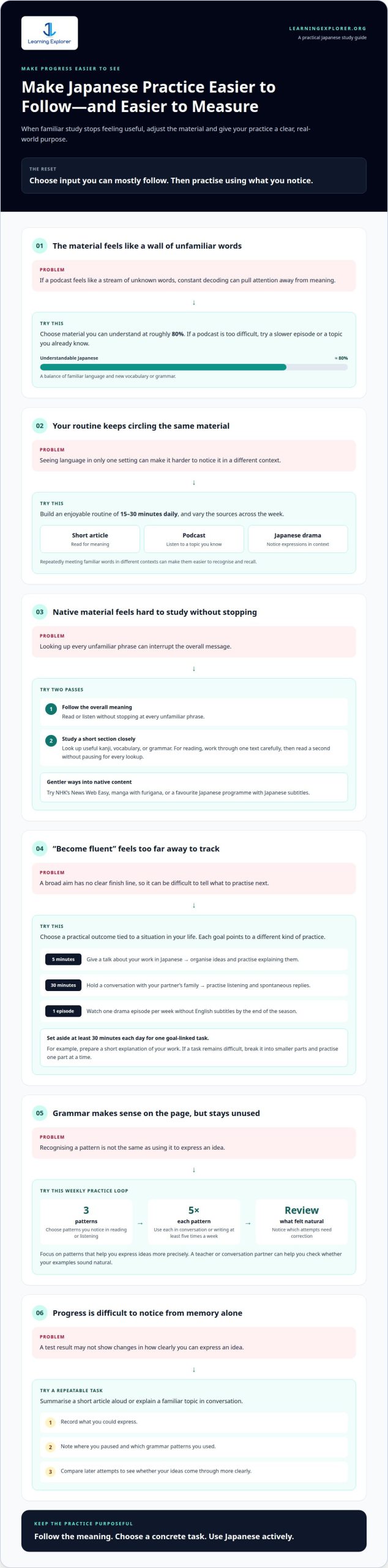
Choose Japanese material you can understand at roughly 80%. That leaves enough familiar language to follow the message while noticing new vocabulary and grammar. If a podcast feels like a stream of unknown words, switch to a slower episode or a topic you already know. Material that is too difficult can turn learning into constant decoding, with little attention left for meaning.
Build a manageable routine around enjoyable content. Spend 15 to 30 minutes daily reading or listening, and vary the sources: try a short article, a podcast, and a Japanese drama across the week. Repeatedly meeting familiar words in different contexts can make them easier to recognise and recall in conversation. The aim is steady contact with natural Japanese, not an endless queue of study materials.
Use native materials in two passes. First, read or listen for the overall meaning without stopping at every unfamiliar phrase. Then choose a short section and study it closely, looking up useful kanji, vocabulary, or grammar. For reading practice, work through one text carefully and read a second without pausing for every lookup. This combines close analysis with practice following meaning in context.
For a gentler bridge to native news, try NHK’s News Web Easy. Manga with furigana can also help you connect kanji with pronunciation while following a story. Rewatch a favourite Japanese programme with Japanese subtitles to match spoken words with their written forms. Familiar characters and plot details make it easier to notice expressions you missed the first time.
What grammar should I study after intermediate Japanese? Choose three patterns each week that appear in your reading or listening, then use each in conversation or writing at least five times a week. Focus on patterns that help you express ideas more precisely, rather than collecting rules without using them. A teacher or conversation partner can help you notice whether your examples sound natural.
Go beyond literal translation by asking what a phrase does in context. For example, an expression that literally means “a little” can also soften a response or signal hesitation. Notice who is speaking, their relationship, and the surrounding exchange. A teacher can discuss these choices with you and help you practise an appropriate reply.
Learn vocabulary in complete sentences. When you find a useful word in a news story, save the sentence around it instead of memorising an isolated English equivalent. For sentence mining, choose an example with one new word or grammar point, then review the whole sentence daily. This keeps meaning connected to context and gives you language ready for writing or conversation.
Adult learners can make this practice more social by bringing a short article or scene to a regular conversation with a tutor or partner. Ask them to explain one unfamiliar expression, then try using it in your own example. This focused exchange adds coaching, feedback, and community to your progress through the plateau.
2. Setting measurable Japanese-learning goals
A daily target gives your Japanese practice a clear purpose. Set aside at least 30 minutes each day for one task linked to a real situation. For example, spend part of the session preparing a short explanation of your work. A specific outcome helps you choose suitable materials, practise deliberately, and notice where you need more support. It also makes a busy schedule easier to plan around.
Choose goals that show what you can do, not just what you have studied. You might aim to give a five-minute talk about your work in Japanese, hold a 30-minute conversation with your partner’s family, or watch one drama episode per week without English subtitles by the end of the season. Each goal calls for different practice. A talk needs organised ideas, while a family conversation requires listening and spontaneous replies.
Define fluency in terms that matter in your life. “Become fluent” can feel distant because it has no clear finish line. Replace it with a practical milestone, such as explaining a familiar process without switching languages or writing a clear message to a colleague. If you’re returning to Japanese after beginner lessons or a textbook-heavy stretch, start with situations you already encounter. That connection can help sustain motivation.
How can I measure progress beyond JLPT N3 or N2? Track performance on a repeatable task, such as summarising a short article aloud or explaining a familiar topic in conversation. Keep a brief record of what you could express, where you paused, and which grammar patterns you used. Compare later attempts to see whether your ideas come through more clearly, even when a test result hasn’t changed.
Turn grammar study into active practice. Choose three patterns per week and use each in conversation or writing at least five times. For instance, select a pattern for explaining reasons, then use it in a spoken update and several written examples. Note which attempts felt natural and which needed correction. This gives lessons a clear purpose and keeps grammar from remaining a recognition exercise.
Make your study time serve one goal at a time. If your target is a work presentation, use a textbook or reading passage to gather useful vocabulary, then practise saying your explanation aloud. If your goal is following a drama, focus on listening and summarising a scene. A Conversational Japanese Course can provide structured speaking practice when you want guided feedback as part of your learning plan.
Review your goals regularly and adjust the task, not just the hours. If a five-minute talk remains difficult, break it into an opening, two supporting points, and a closing. Practise one part, then connect the sections. These small milestones make progress visible and help you work through the plateau with purposeful practice.
3. Why progress slows at the intermediate level
The intermediate level often follows a few years of Japanese study. Early progress can feel quick because each lesson adds useful basics, from greetings to sentence structure. Later, improvement becomes less visible as you refine familiar skills instead of reaching obvious milestones. One learner studied Japanese for three years before recognising that her communication skills remained poor. That gap between study and communication can feel discouraging, but it also points to what needs practice.
Why do Japanese learners get stuck at the intermediate level? Learners can recognise grammar and vocabulary while studying but struggle to retrieve them in conversation. A textbook exercise offers prompts and predictable answers, while a native speaker may change topics or use an unfamiliar expression. This gap between recognition and spontaneous use can make progress feel stalled, even when understanding has grown.
Study habits can reinforce that mismatch. For example, repeatedly reviewing familiar notes may feel productive but leave little room to speak or write independently. Podcasts expose you to natural speech, but listening without pausing to summarise or respond may not practise recall. Choose one short segment, note its main idea, then explain it aloud without reading your notes.
Another cause is relying on material that is either too easy or too difficult. Familiar beginner content may not introduce new patterns, while dense native material can demand so much decoding that you lose the meaning. Adjust the challenge by choosing a podcast episode on a familiar topic, then identify one expression worth reusing. That specific task makes practice more active without requiring you to understand every word.
Motivation can dip when effort no longer produces dramatic changes. To stay engaged, connect practice to the reason you started learning Japanese. If you enjoy cooking, describe a recipe; if you follow a Japanese musician, summarise an interview. A small, personally relevant task gives each session a clear endpoint and makes study more tangible than checking off another page.
Recognise progress through specific comparisons, not just a general sense of fluency. Record a short spoken summary of a familiar topic, then revisit it after changing your practice routine. Notice whether you explain more clearly, pause less, or recover more easily after missing a word. These signs may be modest, but they show skills developing beneath the surface. Be patient, and take a short break when fatigue makes practice unproductive. Light Japanese listening can continue if it feels enjoyable.
To break through, change one part of your routine and observe the effect. For example, replace one review session with a conversation, or turn a podcast into a short spoken summary. Keep practising consistently, but allow time for progress to become noticeable. At advanced stages, improvement can be harder to see because you’re refining nuance, speed, and flexibility rather than mastering entirely new basics.
4. Building Japanese listening skills through active and passive listening
Listening improves when you combine focused practice with regular exposure to Japanese. Passive listening means having Japanese audio on while commuting or doing routine tasks. Active listening means giving a clip your full attention, then checking what you understood. For example, listen to a short interview once for its main idea, then replay a section to catch details. Each approach serves a different purpose.
Passive listening familiarises you with natural rhythm, pronunciation, and recurring vocabulary. Choose audio that fits an existing routine, such as a Japanese radio segment during a walk. Don’t expect background audio alone to make every expression active. It can help you recognise familiar words, but focused practice is still needed to retrieve them when speaking.
For active listening, work with a short audio clip. First, listen without pausing and note the topic. Replay it, then write down words or phrases you recognise. Finally, check a transcript if one is available and listen again while following it. This sequence helps connect sound, meaning, and written form without turning every session into a test.
Vocabulary moves from passive to active when you recall and use it yourself. After hearing a phrase meaning “take care,” make a new sentence for a situation where you might say it. Then speak that sentence aloud without reading. Recognising a word in audio is useful, but retrieving it in context makes it ready for conversation.
One learner preparing for JLPT N2 and N1 understood about 30% of the native Japanese listening material they used. That example shows why difficult audio can still offer exposure, but it shouldn’t be your only practice. Pair a challenging clip with material you can follow more easily, so you can notice both the broad message and specific language.
How can conversation practice help overcome the Japanese intermediate plateau? Conversation makes you retrieve familiar vocabulary and grammar in real time, then adapt when another speaker responds. Practise with a partner by discussing a familiar topic, such as weekend plans, and asking follow-up questions. This shifts language from recognition to active use and shows which expressions still need attention.
Build a repeatable routine around listening and speaking. Shadow a short audio clip by speaking along with the speaker, then repeat it from memory. You don’t need to master every sound before you start; focus on matching the speaker’s rhythm and intonation. You can also speak aloud to yourself or summarise what you heard for a conversation partner. Small, deliberate repetitions matter: each gives your Japanese another chance to become usable.
5. Signs of the intermediate Japanese plateau
What is the intermediate plateau in Japanese language learning? It’s a stretch when you continue studying, but improvement feels less visible than it did earlier. You may understand familiar material yet struggle to use that knowledge flexibly in reading, speaking, or writing. The key sign isn’t one difficult conversation; it’s a recurring gap between what you recognise and what you can do.
Notice what happens across different tasks. You might follow a textbook explanation of a grammar pattern, then hesitate when using it in a sentence. You may understand a podcast’s topic but miss the speaker’s implied meaning. These examples involve different skills, so record which task feels difficult instead of concluding that your Japanese has stopped improving altogether.
Another sign is relying on the same safe language repeatedly. For example, you can describe your weekend but struggle to explain why you enjoyed it or compare it with another experience. In writing, you may produce clear short sentences but avoid connecting ideas. This doesn’t mean you lack knowledge; familiar language may simply be easier to retrieve than more flexible expressions.
Reading can reveal a similar pattern. You may understand an article’s main idea but need frequent pauses to interpret details, or recognise kanji without quickly recalling their readings. Compare a passage on a familiar topic with one on an unfamiliar topic. If comprehension changes sharply, the challenge may involve topic-specific vocabulary as well as general Japanese ability.
Speaking difficulties can feel especially discouraging because conversation moves quickly. You might remember the word you needed only after the discussion ends, or understand a question but take too long to shape your response. Notice whether this happens with one topic or across conversations. That distinction helps you identify whether you need topic-specific vocabulary, quicker recall, or more practice responding spontaneously.
Test scores alone can miss these differences. One learner had received JLPT N1 a year earlier and still encountered unfamiliar vocabulary. A high result therefore doesn’t mean every word, register, or situation will feel easy. Instead, assess progress with a concrete task: summarise a short article, explain an opinion aloud, or write a connected paragraph, then note what came more easily.
Keep a brief record of these signs over several study sessions. Write down one task that felt comfortable, one that caused hesitation, and one expression you wanted but couldn’t retrieve. This comparison can show whether the difficulty is narrowing. It also gives a teacher or conversation partner specific examples to work on, rather than the broad feeling that everything is stuck.
If speaking is the clearest challenge, build confidence with Japanese conversation practice through guided learning. Use a real topic, such as describing a recent decision, and notice which ideas you can express without translating word by word. Track the change in clarity and flexibility, not just the number of new words you remember.
Learning Explorer: Conversational Japanese Course
Learning Explorer’s Conversational Japanese Course provides a structured setting to practise conversation and put your Japanese to use. Consider guided learning when independent study isn’t giving you enough opportunities to speak, or when you want regular instructor-led practice. The course is taught by certified native-speaker instructors who are bilingual, supporting an interactive learning experience for adult learners.
Bring a real communication goal to your lessons, such as explaining your work or sharing an opinion. Practising with a teacher can help you focus on expressing meaning, responding naturally, and using Japanese beyond textbook exercises. It gives your study a practical direction while you continue reading and listening independently.
If guided conversation fits your next step, contact Learning Explorer to discuss the Conversational Japanese Course.
Choose your next Japanese milestone
Let your next step be a real conversation you want to feel more prepared for. Choose a subject that matters to you, then use Japanese to express your own ideas rather than simply repeat familiar examples. Breaking the intermediate plateau in Japanese means keeping your learning connected to the life in which you want to use the language.
If you’d benefit from guided speaking practice, Learning Explorer’s Conversational Japanese Course can support your next step. Learning Explorer also offers Conversational English, Business English, and Conversational Mandarin courses for other communication goals.
Contact Learning Explorer to discuss Japanese learning support. Keep your next goal personal and manageable, and give yourself room to grow into it. Each conversation is another chance to use Japanese with greater confidence.
Frequently Asked Questions
How long does the plateau last?
There’s no set duration; some Japanese learners notice progress again within a few months of changing their study approach. The time depends on what’s causing the slowdown and whether your practice addresses it. If conversation feels hardest, give more attention to speaking and responding. If reading feels slow, work with texts suited to your level. Track one task over time to see where change becomes noticeable.
Is it worth switching textbooks?
Switch textbooks when your current one no longer supports your learning goal, not simply because progress feels slow. For example, a grammar-focused book may not help if you need practice understanding spontaneous replies. Before replacing it, identify the gap: explanations, listening tasks, or opportunities to produce language. A different resource can help when it fills that gap; changing materials without changing how you use them may leave the problem untouched.
How can I improve Japanese listening comprehension beyond the intermediate level?
Build listening stamina by following one subject across different speakers and formats. For example, listen to a short interview about food, then hear another speaker discuss the same topic. Note how familiar terms sound in different voices and sentence patterns. After listening, give a brief spoken summary without looking at your notes. This tests whether you followed the ideas, not just whether you recognised individual words.
How can I expand Japanese vocabulary and kanji efficiently?
Organise new vocabulary around situations you actually encounter, such as workplace updates, hobbies, or travel plans. For each useful kanji, record a word containing it and a sentence that shows its meaning. Then retrieve the word from its meaning instead of only rereading your notes. This connects kanji recognition with usable vocabulary and helps you focus review on words that need it, rather than treating every unfamiliar item equally.
How much daily study is needed to break through the intermediate plateau in Japanese?
A practical target is at least 30 minutes each day, directed toward a specific skill. To make that time count, choose a task before starting: follow a short audio segment, write a message, or explain an idea aloud. Keep the activity connected to your current goal, then note what you could do independently. A focused daily session gives you a clearer progress signal than unfocused study time.
Which Japanese textbooks, apps, or courses help advanced learners improve?
Choose resources according to the skill you want to strengthen. A textbook can clarify grammar, an app can support vocabulary review, and a conversation-focused course can provide structured speaking practice. For advanced learners, check whether the material asks you to express opinions, explain reasons, or respond without a prepared script. Learning Explorer’s Conversational Japanese Course is an option for learners seeking guided conversation practice.
What common study habits keep Japanese learners stuck at intermediate level?
Study can stall when it centres on recognition rather than recall. For instance, repeatedly rereading a vocabulary list may make the words feel familiar without helping you use them in a new sentence. Another limiting habit is avoiding topics that require explanation, such as describing a decision or defending an opinion. Add a small speaking or writing task to familiar study materials so you practise using Japanese, not just identifying it.