Your first Japanese class should fit your week, not just your wish list. For Japanese language classes for beginners in Singapore, part-time options commonly meet once or twice weekly, while intensive courses can meet two to five times weekly. Choosing a starting level also means considering what you already know and what you want to practise.
It’s understandable to want a clear picture before committing time to a new language. Course labels, lesson lengths and schedules can differ, so look for a class that matches your starting point and routine.
This guide explains how beginner levels can progress and what to compare when reviewing class lengths, weekly frequency and evening options. It also covers how to weigh location and transport access, so you can narrow your choices with more confidence and find a learning rhythm that feels manageable.
Key Takeaways
- Choose a beginner level that matches what you already know and the skills you want to build next.
- Compare course length and weekly timetable together to find a pace you can maintain.
- Look at evening class options alongside commute time and transport access when planning around work or other commitments.
- Use class frequency to weigh a lighter routine against a more intensive learning pace.
- Explore how a conversational course can help you practise Japanese for everyday situations.
Course levels and progression
Japanese language classes for beginners in Singapore usually start with sounds, writing systems, greetings and simple phrases. Students with no Japanese background can build these foundations before moving into longer exchanges. A placement process helps identify existing skills, such as recognising hiragana or introducing yourself. This matters if you have studied independently or attended classes before. Someone who can read basic hiragana may need a different starting point from someone new to Japanese.
Progression often moves from introductory language tasks to practical conversations. Early lessons may introduce hiragana, katakana, pronunciation and basic sentence patterns. Later topics can include asking directions, ordering food and describing routines. A useful syllabus connects each grammar point with speaking practice. For example, practise using a new phrase in context instead of memorising it without knowing when it fits.
A trial lesson and a placement assessment serve different purposes. A trial lets you experience the teaching and class activities; an assessment helps identify skills gained through earlier study. Beginners starting from zero can use an introductory class as their reference point. Learners with prior experience can use placement to find an appropriate level and avoid repeating material they already know.
Registration dates depend on the intake. Some Japanese schools in Singapore may start new intakes each month. A listed Japanese Level 1 Monday-and-Wednesday course starts on 11 January 2027. For schools with April and October intakes, applications are generally due in October or November the previous year for April, and in April or May for October. These dates can help you plan around the timetable you prefer.
When comparing Japanese language classes for beginners in Singapore, review the syllabus in practical steps: check the entry level, identify writing, listening and speaking activities, then see how topics build on earlier lessons. An introductory course should make its starting assumptions clear. A sample unit on greetings, for instance, can show whether learners practise listening, pronunciation and short replies alongside vocabulary.
- Hiragana chart: Useful for recognising and reviewing the first Japanese syllabary.
- Flashcards: Help practise vocabulary and kana in short study sessions.
- Notebook: Keeps grammar examples and corrected sentences together for review.
These tools support classwork, but the sequence of levels remains central. Match your starting point to your current reading and speaking skills, then choose a syllabus that develops the next practical task. A course with clear progression helps you track what you can understand and say at each stage.
Class durations and schedules
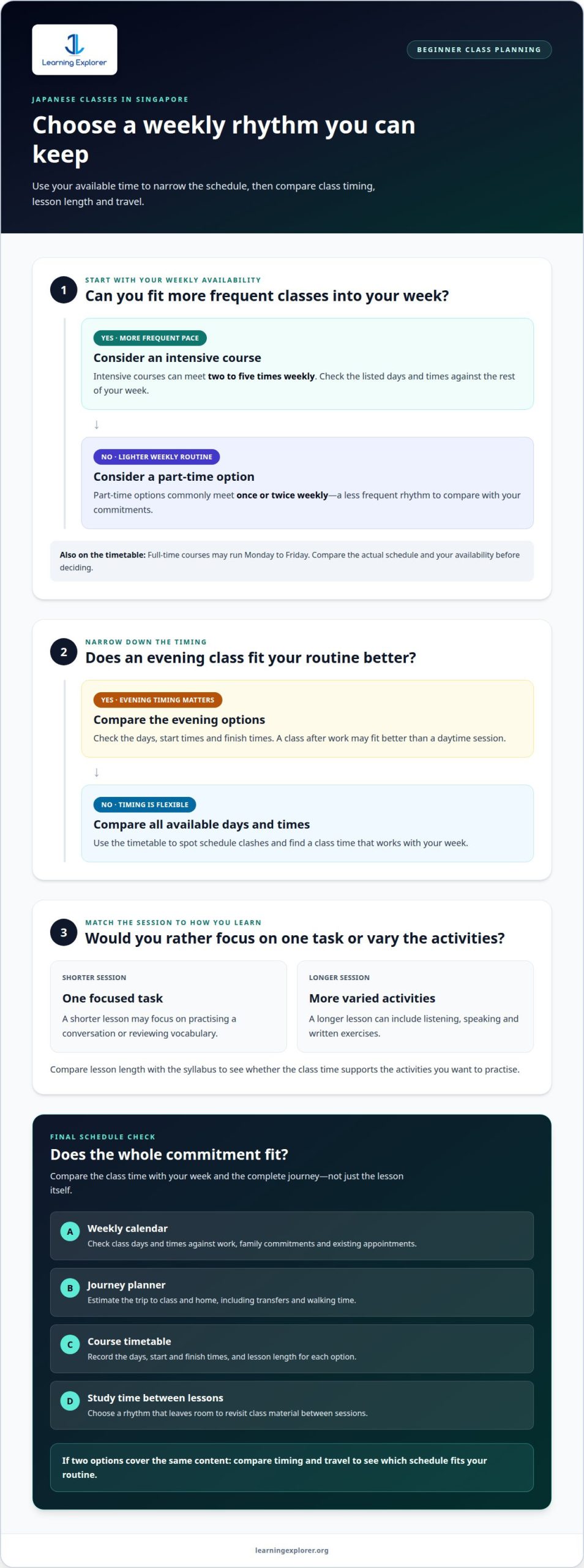
Japanese courses in Singapore use different schedules, so compare lesson length with the whole weekly commitment. Intensive courses can meet two to five times weekly, while full-time courses may run Monday to Friday. These formats create different rhythms: a working adult may prefer a regular evening class, while a learner with more daytime flexibility may consider weekday study.
Lesson duration affects how a class can use its time. A shorter session may focus on one task, such as practising a conversation or reviewing vocabulary. A longer session can make room for several activities, such as listening, speaking and written exercises. Compare the class length with the syllabus to see whether the time commitment supports your learning priorities.
Some schools use letter codes to distinguish class options. At Hello! Nihongo, options with different letter codes have the same course content but take place at different times of the week. The code signals a timetable choice, not a different syllabus. Compare the days and times attached to each option before deciding which fits your routine.
Build a simple schedule comparison before enrolling. Record the class days, start and finish times, lesson length, and travel time for each option. Then consider the rest of your week. For example, a class after work may suit you better than a daytime session, even if both cover the same material. A calendar view can reveal clashes that are easy to miss in a course list.
Use these tools to judge the practical fit of a schedule:
- Weekly calendar: Shows whether class times fit around work, family commitments and existing appointments.
- Journey planner: Helps estimate the trip to class and home, including transfers and walking time.
- Study log: Tracks lesson topics and short review sessions between classes.
- Course timetable: Lets you compare class days, start times and session lengths in one place.
Before choosing, decide whether you prefer a compact session or more time for varied classroom activities. Then match that preference to the schedule and teaching plan. If two options cover the same content, as with Hello! Nihongo’s letter-coded schedules, choose based on timing and travel rather than assuming one offers a different course level.
A manageable schedule leaves room to revisit class material between lessons. Use your study log to note one phrase or grammar point from each session, then review it before the next class. For an overview of Japanese learning options, consider how conversation practice fits the time you can set aside.
Onsite location and transport access
For in-person lessons, the training centre is at 10 Anson Road, level 22, International Plaza, Singapore 079903, directly above Tanjong Pagar MRT. That landmark makes it easier to plan a rail journey before class. Include the building name and level in your route search, not only the street address. A route to the MRT station alone won’t show the final walk to the classroom.
Plan the full trip from your starting point to the classroom. First, identify your nearest MRT station or bus stop. Next, compare routes to Tanjong Pagar MRT. Then allow time to travel from the station into International Plaza and reach level 22. For example, someone travelling from another part of the Central Business District can compare a direct train journey with a bus route, then choose the option that best fits the class start time.
Use a map app such as Google Maps to view the address, building entrance and walking route. A public transport journey planner can help compare rail and bus options from your starting point. Check the route at the time you expect to travel, since your journey may differ between a weekday morning and an evening class. Save the destination as International Plaza, then confirm the full street address and level before setting off.
Make the final approach part of your plan. International Plaza is a named building, but a map pin may not guide you from the entrance to the classroom. Note the level 22 destination and allow time to find the lift and room. If you’re attending after work, for example, plan the trip from your workplace rather than estimating from home. This gives you a clearer picture of the time between finishing work and joining the lesson.
- Map app: Useful for locating International Plaza and viewing the walking route from Tanjong Pagar MRT.
- Transport planner: Helps compare rail and bus journeys from your usual starting point.
- Calendar: Keeps the lesson time, departure time and travel plan together.
For recurring lessons, save the route once and revisit it when your starting point or class time changes. A calendar reminder can prompt you to leave enough time for the walk from the station to the building. If you’re travelling from outside central Singapore, compare the full door-to-door journey rather than choosing a route based only on its train segment.
Before your first in-person session, use the address, building name and level as a single destination set. Check the route from your actual starting point, then note how you’ll reach Tanjong Pagar MRT and International Plaza. This preparation helps you arrive ready to focus on the lesson instead of working out the final approach on the way.
Weekly class frequency and evening options
Part-time Japanese courses in Singapore commonly meet once or twice weekly. Some schools offer evening classes at both frequencies, giving working adults a way to fit lessons around daytime commitments. The suitable choice depends on the space in your weekly routine, travel time and how often you want classroom practice.
A once-a-week class creates one regular learning point in your calendar. It may suit someone balancing work, family commitments and independent review. For example, a learner with a busy weekday schedule could reserve one evening for class, then revisit notes during shorter study sessions at home. Keep review connected to the lesson rather than leaving new vocabulary untouched until the next class.
Twice-a-week classes place lessons closer together. This structure may suit students who prefer more frequent contact with Japanese and can protect two evenings in their schedule. Before choosing, look at which weekdays are offered. Two classes on demanding workdays may be harder to sustain than two evenings that leave room for other commitments.
To find a suitable frequency, map a typical week before comparing timetables. Mark work hours, caregiving, regular appointments and the commute to class. Then identify one or two evenings that remain realistic during an ordinary week. A schedule that works only when every day goes smoothly can be difficult to maintain. Consider likely changes, such as a late meeting or a family commitment.
Use simple planning tools to make the comparison concrete:
- Weekly calendar: Shows whether one or two class evenings fit around existing commitments.
- Reminder app: Sets a prompt for class and a separate review session after each lesson.
- Travel planner: Helps compare the journey from work or home to the classroom at the relevant time.
- Study tracker: Records class topics and review tasks between weekly sessions.
Evening options can reduce the need to rearrange daytime responsibilities, but the full journey matters. For example, a class after work may require travel from the office, while another evening could allow you to leave from home. Compare the class time with the route and your usual departure point. This makes the timetable decision more practical than choosing by weekday alone.
Finally, match frequency to a rhythm you can maintain. Choose once weekly if protecting one evening is realistic, or consider twice weekly if two class sessions fit your routine. Mark the lessons and review time on a calendar to see whether the plan is workable before the course begins.
Beginner Japanese classes and learning levels
The best Japanese school for a beginner depends on learning goals, schedule and preferred teaching format. Compare how a course introduces speaking, listening, reading and writing, then consider whether its class structure supports regular practice. A learner aiming to handle everyday greetings has different priorities from someone focused on reading Japanese signs.
Beginner formats in Singapore include in-person or online lessons, with group or private instruction. Each suits a different learning routine: group classes create opportunities to practise conversation with classmates, while private lessons focus attention on one learner. Online sessions avoid travel, while in-person classes provide face-to-face interaction. Choose according to how you learn and the time you can commit.
Reviews and class sizes don’t create a reliable ranking on their own. Read comments for specific details, such as whether lessons include speaking practice, explanations suit new learners, and the pace feels manageable. Compare class sizes in light of your preference for individual attention or peer conversation. A small group may offer more turns to speak, while a larger group may provide more varied exchanges. These are trade-offs, not guarantees.
Funding eligibility depends on the particular course and the learner’s circumstances. A beginner label alone doesn’t establish whether a class qualifies for public support or another subsidy. Treat course content and financial eligibility as separate questions, and don’t assume funding applies across all Japanese classes.
Learning levels make more sense when linked to practical tasks. An introductory stage might build recognition of hiragana, everyday greetings and basic sentence patterns. Later study can extend those skills into short exchanges, such as introducing yourself or asking for directions. To learn Japanese with a clear purpose, connect each syllabus topic to a situation you want to handle.
Use a few simple tools to reinforce class learning:
- Hiragana chart: Helps identify characters while reading beginner words.
- Flashcards: Support short vocabulary and kana review sessions.
- Audio recorder: Lets you listen back to pronunciation practice and notice sounds that need attention.
- Notebook: Keeps useful phrases and corrected examples together for later review.
For example, after learning a greeting, record yourself saying it, then compare your attempt with the class audio. This combines listening, speaking and review without adding a complicated study routine. Before choosing a course, identify your preferred format, the everyday tasks you want to practise, and whether peer interaction or individual focus matters more. Those priorities make the level and class structure easier to assess.
The best choice is a school whose beginner course matches your goals, schedule and preferred format, with a manageable pace and regular practice in speaking, listening, reading and writing. Compare class structure and reviews for details about speaking opportunities, explanations for new learners and class size.
Learning Explorer: Conversational Japanese Course
Learning Explorer’s Conversational Japanese Course is a natural next step if you want structured practice for everyday communication. Choose it when you’re ready to build speaking confidence and use Japanese in practical conversations, rather than studying vocabulary in isolation.
As you consider your next learning goal, focus on the situations you want to handle, such as greetings, introductions or daily exchanges. Learning Explorer also offers Conversational English, Business English and Conversational Mandarin courses for learners with different language goals.
Contact Learning Explorer to discuss the Conversational Japanese Course and your learning goals.
Make your next learning step count
Choose a first milestone that feels useful beyond the classroom. You might aim to introduce yourself, follow a simple exchange, or recognise familiar words in a Japanese menu. A clear purpose gives your practice direction and helps you notice progress in everyday situations. As you explore Japanese language classes for beginners in Singapore, keep that personal goal beside your schedule and preferred learning style.
Learning Explorer offers a Conversational Japanese Course for learners focused on spoken Japanese. It also offers a Conversational English Course, Business English Course, and Conversational Mandarin Course. If your language goals extend beyond Japanese, these options provide a place to continue building practical communication skills.
Take the next step by sharing what you hope to learn and the kind of conversation you want to handle. Contact Learning Explorer to explore course options and identify a suitable starting point. Every new phrase is a small step toward participating with greater confidence, so begin with the goal that matters most to you.
Frequently Asked Questions
Who is this for?
Beginner Japanese classes suit people starting from scratch and learners who want to rebuild basic skills. You don’t need to know Japanese writing before beginning an introductory course. For example, a learner who has practised greetings through an app can still start at beginner level if they can’t yet form simple exchanges. Set a practical goal, such as introducing yourself, then choose a class structured for that starting point.
Where can beginners take Japanese language classes in Singapore?
Beginners can take Japanese lessons in person in Singapore or choose online classes. Learning Explorer offers physical and online classes, as well as private and group Japanese classes. In-person lessons suit learners who value a shared classroom, while online study avoids travelling to class. Choose the format that works with your routine and how you prefer to practise. For in-person sessions, use the training centre address provided by Learning Explorer.
What are the class schedules and course durations for beginner Japanese classes in Singapore?
Schedules vary by course, with part-time classes commonly meeting once or twice weekly and evening options available at some schools. Intensive courses can meet more frequently, while full-time courses may run on weekdays. Course duration depends on the programme’s structure and syllabus. Before enrolling, compare the complete timetable with your work and travel plans, and note whether the scheduled lessons leave time for review between classes.
What do beginner Japanese courses in Singapore cover, including hiragana, katakana, and basic conversation?
Beginner courses commonly introduce hiragana, katakana, pronunciation, basic sentence patterns and everyday conversation. A practical lesson might combine reading a simple word, practising its pronunciation and using a short phrase in a greeting. Course outlines can differ, so consider how writing and speaking activities are balanced. For instance, learners aiming to order food may value role-play that lets them practise a short exchange aloud.
What are the entry requirements and age limits for beginner Japanese classes in Singapore?
Beginner classes are designed for learners without prior Japanese knowledge, and entry requirements depend on the course. A placement assessment can help someone with previous study find an appropriate starting level, while a complete beginner can look for an introductory class. Age limits also vary between courses. For a child or adult learner, use the course’s stated age group as a guide when choosing a suitable class.
How can I register for a beginner Japanese class in Singapore, and what are the cancellation or refund rules?
To begin registration with Learning Explorer, contact the school by calling +65 9725 8311 or emailing info@learningexplorer.org. Cancellation and refund terms depend on the enrolment conditions for the course; don’t assume one policy applies to every class. Read those terms before completing registration, paying fees or arranging your schedule. Keep the written enrolment details so you can refer to the applicable conditions later.
Are there beginner Japanese classes in Singapore eligible for SkillsFuture funding or other subsidies?
Self-sponsored Singapore citizens aged 25 and above may use available SkillsFuture Credit to pay the listed course fees.