The best corporate language training format may not be a single one. On-site classes support live conversation, immediate feedback and group practice, while online lessons make it easier for employees in different locations to participate. The pros and cons of on-site vs online corporate language training depend on your team’s schedule, locations and learning goals, so a blended approach may offer the benefits of both.
It’s understandable to want a format that fits busy workdays without losing the interaction employees need to build confidence in another language. The key is to match the learning experience to the skills your team needs, from everyday conversation to workplace discussions.
This guide compares on-site, online and blended training, outlining practical benefits and trade-offs. You’ll learn how to choose a format for your organization in Singapore and when combining live online lessons with in-person practice can give your team greater flexibility and focus.
Key Takeaways
- Choose on-site learning when live conversation, group practice and immediate feedback are central to your team’s goals.
- Use online lessons to make training easier to fit around different locations and schedules, while planning for interaction and reliable connectivity.
- Compare formats by considering your employees’ work patterns, learning needs and opportunities to practise together.
- Blend online lessons with in-person sessions to balance regular learning with focused speaking practice and group activities.
- Keep blended training connected with shared objectives, aligned materials and consistent progress tracking.
What Is On-Site Training?
On-site corporate language training takes place at employees’ workplace or another physical learning space. A trainer can guide a group through a meeting role-play, notice hesitation and respond when learners seem unsure. This face-to-face format gives employees a shared setting to practise skills they need at work.
On-site training’s main advantages are hands-on practice, immediate feedback and interaction among colleagues. Its drawbacks include fixed schedules, travel or venue logistics, and a less convenient fit for teams spread across offices. For example, employees in one Singapore office can practise customer conversations together, while colleagues working remotely may not be able to attend.
Online corporate language training offers scheduling flexibility and access from different locations. Live virtual classes let employees practise with an instructor, while self-paced programs allow learners to review material around work commitments. However, learners need to manage their focus independently. Email alerts, workplace interruptions and limited peer interaction can make virtual learning feel isolating.
Online lessons can still be interactive. In a video class, an instructor can invite learners to role-play a client call, answer questions and give feedback. Quizzes and discussion activities can encourage participation between live sessions. Reliable internet access and a working device matter, since poor connectivity can interrupt speaking practice or make it hard to follow the class.
Both formats can support workplace goals when activities reflect real tasks. An on-site class can use group problem-solving or a physical demonstration; an online class can use a shared scenario, quiz or video meeting. Digital materials can also be made available for learners to revisit. The key is to connect each activity with a language skill employees need on the job.
Online learning works best with structure, not just a platform login. For example, a team can use self-paced modules to review essential vocabulary, then bring questions to a live lesson. This gives employees room to revisit challenging material while keeping instructor contact. Managers can also make participation easier by setting class times that fit team schedules.
| Format | Flexibility | Interaction | Best suited to |
|---|---|---|---|
| On-site | Fixed place and schedule | Live, face-to-face practice | Group role-plays and shared activities |
| Online live | Join from different locations | Instructor-led virtual discussion | Distributed teams needing regular classes |
| Self-paced online | Learners choose study times | Independent review and activities | Flexible practice around work schedules |
Choose on-site classes for shared, hands-on practice, and online learning for location flexibility and self-paced review.
Are Online Language Lessons as Interactive as In-Person?
Online lessons can support active speaking practice, but interaction depends on lesson design and reliable technology. In-person classes make it easier to read body language and respond naturally to the group.
Face-to-Face Interaction and Engagement
In a classroom, employees can notice a colleague’s hesitation, respond to facial expressions and build on comments without waiting for a screen prompt. For example, a team practising a client meeting can rotate roles, listen to each exchange and adjust its communication in the moment. Informal interaction before class or during breaks is also easier. Online lessons can connect colleagues in different locations, but turn-taking and social cues may feel less spontaneous.
Real-Time Feedback and Interaction
A live instructor can correct word choice, pronunciation or sentence structure as employees practise. In a video lesson, learners can still ask questions, take turns in a discussion and rehearse a workplace conversation. The instructor may need to invite quieter participants to contribute, since a virtual room can make it easier to stay muted or multitask. Short role-plays and clear turn-taking help keep the lesson participatory.
Technology needs differ by format. Online classes call for an internet-connected device with a microphone and speakers or headphones; a camera can support face-to-face communication. On-site classes need a suitable room where employees can hear one another and participate. Employers should also consider privacy, security and accessibility: limit access to online sessions, handle recordings carefully and provide materials in formats employees can use.
Technology and Internet Barriers
A weak connection can interrupt a learner mid-sentence, delay a response or make an instructor’s feedback hard to hear. Background noise and workplace interruptions can also distract from a virtual class. Before the lesson, test the audio, camera and connection, then choose a quieter space. In-person classes avoid video-call disruptions, though room availability and gathering employees in one place still require coordination.
International assignments show why lesson design matters. Google arranged Vietnamese training for 36 employees ahead of business travel to Vietnam. For employees preparing for travel, online lessons can connect teams across locations, while in-person practice can create space for focused conversation. The right balance depends on where employees are based and which communication tasks they need to rehearse.
Choose online lessons when employees need to join from different locations and can access a dependable setup. Choose face-to-face sessions when body language, group exchange and immediate conversational flow are central. For organizations developing workplace communication, corporate language learning can be shaped around the interactions employees need to practise.
What Are the Main Corporate Language Training Formats?
Class size and schedules shape the choice: on-site classes bring learners together at one physical location and time, while online classes let employees attend remotely. In Singapore, subsidy eligibility depends on the terms of each scheme, so don’t assume every corporate language course qualifies.
Remote Training Flexibility and Convenience
Remote training uses video meetings, webinars or online courses, with live classes or self-paced modules. Employees can attend from different locations, which helps when a Singapore team works across offices or has rotating operational demands. A live meeting still requires everyone to join at the same time; self-paced learning gives learners more control over when they study.
That difference matters when leaders plan around busy periods. For example, a customer-facing team may find it difficult to leave service coverage for a shared physical class. Online modules can fit between work commitments, while scheduled virtual sessions provide a regular opportunity for speaking practice. Remote learning is convenient, but flexibility works best when the schedule still gives learners time to participate.
Online Training Scalability and Accessibility
Online classes can reach employees in multiple locations, and materials can remain available online for review. A company opening a new Singapore office can include staff without arranging a shared venue. Teams can also join from anywhere with an internet connection, making remote training useful when travel between workplaces would disrupt attendance.
Scalability doesn’t mean every learner has the same needs. A large online session can reach a broad group, while smaller live classes can create more opportunities to speak. Self-paced modules let employees revisit vocabulary or instructions; live lessons give them a scheduled place to practise. Match the format to the learning task, not just the headcount.
On-site training can be convenient when employees already work together in one location. A shared physical class can fit into an office learning schedule, and learners can practise in pairs without coordinating separate video calls. However, the fixed location and timetable can make attendance harder for shift workers, hybrid teams or employees in other cities.
Class size also affects participation and coordination. In a smaller group, each employee may have more chances to speak during a live discussion. A larger group can reach more people at once, but the instructor needs to structure turn-taking so quieter learners aren’t overlooked. Online classes can use breakout activities for smaller conversations; on-site sessions can use paired role-plays.
Use this planning sequence: identify employees’ work locations, map schedules around operational peaks, then choose live or self-paced learning. If staff are spread across offices, remote classes reduce the need for everyone to travel. If a team shares a workplace and needs collaborative practice, an on-site session may fit more naturally. Either way, give employees a clear time to attend and a defined learning goal.
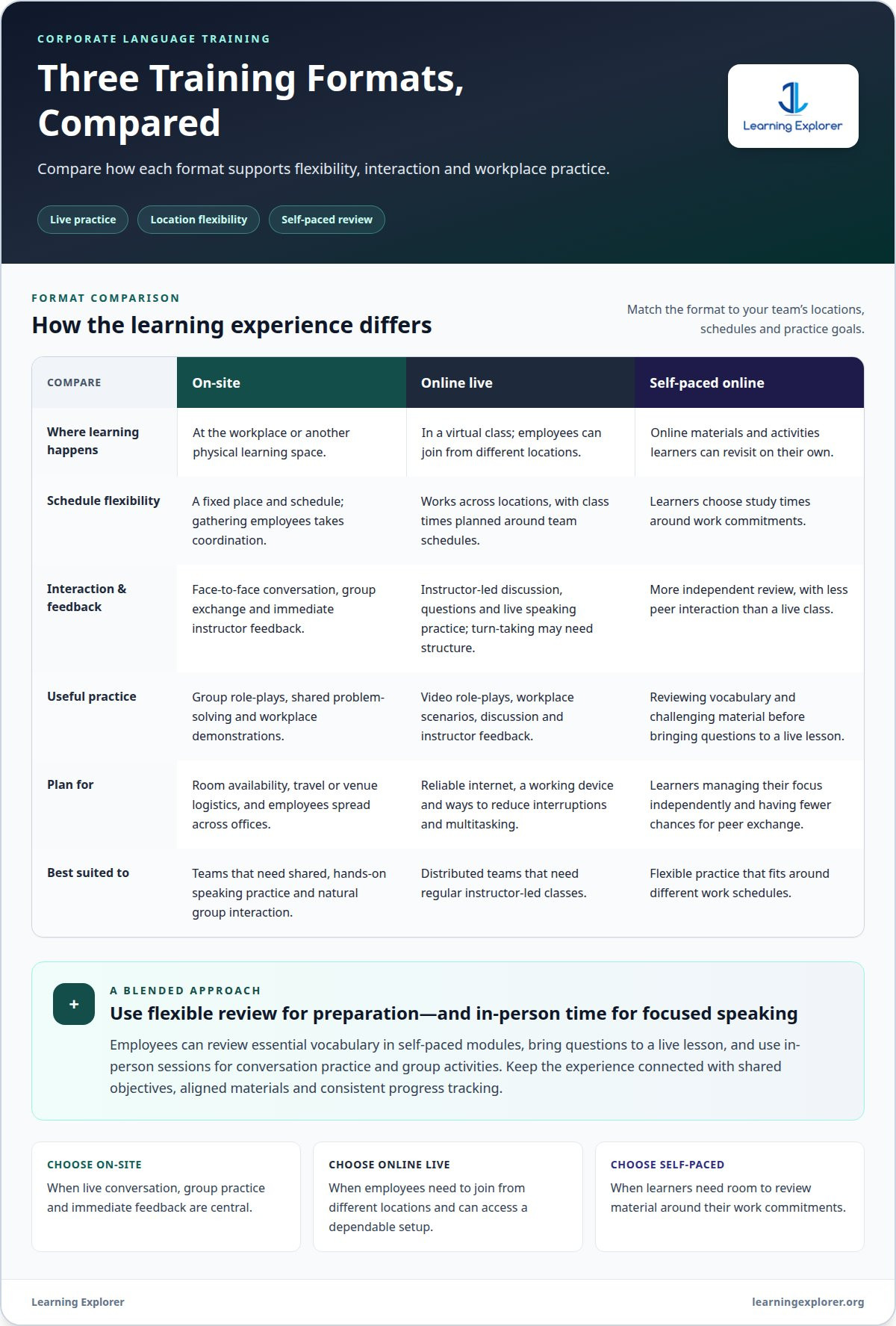
Choosing a training format for an organization
Choose a format by matching the learning goal to employees’ work patterns. The on-site vs online corporate language training pros and cons become clearer when you first identify the conversations and tasks employees need to handle.
Remote Training Formats
Remote training includes live video classes, webinars and self-paced online courses. It suits organizations whose employees work across locations or can’t pause operations together. For example, staff in separate Singapore offices can join a shared live lesson without travelling to one physical venue. Self-paced modules support review between sessions, while instructor-led meetings create scheduled opportunities to practise speaking and ask questions.
In-Person Training Formats
In-person training brings employees together for instructor-led classes at a workplace or another physical learning space. It can suit a team that needs to practise conversations face-to-face, observe body language or work through group activities. For example, colleagues preparing for customer discussions can rotate speaker and listener roles in the same room. This format is less convenient when employees work in different locations or can’t attend together.
Formats for Shifts and Locations
For shift-based teams, build the training plan around coverage rather than expecting everyone to attend one session. A company could schedule repeated in-person classes for separate teams or hold live remote sessions at different times. For employees in several locations, online classes reduce the need to gather in one place. A shared course plan helps each group work toward the same communication goals.
Use three checks before selecting a format. First, name the workplace task employees need to perform, such as handling a client call or contributing to a meeting. Next, identify where learners work and which schedules allow active participation. Finally, choose the setting that gives them the right practice, rather than selecting a format simply because it’s familiar. Treat the on-site vs online corporate language training pros and cons as a framework for weighing these needs, not as a universal answer.
- Speaking confidence: Use live sessions when employees need to practise conversations and receive instructor feedback.
- Knowledge review: Use self-paced courses when learners need to revisit vocabulary around work commitments.
- Team alignment: Use shared classes when colleagues need consistent language for workplace communication.
Then set a clear learning objective for each class and connect it to a real work task. For example, employees learning meeting language can practise opening a discussion, clarifying a point and summarising next steps. This keeps the format decision focused on useful skills and gives everyone a practical reason to stay engaged.
Combining in-company and online training
A blended program connects online learning with in-person practice instead of treating them as separate courses. For a Singapore team, digital lessons can build vocabulary between live sessions, while classroom activities give participants space to practise challenging workplace conversations together.
Start by sorting learning goals by activity. Employees can review essential phrases and lesson materials online, then use an in-person session for role-plays, group discussion or challenging speaking tasks. For example, learners preparing for client meetings could study useful expressions digitally before practising a meeting scenario with colleagues and an instructor.
Use virtual sessions to maintain regular contact when participants work in different locations, travel or follow varied office schedules. A live webinar can bring those employees together for guided conversation, while self-paced modules let them revisit content around their responsibilities. This arrangement supports flexibility without relying on independent study alone.
Keep the learning sequence connected. Set one shared objective, such as handling a customer enquiry, and carry it through each format. Online activities can introduce relevant phrases; a live session can model the exchange; an in-person workshop can let learners practise adapting their responses. Participants then see how each session builds their ability to communicate at work.
Coordination matters. Give each format a clear role, set schedules that work across teams and provide consistent materials. If one group joins virtually while another meets in person, use the same lesson objective and progress measures. Without that alignment, employees may experience disconnected activities rather than one coherent program.
Blended training also needs a practical way to evaluate progress. Gather participant feedback, review completion rates and test scores, and consider how learners apply new language on the job. For example, if employees complete online lessons but struggle during customer role-plays, shift more time toward guided speaking and adjust the next session’s activities.
Review the mix as work needs change. A new team handling international calls may need more live conversation practice, while experienced staff might benefit from focused online refreshers. Use feedback and workplace performance to decide whether the next learning cycle needs more virtual discussion, in-person group work or independent review.
The takeaway is simple: use online learning for flexible, repeatable foundations and in-person time for intensive practice or discussion. Make objectives, materials and progress tracking consistent across both. To shape language learning around real workplace communication, plan corporate language training that connects practice with the conversations employees need to handle.
Learning Explorer
Learning Explorer helps organizations connect language learning with employees’ communication needs. If your team is choosing between general conversation practice and workplace-focused language skills, its Conversational English Course and Business English Course offer different learning directions. The Conversational Mandarin Course and Business Mandarin Course provide the same distinction for Mandarin learning.
Use the format principles in this guide to clarify your team’s goals, work schedules and preferred learning setting. Then consider which course best matches the conversations employees need to handle. Contact Learning Explorer to discuss your organization’s language learning needs.
Make Your Team’s Next Step Count
Your training format can evolve as your organization’s communication needs change. Treat the first decision as a starting point, then notice where employees feel more confident using new language at work. Changes in responsibilities, team structure or customer interactions may call for a fresh look at the learning setup.
When weighing the pros and cons of on-site vs online corporate language training, focus on the conversations employees need to handle, not on choosing a format for its own sake. That gives your team a practical basis for shaping learning that supports real workplace communication.
Learning Explorer can help you consider language learning options for your organization. Contact Learning Explorer to discuss your team’s needs and take a thoughtful next step toward more confident communication.
Frequently Asked Questions
How Should L&D Teams Choose a Language Training Program?
Start with the workplace conversations employees need to manage, then define what better performance would look like. For example, a sales team may need to explain product details clearly, while reception staff may focus on welcoming visitors. Next, consider learners’ current ability, work schedules and preferred practice setting. Use a short speaking task before training, then repeat a comparable task later to assess progress.
Which Works Best for Your Organization?
The best fit depends on where employees work and what they need to practise. A co-located team preparing for customer discussions may benefit from shared in-person sessions. A hybrid organization with staff in different locations may need online access. If learners have varied needs, combine formats and give each a distinct role, such as digital preparation followed by a focused speaking activity.
How do on-site and online language training compare in cost per employee in Singapore?
Online training can reduce venue and travel expenses, while in-person sessions may involve more location and coordination costs. The cost per employee also depends on group size, curriculum customization and training location. For Singapore organizations, the price depends on the course and training arrangement. Compare the full delivery setup, not just the class format, when planning a training budget.
How do on-site and online formats compare for employee engagement and learning outcomes?
Engagement depends on whether learners actively use the language during class. In-person activities can make it easier to notice hesitation and encourage spontaneous conversation; online lessons can use instructor prompts, paired tasks and short speaking turns. To assess learning outcomes, track participation and compare employees’ ability to complete a relevant workplace task, such as explaining a process or responding to a customer enquiry.
Which language training format is more flexible for hybrid and shift-based teams?
Online formats generally offer more flexibility for employees working across locations or shifts. Self-paced activities can fit around changing duties, while live virtual sessions can bring together staff who share a suitable time. For shift-based teams, plan repeated sessions or combine independent preparation with scheduled practice. This helps maintain a common learning goal without requiring every employee to attend the same class.