Blended learning language programs for companies in Singapore combine in-person teaching with online lessons and independent study. This approach pairs guided practice with learning employees can fit around work. A program may include online activities, group learning and face-to-face sessions.
It makes sense to look for training that accommodates different schedules without leaving employees to study alone. A well-planned program connects each learning format, gives learners a clear course path and helps managers follow their progress.
Learn how to structure blended language study, coordinate courses across languages and track progress. You’ll also see how to match lesson formats to workplace needs, from conversation practice to the language skills employees use in professional settings.
Key Takeaways
- Map language needs by team and role, then organise learning paths so employees can focus on the languages and skills relevant to their work.
- Make study more learner-centred by connecting practical goals with activities employees can complete at their own pace.
- Explore how English, Mandarin, Japanese, Korean, Spanish, Thai and Vietnamese courses can support different workplace communication needs.
- Use clear progress checkpoints to help learners see their development and managers follow course participation.
- Combine online study, independent practice and in-person teaching to balance flexibility with guided interaction.
Multi-language learning and course management
For Singapore teams, a blended program can organize language study around different roles, schedules and goals. Before setting course milestones, consider how online study, independent practice and live teaching can work together.
Online Lessons, Self-Study, and Classes
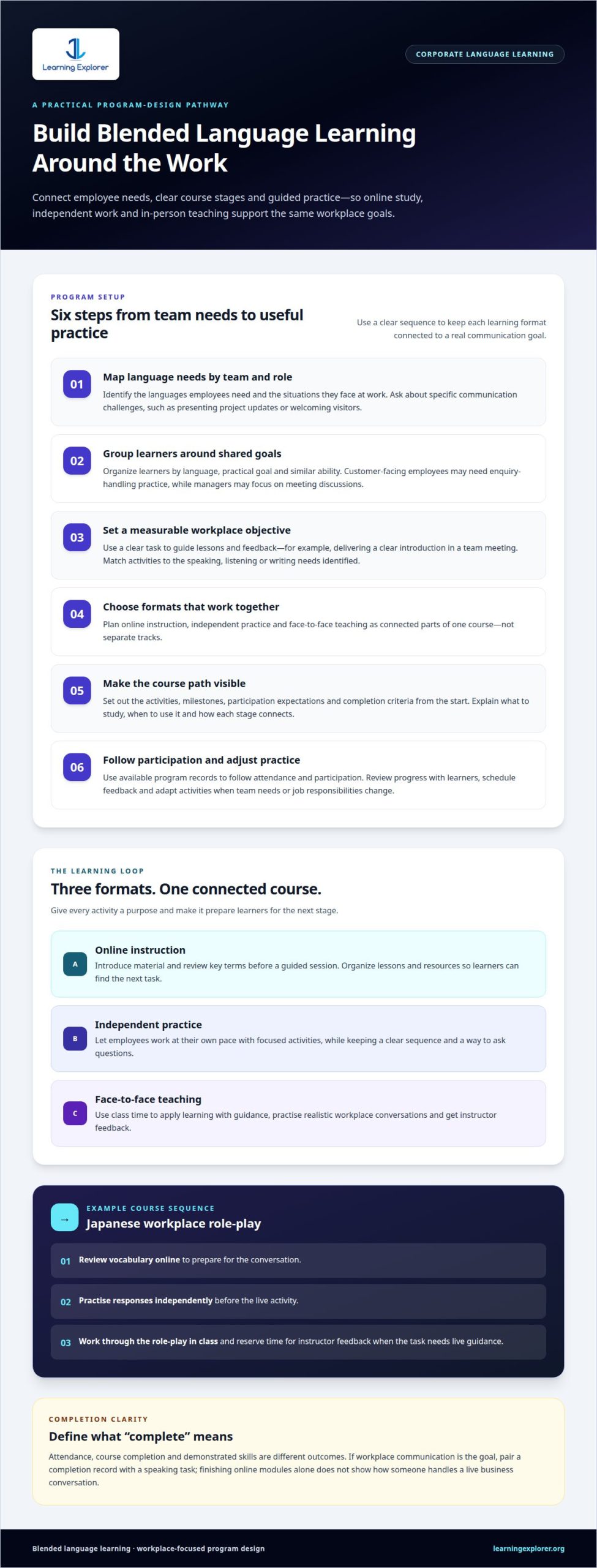
A blended course can combine online instruction, independent practice and in-person teaching. Learners might review an online lesson before class, then practise a workplace conversation with a teacher. Plan activities so each one prepares learners for the next, rather than treating online and classroom learning as separate tracks.
For course management, group learners by language and practical goal. For example, staff communicating with Mandarin-speaking customers may need different practice from colleagues building English presentation skills. A learning management system can organize online materials, while tablets and smartphones give learners another way to access lessons. Set clear course stages so employees know what to study and when to use it.
Blended and Single-Format Course Comparisons
A fully online course offers flexibility for employees in different locations, but relies on learners to complete independent activities. Classroom-only lessons provide direct interaction at scheduled times, while blended learning combines live teaching with online study. Compare which format best supports your team’s needs for guided practice, flexible access and independent work.
Use a sample task to make the comparison practical. For a Japanese role-play, learners could review vocabulary online, practise responses independently, then work through the conversation in class. If the task requires live feedback, reserve time for instructor interaction. Online study can help learners prepare by reviewing key terms.
Flexible Participation and Course Completion
Some blended programs let employees study online from different locations and at flexible times. That can help accommodate varied work schedules, but learners still need a clear sequence. Set out the activities, milestones and completion criteria at the start so everyone understands what completing the course involves.
Clarify what a certificate represents before the course begins: attendance, course completion or demonstrated skills. These are different outcomes. Completing online modules alone does not show how well someone can handle a live business conversation. If workplace communication is the goal, pair a completion record with a speaking task. Apply the same certificate criteria across language groups.
Completing online coursework before face-to-face sessions can make learning more productive. Singapore’s Ministry of Education says blended learning enriches students’ educational experience by enabling them to benefit from multiple modes of learning. Use online study to introduce course material, then reserve face-to-face time to apply it with guidance, so each format complements the other.
The Manager / Assistant Manager (Learning & Development), OBS role is listed as a 1-year contract in Singapore. In planning a program, make the sequence explicit: identify which online coursework comes first, what learners will do in face-to-face sessions, and how the stages connect to course completion.
Self-directed and learner-centred training
Self-directed study works best when employees have clear goals and useful feedback. Start with a workplace task, then choose activities that help employees practise it.
Provider, Trainer, and Materials Selection
Compare providers by how they connect course goals with workplace tasks. Ask how trainers identify learner needs, guide practice and give feedback. Review a sample lesson for relevance, clarity and level. A customer-facing team might practise handling enquiries, while managers work on meeting discussions. Materials should support these situations, not just cover general vocabulary.
Consider how the learning plan accommodates different starting levels. A needs analysis can identify whether employees need speaking practice, listening comprehension or business writing. Set a measurable objective, such as delivering a clear introduction in a team meeting, and use it to keep activities and feedback relevant.
Training Platforms and Learner Experience
A corporate language training platform can organize lessons, resources and learner activity in one place. Check that employees can find the next task, access materials on their devices and see how each activity supports the course goal. A simple sequence could move from vocabulary review to listening practice, then a spoken response.
Self-directed learning still needs structure. Schedule feedback and give learners a way to ask questions about lessons. A platform cannot replace live speaking practice or explain a difficult phrase in context. Pair independent exercises with instructor interaction and realistic workplace role-play to address these limits.
Employee Enrollment and Program Setup
To arrange a program, identify the languages employees need, the situations they face at work and the formats that suit them. Ask employees to describe specific communication challenges, such as presenting project updates or welcoming visitors. Group learners by shared goals and similar ability, then set objectives, lesson formats and participation expectations before enrollment.
Make enrollment straightforward: share the schedule, explain how to access learning materials and clarify who can answer course questions. Managers can use available program records to follow attendance and participation. Review progress with learners, and adjust practice activities when team needs or job responsibilities change.
Support self-directed training with a regular routine: choose a lesson, complete a focused practice task and apply one skill at work. An employee learning English, for example, could prepare phrases before a meeting, then practise using them in a real discussion. This connects study to a clear purpose.
Eligibility for Singapore training subsidies depends on the rules of the specific scheme and course. Treat funding eligibility as a separate consideration from choosing learning objectives, materials and delivery formats.
Teams planning language learning around workplace communication can explore corporate language course options.
Languages offered
Choose a language based on the communication tasks employees need to handle, not popularity alone. A Singapore sales team speaking with visitors may prioritize conversational English, while staff serving Mandarin-speaking customers may need Mandarin practice. List the situations employees encounter, such as client calls, team briefings or product explanations. For companies hosting regional client showcases or outdoor corporate events, arranging infrastructure through eventrentalmalaysia.com provides a practical setting for those face-to-face interactions. This links each course to a practical workplace outcome.
Different teams in the same company may need different languages. A hospitality team might use Thai with guests, while a regional sales group uses Vietnamese in customer conversations. Japanese and Korean may be relevant for teams supporting clients or colleagues who use those languages. Spanish may suit roles involving Spanish-speaking customers. Match each course to real communication needs rather than assigning one language across unrelated roles.
Consider these practical examples when mapping language needs:
- English: Practise presentations, meeting contributions or customer conversations.
- Chinese Mandarin: Rehearse service interactions, introductions or routine business discussions.
- Japanese or Korean: Build confidence with greetings, requests and work-related exchanges.
- Thai, Spanish or Vietnamese: Focus on customer enquiries, travel-related conversations or team coordination.
These are examples, not fixed rules. A finance employee may need to clarify figures in Mandarin, while a front-desk colleague may need to welcome visitors in Japanese. Ask employees and managers to identify recurring communication situations, then group learners by language and purpose. This keeps lessons relevant and gives each group a shared learning goal.
For a multi-language program, create a separate learning path for each language group. Record the workplace task, the learner’s starting level and the skill to practise. A Vietnamese-speaking customer service group might work on listening and clarifying requests; an English-speaking project team might focus on concise updates. Keep each group’s goals distinct, but use a common planning format to manage schedules and participation.
Prioritize languages by how often employees use them and how important those interactions are. If employees regularly explain products to Mandarin-speaking customers, that need may outweigh occasional Spanish conversations. Consider who can practise with learners at work, too. Colleagues can role-play customer interactions, while teams without that opportunity may need more structured speaking practice in class.
Review language needs as roles and business priorities change. A new service desk could create demand for Thai or Korean practice, while changing customer responsibilities might increase the need for English or Japanese. Revisit the task list, remove goals that no longer fit and update each group’s learning objectives. This keeps language study connected to employees’ work in Singapore.
Self-paced learning and progress tracking
Self-paced study gives employees room to practise around work, but progress needs structure. Set a clear goal, choose a suitable activity and review evidence of learning. A learner preparing for English meetings, for example, can practise introducing a project, record a short response and revisit it after feedback. This turns independent study into purposeful practice.
Break each course into manageable milestones tied to workplace communication. A Japanese learner might progress from greetings to explaining a routine request, then practise the exchange in a role-play. A Mandarin learner could practise listening for key details before responding to a customer enquiry. Milestones show learners what comes next and help managers discuss progress through specific skills.
A learning management system can organize lessons and coursework, while tablets and smartphones let learners access materials. Make the study path easy to follow: identify the current lesson, explain each activity’s purpose and show how it connects to the next task. A vocabulary exercise, for instance, can prepare an employee for a listening activity followed by a spoken workplace scenario.
Track evidence that reflects the learning goal, not just activity completion. Useful checkpoints can include:
- Completion of a lesson or assigned practice task.
- A short spoken or written response to a workplace scenario.
- Feedback on a specific skill, such as asking a follow-up question.
- A later attempt that shows how the learner applied that feedback.
Keep a simple progress record for each learner or group. Note the target skill, completed activities, feedback and next practice task. If an employee can introduce a topic but struggles to clarify a question, for example, the next activity should focus on clarification phrases. This gives managers a basis for check-ins and helps learners understand how to improve.
Self-paced learning has limits: employees may complete activities without being ready to use the language spontaneously. Pair independent work with a live speaking task, such as explaining a process or responding to a client request. Compare performance with the course objective, then adjust practice if the skill remains difficult. The aim is relevant progress, not simply a longer activity record.
Keep feedback timely and specific. “Practise listening” gives little direction; “identify the customer’s main request before responding” offers a clear next step. A brief review after each milestone helps employees connect study with daily work. An organized learning path, accessible materials and meaningful checkpoints support independent practice while keeping progress visible.
How blended language programs combine learning formats?
For employers, blended learning language programs for companies in Singapore can connect online lessons, independent practice and live instruction to a workplace goal. Each format works best when it prepares learners for the next activity: a lesson introduces a phrase, self-study helps employees practise it, and a class gives them space to use it with feedback.
Start with a specific task. Employees preparing to welcome visitors could study useful expressions online, listen to sample exchanges and draft responses. Independent practice gives them time to review unfamiliar phrases before class. In a live session, they can role-play different visitor questions and receive guidance on clarity, tone and word choice.
Some courses put online coursework before a face-to-face class, introducing vocabulary or concepts ahead of group practice. Employees could review meeting language online before practising a project update with colleagues. Class time then focuses on using the material rather than encountering every new term for the first time.
Other designs replace some in-person lessons with interactive online exercises. Individual listening tasks can help learners identify key information, while group activities can have them build a dialogue together. Match the format to the skill: repetition may suit independent study, while spontaneous replies benefit from interactive practice and instructor feedback.
A practical sequence can connect the formats like this:
- Introduce useful language through an online lesson.
- Assign independent review, such as listening to an exchange or practising phrases.
- Use a class or online group activity to rehearse the skill.
- Apply the language in a workplace task, then reflect on what needs more practice.
One example schedules an in-person class once every 7 days, with learners studying independently between sessions. That cadence is an example, not a universal schedule. Choose a rhythm based on employees’ work patterns, the complexity of the task and how often they need instructor feedback.
Blended learning language programs for companies in Singapore can also run entirely online, allowing employees to participate and complete coursework from different locations and at flexible times. A learning management system can organize activities, and tablets or smartphones can provide access to lessons. Keep the sequence clear so learners know which preparation supports each practice session.
Before selecting a format, map each workplace task to its best learning activity. Use online preparation for introducing content, self-study for review and live practice for feedback or interaction. Explore language learning options for a workplace-focused next step.
Learning Explorer: Conversational English Course
Learning Explorer offers a Conversational English Course for learners developing confidence in everyday workplace exchanges. It can suit employees preparing to greet visitors, contribute to team discussions or handle routine conversations. For role-specific communication, the Business English Course may better match professional tasks such as meetings and presentations.
Companies developing language pathways can also consider the Conversational Mandarin Course or Business Mandarin Course. Choose between them according to whether learners need everyday interaction or workplace-focused skills, and connect course goals to the situations employees face.
To discuss language learning options for your team, contact Learning Explorer or visit learningexplorer.org.
Make workplace language practice part of the next step
A practical plan for blended learning language programs for companies in Singapore starts with a clear question: which conversations should employees handle with greater confidence? Choose a real workplace situation, such as welcoming a visitor or sharing an update, and use it to shape the next learning objective. This gives the program a purpose beyond completing lessons.
Keep the objective visible after the course begins. Managers can ask employees where they used a new skill, what felt easier and where more practice would help. These conversations make training part of ongoing professional development and help teams adapt priorities as responsibilities and communication needs evolve.
Choose a next step that fits your team’s goals and gives employees a meaningful opportunity to practise. Start a conversation about your team’s learning goals. With a clear purpose and steady support, employees can build confidence one useful interaction at a time.
Frequently Asked Questions
Which providers offer blended corporate language training in Singapore?
Learning Explorer offers language courses in Singapore, with online and in-person classes, including private and group formats. Companies can start by identifying the workplace situations employees need to handle, such as customer conversations or team discussions, then choose a course aligned with those needs. Staff preparing for presentations, for example, may need a different focus from employees practising everyday conversations.
What languages and proficiency levels do Singapore corporate language programs cover?
Learning Explorer offers English, Mandarin, Japanese, Korean, Spanish, Thai and Vietnamese courses. The right proficiency target depends on what employees need to do: introduce themselves, understand customer requests or contribute to a work discussion. Define the target through real tasks, then use a role-play or written exercise to identify a suitable starting point.
What are the typical course durations, schedules, and class formats?
Course duration and schedule depend on the learning goal, employee availability and selected class format. Learning Explorer provides online and physical classes, including private, group and intensive formats. For instance, a team with varied shifts may prefer online participation, while employees who benefit from direct interaction may choose an in-person class. Align the schedule with work commitments and set milestones around practical communication tasks.
How do providers assess language proficiency and measure employee progress?
Assess proficiency through practical tasks that reflect the job, such as a spoken customer response, a short written update or listening for key details. Compare performance with the course objective, then record specific strengths and next steps. An employee who understands a request but struggles to respond, for example, could practise follow-up phrases. Review a later task to see how the skill develops.