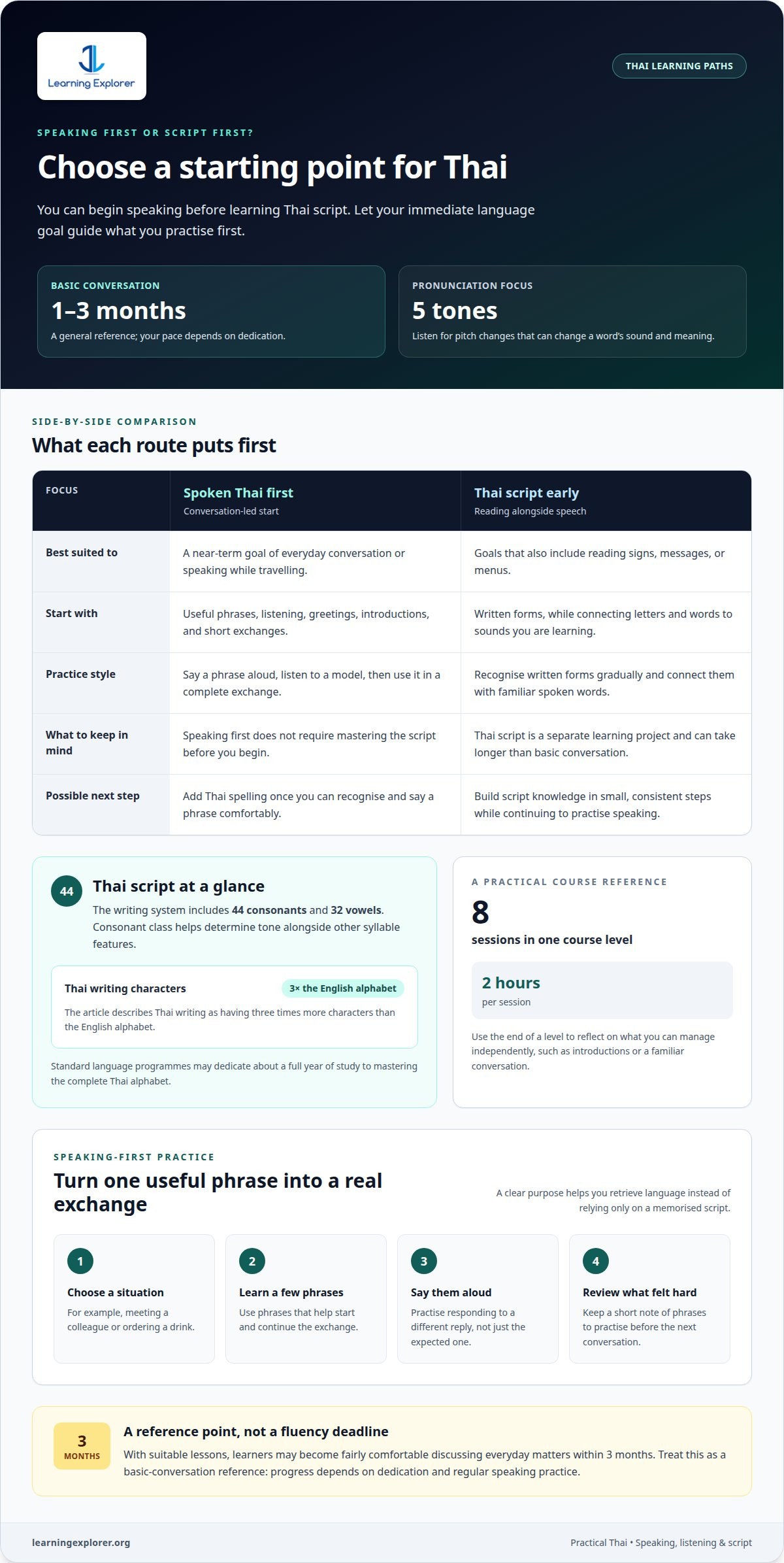
Thai proficiency doesn’t have to mean mastering the script before you can speak. Basic conversational Thai typically takes 1-3 months to learn, depending on your dedication, and learners with suitable lessons may become fairly comfortable discussing everyday matters within 3 months. For adults considering conversational Thai classes in Singapore, the key is to practise useful phrases and listening from the start.
It’s natural to wonder whether you need to read Thai, how lessons can fit around work, and what progress to expect. You can begin with spoken Thai and build confidence through practical topics such as greetings, introductions, ordering food, and everyday conversations. Learning the script can support reading and pronunciation, but it need not be your first step if speaking is your priority.
This guide covers what beginner lessons commonly focus on, how Thai tones shape pronunciation, and how to consider schedules and fees without assuming one format suits everyone. You’ll also learn what affects your pace, why regular speaking practice matters, and how to choose an approach that fits alongside your daily commitments.
Key Takeaways
- Get a clearer picture of the speaking, listening, and pronunciation skills beginner lessons can develop.
- Decide how Thai script fits your goals, whether you’re focused on conversation or broader language skills.
- Compare class formats and identify the schedule and fee factors that matter for your routine.
- Explore practical ways to prepare for conversations while travelling and in everyday situations.
- Use your goals and available practice time to set a realistic path towards greater confidence in Thai.
Beginner conversational Thai lessons for adults
Beginner Thai lessons can help you build practical speaking habits from the first session. In conversational Thai classes for adults in Singapore, start with greetings, introductions, and short exchanges you can use in real situations. Thai has 5 tones, so listen closely to how pitch changes a word’s sound and meaning. Practise one phrase, then use it in a complete exchange.
Give each practice session a clear purpose. For example, try a café role-play: greet the server, make a request, and respond to a follow-up. Repeat the exchange with a different drink or response. This helps you retrieve useful language instead of relying on a memorised script. Keep a short note of phrases that need more practice.
Learning Explorer offers conversational Thai classes in Singapore. A trial lesson can help you experience a class format, while a placement test can assess your existing knowledge and help match you to a level. If you’re new to Thai, start with the foundations. If you already know common phrases, identify what you can say comfortably before choosing what to learn next.
Adults can also use Thai conversation meetups or language exchanges in Singapore for informal speaking practice. Set a small goal for each conversation, such as introducing yourself or asking a simple question. Prepare a few phrases, then listen carefully and try to respond without reading. A lesson provides structure, while an exchange offers another setting to use what you’re learning.
Build a speaking-first routine with these steps:
- Choose one situation, such as meeting a colleague or ordering a drink.
- Learn a few phrases that help you start and continue the exchange.
- Say them aloud, then practise responding to a different reply.
- Review the phrases that felt difficult before your next conversation.
Course levels can progress from beginner exchanges towards longer conversations and more varied topics. One Thai course level in Singapore consists of 8 sessions, each lasting 2 hours. Use the end of a level to reflect on what you can manage independently, such as introducing yourself or keeping a familiar conversation going.
Basic conversational Thai typically takes 1-3 months to learn, depending on dedication. Learners with suitable lessons may become fairly comfortable discussing everyday matters within 3 months. Treat that as a reference for basic conversation, not a fluency deadline. In conversational Thai classes for adults in Singapore, set a personal milestone, then use regular speaking practice to work towards it.
Is it necessary to learn the Thai script to speak Thai?
No. You can focus on spoken Thai first and add reading later, especially if your immediate goal is everyday conversation. The script becomes useful when you want to read signs, messages, or menus without relying on romanised spelling. Choose the order according to what you want to do with the language.
Thai script includes 44 consonants and 32 vowels. Those figures can make reading feel like a separate learning project, rather than a prerequisite for speaking. The system also groups consonants by class, which helps determine tone alongside other features of a syllable. A beginner can practise listening and speaking while gradually learning how written forms connect to sounds.
For a speaking-first route, use this sequence:
- Learn a short spoken phrase for one situation, such as asking for directions.
- Listen to a native Thai-speaking teacher model it, then repeat and compare the sound.
- Practise the phrase in a short exchange, changing one detail each time.
- Add the Thai spelling once you can recognise and say the phrase comfortably.
A native-speaking teacher can model pronunciation and natural phrasing. When practising a request, for example, listen to the complete expression, then repeat it at a natural pace instead of copying isolated sounds. Ask the teacher to use it in a new context. This helps you notice how the same phrase works in a real exchange.
Learning the script can take longer than learning basic conversation. Standard language programmes often dedicate about a full year of study to mastering the complete Thai alphabet. Thai writing has three times more characters than the English alphabet, so learners may prefer to divide script study into small, consistent steps. Start by recognising a few common letters, then connect them to words you already know how to say.
Time to proficiency depends on what “proficient” means for you. Basic conversation is a narrower goal than reading comfortably or discussing unfamiliar subjects. Joanne Tan says she became fluent in Thai within 2.5 years, a personal milestone rather than a universal timetable. Set a practical target first, such as handling a familiar conversation without switching languages, then expand your topics.
Daily speaking practice with a qualified person can help learners pick up basic conversational Thai within 3 months. Use each session to speak, listen, and correct one recurring difficulty. If you want to explore a guided speaking-first approach, consider a structured Thai learning path alongside your script goals.
Course schedules, durations and fees
Plan Thai lessons around the time you can consistently set aside for practice. If your work commitments change, a recurring weekly slot may help; if your routine is steady, reserve the same evening each week. The best schedule is one you can attend regularly, with enough time between lessons to review phrases and practise speaking.
Before choosing a format, map out your week. Mark work hours, commute time, and existing commitments, then identify a realistic lesson window. An adult who finishes work late, for example, could compare an online session at home with an in-person class near the office. Consider travel and how easily each option fits into an ordinary weekday.
Lesson duration affects the kind of practice you can complete. A shorter session might focus on reviewing a dialogue and correcting pronunciation. A longer session can allow time for listening, guided speaking, and a role-play such as ordering food. Ask how lesson time is divided so you know how much of it is spent speaking and listening to explanations.
Fees vary by course, language, level, and duration. Compare the course details rather than focusing only on the total fee, including any registration or material fees. Consider whether the learning plan includes structured speaking practice, review activities, and clear progression between topics.
A trial lesson can help you assess a teaching style before committing to a course. Use it to notice how much time you spend speaking, whether the teacher corrects pronunciation clearly, and whether activities match your goals. A two-hour Thai trial lesson in Singapore is one format available in the market, but the right length depends on the session design and your learning needs.
Use these questions to compare schedules and course structures:
- Can you attend the class consistently alongside work and travel?
- Does the session include time for speaking, listening, and feedback?
- Are review tasks clear enough to complete between lessons?
- Does the course progression match your goal, such as everyday conversation?
Keep a simple study plan between classes. After each lesson, note three useful phrases and practise them in a short exchange. For example, combine a greeting and a request in one dialogue, then repeat it without reading. This routine makes lesson time more useful without requiring a complicated study setup.
If you’re more comfortable planning in English, read course information carefully. Focus on what the course covers, how lessons are arranged, and how fees are calculated. Understanding these details helps you choose a sustainable schedule and a format that supports your Thai speaking goals.
In-person and online class options
Adults in Singapore can take conversational Thai classes through a language school. Compare in-person and online lessons by commute, opportunities to speak, and how you prefer to learn vocabulary.
In-Person Class Options
In-person lessons provide a shared classroom for live conversation, teacher feedback, and pair activities. For example, practise a greeting with a partner, then repeat it with a new response. Before choosing a class, consider travel time, location, and whether the timetable works alongside your workday. A classroom can also create a clear boundary between study and home routines.
Use a sample lesson to see how the teacher supports speaking. Notice whether learners take turns, receive pronunciation feedback, and practise vocabulary in complete exchanges. An activity might involve asking for directions, listening to a reply, then confirming the destination. If writing matters to your goals, look for opportunities to connect spoken phrases with their written forms.
Online Class Options
Online lessons can remove the commute and let adults join from home or another quiet space. Singapore schools may offer virtual lessons, but formats differ. Compare whether the class is live, how learners take turns speaking, and how the teacher demonstrates pronunciation. A live video lesson can support conversation when students have time to respond, rather than only watch explanations.
Prepare your learning space before class: choose a quiet room, open the lesson materials, and keep a notebook nearby. During a role-play about ordering food, say each line aloud instead of relying on chat messages. Ask for corrections as you practise, then write down unfamiliar vocabulary for review. These steps help keep screen-based practice active and focused.
Which Singapore school offers conversational Thai classes for adults? Learning Explorer offers a Conversational Thai Course. Compare the class format with your commute, preferred learning environment, and speaking goals. The course description can help you understand how the lessons fit your needs.
Choose a format that makes regular participation realistic. If travelling across Singapore is difficult, online lessons may suit your routine; if interaction in a shared room helps you focus, consider in-person learning. Before enrolling, write down your main goal, such as making small talk with colleagues, and use it to assess lesson activities.
Make a simple comparison: list your preferred study time, travel constraints, and need for live feedback, then match each factor to a format. An adult with a reliable evening routine may value a classroom session, while someone working across locations may prefer joining online. Either way, make sure speaking is part of the lesson, not just an occasional add-on.
Practical Thai for travel and everyday situations
Practical lessons connect useful Thai to situations you may encounter while travelling or socialising. Build a sequence around transport, hotel check-in, shopping, and casual conversation. For example, practise explaining a destination to a driver, then confirming the details you heard. This gives each sentence a clear purpose beyond memorising vocabulary.
Travel role-plays can prepare you for short exchanges. Practise checking into a hotel, asking about breakfast, or telling staff you didn’t understand. In each scenario, learn to start politely, give essential information, and respond to a follow-up. If a detail is difficult to catch, practise asking someone to repeat it more slowly.
Everyday Thai can also support conversations beyond travel. Use a simple routine with a neighbour or colleague: start with a greeting, ask a relevant question, then respond with a related detail. For example, ask what someone plans to do after work and mention your own evening plans. Practising connected sentences helps an exchange feel less like a memorised script.
Choose lesson topics by listing the situations that matter most to you. A traveller might prioritise transport and hotel needs, while someone with Thai-speaking friends may focus on introductions and social plans. Start with the most urgent scenario, then add less familiar topics. This makes practice purposeful and gives you a manageable way to track progress.
Use a repeatable practice cycle for each scenario:
- Choose one setting, such as speaking with hotel staff.
- Learn a short sentence for your main request and a response you may hear.
- Practise the exchange aloud, then change one detail, such as the time or destination.
- Repeat the difficult part until you can respond without reading the full script.
Keep a compact record after each lesson. Note the situation, the sentence you want to remember, and one point that needs more practice. For example, write that you can ask about a service but need to practise understanding the answer. Review your notes before the next session, then use the same sentence in a different role-play.
Don’t aim to memorise a long dialogue word for word. Prepare a few flexible sentence patterns instead, such as asking for help, checking information, or explaining a preference. A teacher can vary the role-play so you practise adapting your response. This prepares you for everyday exchanges where the other person’s reply may differ from your expected script.
Set a practical goal for your next trip or conversation, such as handling a hotel check-in with less reliance on written prompts. Choose a scenario, practise its key sentences, and track which responses still feel difficult. Explore a structured Thai learning approach to build practical conversation skills around situations that matter to you.
Learning Explorer: Conversational English Course
Learning Explorer offers a Conversational English Course for adults who want to build confidence in everyday English communication. It may suit you if you’re learning Thai for travel or social situations and also want to communicate more comfortably in English at work or in daily life.
Choose a course based on the conversations you want to handle. For practical English, that might mean introducing yourself, asking for clarification, or keeping a conversation going. Learning Explorer also offers a Business English Course, as well as conversational and business Mandarin courses for different communication goals.
If improving your English communication is another goal, contact Learning Explorer to explore its courses.
Make Your Next Step Count
Choosing conversational Thai classes for adults in Singapore depends on what you want to do with the language. Before taking the next step, write down a real conversation you’d like to manage, such as chatting with a Thai-speaking friend or asking a question while travelling. That goal can help you focus your learning and make progress more meaningful.
Think about what helps you stay engaged. You might prefer practising with a teacher, following a planned lesson, or setting aside time to review between sessions. A clear sense of your goals and preferences makes it easier to choose a learning direction.
If you’re ready to explore your language-learning options, contact Learning Explorer to discuss classes. Start with one practical goal, take it step by step, and give yourself room to grow more confident with each conversation.
Frequently Asked Questions
How long does it take to become proficient in Thai?
It depends on what proficiency means for your goals. Managing familiar exchanges differs from following rapid conversation or discussing unfamiliar subjects. For conversational Thai classes for adults in Singapore, set a practical milestone, such as asking for directions and understanding the reply. Then track whether you can do it without notes. Regular speaking practice and review shape progress, so your routine matters alongside lesson time.
Is Thai grammar hard?
Thai grammar can feel unfamiliar, but you can learn it through useful sentence patterns rather than abstract rules alone. Practise building a request, a question, and a short reply around one topic, such as choosing food. Pay attention to word order and context as you listen. Once you recognise a pattern, change a word and use it in a new sentence to make the structure easier to recall.
Need More Information?
Contact Learning Explorer with your learning goal, current Thai experience, and preferred class format. That gives the team useful context for discussing classes and the next step. You can call +65 9725 8311 or email info@learningexplorer.org. For example, mention whether you’re preparing for travel, personal conversations, or another specific situation, so your enquiry focuses on what you want to practise.
What are the current prices for adult Thai classes in Singapore?
The price depends on the case and is given after a quote request. Factors include the course level, duration, class format, and whether instruction is individual or in a group. If materials or registration charges apply, include those in your comparison too. Before making a decision, write down the format and learning goals you need, then compare the full course details rather than tuition alone.
Are Thai classes available in group, private, or online formats in Singapore?
Learning Explorer offers group and private language classes, with physical and online formats. Choose a group setting if exchanging ideas with classmates helps you practise, or private lessons if you want the session centred on your individual needs. Online classes can work around location constraints, while in-person lessons provide a shared classroom. Consider where you can participate consistently.
What levels of conversational Thai do Singapore courses offer, from beginner to advanced?
Course levels generally reflect how much Thai you can understand and express. Beginners may work on introductions and familiar requests, while more advanced learners may practise longer discussions and less predictable replies. To identify a useful next level, consider what you can already manage without notes and where you get stuck, such as understanding follow-up questions or explaining an opinion.
What are the schedules, course durations, and class sizes for adult Thai classes in Singapore?
Schedules, course length, and class size vary by format and programme. Compare the timetable with your regular commitments, then consider how class size affects your speaking turns and feedback. Ask yourself whether you prefer frequent pair exchanges or more individual attention. A useful schedule is one you can attend reliably, and the course should allow time to practise its stated learning goals.
What qualifications and teaching methods do Thai instructors in Singapore use?
Learning Explorer describes its instructors as certified native speakers who are also bilingual. Its approach is interactive and designed to engage adult learners. In a Thai lesson, useful practice can include listening to a model, repeating a phrase, and using it in a role-play, such as greeting a colleague. Look for clear pronunciation guidance and opportunities to use new language in conversation.