Thai for managing regional manufacturing teams works best when clear instructions go hand in hand with respectful language and awareness of face-saving practices. Speaking some Thai can help Singapore-based managers build rapport with factory workers. Calm, private feedback can also make misunderstandings easier to address without causing embarrassment. Clear communication supports safer, more consistent work on the production floor.
Schedules, output and quality naturally demand attention, especially when teams coordinate across locations. But how a message is delivered can affect whether workers feel comfortable asking questions, raising concerns or confirming instructions. Useful Thai phrases, workplace etiquette and face-sensitive communication can support clearer conversations. Make directions specific, check shared understanding and respond constructively when something goes wrong. These habits help managers build trust while keeping expectations clear.
Key Takeaways
- Make factory instructions clearer by using concise wording, demonstrating tasks and inviting workers to explain the next step in their own words.
- Build rapport through respectful greetings, attentive listening and awareness of how public criticism can affect face and trust.
- Give feedback privately and focus on observable work, clear expectations and practical next steps rather than personal blame.
- Handle disagreements calmly by listening to each perspective, clarifying the issue and agreeing on a way forward.
- Explore how Learning Explorer’s Conversational English Course can support clearer workplace communication across regional teams.
Communication with Thai factory workers
Learning Thai for managing regional manufacturing teams can make routine production conversations more direct and respectful. In Thailand, manufacturing sectors such as automotive, electronics and food processing employ a large workforce. Communication needs still vary by site, role and task. A line operator may need a visual sequence, while a maintenance lead needs a precise fault description. Match the message to the person’s function, not just their job title.
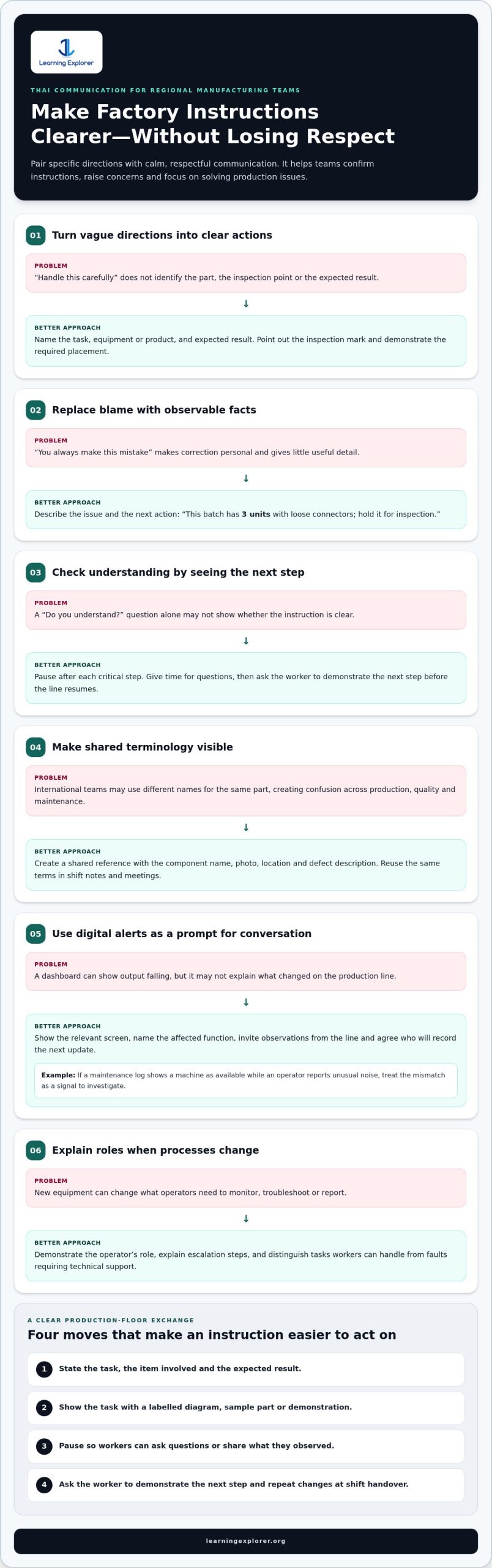
Start with short, specific instructions. State the task, the equipment or product involved, and the expected result. Instead of saying, “Handle this carefully,” identify the component, point out the inspection mark and demonstrate the required placement. Pause after each critical step. Give employees time to ask questions or show what they understood before the line resumes.
Separate production facts from assumptions. If an electronics batch fails inspection, identify the lot, the defect and the next action. Avoid saying, “You always make this mistake.” A neutral statement such as, “This batch has three units with loose connectors; hold it for inspection,” gives workers information they can act on. Specific details help supervisors trace the issue without turning correction into blame.
- Use one instruction for one action, especially near moving equipment.
- Pair spoken directions with a labelled diagram or sample part.
- Ask the worker to demonstrate the next step, rather than asking only, “Do you understand?”
- Repeat changes at shift handover, using the same terms and sequence.
Demonstration helps when teams use different vocabulary. For a packaging change, show the reference sample, point to the seal, then ask the operator to prepare one unit. Compare it together before production continues. This creates a visible reference and helps distinguish a language gap from a process or equipment problem.
Use digital systems to reinforce, not replace, direct conversation. Thai manufacturers are adopting tools such as real-time production monitoring, digital maintenance tracking, inventory platforms and data dashboards. A dashboard may show output falling, but a supervisor still needs to explain what changed and invite observations from the line. Show the relevant screen, name the affected function, then agree who will record the next update.
Digital rollouts are often tested on specific production lines or at individual facilities before wider expansion. During a pilot, managers should clearly explain what the tool involves, which observations workers should report, and how to raise concerns. For example, if a maintenance log shows a machine as available while an operator reports unusual noise, treat the mismatch as a signal to investigate. Clear reporting protects the quality of the data.
Automation also changes workplace conversations. Thai manufacturers are selectively automating repetitive, physically demanding or quality-sensitive work with robotic arms, automated material handling and semi-automated inspection. Operators may need to supervise equipment, troubleshoot basic issues and interpret production data. Explain the operator’s role in the new process, demonstrate escalation steps, and distinguish tasks workers can handle from faults requiring technical support.
Keep terminology consistent across international teams. A Singapore manager, Thai supervisor and foreign technical specialist may use different names for the same part. Create a shared reference with the component name, photo, location and defect description. Use the same wording in shift notes and meetings. This practical communication tool can reduce confusion between production, quality and maintenance teams.
Regional manufacturing teams also benefit from language learning grounded in real workplace exchanges. Practise greetings, polite requests, clarification and basic production vocabulary through realistic scenarios. For example, rehearse asking an operator to repeat a measurement or explain a machine stoppage. Thai language ability can be an advantage, but clear visuals, consistent terminology and attentive listening remain essential across Thailand’s diverse workforce.
When introducing new operational protocols, ensure teams understand what the pilot involves, which observations workers should report, and how to raise concerns. Explain relevant protections in concrete terms as well: for time not worked because of work-related injury or illness, Thai employers pay compensation at 70% of the employee’s monthly wages, up to THB 14,000 per month. Companies that provide worker housing near production facilities typically reduce annual turnover to 8-10%, a point managers can include in discussions about workforce support.
Communication should also clarify obligations relevant to the operation. Manufacturing operations in Thailand may require factory licences from the Ministry of Industry, and food-related businesses in Thailand must comply with Food and Drug Administration regulations. Explain these requirements in terms relevant to each worker’s role, and make clear where questions about procedures or responsibilities should be raised.
Thai workplace etiquette and face-saving
In Thailand, workplace etiquette can shape how people raise concerns, respond to instructions and discuss mistakes. Face-saving means protecting dignity during an interaction, not avoiding accountability. If a packaging error appears on a shift report, for example, discuss the specific issue calmly rather than naming and shaming an operator in front of colleagues. Standards still matter. A respectful approach keeps attention on correcting the process and preventing a repeat.
Start interactions with a courteous greeting and an even tone. In a morning production meeting, acknowledge the team before reviewing output or safety priorities. Give people time to respond, especially when the topic is unfamiliar or managers from another country are present. A pause does not automatically mean agreement or refusal. Invite a specific response, such as asking the line lead to describe the next action or identify a concern.
Use private conversations for individual corrections. If an operator misses a quality check, arrange a quiet discussion away from the production line. Describe the expected check and ask what made it difficult. Avoid comparing employees in public. A supervisor can still record the operational issue and agree on a follow-up. This separates the person from the problem while keeping quality expectations clear and structured.
Hierarchy can influence how concerns move through an established team. A new foreign manager may hear information first from a Thai supervisor rather than directly from every employee. Respect that position while creating more than one channel for feedback. Ask the supervisor for their view, then invite operators to share observations during a small process review. This can surface practical details without bypassing established responsibilities.
- Correct a process privately, then restate the required standard to the full team without identifying anyone.
- Ask open, concrete questions, such as, “Which step slowed the line this morning?”
- Recognise specific contributions, such as careful inspection or a useful maintenance observation.
- Discuss sensitive topics, including income or work-permit concerns, with discretion and clear boundaries.
Interpret non-verbal cues carefully. A quiet response during a corporate meeting may reflect respect, uncertainty or a wish to avoid public disagreement. Don’t treat silence as confirmation. Offer a lower-pressure way to contribute, such as inviting the team to share concerns with its supervisor after the meeting. Then return to the issue with a clear summary of decisions and responsibilities.
Etiquette matters in cross-functional work, too. In Thailand’s automotive and food processing sectors, a production change can affect quality, logistics and maintenance at once. Bring the relevant functions together, explain the reason for the change and let each role describe its impact. If a concern emerges, acknowledge it before deciding next steps. This keeps operational discussions constructive in Southeast Asia’s competitive industrial environment.
Keep cultural awareness practical, not prescriptive. A Thai colleague’s preferences may differ from another employee’s, so observe their response and adjust respectfully. For instance, ask whether they would prefer to discuss a technical correction privately or review it with the shift group. When discussing incentives or a new process, explain the purpose and invite questions. Clear, respectful Thai phrases can make these exchanges more collaborative.
Managers based in Singapore can build this skill by practising greetings, polite requests and ways to clarify concerns. Rehearse a short exchange about a delayed component or a safety observation before a real meeting. To strengthen your everyday Thai, explore conversational Thai practice for workplace interactions.
How can managers handle performance reviews, feedback, and conflict with Thai factory teams?
Make reviews specific, balanced and focused on work employees can influence. For a machine operator, discuss inspection accuracy, handover notes and response to downtime rather than labelling someone “careless.” Bring examples from the review period, such as a completed maintenance log or a missed quality check. Explain the standard, describe the observed result, then agree on a practical next step. This gives both sides a shared basis for discussion.
Before a review, gather information from the relevant functions. A production supervisor may see output, while a quality lead understands defects and a maintenance technician knows recurring equipment faults. Compare these perspectives before drawing conclusions about an employee. If a production target was missed because a component arrived late, separate that constraint from the worker’s performance. Fair context makes a review more credible and helps identify useful support.
Begin the conversation by asking for the employee’s perspective. Ask what went well, what felt difficult and what support would help. Then share your observations with concrete examples. “The last two handovers didn’t include the machine’s reset status” is clearer than “Your communication is poor.” Pause and listen. If language differences make a point unclear, restate it in simpler words and invite the employee to explain their understanding.
- Describe the evidence: identify the task, shift or output involved.
- Explain the impact: connect the issue to quality, safety or the next team’s work.
- Ask for context: listen for process barriers, unclear instructions or training needs.
- Agree on follow-up: record the action, owner and review point in plain language.
Keep performance notes factual and consistent. Record what happened, when it happened and what response followed. For example, document that a worker stopped a line after noticing a damaged guard, rather than describing them as “difficult.” Apply the same criteria across comparable roles. A structured record supports continuity between supervisors and prevents one tense exchange from defining an employee’s overall contribution.
Address conflict early, before assumptions spread across shifts. If a Thai team lead and a regional quality manager disagree about a rejected batch, meet with them privately. Let each person explain the sequence without interruption. Summarise the shared facts, identify where accounts differ, then review the batch record or inspection evidence together. Keep the discussion focused on the work decision, not on status or whose account should automatically prevail.
When emotions rise, slow the discussion and clarify the immediate objective. Say, “We need to decide whether this batch stays on hold,” rather than debating personal intent. If either person needs time, agree on when to resume and preserve the relevant records. After reaching a decision, explain it to affected employees neutrally. This prevents private disagreement from turning into confusing instructions on the production floor.
Close each review or conflict discussion with a concise written summary. Include the concern, the agreed action, who owns it and how the result will be assessed. Ask the employee or supervisor to restate the next step, then invite corrections to the record. Managers who want more confidence using Thai in respectful feedback conversations can practise Thai for workplace discussions.
Review the records before deciding what happened. Close the discussion by confirming the decision, its reason and any next step in plain language. If the evidence is incomplete, explain what information is still needed and arrange to revisit the issue when it is available. Keep the conversation private and give each person a chance to correct factual misunderstandings. A calm follow-up can prevent a disagreement from becoming a judgement about someone’s character or standing with the team. If an issue may lead to formal action, involve the appropriate manager or HR contact and apply the process consistently. Make sure employees understand what support or change is expected, and give them the chance to raise practical barriers before conclusions are finalised.
Timing and employment context matter too. A typical Bangkok middle manager works from 9:00 to 18:00 with a one-hour lunch break, so managers can plan a private conversation within working hours and allow enough time for both sides to speak. Keep review decisions distinct from statutory employment obligations. From October 2025, businesses in Thailand with 10 or more employees must contribute to the Employee Welfare Fund. The article states that severance for employees in Thailand with 1-3 years of service equals 90 days of wages. In Thailand, severance for employees with 3-6 years of service equals 180 days of wages. In Thailand, severance for employees with 6-10 years of service equals 240 days of wages. Severance entitlements can depend on an employee’s length of service and the circumstances of termination. When a conflict raises questions about discipline or continued employment, check the applicable requirements with HR rather than treating a performance review as a substitute for that process.
Learning Explorer: Conversational English Course
Learning Explorer’s Conversational English Course can help managers practise everyday discussions with regional colleagues, including check-ins, shift handovers and conversations that depend on clear questions. For more formal workplace language, the Business English Course offers another option. Choose a focus based on where communication feels hardest, whether in casual team interactions or structured business discussions. Stronger English can complement Thai learning, helping you clarify responsibilities and share information across teams while maintaining respectful, face-aware communication. Explore the courses with Learning Explorer at learningexplorer.org.
Make your next team conversation count
Building confidence in Thai for managing regional manufacturing teams takes ongoing practice through everyday conversations. Start by choosing one interaction to improve, such as opening a shift discussion, asking a colleague for input or clarifying a decision. Consistent practice can help you approach these moments with greater care and confidence.
Language learning can also support broader regional communication. Learning Explorer offers a Conversational English Course, a Business English Course and a Conversational Mandarin Course. Choose the learning focus that matches the conversations you want to handle more comfortably, then put that practice to use in your next workplace interaction.
Contact Learning Explorer to explore a suitable course and take your next step with confidence.
Frequently Asked Questions
What Thai language skills are useful for managing manufacturing teams in Thailand?
Prioritise listening and vocabulary for quantities, dates, equipment status and production locations. These skills help distinguish, for example, a reference to line two from a reference to batch two. Practise asking someone to repeat a measurement, confirm a delivery date or explain whether a machine is ready. Learning common polite forms can also keep requests professional. Pair spoken practice with the terms and labels your team uses each day.
What are common Thai workplace communication styles and hierarchy in factories?
Communication practices vary by workplace, so learn the factory’s actual decision paths instead of relying on assumptions. Clarify who can stop a line, authorise a process change or sign off on a quality deviation. Ask the site lead how an operator should escalate a suspected defect during a shift. Share that route with each team, and make sure handovers identify the responsible person and the next decision.