The best Korean-for-K-pop-lovers class in Singapore isn’t necessarily the one built around songs; it’s the one that matches your current level and learning goals. There’s no single class level or fee that suits every learner, so compare what each pathway teaches and how its lessons are structured. Fees depend on factors such as class format, lesson duration, and starting level, and are provided after a quote request.
If you love singing along but want to understand more than the chorus, you’re not alone. A well-matched learning path can help you build useful Korean skills while keeping your interest in K-pop close to the experience. This guide explains how instructors can use music and related materials in lessons, what to expect from a trial and level assessment, who different classes may suit, and how to compare fees fairly. You’ll also see how to choose between a conversational pathway and study focused on a particular starting level, so you can make a confident choice without getting lost in the options.
Key Takeaways
- Compare instructors by how they make lessons relevant to your goals, including whether music helps you practise practical Korean.
- Use a trial and assessment to understand the class format and identify a suitable starting level.
- Choose a class based on its age range and learning environment, not just its K-pop theme.
- Compare fees by looking at what the class format and package include, rather than focusing on the headline price alone.
- Match your pathway to your current skills: build a foundation first, then progress as your confidence and ability grow.
1. Instructor expertise and teaching approach
In Singapore, look for Korean classes that use song lyrics, music clips, or K-pop culture as lesson material. A conversation-focused class can also help you discuss artists and dramas. Notice whether activities connect listening, vocabulary, pronunciation, and speaking.
Instructor expertise matters because a catchy chorus can hide unfamiliar grammar and compressed pronunciation. Learning Explorer’s Korean classes are taught by certified native-speaker instructors who are also bilingual. This supports explanations of Korean expressions in context, rather than relying on memorised translations alone. For example, an instructor can help you distinguish a word’s dictionary meaning from how it works in a lyric or everyday conversation.
Look for a clear learning sequence. A useful song-based activity might start with listening for familiar words, then move to reading a short lyric excerpt, identifying repeated expressions, and practising them aloud. The instructor can then guide learners to use the new vocabulary in an original sentence. This connects music to language practice, rather than treating the lesson as karaoke or fan discussion alone.
K-pop offers varied material for this process. The genre includes electronic, hip hop, pop, rock, and R&B, so lessons can explore different rhythms and vocal styles. A slower passage may help beginners hear word boundaries. A faster rap section can prompt learners to notice how pronunciation changes during performance. In either case, an instructor should focus the activity on a manageable excerpt and explain the language before asking learners to repeat it.
Cultural context can make vocabulary easier to remember. Non-Korean idols have been part of the industry since the 1990s. NewJeans and Stray Kids each have two Australian members, while S.E.S had one Japanese member. These examples can lead to discussions about group roles, interviews, and how artists communicate across languages. They also give learners familiar names to use when practising questions, descriptions, and short opinions in Korean.
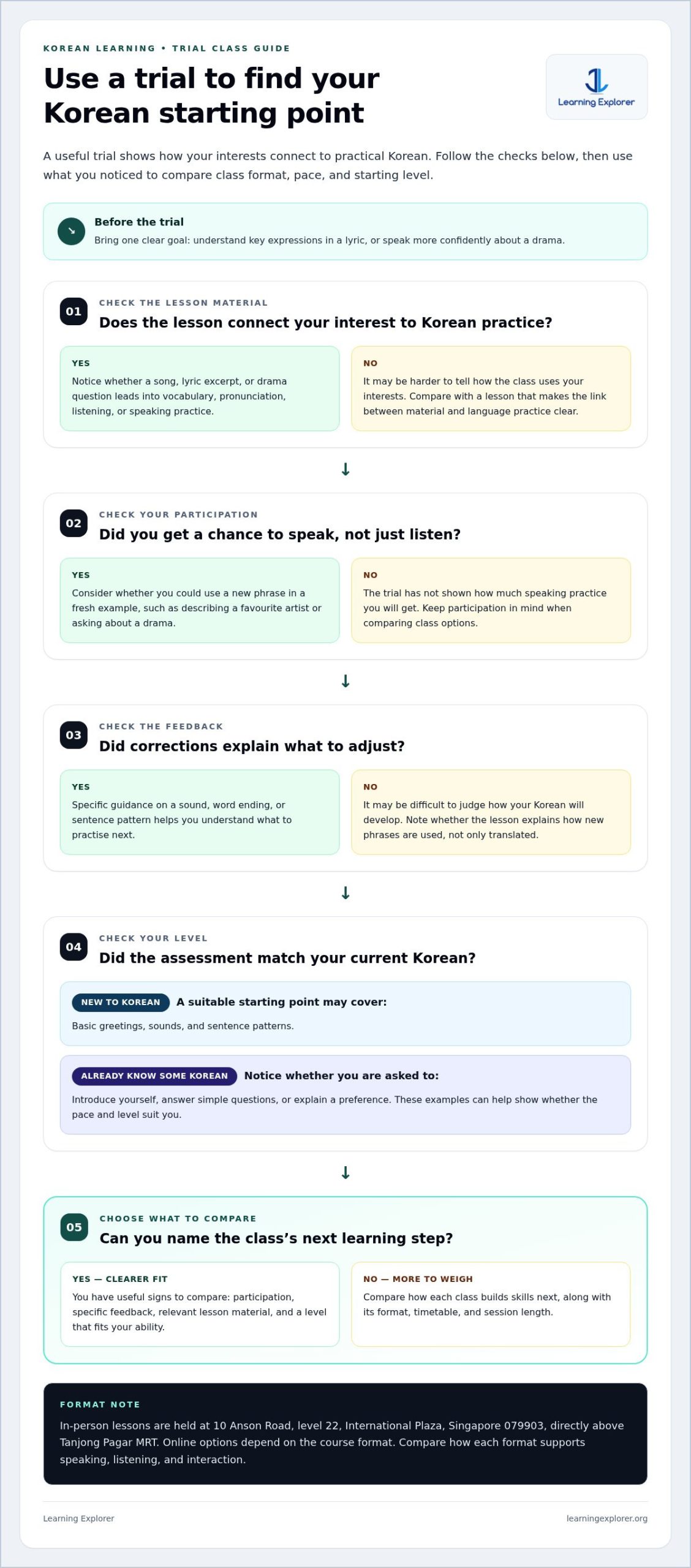
In a group, check whether the instructor gives each learner time to speak, not just listen to explanations. Notice whether feedback identifies a specific sound, word ending, or sentence pattern. Consider whether you’ll leave able to use an expression in a fresh example, such as describing a favourite song or asking about a drama. That signals a lesson connecting K-pop interests with usable Korean skills.
Options include Korean lessons that use K-pop songs and culture for language practice, along with conversation-focused classes where fans can discuss artists and dramas. Learning Explorer’s language courses are taught by certified native-speaker instructors who are bilingual.
That signals an approach where language practice extends beyond simply enjoying the music. Stephanie Phua has more than a decade of experience working with multinational brands. When comparing instructors, consider whether their guidance helps you carry expressions from a song into clear, independent communication.
2. Trial class format and assessment
Singapore learners can choose a conversational Korean class and use K-pop interests as practice material. For example, bring a short lyric excerpt or a question about a drama to explore relevant vocabulary and expressions. Class content and format differ, so use a trial to understand how a school connects your interests with language skills.
In-person lessons are held at 10 Anson Road, level 22, International Plaza, Singapore 079903, directly above Tanjong Pagar MRT. Online options depend on the course format. Before enrolling, compare how each format supports speaking practice, listening activities, and interaction with the instructor and other learners.
A useful first lesson gives you a feel for the teaching style, not just a taste of Korean vocabulary. Notice how the instructor introduces a new phrase, checks understanding, and helps learners use it in a fresh example. A sample activity might involve hearing a familiar expression, practising its pronunciation, then using it to describe a favourite artist or scene.
An assessment helps identify a starting point. If you’re new to Korean, consider whether the lesson begins with basic greetings, sounds, and sentence patterns. If you already know some Korean, notice whether the instructor asks you to introduce yourself, answer simple questions, or explain a preference. These examples can show whether the class pace and level suit you.
Use a short checklist after the trial:
- Participation: Did you get a chance to speak, rather than only listen?
- Feedback: Did corrections explain what to adjust, such as a sound or word ending?
- Relevance: Could you connect a lesson example to a song, group, or drama you enjoy?
- Next step: Do you understand what skills the class will develop next?
Schedules, lesson duration, and enrolment steps vary by school and course. Compare the stated timetable and session length with your weekly routine before deciding. A practical sequence is to choose a learning format, discuss your current Korean ability during assessment, select a suitable class level, and complete the school’s registration process. Keep these details in view so your decision reflects both your learning needs and availability.
A trial is most useful when you arrive with one clear goal, such as understanding a lyric’s key expressions or speaking more confidently about a drama. Write down what felt manageable and what needs practice. Then use those observations to compare your options, including Korean conversation learning, and choose a class that makes each lesson feel purposeful.
Class age range
In Singapore, adult Korean classes are intended for adult learners, while children’s classes serve younger learners. Age suitability and Korean proficiency are separate considerations: choose a group that fits the learner’s age, then match its level to what they can already understand and say.
K-pop interest can start early, but a music programme isn’t the same as a language class. A 12-year-old attended a Singapore K-pop training camp, while a 17-year-old camp attendee was an incoming vocal training student at Singapore Raffles Music College. Those examples show a range of ages engaging with K-pop training, not the age eligibility of a Korean language class. For language study, check whether the class is designed for adults or children before considering its music theme.
Age can shape lesson materials and group dynamics. An adult learner might want to discuss a concert, read a short artist interview, or understand phrases heard in a drama. A younger learner may respond better to short speaking activities and familiar topics. These are examples of adapting instruction, not fixed rules. The right format depends on the learner’s needs and the class’s intended audience.
Proficiency also matters. A learner who knows Hangul but struggles to form sentences has different needs from someone who can already describe a favourite group in Korean. Consider these practical markers:
- New to Korean: The learner is still building familiarity with sounds, basic vocabulary, and simple expressions.
- Some prior study: The learner recognises common words but needs practice forming replies or describing interests.
- More confident: The learner can hold a simple conversation and wants to express opinions with greater detail.
Use a short self-check before selecting a group. Can the learner introduce themselves in Korean? Can they recognise familiar words in a lyric, even without understanding every line? Can they answer a simple question about a favourite song? These examples help distinguish listening familiarity from speaking ability. Enjoying NewJeans or Stray Kids can inspire study, but fandom alone doesn’t indicate proficiency.
For adults balancing work and study, a conversation-oriented class may suit goals such as discussing music, performers, or Korean dramas. Younger learners need a class designed for their age and learning needs. In either case, choose based on age eligibility, current skills, and what the learner wants to do next. A clear match helps learners participate confidently and turn K-pop enthusiasm into steady Korean practice.
4. Class prices and package rates
Korean class fees in Singapore vary by course, proficiency level, and duration. Learning Explorer’s fees are charged for structured group or individual language training, with pricing depending on the language, level, and course duration. Compare fees in S$ and check that each covers a similar learning arrangement.
A headline fee alone won’t show whether two options offer equal value. For example, one package may focus on group conversation, while another may include individual instruction. Compare the learning time, level of feedback, and opportunities to practise speaking. A K-pop fan hoping to discuss lyrics needs a different measure of value from someone seeking basic listening practice.
Before comparing packages, identify what matters to you. Do you prefer a group or individual setting? Would online or in-person learning fit your routine? How much instructor interaction do you need? These preferences help clarify what a quoted fee covers. Don’t assume that a package with more sessions is automatically the better fit.
Use this checklist to assess each option consistently:
- Class format: Compare group lessons with individual instruction, if both are offered.
- Lesson duration: Check the length of each session, not only the total package cost.
- Class size: Consider how much speaking time you may have in a group.
- Included materials: See whether resources for vocabulary, listening, or lyric practice are part of the package.
- Learning focus: Match the course content to your goal, such as discussing a song or improving everyday conversation.
For a practical comparison, imagine two packages with different session lengths and formats. Work out what each includes before weighing the total fee. If one option includes structured feedback and another focuses on group conversation, decide which better supports your current goal. A learner inspired by K-pop dancing may value conversation about performances, while another may prioritise listening to spoken Korean.
Also consider how the package fits your schedule. A class that conflicts with work or other commitments can be difficult to attend consistently, even if its fee seems attractive. Compare the stated timetable and enrolment terms alongside the learning format. Clear information makes it easier to understand the commitment before you choose.
Finally, compare like with like: the same format, similar session duration, comparable class size, and matching learning focus. That gives you a more useful basis for evaluating Korean class fees in Singapore without relying on an unsupported “average” price. Keep your priority in view, whether it’s speaking more confidently, understanding familiar expressions, or discussing K-pop with classmates.
5. Foundation, intermediate, and advanced pathways
Choose a Korean pathway based on what you can do now, not how many songs you recognise. A listener may know a chorus by heart yet still need a foundation in reading, vocabulary, and sentence structure. Use familiar K-pop or drama material as motivation to practise, then build skills in a clear sequence.
Foundation: Start here if Hangul, basic greetings, or simple sentence patterns still feel unfamiliar. A practical first goal could be reading an artist’s name, recognising a greeting in a drama, and introducing yourself in Korean. Work with short phrases before tackling a full lyric. For example, identify a greeting, practise its sounds, then use the same expression in a new conversation.
Intermediate: Move into this pathway when you can understand familiar expressions and form simple sentences, but need more range. You might describe why you enjoy a song, summarise a drama scene, or ask a classmate about a favourite performer. Use a short dialogue to practise: identify an expression, notice how it fits the sentence, and adapt it to share your own opinion.
Advanced: Choose advanced work when everyday conversation feels manageable and you want to explain ideas in more detail. You could compare performances, discuss a character’s choices, or summarise an interview in your own words. The focus shifts from recognising familiar phrases to choosing precise expressions and connecting thoughts smoothly.
Use these checks to identify a suitable starting point:
- Reading: Can you read Hangul without relying on romanisation?
- Listening: Can you catch familiar phrases in a short clip, even when you miss other words?
- Speaking: Can you introduce yourself and answer a simple question in Korean?
- Expression: Can you explain a preference, rather than naming a favourite song or drama only?
Your answers may point to different levels across skills. For instance, you might read Hangul comfortably but hesitate during conversation. In that case, prioritise speaking practice instead of assuming every skill belongs at the same stage. Bring a concrete goal, such as describing a scene without translating each sentence word for word.
Progress when the current work feels usable. If you can read short phrases and form basic replies, try longer exchanges. If an advanced discussion feels difficult, return to a shorter example and strengthen the foundation. A well-chosen pathway keeps K-pop and drama interests connected to active Korean practice. Explore Korean conversation learning to take a practical next step.
Learning Explorer: Conversational English Course
If your language goals extend beyond Korean, Learning Explorer offers a Conversational English Course. Practise everyday English conversations for work, travel, or social settings, while keeping your Korean study focused on K-pop and dramas. Choose this course when you want to build confidence expressing ideas in English, not as a replacement for Korean learning.
If your goals are more specific, the Business English Course focuses on workplace communication. Conversational Mandarin and Business Mandarin Courses offer pathways for learners with different Mandarin goals. Consider which language you want to use, and in what situations, before choosing a course. That simple distinction helps connect study with everyday needs.
Contact Learning Explorer to discuss which course best fits your language-learning goals.
Turn your interest into your next learning step
Your favourite songs and dramas can be more than entertainment. Give your Korean practice a personal purpose: understanding an expression, sharing an opinion, or following a conversation with greater confidence. A Korean class for K-pop lovers in Singapore can connect that motivation with steady learning, one practical goal at a time.
Choose what you want to do next, then take a manageable first step. You might focus on speaking about music, understanding dialogue, or becoming more comfortable using Korean in everyday situations. Keep your goal specific so you can recognise your progress as your skills grow.
If you’re ready to explore language learning beyond Korean, Learning Explorer also offers courses for everyday and workplace communication. Contact Learning Explorer to explore classes and find a learning direction that fits your goals. Your interest can be the beginning of a rewarding new skill.
Frequently Asked Questions
How much do Korean classes for K-pop lovers cost in Singapore?
Fees vary by course, proficiency level, and duration, so there isn’t one standard price for every learner. The cost depends on your chosen format and learning needs, and is provided after a quote request. Budget comparisons should also account for any registration or learning material fees. For example, compare the total course commitment and included materials, not just a per-session figure, when weighing options in Singapore.
Do Singapore Korean language schools offer trial lessons or short K-pop workshops?
Trial lessons and short K-pop workshops are different from structured Korean courses, so don’t assume they’re included as standard. Korean classes in Singapore are available in physical and online formats. A trial or workshop can help you experience the lesson style before making a longer commitment, while a structured course provides ongoing language learning. Consider whether you want a brief introduction or a planned pathway for building Korean skills.
Which Korean classes in Singapore are best for learning conversation through K-pop?
A Korean class for K-pop lovers in Singapore is a strong fit when it gives you regular speaking practice alongside language instruction. Learning Explorer offers Korean classes, including group and private options. Look for opportunities to turn your interest into conversation, such as describing a performance, sharing an opinion about a song, or talking about a drama scene in Korean.
What should I check before enrolling in a Korean class in Singapore?
Before enrolling, match the class’s age group and level to your needs, then review its teaching format and timetable. Set a concrete goal, such as speaking about a favourite group or understanding dialogue in a drama. Also compare the full course fee, including registration or materials charges, and decide whether physical or online lessons fit your routine. These details can help you choose a class you’ll attend consistently.
What is the class schedule, duration, and enrolment process?
Schedules and lesson duration vary by school and course. Select a learning format, discuss your Korean ability during assessment, choose a suitable class level, and complete the school’s registration process.