Korean feels more natural when you connect words directly to their meanings instead of routing every sentence through English. To learn how to stop translating in my head when speaking Korean, practise linking words to images, objects, actions, and complete phrases. Mental translation is common when you’re starting out, but regular listening and speaking can help you build more direct recall.
It’s frustrating to understand a sentence but pause while assembling an answer word by word. That doesn’t mean you’re failing; it means your mind is still relying on a familiar route. This guide shares practical ways to strengthen Korean-to-meaning connections, use simple self-talk, and respond without translating every thought. You’ll also learn how immersion can help you notice patterns and follow the gist of a conversation, even when you miss a few words. Start with familiar topics, keep practice manageable, and let direct Korean thinking develop through repeated use.
Key Takeaways
- Notice Korean sentence patterns as complete structures, so you can respond without rebuilding each thought in English.
- Connect new words with objects, images, and experiences to make their meanings easier to recall directly.
- Follow the overall message in a conversation instead of pausing for every unfamiliar word.
- Use Korean listening and speaking practice to build familiarity with natural pronunciation, vocabulary, and grammar.
- Try shadowing short audio passages to practise rhythm and pronunciation, then notice which phrases feel easier to say.
1. How do you stop translation in your head?
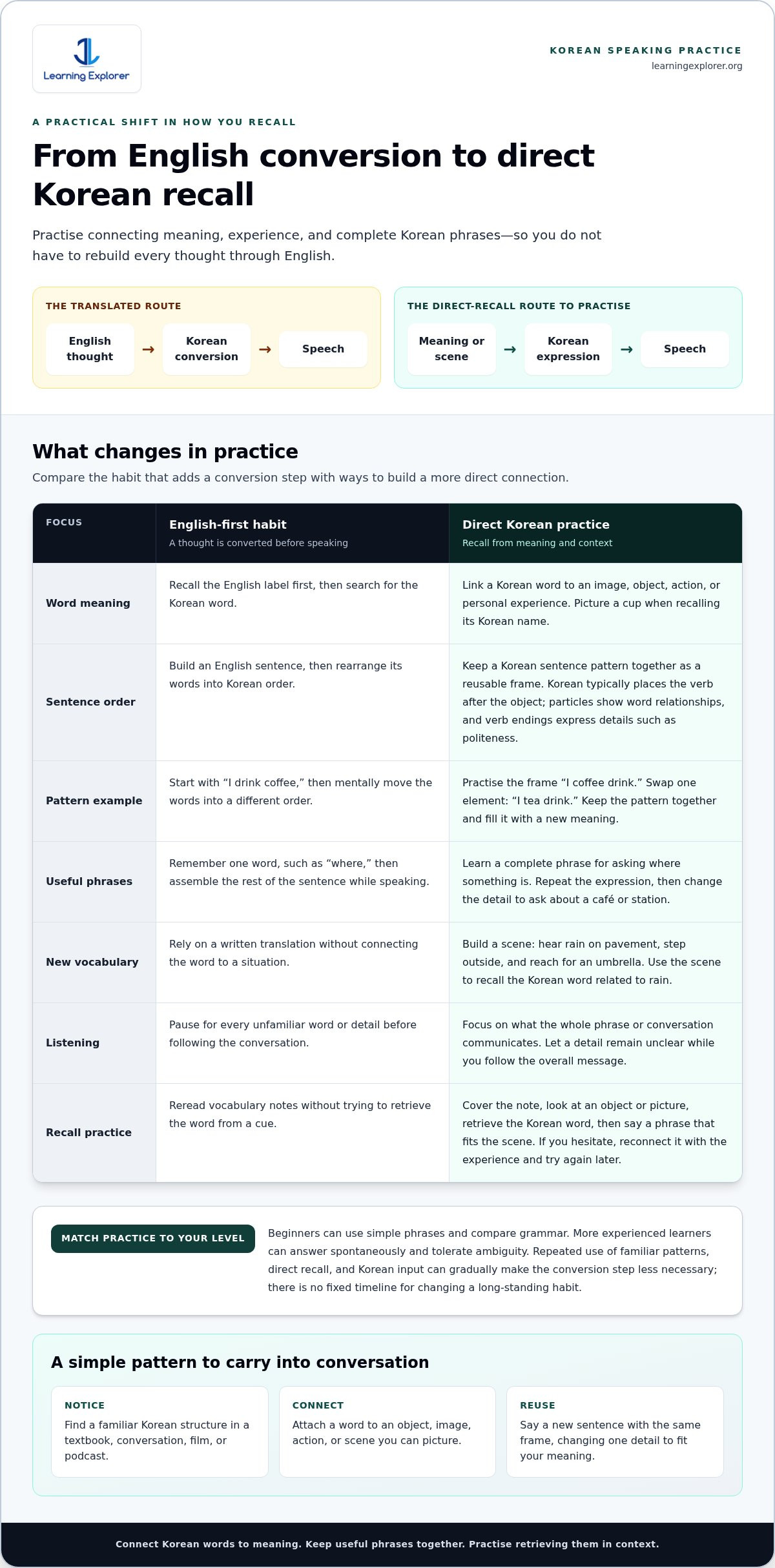
Begin by noticing the three steps in a translated response: thought, conversion, and speech. Instead of translating each English word, practise retrieving a Korean expression directly from its meaning. For example, picture a cup when recalling the Korean word for “cup,” rather than first recalling its English label. This gives your mind a direct connection to draw on in conversation.
Korean sentence order and grammar can add another pause. English commonly puts the subject, verb, and object in that order, while Korean typically places the verb after the object. Particles show how words relate, and verb endings express details such as politeness. If you build an English sentence first and then rearrange it, you add a conversion step before speaking.
That habit is understandable. Beginners often translate because comparing Korean with English helps them notice unfamiliar grammar and sentence structure. But translation can become a routine after years of language use. At intermediate and advanced levels, direct comparisons become less useful: expressions, nuances, and inflections may not have exact English matches. Focus on what the whole phrase communicates, even if a detail remains unclear.
Practise a Korean pattern as a reusable frame. Start with a familiar idea, such as “I drink coffee,” then notice the Korean-style order: “I coffee drink.” Keep the pattern together instead of mentally moving each English word. Next, swap one element: “I drink tea” becomes “I tea drink.” The goal isn’t to speak in English word order; it’s to recognise the Korean structure and fill it with a new meaning.
Learn complete phrases, not just isolated vocabulary. A phrase for asking where something is gives you a ready-made structure, while a single word for “where” leaves you to assemble the rest. Repeat the full expression, then change one detail, such as asking about a café or station. This helps you recall both grammar and vocabulary in a useful context.
Connect patterns across your learning materials. If a textbook example puts the verb at the end, listen for that structure in a conversation, film, or podcast. When you notice it again, say a new sentence using the same frame. This helps your brain recognise Korean patterns as language, rather than as sentences waiting to be converted into English.
For vocabulary, pair a mental image with a word’s meaning. Picture rain on a window when learning a word related to rain; imagine opening an umbrella as you recall it. This observation-based approach gives the word an experience of its own, instead of making English the only route to meaning.
Match practice to your level: beginners can use simple phrases and compare grammar, while more experienced learners can answer spontaneously and tolerate ambiguity. There’s no fixed timeline for changing a habit built over years. Repeated use of familiar patterns, direct recall, and Korean input can gradually make the conversion step less necessary.
2. Directly linking words to meaning and experience
Give each Korean word a meaning you can experience, not just an English equivalent. For a word connected with warmth, notice a warm mug in your hands. Recall its heat, shape, and smell as you practise saying the Korean word. These multiple cues support recall without relying on an English label first.
Use familiar objects as prompts throughout your day. When you see a door, connect its Korean name with the handle, the action of opening it, and the room beyond. At a café, notice a cup, the sound of pouring, and the taste of your drink. These real scenes help vocabulary attach to actions and surroundings, rather than remain a translation on a page.
Make the connection active. Choose an object, name it in Korean, then do something with it. Pick up a book, open it, and describe what you’re doing with the Korean words you know. If you can’t recall a word, use a simpler phrase or point to the action. Keep communicating. Retrieving meaning directly is useful practice, even when your first attempt feels incomplete.
Build a small scene around new vocabulary. To learn a word associated with rain, imagine stepping outside, hearing drops on the pavement, and reaching for an umbrella. Later, when it rains, revisit that scene and retrieve the Korean word. You’re not memorising an isolated sound; you’re tying it to a familiar situation that can help bring it to mind naturally.
Give each new word more than one personal connection. For a word related to food, connect it with a meal you enjoy, the smell of cooking, or a conversation at the table. Then use it in a short phrase about that experience. Personal details make the example easier to picture and give you a useful starting point for speaking. Avoid making a long vocabulary list without context; choose words you can use in familiar situations.
Review through recall, not just rereading. Cover a vocabulary note, look at the object or picture, and try to retrieve the Korean word. Then say a phrase that fits the scene. If you hesitate, reveal the answer, reconnect it with the experience, and try again later. You can test whether these associations are ready for conversation through structured Korean speaking practice, where a prompt gives you a reason to retrieve a phrase in context.
You can also label familiar objects with Korean vocabulary, building associations between the words and the objects. Seeing labels in everyday settings gives you another practical cue for recall.
3. How reduced translation can improve response speed and listening
Conversation moves quickly, so train your attention to recognise signals that a turn is changing. A rising voice may indicate a question, while a pause can mark the handover between speakers. Notice these cues before planning your reply. They help you judge when to listen closely and when to take your turn, instead of waiting until you’ve mentally processed every sound.
Korean sentence endings offer useful listening clues. Listen for the final verb ending to distinguish a question, statement, or request. For example, a familiar rising ending can signal that the speaker expects a response. Try listening to a short exchange and identifying the speaker’s intention before checking a transcript. This builds quicker recognition of the conversation’s purpose.
Also notice topic markers and particles as signposts. You don’t need to translate each one aloud; use them to track what a sentence is about and how its details relate. If a speaker mentions a person, then adds a place or time, hold those details as separate pieces. Organising them mentally can make a reply easier to prepare once the sentence ends.
To practise, listen to a Korean exchange and mark where each speaker’s turn begins and ends. Then replay it and identify one clue that helped you recognise a question or topic change. This isn’t a test of complete comprehension. It trains you to follow the structure of an exchange and prepare for the next turn.
Another useful technique is selective listening. Choose one feature for each pass, such as sentence endings, names, or time expressions. On a later pass, focus on how the speakers signal agreement or surprise. Narrowing your attention gives each listening session a clear purpose and helps you notice details that disappear when you try to decode everything at once.
If you’re exploring how to stop translating in my head when speaking Korean, practise recognising intent before composing a response. Notice whether the speaker is asking, inviting, or checking information. Then choose a response that fits. This shifts the task from translating a complete sentence to understanding what the other person needs from you.
After a conversation, write down one listening cue that changed how you understood a turn. Perhaps a sentence ending revealed a question, or a pause showed the speaker had finished. Use that cue as the focus of your next listening exercise. Over time, this purposeful attention can help you keep pace and respond with less delay.
4. Immersion in the target language
Immersion means bringing Korean into ordinary routines, not understanding every sentence perfectly. Choose a familiar activity, such as breakfast, and add Korean input around it. Play a short Korean audio clip while preparing coffee, or read a simple Korean message during a break. Repeated contact with familiar subjects helps pronunciation, vocabulary, grammar, and sentence patterns feel less unfamiliar.
Use films for relaxed exposure rather than testing yourself on every line. Choose a Korean scene with a clear setting, such as friends meeting at a café. Watch for gestures, facial expressions, and repeated phrases that reveal the situation. Let unfamiliar words pass when the scene still makes sense. Later, revisit one short exchange and listen for how the speakers connect their words.
Podcasts can add natural speech to a routine, but choose an episode you can follow. One listener found it difficult to maintain focus beyond 20 minutes and preferred one episode per week. Treat that as a personal example, not a required schedule. If a Korean episode feels dense, choose a familiar topic, pause after a section, and note its main idea.
Build immersion across four skills: reading, writing, listening, and speaking. Read a short Korean post, write a brief response, listen to related audio, then summarise the topic aloud. For example, after reading about a meal, write what you would order and say why. Meeting vocabulary in different contexts helps you recognise how it is used beyond one exercise.
Make input easier to process by starting with familiar material. A learner who enjoys cooking can follow a Korean recipe video, notice repeated food words, and listen for action verbs. The topic provides context even when some language remains unfamiliar. Once the main idea feels clear, try a new subject, such as travel or music, and notice which patterns carry over.
Speaking with a native Korean speaker adds real interaction. Ask about a familiar topic, listen to the response, then ask a follow-up question. Invite corrections on pronunciation or phrasing, and repeat the corrected expression in your next turn. A correction becomes useful input when you hear it, understand its context, and try it yourself.
Keep a small immersion routine that fits your day. For example, listen to Korean on your commute, read a short passage at lunch, and describe one evening activity aloud. You don’t need to decode every word for these activities to help. Consistent contact gives your mind more examples of how Korean sounds and works, supporting more direct understanding over time.
5. How can shadowing Korean audio improve speaking fluency?
Shadowing means speaking along with a Korean recording, following its words and rhythm. Unlike repeating after a long pause, you listen and speak almost at the same time. This gives your mouth practice producing connected speech while your ears follow the speaker. Use a clear, short passage about a familiar topic, such as ordering food or describing a daily routine.
Start with a short audio passage. Listen once without speaking and identify its topic. Then replay it while following the transcript, if available. On the next listen, speak alongside the recording. Don’t stop for every unfamiliar word. Focus first on keeping pace and noticing where phrases join or pause.
Choose material that feels manageable. A fast interview may overwhelm a beginner, while a simple dialogue offers clearer phrases to follow. For example, shadow a greeting and a short exchange about someone’s plans. Repeat the passage until you can follow its rhythm, then choose a different clip on a similar topic.
Listen for the shape of each phrase, not just its vocabulary. Notice which syllables sound stronger, where the speaker links sounds, and how the voice changes in a question. Copy the whole expression rather than pronouncing each word separately. This helps you practise Korean as connected speech, instead of assembling isolated sounds.
Record yourself shadowing the same passage. Compare your recording with the original and choose one detail to improve, such as a pause or ending. Write a short Korean sentence of your own, record it, then listen again. Hearing your voice can help you notice pronunciation habits that are hard to catch while speaking.
Turn the passage into a speaking prompt after shadowing. Pause the audio before a familiar reply and answer in Korean in your own words. If the speaker asks about weekend plans, give a simple response, then continue listening. This moves practice beyond imitation and encourages direct recall during a conversation.
Keep sessions focused and regular. A 20-minute daily speaking practice may help shift deeper language patterns more than a longer session held twice a week. Use part of that time for shadowing, then speak independently about the same topic. Familiar material makes it easier to notice progress in rhythm, recall, and response.
Pair shadowing with structured Korean speaking practice so you can try expressions aloud in conversation. Bring a short passage into your routine, shadow it, record one attempt, and use its topic for a spontaneous response. Each step connects listening with speaking, helping Korean phrases feel more accessible in real exchanges.
Learning Explorer: Conversational English Course
Learning Explorer offers a Conversational English Course for learners who also want to speak English with greater confidence. The Korean strategies above focus on building direct responses; guided conversation can also help you become more comfortable expressing ideas aloud in English. Consider the course if everyday English conversation is another learning goal, such as sharing an opinion, asking a follow-up question, or keeping a discussion moving.
Use your learning time with a clear purpose: identify situations where you want to communicate more naturally, then practise expressing those ideas in conversation. Building confidence in one language can complement your wider language-learning journey without replacing focused Korean practice.
Contact Learning Explorer or visit learningexplorer.org to learn more about the Conversational English Course.
Make Your Next Korean Conversation Count
If you’re working out how to stop translating in your head when speaking Korean, choose one small intention for your next conversation: respond to the meaning you catch, even if your answer is simple. Let the exchange keep moving. A short, genuine reply can create more room to listen, respond, and stay present than waiting for a perfect sentence.
After practising alone, bring a question or familiar topic into a conversation with a Korean speaker. Notice which moments feel easy and where you pause. Use those observations to shape your next practice, so each session connects to a real communication goal. Progress doesn’t require flawless speech; it grows as you keep taking part.
If you’d like support with your Korean learning, contact Learning Explorer to discuss your learning goals. Take the next step at a pace that feels manageable, and keep making space for Korean in your everyday conversations.
Frequently Asked Questions
How do you stop translation in your head?
Answer with the simplest Korean you can retrieve, then add detail only if needed. If someone asks about a meal, start by saying whether you liked it instead of planning a polished explanation. Keep familiar response types ready, such as agreement, preference, or a short reason. This reduces what you need to plan before speaking and helps you stay engaged in the exchange.
Why do Korean learners translate in their head while speaking?
Korean learners often translate because English feels like a reliable planning system. Conversation also asks you to choose words, grammar, and polite endings quickly. Monitoring every part of a sentence can make translation feel safer than speaking. Treat a pause as a cue to shorten your response, not as proof that you need to compose a perfect English sentence first.
How can I think in Korean instead of translating from English?
Shift your attention from wording to immediate meaning: identify the person, action, or choice, then express one part in Korean. During a shop conversation, focus first on whether you want an item, not on composing a full English explanation. Use familiar Korean you can retrieve, then add another thought. This helps you begin with intent rather than English phrasing.
What daily exercises help Korean learners speak without translating?
Try a short prompt routine: answer a yes-or-no question aloud, give one reason, then ask a related question. Rotate topics such as plans, food, or preferences, and notice which responses come without a written script. You can also listen to a Korean question and respond before replaying it. This practises quick retrieval while keeping your focus on meaning.
How can I build Korean vocabulary chunks and ready-made phrases for conversation?
Group complete phrases by purpose, such as opening a conversation, showing interest, asking someone to repeat, or changing the topic. Write each expression beside a situation where you might use it. Practise recalling the phrase from the situation, then adapt its ending or one key detail. This makes expressions useful across different exchanges, rather than tying them to one memorised dialogue.