What if choosing Korean lessons for a logistics role starts not with a job title, but with the conversations you want to handle? Search results can mix job vacancies with language courses, making it hard to decide what to do next. If you’re exploring korean for logistics and shipping management singapore, start by identifying the workplace exchanges where you’d like to communicate with greater confidence.
Korean may support communication with Korean-speaking colleagues and business counterparts, but learning the language does not guarantee a particular role or career outcome. This guide helps you turn work-related communication goals into practical learning priorities, compare study formats and teaching approaches, and choose a realistic starting point in Singapore.
Korean lessons are offered through Korean Explorer, a language school within the Learning Explorer group. You can compare online and in-person learning, consider the Korean course locations at City Centre, Jurong East, and Tampines, and weigh native-teacher instruction, communicative teaching methods, and materials sourced from Seoul National University against your preferences. The aim is to help you choose a way to study that fits your goals and routine.
Key Takeaways
- Separate a search for job listings from a search for Korean lessons. If your goal is stronger workplace communication, focus on course options.
- Use korean for logistics and shipping management singapore as a planning lens: identify the conversations you want to manage before choosing learning priorities.
- Compare learning options by format, teaching approach, location, and materials, then decide which factors matter most to you.
- Build a realistic study plan by listing your priorities, choosing a format, comparing locations, and setting a routine you can maintain.
Korean for logistics and shipping management in Singapore: course or job search?
You may be interested in Korean because your work brings you into contact with Korean-speaking colleagues, clients, or business counterparts. That interest can lead to two different questions: where to find openings, and how to develop language skills for professional conversations. Keeping those questions separate helps you choose a useful next step.
Logistics and shipping management can involve coordinating the movement of goods and communicating about services. The work varies by role, so begin with the interactions you encounter or hope to handle instead of assuming every position requires the same vocabulary. For a foundational overview, see What is Logistics?
For a broad overview of logistics and supply chain study in Singapore, this video offers another perspective:
What Korean communication goals could matter at work?
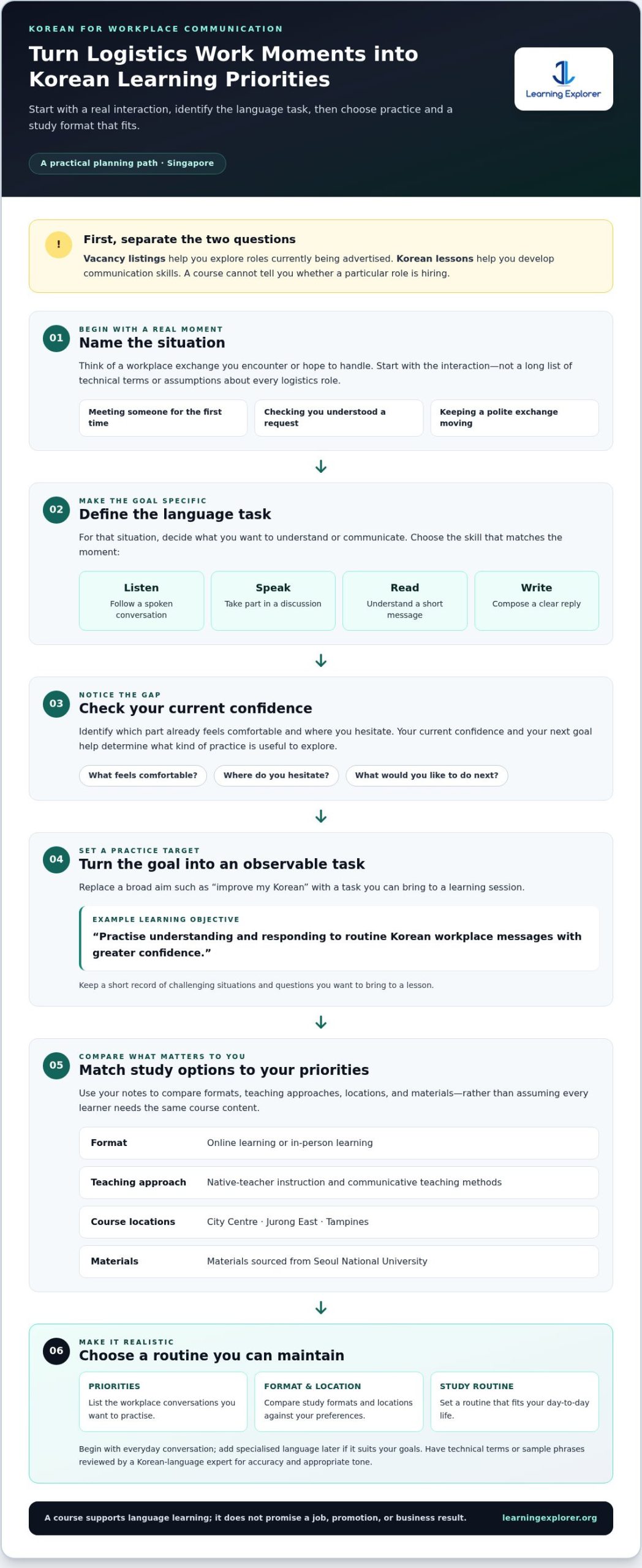
Start with situations you recognise, not a long list of technical terms. Consider where clearer communication could help you take part: meeting someone for the first time, checking that you understood a request, or keeping a polite exchange moving. These are useful learning goals to consider, not claims about what a particular employer expects.
- Introducing yourself and explaining your role clearly.
- Asking for clarification when a message, request, or detail is unclear.
- Using courteous language in routine workplace exchanges.
Choose one or two situations that matter most to you now. Build from everyday conversation, then add more specialised goals to your longer-term learning plan if they are relevant.
Is this guide for course seekers or job seekers?
Job boards help you search for vacancies. A language course helps you develop Korean communication skills. Those needs may both matter to your career planning, but they are not interchangeable: a course guide cannot tell you whether a particular role is hiring or what its requirements are. Here, korean for logistics and shipping management singapore describes a learning interest, not a promise of employment or advancement.
If you’re exploring work opportunities, keep that research separate from your study decision:
- Use vacancy listings to understand the roles currently being advertised.
- Use your day-to-day communication goals to decide what you want to practise in Korean.
This distinction gives you a practical starting point. You can research career opportunities on their own terms while choosing Korean lessons for the conversations you want to approach with greater confidence. Learning Korean can be a meaningful professional goal, but it does not guarantee a job, promotion, or business result.
Turn logistics and shipping work goals into Korean learning priorities
Once you know that lessons, rather than vacancy listings, are your focus, make your work goals specific. An aim such as “use Korean at work” can feel difficult to act on. Start by noticing recurring situations: a discussion you want to follow, a written update you need to understand, or a question you want to ask. Treat these as planning prompts, not assumptions about every logistics role or a particular course syllabus.
Singapore’s logistics sector includes a range of activities and work contexts. The Singapore’s Logistics Sector Overview offers industry context, but your own communication priorities should come from your role and goals. Connect a real situation to a language task, then decide what you want to practise.
Which Korean skills should a logistics professional prioritize?
Consider listening, speaking, reading, and writing separately. You might want to follow a spoken conversation, take part in a discussion, understand a short written message, or compose a clear reply. The most relevant skill depends on the communication you encounter, your current confidence, and what you hope to do next. Use these as planning prompts rather than assumptions about course content.
Specialised shipping terms can be difficult to use accurately without their work context. If you plan to study technical vocabulary or use sample Korean phrases, have them reviewed by a qualified Korean-language expert for accuracy and appropriate tone. Begin with familiar communication needs, then add specialist language as a longer-term goal if it suits your priorities.
How can learners make a professional goal manageable?
Turn a general ambition into an observable task. “Improve my Korean” is hard to track; “practise listening for key details in a routine work discussion” points to a specific skill. Keep a short record of situations that feel challenging and questions you want to bring to a learning session. These notes can help you compare learning options without assuming every learner needs the same content.
Use this four-part framework to shape each priority:
- Situation: Where does the communication happen?
- Task: What do you need to understand, say, read, or write?
- Current confidence: Which part feels comfortable, and where do you hesitate?
- Desired practice: What would you like to rehearse or strengthen?
Learning objective: I want to practise understanding and responding to routine Korean workplace messages with greater confidence.
Choose one immediate priority, such as everyday conversation, and keep broader professional ambitions on a separate list. This makes your course comparison more focused. If you’re ready to explore a Korean course in Singapore, use these priorities to guide your choice of format and teaching approach.
Compare Korean course options by format, teaching approach, and fit
Use the same checklist for each course you consider. Comparing concrete features makes it easier to see what fits your goals, routine, and preferred way of studying. Look beyond broad claims such as “fast progress” or “perfect for professionals.” For wider context on language-study formats, the language courses in Singapore guide offers a broader perspective.
Online or in-person Korean lessons: which fits your routine?
Think beyond convenience. Consider where you can focus, how you prefer to interact, and whether travelling to a class makes regular attendance easier or harder. If your schedule changes often, flexibility may be important. If you prefer face-to-face interaction, an in-person setting may carry more weight. Choose the format that feels sustainable alongside work and other commitments.
What teaching approach and materials should learners consider?
Look for specific information rather than superlatives. A clear description of a course’s teaching approach can help you judge whether it suits the way you want to practise. Consider whether the materials have an identifiable source and how they support your learning goals. Then compare those details with your priorities, such as improving listening or becoming more comfortable speaking.
Weigh these criteria together. A convenient setting may not suit you if the learning approach does not match your preferences. Materials are most useful when they support the skills you want to develop. Choose an option that feels practical, clear, and aligned with your next step.
Choose a Korean course location and study plan that work in Singapore
A practical study plan should fit around the week you already have. Before settling on a routine, look at which parts of your schedule are predictable, where you regularly travel, and how much time you can realistically set aside for learning. A plan that works with your existing commitments is easier to maintain than one built around an ideal week.
How should Singapore learners compare Korean course locations?
Think about your usual routes and when you would attend lessons. A location may look convenient on a map but feel less practical when you consider the journey from work or home. Also consider the learning environment where you feel most comfortable focusing. These factors can help you compare options without relying on assumed travel times, venue details, or schedules.
Make a short list of what matters most: a manageable commute, a setting where you can concentrate, or a study plan that fits around work. Rank your priorities rather than trying to optimise every part of the decision at once. Your preferred location should support consistency and leave enough energy for learning.
How can learners build a realistic Korean study routine?
Choose study periods that already fit your week, then treat them as appointments with yourself. Keep a brief note of questions, phrases you want to understand, or communication situations you’d like to practise. Taking these prompts to a learning session connects your study to your goals without requiring an elaborate preparation routine.
Use this four-step sequence to shape your plan:
- List your goals. Pick the communication skills you want to work on first and keep longer-term interests separate.
- Set your study preferences. Decide what kind of learning environment helps you focus and participate.
- Compare practical locations. Consider how each option fits your usual routes and commitments.
- Choose a routine. Identify study periods you can sustain and keep a short record of questions to revisit.
If you’re exploring Korean language learning for adults in Singapore, use these priorities to guide your decision. A clear plan can make the next step feel manageable, even when work and personal commitments compete for your attention.
When you’re ready, explore Korean lessons in Singapore and consider which option best fits the way you want to study.
Start learning Korean with Korean Explorer in Singapore
Choosing a language course is one step; making learning part of your routine helps you keep moving. Korean Explorer provides Korean lessons within the Learning Explorer group. Use the priorities you’ve identified to decide what to focus on first, and keep your expectations practical. Korean study can support your communication goals, but it cannot promise a particular job or workplace outcome.
What should you consider about Korean lessons?
Before starting, think about what would make learning feel relevant to you. Are you looking for a stronger foundation in everyday Korean, more confidence taking part in conversations, or a way to practise specific communication tasks? Choose a manageable starting point instead of trying to cover every possible workplace situation at once. You can revisit your goals as your needs and confidence develop.
It may also help to note what keeps you engaged when learning something new. Some learners prefer clear milestones; others like to build confidence through regular practice. Knowing your preferences gives you a useful way to reflect on whether a learning option suits you.
What should readers do before taking the next step?
Write down your main goal, the kind of practice that would help, and any questions you want to keep in view. Use those notes to make your decision rather than relying on assumptions about how Korean will affect your career. The Singapore language school guide can provide broader context as you consider what matters to you in a language-learning provider.
- Goal: Name one communication skill you want to develop.
- Practice: Identify the kind of activity that would help you work on it.
- Next step: Choose a starting point that feels realistic alongside your commitments.
Take your time, then move forward when you’re ready. Explore Korean lessons with Korean Explorer and choose a next step that suits your learning goals.
Make your next Korean-learning step count
A useful next step doesn’t need to solve every workplace communication challenge at once. Choose one situation you’d like to handle with more confidence, then use it to guide your early practice. As your needs change, you can adjust your priorities and build on what you’ve learned. That keeps korean for logistics and shipping management singapore focused on practical communication goals, not expectations of a particular job or career outcome.
Give yourself room to learn steadily. A clear priority can make it easier to decide what to practise and how Korean study fits alongside your professional responsibilities. You don’t need a perfect plan before beginning; start with a goal that feels relevant and manageable.
Ready to take that step? Explore Korean lessons with Korean Explorer and choose a learning path that fits your goals.
Frequently Asked Questions
Can Korean help with logistics and shipping work in Singapore?
Korean may support communication with Korean-speaking colleagues or business counterparts, depending on your role and the conversations involved. For korean for logistics and shipping management singapore, begin by identifying situations where you’d like to participate more confidently, such as introducing yourself or clarifying a message. Learning a language can help you develop communication skills, but it doesn’t guarantee a job, promotion, or business outcome.
What Korean should a logistics or shipping professional learn first?
Start with language for familiar, everyday exchanges. For example, practise listening for the main point, asking someone to repeat or clarify information, and responding politely. Your first priorities depend on your current level and work situation, so you don’t need to assume specialist shipping vocabulary is the right starting point. If technical terms or sample phrases are part of your plan, have them reviewed by a qualified Korean-language expert.
Does Learning Explorer offer Korean lessons in Singapore?
Yes. Korean lessons are provided through Korean Explorer, a school within the Learning Explorer group. This gives learners in Singapore a local option for studying Korean while keeping the Korean school distinct from the group’s other language schools. Before starting, write down what you want to practise and where you hope to use Korean. A short list can help you keep your learning goals specific and realistic.
Are Korean classes available online or in person?
Korean classes are available online and in person. Consider which setting fits your routine: online learning may suit you if you prefer to study without travelling to class, while in-person lessons may be a better fit if you prefer a classroom environment. Think about your work commitments, where you concentrate best, and how you like to interact while learning. Choose a format that feels manageable alongside your responsibilities.
Where can I take Korean lessons in Singapore?
Korean courses are available at City Centre, Jurong East, and Tampines. Compare each location with the routes you already travel and the learning environment you prefer. Avoid relying on assumed journey times or schedules; consider your own commute and commitments. If attending in person does not fit your routine, online classes are another option.
Who teaches Korean at Learning Explorer?
Korean lessons include instruction from native teachers and use communicative teaching methods. When comparing how you prefer to study, consider whether guided interaction supports the language skills you want to practise. Your goals may include listening, speaking, reading, or writing, with priorities shaped by your needs. Set realistic expectations rather than expecting a course to guarantee a workplace result.
What materials are used for Learning Explorer Korean courses?
Korean course materials are sourced from Seoul National University. Consider how the resources fit your learning preferences and help you stay focused on your goals. As you study, note unfamiliar words or questions to guide your practice. For logistics-related communication, have specialised terminology or sample Korean phrasing reviewed by a qualified language expert before relying on it.