Could a small spelling difference send you down the wrong language-learning path? “Chine” looks close to “Chinese,” so it’s understandable to wonder whether the chine word belongs in Mandarin vocabulary. It doesn’t: “chine” is an English word that can mean an animal’s backbone, a cut of meat containing the backbone, or a steep-sided ravine.
The confusion is easy to make, especially when a dictionary entry includes unfamiliar characters, pronunciation and translation. But “chine” isn’t a Mandarin word or a valid Hanyu Pinyin syllable. Recognising the difference helps you avoid memorising an English lookalike as Chinese vocabulary.
In this guide, you’ll learn how “chine” is used in English, how to tell a Chinese character from a complete Mandarin word, and what to look for in a dictionary entry. You’ll also get a practical routine for learning useful Mandarin vocabulary: connect each word’s sound and meaning to a real situation, then practise using it. That approach makes unfamiliar entries easier to understand and remember.
Key Takeaways
- The chine word belongs to English, not Mandarin; spelling alone isn’t enough to identify Chinese vocabulary.
- Distinguish a Chinese word’s written characters from its pinyin pronunciation and meaning.
- Use each part of a dictionary entry to work out how a word is written, spoken and used in context.
- Build vocabulary by choosing useful words, listening, understanding, practising and reviewing, rather than copying long lists.
- Learning Explorer’s Conversational Mandarin Course offers a structured way to practise using Mandarin in meaningful contexts.
What Does “Chine” Mean, and Is It a Chinese Word?
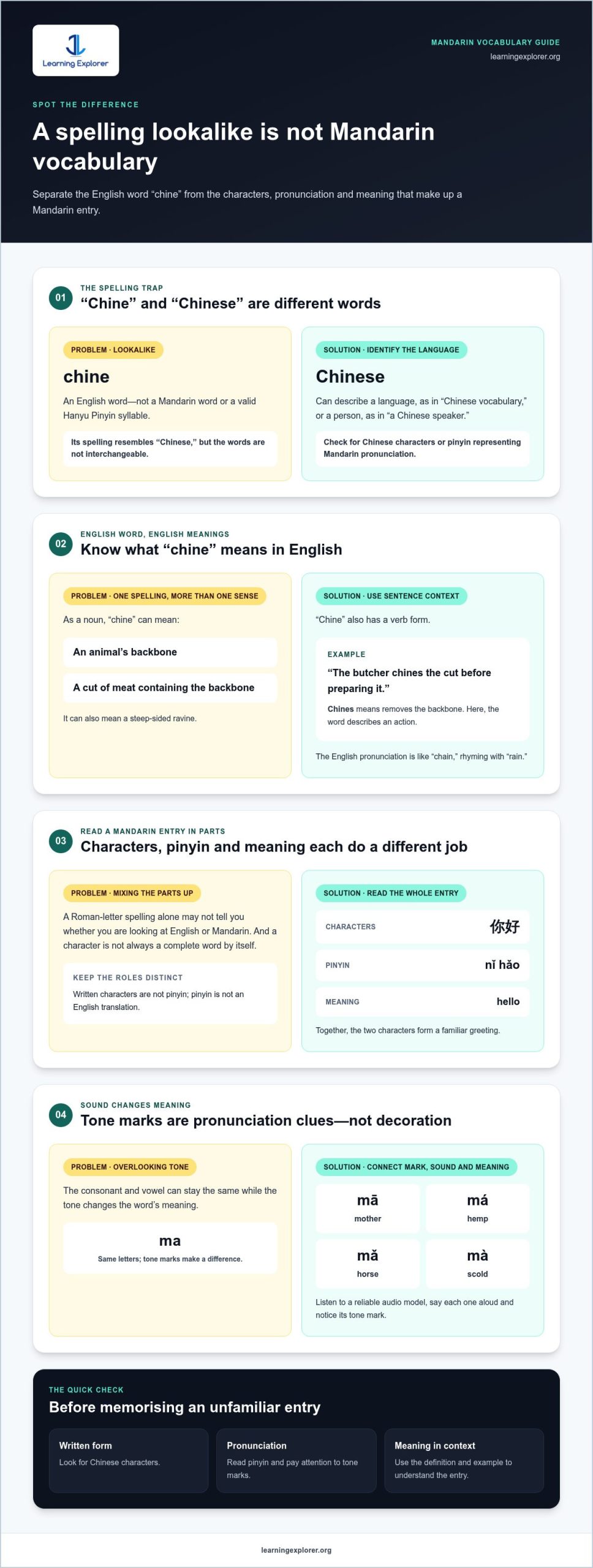
“Chine” is an English word, not a Mandarin word. As a noun, it can mean an animal’s backbone or a cut of meat that includes the backbone. It also has a verb form: to chine meat is to remove the backbone from a cut. The spelling may resemble “Chinese,” but the words have different meanings and uses.
That small spelling difference can make a dictionary result confusing. Standard Chinese (Mandarin) is a language, while “chine” is an English vocabulary item. Chinese words are written with Chinese characters, and Mandarin pronunciation can be represented with pinyin, a system that uses Roman letters. The spelling “chine” isn’t a Mandarin word or a valid Hanyu Pinyin syllable.
For a quick introduction to the Roman alphabet sometimes used to represent Mandarin sounds, watch this video:
The English meanings of “chine”
Cambridge Dictionary distinguishes the noun’s food-related and anatomical senses: a chine can be an animal’s backbone or a piece of meat that includes it. “Chine” is commonly pronounced like “chain,” rhyming with “rain.” This is a guide to the English pronunciation, not Mandarin pronunciation.
Verb example: “The butcher chines the cut before preparing it.” Here, “chines” means removes the backbone. The noun and verb share a spelling but have different roles in the sentence: a chine is a thing, while to chine is an action.
Why “chine” and “Chinese” are easy to confuse
The words share several letters, so a quick glance can lead you to the wrong dictionary entry. “Chinese” can describe a language, as in “Chinese vocabulary,” or identify a person, as in “a Chinese speaker.” “Chine” has none of those uses. Their written forms look similar, but the words are not interchangeable.
To recognise Mandarin vocabulary, look for Chinese characters or pinyin that represents Mandarin pronunciation. Don’t assume every Roman-letter spelling is a Chinese word. When you encounter an unfamiliar entry, first identify whether you’re reading an English definition or a Mandarin item, then learn its meaning and pronunciation.
“Chine” is an English word, not a Mandarin vocabulary item. The chine word belongs in an English dictionary entry; “Chinese” refers to a language or a person. Keeping that difference in mind prevents a spelling lookalike from becoming a memorised mistake.
How Chinese Words Work: Characters, Pinyin, Tones, and Meaning
A useful way to read Mandarin vocabulary is to separate what you see from what you hear and what it means. A Chinese word is a unit of vocabulary written with one or more Chinese characters and spoken with Mandarin pronunciation. Characters show its written form; pinyin helps represent its sound; an English translation gives an approximate meaning. These parts work together, but they aren’t interchangeable.
For example, 你好 is a common greeting meaning “hello.” It is written with two characters, 你 and 好. Its pinyin is nǐ hǎo, with tone marks above the vowels. Learning it as a complete greeting gives you a practical expression to recognise and use, rather than two characters to memorise without context.
Characters and words are related, but not identical
A Mandarin word may consist of one character or several. In 你好, two characters combine to form a familiar greeting. But don’t assume that every character works as a complete word on its own. A character can contribute meaning or sound within a longer word, so pay attention to how it functions in the full vocabulary item.
The chine word belongs to English, while characters such as 你 and 好 belong to Chinese writing. For the English term’s dictionary meanings, see Merriam-Webster’s Definition of ‘Chine’. Keeping the English entry separate from Mandarin vocabulary helps you focus on the correct written form as you learn.
What pinyin and tones tell a learner
Pinyin uses the Roman alphabet to guide learners towards Mandarin pronunciation. It’s a useful reading aid, but English letter sounds don’t always match Mandarin sounds exactly. Tone marks show the pitch pattern for a syllable. They aren’t decorative accents, and leaving them out can hide a difference in pronunciation.
Compare mā (mother), má (hemp), mǎ (horse) and mà (scold). The consonant and vowel stay the same, while the tone changes the word’s meaning. Listen to a reliable audio model, say each one aloud, and notice the tone mark. This connects the written cue with the sound you’re practising.
Characters show written form, pinyin guides pronunciation, and an English translation gives a meaning. When you meet an unfamiliar entry, read all three instead of relying on the Roman letters alone. This habit makes new Mandarin vocabulary clearer and easier to recall.
To practise vocabulary in useful contexts, explore guided Mandarin learning through Learning Explorer’s Conversational Mandarin Course in Singapore.
How to Read a Chinese Dictionary Entry Without Mixing Up Its Parts
A dictionary entry is easier to use when you treat it as a compact guide, not just a translation. Look for the written characters, pinyin, tone marks, an English gloss and an example sentence. Each part answers a different question: What does the word look like? How is it pronounced? What might it mean here?
A beginner-friendly Chinese word entry
Consider 学校, a common word meaning “school.” The example below separates the entry’s details to show what each one contributes.
| Entry part | Example | What it tells you |
|---|---|---|
| Characters | 学校 | The written word in simplified Chinese |
| Pinyin | xuéxiào | A Roman-letter guide to its pronunciation |
| Tone marks | xuéxiào | ué carries the second tone; iào carries the fourth tone |
| English gloss | school | A concise starting meaning |
| Example sentence | 我今天去学校。 Wǒ jīntiān qù xuéxiào. “I’m going to school today.” |
Shows the word in a sentence |
The sentence adds useful clues: 去 means “go,” and 今天 means “today,” so 学校 is the place the speaker is going to. Read the characters to recognise the written form, use pinyin to practise saying it, then check the example to see how it fits with the surrounding words. The English gloss is a quick guide, not a complete description of every possible use.
Some dictionaries also show a traditional form. For this example, simplified 学校 corresponds to traditional 學校; both represent the word “school.” A dictionary may display one form or both. The form you encounter can depend on the text or learning material, so notice the characters and keep the form consistent in your notes.
Why context matters when translating a word
An English gloss is often brief because it orients you rather than translating every sentence automatically. The words around an entry help show its role and intended sense. In “我今天去学校,” the action 去 (“go”) and time phrase 今天 (“today”) make it clear that 学校 is the destination. Seeing the word in context tells you more than memorising “学校 = school” alone.
Context improves a word’s interpretation by showing how it works alongside other words in a real sentence. When an entry includes an example, read the whole sentence and compare its meaning with the gloss before adding the word to your notes. Check the language label, too: an English chine word entry follows different conventions from a Mandarin entry.
A Simple Routine for Learning and Remembering Chinese Words
A long vocabulary list can feel productive, but words are easier to use when they connect to situations you actually face. Follow a repeatable routine: choose a useful word, hear it, understand it, use it, then review it. Keep each entry together with its characters, pinyin and tone marks, a short meaning, and a relevant example sentence.
Choose words that fit a real situation
Start with a situation you want to handle, such as introducing yourself, asking for directions or making a simple request. Group related vocabulary under that situation so you have a small, useful set rather than a disconnected list. For each word, note where you might use it. That personal cue gives you a reason to recall it later.
For example, a directions set might include 哪里 (nǎlǐ, “where”) and 地铁 (dìtiě, “metro”). Practise them with a prompt, such as asking where a place is or identifying the transport you need. Keep the set focused, and add words when you meet a real need rather than simply trying to make the list longer.
Practise pronunciation, meaning, and recall together
Work actively with each entry instead of only rereading it. Listen to reliable audio when available, repeat the word while checking its tone marks, and connect its written form with its meaning. Then hide the translation and try to recall it from the characters or pinyin. Finish by saying or writing an original sentence.
- Choose: Pick one useful word for a situation you’re learning to handle.
- Hear: Listen to its pronunciation and repeat it, paying attention to the tones.
- Understand: Check the meaning and read an example sentence to see how the word is used.
- Use: Make a short sentence of your own, adapting a familiar pattern if needed.
- Review: Return to the word later and test your memory before looking at the answer.
Space your reviews over time instead of studying every word in one sitting. You don’t need a rigid schedule: revisit words during regular study sessions and give extra attention to the ones you can’t recall. Active recall means trying to retrieve a word from memory, not simply recognising it on the page. Keep your notes clear, with characters, pinyin, meaning and your own sentence together.
If an English-language resource places the chine word beside Mandarin vocabulary, check the language label before adding it to your study notes. Keep your learning set focused on words you can practise in context.
For structured practice using vocabulary in meaningful situations, explore Learning Explorer’s Conversational Mandarin Course. Learning Explorer offers language classes in Singapore, with in-person and online learning formats.
Keep Building Mandarin Vocabulary with Guided Practice
Once you can identify a word’s form and meaning, practise using it. Decide what you want to say, choose a word that fits, then try it in a sentence or exchange. This turns vocabulary study into a small communication goal. You might practise introducing yourself, asking a simple question or responding in a familiar situation.
As you continue, think about what you want your practice to help you do. Do you want to choose words for everyday conversations, or focus on speaking with more confidence? Naming your goal can help you choose a relevant learning path instead of collecting vocabulary without a clear purpose.
What guided Mandarin practice can add
Self-study gives you room to explore at your own pace. Guided learning offers a structured way to return to Mandarin and apply what you’re learning. Learning Explorer’s Conversational Mandarin Course is for learners who want to develop practical language skills. Treat each new word as something to try: use it in a short exchange, notice what you can express, and identify what you want to practise next.
You don’t need to know a large vocabulary before you begin using Mandarin. Start with a familiar topic and build from there. A simple exchange can show you which words come readily and which ones you want to revisit. That reflection gives your next practice session a clear focus.
Choose a useful next learning step
Decide what would help you most right now. If you want a broader perspective on learning conversational Mandarin in Singapore, Mastering Conversational Mandarin in Singapore: The 2026 Learner’s Guide is a relevant next read. If you want to concentrate on pronunciation, use Mandarin Tones: A Simple Practice Routine to focus your study. Choose one area, practise it, then notice how it supports your everyday communication.
Keep a short record of situations you’d like to handle in Mandarin. Use those situations to guide what you study and reflect on what you can already say. Progress can begin with a single exchange and grow through steady, purposeful practice.
To explore a guided next step, visit Learning Explorer’s Mandarin learning options and choose an approach that suits your learning goals.
Turn Your Next Mandarin Word into Practice
Let curiosity guide your next step. Choose a Mandarin word you’d like to use, then set a small goal: bring it into a sentence or try it in a conversation. If you come across an unfamiliar chine word, check whether it belongs to English or Mandarin before adding it to your notes. That quick pause keeps your learning focused and helps you decide what to explore next.
As your interests grow, choose vocabulary around the situations you want to handle. You might focus on everyday introductions, a conversation at work or asking someone for help. Start with one useful expression, practise it, then build towards the next exchange. Learning Explorer’s Mandarin learning options can support your next step.
Explore Mandarin learning options at Learning Explorer and choose a next step that fits your goals. Each new phrase gives you another way to connect, so keep practising and build your confidence one conversation at a time.
Frequently Asked Questions
Is “chine” a Chinese word?
No. “Chine” is an English word, not a Mandarin vocabulary item. As a noun, it refers to an animal’s backbone or a meat cut that includes it; as a verb, it means removing the backbone from meat. It isn’t the same spelling as “Chinese.” If a dictionary page about this chine word appears beside Mandarin results, check the entry’s language label before saving it.
What does “Chinese word” mean?
A Chinese word is vocabulary used in a Chinese language, including Mandarin Chinese. For example, when learning how to greet someone, you might encounter a Mandarin term in Chinese characters alongside a pronunciation guide. An English translation helps explain the meaning, but it can’t show exactly how the word is written or spoken. Keep those forms together in your notes so you can recognise the vocabulary later.
Can one Chinese character have more than one meaning?
Yes. A character can contribute different meanings depending on the word or sentence around it. For instance, 行 appears in 银行 (yínháng), meaning “bank,” and 行动 (xíngdòng), meaning “action” or “to act.” The character’s pronunciation differs between these examples too. Check the full word and a reliable example sentence instead of assigning one English equivalent to a character in isolation.
Why do Chinese dictionaries show pinyin?
Dictionaries show pinyin to help learners identify and pronounce Mandarin words. Its Roman letters and tone marks can also help you look up a word when you don’t yet recognise its characters. Use pinyin as a bridge: listen to the word, practise saying it, and connect it back to the written form. For example, pinyin can help you find a spoken term you heard in a conversation.
Are simplified and traditional Chinese characters the same?
They are two forms of Chinese character writing. Some characters look the same in both, while others have different written forms. A learning resource may show one form or identify both. If you’re starting with a course or textbook, follow the form it teaches and practise reading it consistently. When you encounter another form in a text, compare it with your reference rather than assuming it represents a different word.
Can Chinese words be translated word for word into English?
Not always. A direct translation can sound awkward or miss the intended meaning because Mandarin and English express ideas differently. For example, a polite request may need a natural English phrase rather than a literal rendering of each Mandarin word. Read the whole sentence and consider who is speaking, what they’re asking and the situation. Learning a word with a natural example gives you a more useful guide than memorising one translation.
Do Chinese sentences put spaces between words?
Standard written Chinese generally doesn’t place spaces between individual words as English does. Characters usually appear in a continuous sequence, with punctuation helping mark sentence boundaries. Readers use vocabulary knowledge and the surrounding sentence to recognise where one word ends and another begins. For practice, read a short sentence and mark familiar multi-character words together; this builds word recognition without treating every character as a separate vocabulary item.