If you’re deciding where to learn Korean in Singapore, distance is only one part of the choice. Your weekly routine, preferred lesson format and reasons for learning all affect which option is practical to keep up with. Comparing these factors can make it easier to choose a course that fits your life, rather than picking a location based only on what seems central.
Korean Explorer offers Korean courses in City Centre, Jurong East and Tampines, with physical and online classes available through Learning Explorer. This guide explains how to compare the locations and formats, what communicative teaching means, and how the course syllabus and materials sourced from Seoul National University fit into the learning experience. Use these details to identify a starting point that suits your goals and routine.
Key Takeaways
- Decide what you want Korean for, then use that goal to guide your choice of course and practice style.
- When comparing Where to Learn Korean in Singapore, weigh your regular travel and routine alongside whether you prefer lessons online or in person.
- Look for a teaching approach that gives you opportunities to use Korean actively, not just study it passively.
- Use a simple decision path: clarify your purpose, choose a format, compare locations, and review how lessons are taught.
Where to learn Korean in Singapore: start with location and convenience
For adults balancing lessons with work and personal commitments, the journey to class can affect whether a course fits into the week. Korean Explorer offers Korean courses in City Centre, Jurong East and Tampines. Consider where you live, work and regularly spend time, then compare the course areas with those routines. A location along a familiar route may be easier to plan around than one that requires a separate trip.
When deciding where to learn Korean in Singapore, look for the Korean course offered by Korean Explorer. It is the Korean lesson provider within the Learning Explorer group, which also has schools focused on other languages. This helps distinguish the Korean course from the group’s wider language options. For background on the language itself, see this overview of the Korean language.
A short introduction to a Korean language school in Singapore offers another perspective on local learning:
Korean lessons in City Centre
City Centre may fit learners whose regular week already brings them into central Singapore. If you work in the CBD, consider whether attending a class in this area could fit around your existing routine. Compare the route with your usual day and how you would get to and from class. City Centre is one of the listed areas for Korean courses, so make your choice based on how it fits your schedule rather than assumptions about class times or travel convenience.
Korean courses in Jurong East and Tampines
Jurong East and Tampines are two other areas to consider. Compare them with your home, workplace and regular commitments. For example, if you often spend time in the west, weigh Jurong East against a central option. If your routine is centred in the east, consider Tampines. These comparisons help you think through your own travel pattern without assuming that every class format is offered at each location.
Make the decision concrete by looking at your usual week. Consider:
- Your regular routes: Which area fits most naturally with places you already go?
- Your routine: Would getting to a class from home, work or another regular commitment feel manageable?
- Your preferred setting: If travelling to a class does not suit your week, consider whether an online class fits your routine.
There isn’t one best neighbourhood for every learner. Compare the three areas against your day-to-day pattern, then use your preferred format and teaching approach to refine your choice. Starting with a location that feels realistic gives you a practical basis for choosing Korean lessons you can plan around.
What Korean lessons in Singapore can offer adult learners
Location is one part of choosing Korean lessons. The teaching approach shapes how you engage with the language, while the syllabus and learning materials provide a framework for course content. Korean Explorer’s Korean courses include communicative teaching and native-teacher instruction, with a syllabus and learning materials sourced from Seoul National University. These details can help you compare the learning experience with your own goals.
Communicative teaching focuses on using language to express and understand meaning. Rather than treating grammar and vocabulary only as topics to study, it connects language learning with purposeful communication. If you want to become more comfortable communicating in Korean, this approach is a relevant feature to consider when comparing courses.
How communicative teaching supports Korean learning
With communicative teaching, language is something to use, not only a subject to study. The approach centres on making meaning through interaction and purposeful communication. This can suit learners who want communication to be part of their learning, whether their interest is everyday conversation, travel or culture. These are examples of personal goals, not promises of a particular result or descriptions of specific classroom activities.
Communicative practice treats language as an active tool for meaning, not just material to memorise.
This distinction can help you assess a course beyond its location or format. If practical communication is your priority, consider whether the teaching approach gives language use a central place. Lessons can also include explanations that help you understand how Korean is structured. Communicative learning emphasises connecting that knowledge with purposeful use. The approach describes how learning is framed, not a guaranteed level of proficiency.
Why course materials matter
Korean Explorer’s Korean syllabus and learning materials are sourced from Seoul National University. A syllabus gives the course a defined structure, and shared learning materials provide a reference as you work through the content. These details can help you understand how the course is organised and compare it with your preferred way of learning. They describe the course framework, not a qualification or a guaranteed outcome.
Native-teacher instruction is another feature of Korean lessons. Consider it alongside the communicative approach and the course materials when deciding whether the learning experience suits your aims. Together, these details describe who leads instruction, how language learning is approached and what source the syllabus and materials come from.
When comparing Where to Learn Korean in Singapore, look beyond the map to how lessons are taught and organised. The teaching approach shapes the focus of learning, while the syllabus and materials provide a framework for course content. To explore the Korean learning option within the group, visit Korean language lessons.
Compare Korean learning formats and locations in Singapore
Once you’ve considered how lessons are taught, compare the learning setting with your weekly routine. Korean Explorer offers physical and online classes, and Korean courses are offered in City Centre, Jurong East and Tampines. Treat these as two related decisions: first choose the format that suits how you prefer to learn, then consider how the listed course areas fit your regular travel. This gives you a practical way to narrow down where to learn Korean in Singapore without assuming that every format is available at every location.
| Format | Setting | Routine fit | Convenience to consider |
|---|---|---|---|
| Physical | In person | May suit learners who prefer attending lessons outside the home. | Factor the journey to a course location into your usual week. |
| Online | Remote | May suit learners who prefer joining lessons from their chosen setting. | Consider how a remote lesson would fit around your existing commitments. |
Physical Korean classes or online lessons?
Physical classes provide an in-person learning setting, while online classes offer a remote option. Think about where you focus best and what feels workable after a full day or during a busy week. For an in-person class, include the journey in your plans. For an online lesson, consider whether remote learning fits the way you organise your time. Neither format is automatically more convenient. The better fit depends on your preferences and routine.
Match a Korean course location to your routine
Compare City Centre, Jurong East and Tampines with places you already travel to, rather than choosing based on reputation or assumption. If your work or regular commitments are in the city, consider whether City Centre fits naturally into your week. If you spend more time in the west, weigh Jurong East; if your routine is centred in the east, consider Tampines. These examples are prompts for your own comparison, not claims about travel times or transport connections.
Think through a typical week, including where you start and end the day and how much time you’re comfortable setting aside for lessons. A location that aligns with your routine may be easier to plan around. If remote learning suits you better, consider the online format. Keep the options distinct: the listed course areas do not mean every format is offered at each one.
For a broader view of language study options, the language courses in Singapore guide can help you place Korean alongside other learning choices. Then compare the options against your own priorities: setting, routine and location. A clear comparison makes your next step more manageable and keeps the decision focused on what matters to you.
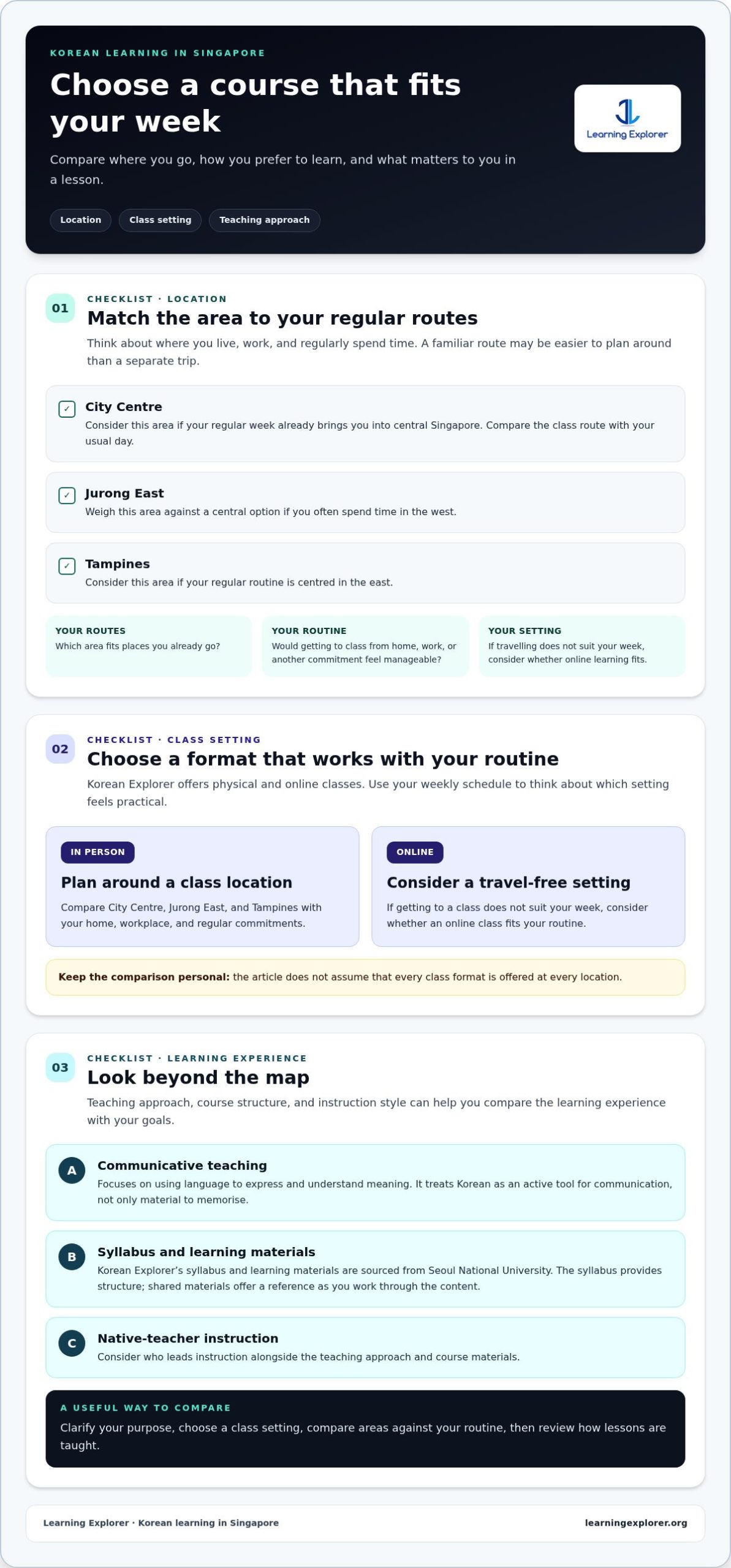
How to choose where to learn Korean in Singapore
A clear decision process can turn a long list of possibilities into a manageable choice. Start with what you want to use Korean for, then choose a setting that suits you, compare course locations with your routine and review how lessons are taught. This order keeps your priorities at the centre instead of letting one feature, such as a convenient area, decide everything.
Set a clear reason for learning Korean
Think about situations where you’d like to use Korean. Your interest might be conversation, travel or cultural topics. A specific purpose gives you a reference point for considering which learning approach feels relevant. It does not set a deadline or guarantee a particular result; it helps you compare options with more clarity.
Consider your current experience, too. If you’re new to Korean, you may prefer a course structure that feels clear and manageable. If you’ve studied before, reflect on what you already know and what you’d like to practise next. Think about how you prefer to learn: some people value an in-person setting, while others find remote lessons easier to fit into their week.
Use this four-step path to narrow your options:
- Define your purpose. Note whether conversation, travel, cultural interest or another personal goal is your main motivation.
- Choose a format. Decide whether physical classes or online lessons better match your preferred learning environment and routine.
- Compare locations. Consider City Centre, Jurong East and Tampines in relation to the places you regularly live, work or spend time.
- Review the teaching approach. Consider how communicative teaching and the course materials align with the way you want to learn.
Use a simple comparison checklist
Before settling on an option, rank what matters most to you. Is reducing travel effort the priority, or is an in-person setting more important? Do you want lessons centred on purposeful language use? Would a defined syllabus and learning materials help you follow the course content? Ranking these preferences makes trade-offs easier to see, particularly when no single option meets every preference equally.
- Location: Which course area fits your regular travel pattern?
- Setting: Would you rather attend in person or learn remotely?
- Teaching approach: Does the focus on communicative learning suit your interest in using Korean?
- Materials: Does the syllabus and its learning resources offer a structure that feels useful to you?
For more adult-focused context as you weigh these priorities, explore this Korean learning guide for adults in Singapore. Then make a choice based on your own priorities instead of searching for a universal best fit.
A location and format that suit your routine can make it easier to keep learning. If you’re ready to take the next step, explore Korean lessons and use your priorities to guide your choice.
Start learning Korean with Korean Explorer in Singapore
Once you’ve weighed your learning purpose, preferred format and routine, you can move from comparing options to choosing a practical next step. Korean Explorer is the Korean lesson provider within the Learning Explorer group. Korean courses are offered at City Centre, Jurong East and Tampines, and Learning Explorer provides physical and online classes. Consider these options alongside the teaching approach and course materials rather than choosing by location alone.
The course approach includes communicative teaching and native-teacher instruction. The Korean syllabus and learning materials are sourced from Seoul National University. These details give you a clearer picture of the learning framework: communication is a focus of the teaching approach, native teachers provide instruction, and the syllabus and materials offer a structure for learning. They describe the course without promising a particular outcome.
What learners can expect from the Learning Explorer group
Learning Explorer Language Centre has taught languages to adults in Singapore since 2015. Korean Explorer is the group’s Korean lesson provider, distinct from its other language schools. This makes it easier to focus on the Korean course rather than assume that every school in the group follows the same language-specific programme. For learners considering Korean, the relevant details are the Korean syllabus, teaching approach and materials.
If you’re comparing language education options beyond Korean, the language school guide for Singapore provides wider context on the group. For your Korean course decision, return to the factors that matter to you: how you prefer to learn, what you want to practise and which setting fits your routine.
Take the next step toward Korean lessons
Make your shortlist simple. Choose whether you prefer physical or online learning, then consider which of the listed course areas fits naturally into your week. Finally, connect your personal purpose, such as conversation, travel or cultural interest, with the communicative approach and structured materials. You don’t need to map out every part of your learning journey before getting started. A clear first preference can help you move forward.
For in-person learning, City Centre, Jurong East and Tampines are the listed Korean course areas. Online classes offer a remote format, while the named areas give you physical-location options to consider. Use your preferred setting and routine to guide your choice, without assuming that every format is available at every location.
With the main considerations in view, take a closer look at Korean lessons. Explore the course details and decide which option feels like a practical starting point for learning Korean in Singapore.
Take your first step toward learning Korean
Choosing where to learn Korean in Singapore doesn’t require you to map out every stage of your learning journey. Start with one useful question: what would you like to feel more ready to do in Korean? Keeping that intention in mind can make your course choice feel personal and grounded, rather than like another decision you have to get perfect.
Give yourself room to begin as a learner, not an expert. Build your routine around your current commitments and refine your goals as you gain experience. What matters now is choosing a next step that feels realistic enough to follow through on. A little clarity can turn interest into purposeful action.
If you’re ready to explore your options, explore Korean lessons with Korean Explorer. Choose a starting point that fits your priorities and make Korean part of your learning routine. Your learning journey can begin with one manageable choice.
Frequently Asked Questions
Where can I learn Korean in Singapore?
Korean Explorer, part of the Learning Explorer group, provides Korean lessons in Singapore. Korean courses are offered in City Centre, Jurong East and Tampines, and Learning Explorer offers physical and online classes. To narrow down Where to Learn Korean in Singapore, compare the listed areas with places you already travel to, then decide whether you prefer learning in person or remotely. This gives you a practical starting point for your search.
Can I learn Korean online in Singapore?
Yes. Learning Explorer offers online classes as well as physical classes. Online lessons let you study remotely, while physical classes provide an in-person setting. Consider where you can concentrate, what suits your regular commitments and whether you prefer learning in a classroom. The Korean course areas are separate location options, so do not assume every format is offered at every area.
Which areas in Singapore offer Korean courses?
Korean courses are offered in City Centre, Jurong East and Tampines. Compare these areas with your usual weekly routes, including where you live, work and spend time. The centre address is 10 Anson Road #22‑07, International Plaza, Singapore 079903. Use the listed course areas and address as location references, then choose based on what feels manageable for your routine.
What teaching approach is used in Korean lessons?
Learning Explorer’s Korean teaching approach is communicative and includes native-teacher instruction. The Korean syllabus and learning materials are sourced from Seoul National University. These details help describe the course framework. As you compare options, consider whether purposeful language use, instruction from native teachers and structured materials match the way you’d like to study.
Do I need to learn Hangul before starting Korean lessons?
You don’t need to master Hangul before deciding to study Korean. Hangul is the Korean writing system, so becoming familiar with it can be a useful preparation step if you’re new to the language. Your current experience and goals can help you decide what to focus on first. Consider your starting point and learning aims as you choose a course.
How do I choose between online and in-person Korean lessons?
Choose the format that fits your routine and the way you prefer to learn. If travelling to a physical class feels workable, compare the listed course areas with your regular movements around Singapore. If remote study suits your circumstances better, consider online lessons. You can also weigh how much you value an in-person setting versus learning remotely, without assuming either format leads to a different outcome.
What materials are used for Korean lessons at Learning Explorer?
Alongside the communicative teaching approach and native-teacher instruction, these materials form part of the course framework. Consider whether a defined syllabus and learning resources suit the way you want to organise your study.