The safest choice in Korean isn’t always the most formal one. The question of korean formal vs informal speech is really about who you’re speaking to and the setting, not simply choosing the most respectful-sounding ending.
If the labels formal, polite, informal, and casual seem interchangeable, you’re not alone. It’s natural to worry that the wrong ending could sound disrespectful, especially when classroom examples don’t always match the dialogue you hear in dramas or online. The good news is that you don’t need to memorize every speech level before you can speak with more confidence.
This guide explains how politeness, formality, and familiarity differ, then shows how to choose a practical style for everyday situations. You’ll also learn why a polite everyday style is a useful starting point, when a more casual tone may fit, and how speakers can shift their style as a relationship changes.
With a clearer sense of the cues, you can focus less on second-guessing each ending and more on connecting with the person in front of you. Guided conversation practice, such as a conversational Korean course, can help you apply these choices naturally.
Key Takeaways
- Understand how korean formal vs informal speech reflects both the listener relationship and the conversation setting.
- Use sentence endings as practical clues to whether a style sounds formal, polite, or casual.
- Compare common speech styles through everyday examples and notice how a changed ending can shift the tone.
- Follow a simple decision process: read the context, choose a suitable style, and adapt as the interaction develops.
- Practise saying the same idea in different styles, then note where you hear each one in lessons and media.
Korean Formal vs Informal Speech: What Is the Real Difference?
Korean speech style signals respect, social distance, and the context of a conversation. The endings a speaker chooses help show how they’re positioning themselves in relation to the listener, whether they’re speaking in a public setting, or how familiar the relationship feels.
The labels “formal” and “informal” are useful starting points, but they simplify a system with several patterns. They can make it sound as if speakers choose between only two fixed modes. In practice, speech style is more flexible: the right choice depends on the people, setting, and moment.
Speech style signals how a sentence is framed for the listener; it doesn’t, on its own, reveal the speaker’s overall attitude. A polite ending doesn’t necessarily mean emotional distance, and a casual ending doesn’t automatically mean disrespect. This distinction helps make sense of korean formal vs informal speech without treating every choice as a judgement about the relationship.
Why Korean does not divide neatly into only two styles
Korean has several speech patterns, rather than two universal options. The Korean speech levels are often described as a system of seven levels, though everyday choices are shaped by how people actually interact. Think of “formal” and “informal” as broad signposts, not a complete map of every possible tone.
Context, relationship, and setting all matter, but they aren’t rigid rules that determine one answer every time. You might use one style at work, another during a lesson, and a different one with family or close friends. Even with the same person, the setting can affect how you speak.
Politeness, formality, and familiarity in plain English
Politeness is about addressing another person respectfully. Formality describes a style often associated with public, professional, or more official situations. Familiarity reflects how close or comfortable people are with each other, and that closeness may support casual speech when both people are at ease with it.
These ideas overlap, but they aren’t interchangeable. Someone can be warm and familiar while still speaking politely. A more formal style can suit a public setting without suggesting that the speakers are personally distant.
When you’re unsure, use these questions to understand the situation rather than looking for a single rule:
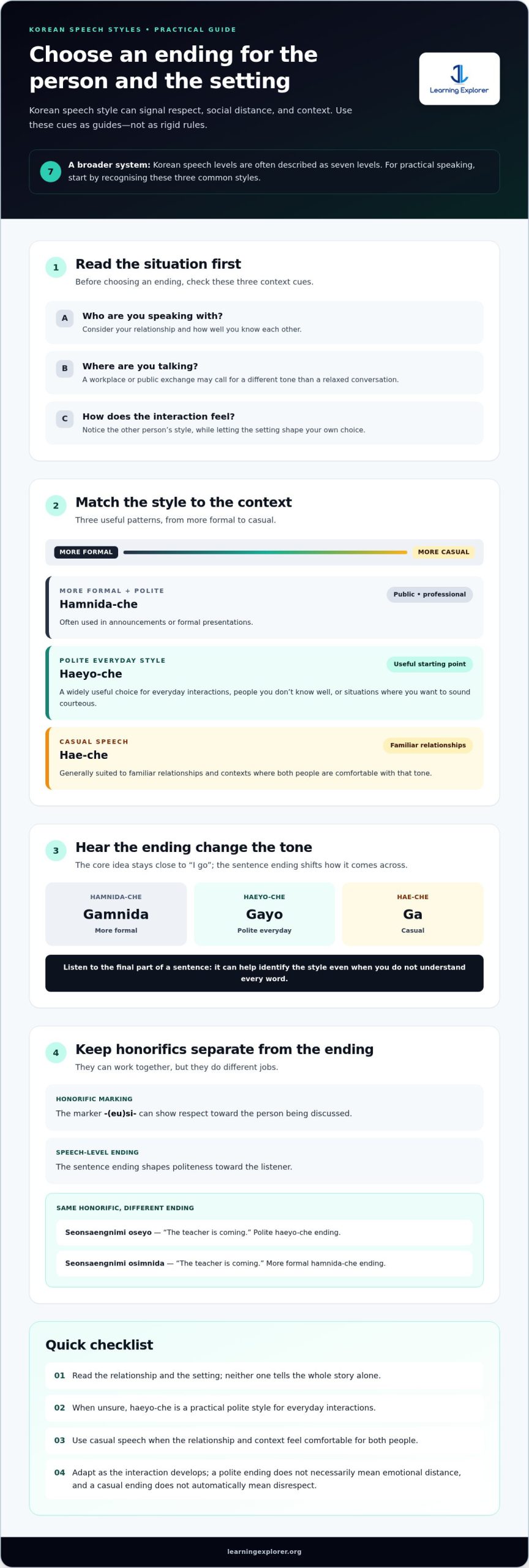
- Who am I speaking with? Consider your relationship and how well you know each other.
- Where are we talking? A workplace or public exchange may call for a different tone than a relaxed conversation.
- How does the interaction feel? Notice the other person’s style, while allowing room for the setting to shape your own choice.
These cues give you a practical way to interpret speech without assuming that one ending tells the whole story. As you learn more, you’ll start to recognise how respect, closeness, and context work together.
How Korean Speech Levels Work: Endings, Respect, and Honorifics
In Korean, the ending of a sentence often signals how polite, formal, or casual the speaker sounds. A sentence’s core meaning can stay much the same while its ending changes the tone. That’s why recognising endings is a practical first step in understanding korean formal vs informal speech.
Grammar references describe several speech levels, including patterns learners may encounter less often in everyday conversation. For practical speaking, it helps to recognise three common styles: 합니다체 (hamnida-che), 해요체 (haeyo-che), and 해체 (hae-che). Treat their context labels as useful guides, not rigid rules for every interaction.
What 합니다체, 해요체, and 해체 communicate
합니다체 is a more formal, polite pattern often used in public or professional contexts, such as announcements or formal presentations. 해요체 is a widely useful polite style for everyday interactions. It’s a practical choice for speaking with people you don’t know well or in situations where you want to sound courteous. 해체 is casual speech, generally suited to familiar relationships and contexts where both people are comfortable with that tone.
These styles are expressed through sentence endings, not simply through a sentence’s vocabulary. For example, the idea “I go” can be expressed as 갑니다 (gamnida) in 합니다체, 가요 (gayo) in 해요체, and 가 (ga) in 해체. The meanings are closely related, but the endings change how the statement comes across. Listening for that final part can help you identify a style, even when you don’t understand every word.
How honorifics relate to formal and informal speech
Speech-level endings address the listener, while honorific marking can show respect toward the person being discussed. One common honorific marker is -(으)시-, which appears within the verb. It doesn’t replace the sentence ending. Instead, it can work alongside different endings to express respect for the subject and politeness toward the listener.
Take the sentence 선생님이 오세요 (seonsaengnimi oseyo), meaning “The teacher is coming.” The verb includes the honorific marker, while the ending gives the sentence a polite 해요체 style. A more formal version is 선생님이 오십니다 (seonsaengnimi osimnida): it retains the honorific marker but uses a 합니다체 ending. You don’t need to master every grammatical detail at once. Start by noticing which part honours the person being discussed and which part shapes the tone toward the listener.
Practising these patterns in conversation can make the distinction easier to hear and use. A conversational Korean course offers a setting to apply speech-level knowledge while speaking.
Korean Formal and Informal Speech Compared in Everyday Situations
Examples make speech levels easier to hear. Compare the endings, not just the translations: similar meanings can take different forms depending on whether you’re meeting someone, asking for help, or chatting with a close friend. The examples below are useful starting points, not fixed rules for every Korean speaker or situation.
| Style | Typical context | Ending cue | Beginner-friendly example |
|---|---|---|---|
| Formal polite | Public or more formal exchanges | -ㅂ니다 / -습니다 | 얼마입니까? (eolmaimnikka?), “How much is it?” |
| Everyday polite | Introductions and unfamiliar everyday interactions | -아요 / -어요, often heard as -요 | 얼마예요? (eolmayeyo?), “How much is it?” |
| Casual | Established, comfortable relationships | Often no polite -요 ending | 얼마야? (eolmaya?), “How much is it?” |
The question stays close in meaning across the examples, while its ending shifts the tone. In a service interaction, asking 얼마예요? is a practical polite option; 얼마입니까? sounds more formal. The casual 얼마야? is better kept for someone you already speak casually with. A more formal ending isn’t automatically better in every situation. Aim for a style that fits the exchange.
When polite speech is a comfortable starting point
For an introduction, 안녕하세요 (annyeonghaseyo, “Hello”) is a common polite greeting. It works in many everyday encounters and can sound warm and natural, not cold or distant. You can use it when meeting someone new, greeting a teacher, or beginning a conversation in a shop. These are helpful defaults, though the relationship and setting can still shape what sounds most natural.
For learners thinking through korean formal vs informal speech, this is a reassuring point: polite speech doesn’t mean you have to sound stiff. A friendly expression, attentive listening, and a courteous ending can sit comfortably together.
When casual speech fits a familiar relationship
With a close friend who’s comfortable speaking casually with you, a simple question might be 뭐 해? (mwo hae?), “What are you doing?” A polite version is 뭐 해요? (mwo haeyo?). The main idea stays similar; the ending changes the tone. Use the casual form within an established relationship, rather than assuming it’s welcome from the start.
Dramas and online clips can be useful listening practice, but they don’t always show the whole relationship or setting behind a line. Characters may already be close, or a scene may use a style for dramatic effect. Notice who’s speaking to whom before copying an ending. Age can be one social cue, but it doesn’t by itself decide which style two people should use.
How to Choose a Korean Speech Style Without Feeling Rude
Choosing an ending can feel like a high-stakes decision, especially when you’re still learning. It doesn’t have to be perfect to be respectful. For beginners, a polite everyday style is a respectful starting point when the relationship or expectations are unfamiliar. It gives you room to listen and learn before deciding whether a different style fits.
A beginner’s step-by-step way to choose
Use the interaction itself as your guide. Rather than guessing from someone’s age or appearance, consider what’s happening and how well you know the person. Then begin courteously and make small adjustments only when the context supports them.
- Assess the setting and relationship. Is this a first meeting, a lesson, a work conversation, or a relaxed exchange with someone you know well? These details offer more useful context than appearance alone.
- Start politely if you’re unsure. A polite pattern works well for many unfamiliar interactions. It’s a practical choice, not a claim that you’ve read every nuance correctly.
- Listen before adapting. Notice the other speaker’s endings, but consider who else is present and what the conversation is about. One person’s style may reflect the setting rather than an invitation for you to copy it.
- Keep your choice consistent until you have a reason to shift. You can stay polite while building rapport. There’s no need to rush into casual speech to sound friendly.
This approach is useful for learners asking how korean formal vs informal speech works in real conversations: choose a respectful starting point, then pay attention to more than one cue. A polite default won’t guarantee perfect nuance, but it can help you communicate consideration while you keep learning.
What to do when the conversation shifts
Speech style can change as people become more familiar or move into a different setting. A conversation between classmates may feel more relaxed over time, while a work discussion may call for a more careful tone. Treat a shift as something to notice, not a switch you must mirror immediately.
A single casual phrase doesn’t automatically mean the other person expects you to use casual speech too. They may be speaking that way to someone else, quoting a line, or responding to the moment. Look for a clear pattern and consider whether the relationship feels mutually comfortable.
If you’re unsure and the relationship makes it appropriate, a brief check-in can prevent awkwardness. You could ask 이제 편하게 말해도 돼요? (ije pyeonhage malhaedo dwaeyo?), meaning “Is it okay if I speak more casually now?” Asking gives the other person room to respond, and you can continue politely if the answer or situation feels unclear.
Build confidence by practising these choices aloud in guided conversation. Explore a conversational Korean course to work on choosing a suitable style as you speak.
Build Confidence with Korean Formal and Informal Speech Practice
Knowing how endings work is one step; choosing them while speaking takes practice. Make the decision easier by working with one familiar situation at a time. Instead of memorising isolated endings, practise complete exchanges and connect each version to the people and setting it suits.
A simple routine for noticing and practising endings
Choose a common purpose, such as asking whether someone is free tomorrow. Write a polite version and a casual version, then check that both sound natural. For example:
- Polite exchange: 내일 시간 있어요? (Naeil sigan isseoyo?), “Are you free tomorrow?” 네, 있어요. (Ne, isseoyo.), “Yes, I am.” This can suit a polite everyday conversation.
- Casual exchange: 내일 시간 있어? (Naeil sigan isseo?), “Are you free tomorrow?” 응, 있어. (Eung, isseo.), “Yeah, I am.” Practise this with a close friend when casual speech is comfortable for both of you.
Say each exchange aloud. Label the relationship and setting before you practise, such as “polite conversation with an acquaintance” or “casual chat with a close friend.” That small step links the ending to a real communicative purpose, instead of treating it as a sound to copy. If you’re uncertain whether a version is natural, check it with a reliable learning resource or instructor.
As you watch Korean media or listen during lessons, pay attention to the sentence endings. Write down a short line, who’s speaking to whom, and what’s happening in the scene. This context matters: a line in a drama may reflect an established relationship, a workplace, or a particular moment in the story. Collect examples as listening clues, not as automatic templates for your own conversations.
How guided conversation practice can help
Practise the same communicative purpose in a short dialogue, then repeat it with a different ending and context. A teacher or conversation partner can help you hear whether the ending matches the exchange and offer feedback on what to adjust. Over time, this makes the choices involved in korean formal vs informal speech easier to apply in real time.
Learning Explorer’s conversational Korean course gives learners a setting to put speech-level knowledge into conversation. Private, group, and intensive formats offer different ways to approach learning, depending on your preferences. Practising with guidance can help turn examples into usable speaking habits.
If you’re ready to practise Korean speech styles in conversation, explore conversational Korean classes in Singapore and find a learning format that fits your goals.
Let Your Next Conversation Be a Practice Opportunity
Your next step doesn’t need to be a perfect performance. Choose one real interaction, prepare a polite way to begin, and give yourself time to listen and respond. Each conversation offers a chance to notice how your choice feels in context. With steady practice, korean formal vs informal speech can become less like a rule to memorise and more like a decision you make with care.
If you’d like support applying these choices aloud, explore Learning Explorer’s conversational Korean classes in Singapore. The course is taught by bilingual, certified native-speaker instructors, giving you a guided setting to practise real exchanges and ask questions as they come up.
Explore conversational Korean classes in Singapore, and take your next step toward speaking with greater ease. You don’t need to know every nuance before you begin. Start with one conversation, stay curious, and build confidence as you go.
Frequently Asked Questions
Is Korean formal speech the same as honorific speech?
No. Korean formal speech and honorifics are related, but they do different grammatical jobs. A sentence ending helps shape how you address the listener, while an honorific marker or special vocabulary can show respect for the person being discussed. These choices can appear together, but one doesn’t replace the other. Keeping that distinction in mind makes korean formal vs informal speech easier to understand in real conversations.
How many speech levels are there in Korean?
Traditional grammar descriptions commonly identify seven Korean speech levels, though learners will hear a smaller group more often in modern everyday conversation. The number refers to grammatical styles, not seven rigid ranks assigned to people. You might meet less common patterns in historical dramas, books, set expressions, or formal announcements. Treat the classification as a way to recognise different endings, not as a list you must use in every chat.
Is 반말 rude, or can it be friendly?
반말, or casual speech, can sound relaxed and friendly between people who are comfortable using it. It may feel abrupt or presumptuous with a new acquaintance, customer, teacher, or someone who expects polite speech. The wording and delivery also matter: blunt language can sound harsh even between familiar speakers. If you hear casual speech, consider who’s speaking and how well they know each other before deciding whether it fits your own conversation.
Does Korean use different words for “you” in formal and informal speech?
Korean often leaves “you” unstated when the listener is clear from context, and speakers may use a person’s name or title instead. Neo is a familiar pronoun suited to casual relationships, while dangsin isn’t a universal polite equivalent of English “you.” Its tone depends on context and can feel intimate or confrontational. In many polite exchanges, using a title or omitting the pronoun sounds more natural.
Can Korean speech levels change in text messages compared with face-to-face conversation?
Yes. Messages lack vocal tone and facial expression, so endings and punctuation can carry more of the social meaning. Friends may text casually, while people who don’t know each other well may keep polite endings. Some online writers use endings such as -eum or -seum in brief, note-like messages, but these aren’t general-purpose polite forms. For a first message, a clear polite style is easier to read.
Are Korean dramas a reliable way to learn when to use casual speech?
Dramas can help you recognise spoken endings, but they don’t always provide enough context to show when you should use them. A scene may leave a relationship unexplained or use a particular style to reveal a character’s mood. Notice who’s speaking, how they know each other, and where the scene takes place. Then compare what you hear with a lesson or reference that explains the situation.
How can I politely ask someone whether casual speech is comfortable?
Suggest the change as a question, rather than assuming the other person agrees. You can say, “우리 이제 말 놓을까요?” (uri ije mal noeulkkayo?), meaning “Shall we speak casually now?” It works best when the conversation already feels relaxed, not as an opening line to a stranger. If the person hesitates or continues speaking politely, follow their lead and keep using polite speech.