Business Japanese for technology companies in Singapore works best when it fits around product releases, client calls and sprint planning. A practical approach combines flexible lesson formats, workplace role-play and regular keigo practice to build confidence for real conversations.
It’s understandable to worry that a demanding tech role leaves little room for language study. A dedicated learner typically needs around 12 months of consistent study to reach a comfortable conversational level for business, so a sustainable schedule matters as much as what happens in class.
This guide explains how workplace scenarios make practice relevant, how different lesson formats can suit busy schedules and why keigo matters in professional interactions. It also shows how to set useful study goals and connect Japanese practice with the conversations technology teams need to handle.
Key Takeaways
- Use work scenarios such as project updates, technical discussions and client meetings to make speaking practice relevant to your role.
- Choose a lesson rhythm that fits around changing work demands, so study can remain consistent without adding unnecessary pressure.
- Practise keigo in context to build a clearer sense of how polite language shapes professional exchanges.
- Set progress expectations around regular practice and the speaking situations you need to handle, not a test score alone.
- A conversational Japanese course can help you build practical speaking skills for workplace interactions.
Business Japanese practice and workplace role-play
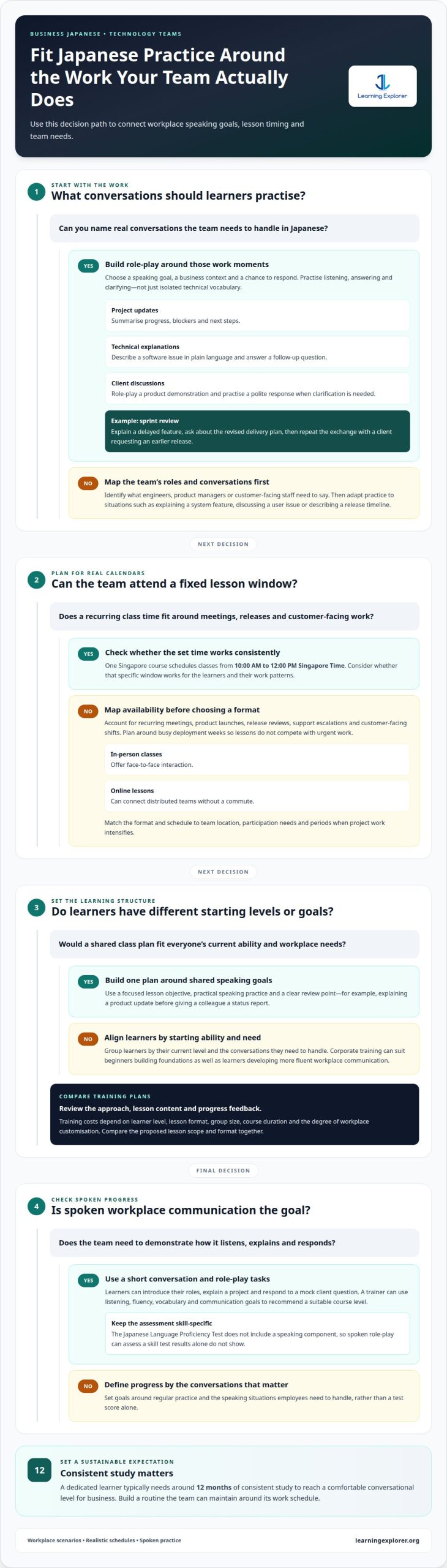
For a software team, useful practice starts with conversations employees actually have: project updates, product demonstrations, incident reports and client meetings. Role-play gives each learner a speaking goal, a business context and a chance to respond in Japanese. This turns vocabulary into communication practice rather than an isolated list of technical terms.
A trainer can build a scenario around a sprint review. One employee explains a delayed feature while another asks about the revised delivery plan. The instructor can pause, model a clearer phrase and repeat the exchange with a new constraint, such as a client requesting an earlier release. This sequence practises listening, responding and clarifying.
- Project updates: Practise summarising progress, blockers and next steps in a concise meeting exchange.
- Technical explanations: Describe a software issue in plain language, then answer a follow-up question.
- Client discussions: Role-play a product demonstration, including a polite response when a question needs clarification.
To assess employees’ proficiency, a provider can combine a short conversation with role-play tasks. Learners might introduce their roles, explain a project and respond to a mock client question. The trainer can then recommend a suitable course level based on listening, fluency, vocabulary and communication goals.
In Singapore, in-person classes offer face-to-face interaction, while online lessons can connect distributed teams without a commute. Japan-based study may suit learners immersed in Japanese daily, but location alone does not determine course fit. Compare the teaching format, workplace scenarios and schedule with your team’s needs.
When choosing corporate Japanese training in Singapore, assess the approach to placement, lesson content and progress feedback. Consider how a sample exercise could be adapted for engineers, product managers or customer-facing staff. A clear link between role-play tasks and work conversations makes the learning plan easier to evaluate.
Singapore has language schools and corporate trainers offering Japanese instruction. For a technology team, the right option depends on whether lessons address workplace speaking, role-specific vocabulary and employees’ starting levels. Compare the teaching approach and course structure, rather than relying on a provider label alone.
Lessons can cover software, IT and technology business vocabulary through relevant situations. A trainer might practise explaining a system feature, discussing a user issue or describing a release timeline. The Japanese Language Proficiency Test does not include a speaking component, so spoken role-play can assess a skill that test results alone do not show.
Corporate training costs depend on factors such as learner level, lesson format, group size, course duration and the degree of workplace customisation. The price depends on the case and is given after a quote request; these factors shape the training plan. A team comparing options can review the proposed lesson scope and format together.
Flexible Japanese lessons for working professionals
A lesson plan needs to work around real technology schedules, not an imaginary open calendar. Product launches, support escalations and release reviews can quickly change a team’s availability. Start by mapping likely lesson windows against recurring meetings and delivery milestones. This gives the provider a clearer basis for planning sessions employees can attend consistently.
For example, a software team could protect a recurring learning window outside its daily stand-up and release review. If a deployment week makes that slot difficult, the training plan can account for the busy period. The aim is to maintain a steady learning rhythm without asking employees to choose between a lesson and an urgent work commitment.
Corporate Japanese training can suit different starting levels, from beginners building foundations to learners developing more fluent workplace communication. In-person classes and online lessons can accommodate different work locations and learning preferences. The right arrangement matches employees’ current ability with the team’s schedule and speaking goals.
One Singapore course schedules classes from 10:00 AM to 12:00 PM Singapore Time. That fixed window may suit some working professionals, but teams with shifting calendars need to consider session timing before committing to a learning routine. A useful planning conversation identifies employees’ availability, time-zone needs and periods when project work is likely to intensify.
Flexibility also comes from designing sessions around a team’s day, not just changing the clock. A trainer can use a short lesson objective, focused speaking practice and a clear review point. For example, a session could centre on a product update, with learners practising a concise explanation before giving a colleague a status report.
- Map work patterns: Identify recurring meetings, launch periods and customer-facing shifts that affect attendance.
- Align levels: Group learners by their starting ability and the conversations they need to handle.
- Choose a format: Match in-person or online learning to team location and participation needs.
These details help a provider build a workable plan before lessons begin. They also make it easier to spot scheduling conflicts early, rather than losing momentum during a release cycle. For professionals balancing technical work and language study, a realistic timetable is a key part of the learning design. Explore Japanese lesson options that can support a consistent routine around work.
Keigo and polite business communication
Keigo is the Japanese language system used to express respect and humility in professional interactions. For technology employees, it matters during a client call, project update or introduction to a new partner. Practice should connect polite language choices with the speaker’s role, the listener and the purpose of the exchange.
Employees can start by distinguishing three communication needs: speaking politely, showing respect to another person and describing their own actions modestly. A software engineer, for example, might explain a system issue to a client, acknowledge the client’s concern and describe the engineering team’s next step. Each part calls for careful wording as well as technical accuracy.
Role-play can make these choices easier to recognise. In a mock project meeting, one learner gives a progress update while another asks for a delivery change. The instructor can pause at the greeting, request and closing, then coach the learner on respectful phrasing and tone. Repeating the exchange with a different client role helps learners see how context shapes communication.
- Opening a call: Practise a courteous greeting, a clear self-introduction and a concise statement of the meeting’s purpose.
- Requesting information: Rehearse a polite question about a software requirement, then listen for the response before asking a follow-up.
- Explaining a delay: Acknowledge the impact, give a factual update and communicate the next action without sounding abrupt.
- Closing a discussion: Summarise agreed actions and end with a professional expression of thanks.
Politeness should support clarity, not obscure it. During an incident update, for instance, a long, indirect explanation can make the status difficult to understand. A useful practice sequence is to state the issue, explain its effect, describe the response and check that the listener understands. The instructor can then refine the respectful phrasing at each step.
Keigo practice also benefits from feedback on delivery. A learner may choose an appropriate formal expression but speak too quickly during a client presentation. A trainer can work on pace, pauses and turn-taking through a short demonstration, followed by another attempt. This gives employees practice with both language and the rhythm of professional conversation.
For teams working with Japanese counterparts, useful scenarios include a product demonstration, a request for clarification and a response to customer feedback. In each case, learners practise adjusting politeness while keeping key details precise. Structured lessons can help employees develop a thoughtful communication style for meetings, written follow-ups and everyday collaboration.
Time required to reach conversational business proficiency
A dedicated learner typically needs around 12 months of consistent study to reach a comfortable conversational level for business. For a Singapore technology professional, that means building more than textbook knowledge. It means understanding a colleague’s question, explaining a work issue and responding clearly during a business conversation.
The timeline depends on the learner’s starting point, study consistency and opportunities to speak. Someone who already understands basic Japanese may focus on expanding workplace vocabulary. A beginner may first need to build sentence patterns and listening skills before taking part in a project discussion with less support.
“Conversational business proficiency” is best defined by the tasks an employee needs to complete. A software engineer might describe a feature, clarify a requirement and explain a technical problem. A product manager may need to summarise decisions, ask follow-up questions and keep a meeting moving. These goals make progress clearer than a general label.
For a practical learning plan, a provider can organise instruction around a progression of workplace tasks:
- Build foundations: Practise introductions, common sentence patterns and listening for familiar information.
- Develop work communication: Explain a product feature, share a project update and ask for clarification.
- Practise connected conversations: Respond to follow-up questions and take part in a longer meeting exchange.
- Review performance: Use practice conversations to identify where vocabulary, listening or clarity needs more attention.
This progression gives employees concrete milestones without treating every learner as identical. An employee, for example, may explain a planned software change well but struggle when a Japanese colleague asks an unexpected question. A trainer can use that exchange to target listening and spontaneous responses in later practice.
Regular study matters because a long gap between lessons can make words harder to retrieve in conversation. Working professionals can reinforce class learning by revisiting expressions used in a mock client discussion or project update. The focus stays on useful language rather than study tasks unrelated to work.
A test result alone cannot show whether someone can speak comfortably in a meeting. The Japanese Language Proficiency Test does not include a speaking component, so it cannot directly assess a learner’s ability to explain a release plan aloud. Trainers can instead evaluate spoken tasks, such as answering a client’s question or summarising a technical decision.
Set expectations around the learner’s starting level, consistency and target conversations. With a clear goal, such as contributing to a project meeting, progress becomes easier to observe across practice sessions. Around 12 months offers a useful reference for dedicated study, while workplace readiness is measured through the communication tasks employees can perform.
What business Japanese courses are available for technology companies in Singapore?
One documented option is an online short-term Japanese course in Singapore with a total duration of 28 hours. It is intended to improve business Japanese and prepare participants for interviews with Japanese companies. For technology teams, business Japanese for technology companies in Singapore may mean interview preparation for some employees, while others need lessons centred on meetings and project communication.
Course format should reflect the work employees need to do. A foundation course can develop basic listening and speaking, while workplace-focused training can practise introductions, updates and requests. A developer preparing for an interview, for example, may need to explain a project clearly. A support specialist may need practice asking questions and describing a user issue.
Before selecting a course, a company can define its learning goal and identify which employees will use Japanese at work. A provider can then assess their current ability and recommend suitable content. The assessment might include a brief conversation, followed by a task such as describing a technical project or answering a mock interview question.
For technology teams, practical course content can use familiar work contexts without assuming everyone needs the same vocabulary. A software engineer may practise discussing a feature, while a product manager may need to summarise decisions. These examples connect language learning with employees’ roles instead of treating the team as one uniform group.
Compare course options by looking at the learning objective, delivery format, total duration and speaking practice. A 28-hour online course has a defined short-term structure. A company considering other formats can weigh whether lessons fit employees’ schedules and include the communication tasks they need. Business Japanese for technology companies in Singapore should match the team’s intended use, since interview preparation differs from training for ongoing client discussions.
- For interview preparation: Prioritise introductions, project explanations and responses to common interview prompts.
- For cross-team collaboration: Focus on meeting contributions, clarification and concise status updates.
- For customer communication: Practise explaining product issues, responding to questions and confirming next steps.
The strongest fit is a course whose purpose matches the team’s next real use of Japanese. A business with upcoming interviews can prioritise interview tasks, while a team coordinating with Japanese colleagues can focus on workplace exchanges.
The Singapore course also had a defined intake and application timetable: it had 25 available places, and its application deadline was May 8th, 2023. Application results were scheduled to be announced on May 8th, 2023. These details may help a technology company distinguish this opportunity from a course designed specifically for an employee cohort, while checking whether the intended learners meet its stated audience.
It was open to engineering students in mechanical, electrical, electronic and information technology fields. Interview practice included writing resumes, describing a student’s area of study and final-year project, and asking questions about a company in an interview. This content helps learners prepare written applications, explain their studies and engage with a company. For a technology business assessing relevance, the stated audience and exercises matter: the course connects engineering study with interview communication, rather than establishing it as a general workplace programme for every technology employee. Teams can compare those features with the roles and situations for which they want Japanese-language preparation.
Learning Explorer: Conversational Japanese Course
Learning Explorer’s Conversational Japanese Course is a practical next step for professionals building confidence in spoken Japanese. Choose it when you want structured language learning to support everyday exchanges alongside the workplace scenarios discussed above.
For a technology professional, stronger conversational foundations can support introductions, questions and clearer participation in discussions. Set a learning goal around situations you expect to handle, such as speaking with Japanese colleagues or explaining your role. This gives your study a useful direction as you develop listening and speaking skills.
If Japanese is one part of a broader communication plan, Learning Explorer also offers a Business English Course, a Conversational English Course and a Conversational Mandarin Course. To discuss your Japanese learning goals and next steps, contact Learning Explorer.
Make your next Japanese conversation a learning goal
Choose an upcoming interaction where stronger Japanese would help your team communicate more clearly. It might be a project discussion, a client introduction or a product conversation. A specific goal gives your learning plan a practical starting point and keeps progress connected to real work.
For teams exploring business Japanese for technology companies in Singapore, the next step is to match the learning objective with a suitable course. Learning Explorer’s Conversational Japanese Course supports spoken-language development. Learning Explorer also offers a Conversational English Course, a Business English Course and a Conversational Mandarin Course for other communication needs.
Bring your team’s goals and the situations employees want to handle into the conversation. A clear starting point can make it easier to shape language learning around professional priorities. Contact Learning Explorer about lessons to discuss a suitable next step for your Japanese learning goals. Each useful conversation can become an opportunity to communicate with more confidence.
Frequently Asked Questions
How can business Japanese courses help professionals navigate cultural nuances?
Business Japanese lessons can help professionals choose language and communication approaches suited to different workplace situations. Learners can practise confirming expectations, clarifying a request and checking shared understanding without making assumptions. After discussing a proposed feature, for example, an employee can restate the agreed priorities and invite corrections. This supports respectful, practical collaboration, especially when colleagues interpret a brief or decision differently.
How does learning Japanese unlock career development in Singapore?
Learning Japanese can broaden the professional situations Singapore-based employees are prepared to take part in, particularly roles involving Japanese-speaking teams or customers. It can help someone contribute directly to cross-border project discussions instead of relying only on translated summaries. Employees can also demonstrate initiative by applying new language skills to real work interactions. Japanese ability can complement technical expertise, though career opportunities still depend on the role and employer.
What are the benefits of Japanese language skills for Singapore technology companies working with Japanese clients?
Japanese language skills can help technology teams clarify client priorities and respond precisely. For example, a team reviewing a product onboarding process can ask follow-up questions, understand user feedback and confirm which changes matter most. Direct communication can make routine collaboration more personal and reduce reliance on indirect summaries. Technical knowledge remains essential, while language skills support clearer exchanges about customer needs and product decisions.
Which Singapore providers offer corporate Japanese training for tech teams?
In Singapore, language schools and corporate trainers offer Japanese instruction. For a technology team, compare workplace speaking practice, role-specific vocabulary, placement approach and course structure to find a suitable fit.