What if your Japanese speaking isn’t improving because you’re studying the language but not practising real-time responses? If you’re wondering why your Japanese speaking is not improving, overthinking, fear of mistakes, passive review, or an unclear routine may be holding you back. Speaking develops when you regularly express ideas, retrieve what you’ve learned, and notice what is becoming easier.
It’s frustrating to understand Japanese but freeze when it’s your turn to reply. You don’t need perfect sentences to make progress. You need practice that helps you speak more freely and learn from each attempt.
Try five practical ways to build confidence: respond more spontaneously, ease up on perfectionism, revisit material so it sticks, follow a clear study sequence, and track progress with evidence. Each step can turn scattered effort into focused practice and make your next conversation feel more manageable.
Key Takeaways
- Practise replying to simple prompts without planning every sentence in advance.
- Let mistakes guide your next attempt instead of waiting until you can speak perfectly.
- Revisit Japanese through active speaking, listening, reading, and recall to help new material stick.
- Choose a clear study sequence so practice time goes to learning, not deciding what to do next.
- Track small signs of progress, such as quicker responses or ideas you can express with less effort.
1. Building spontaneity and faster responses
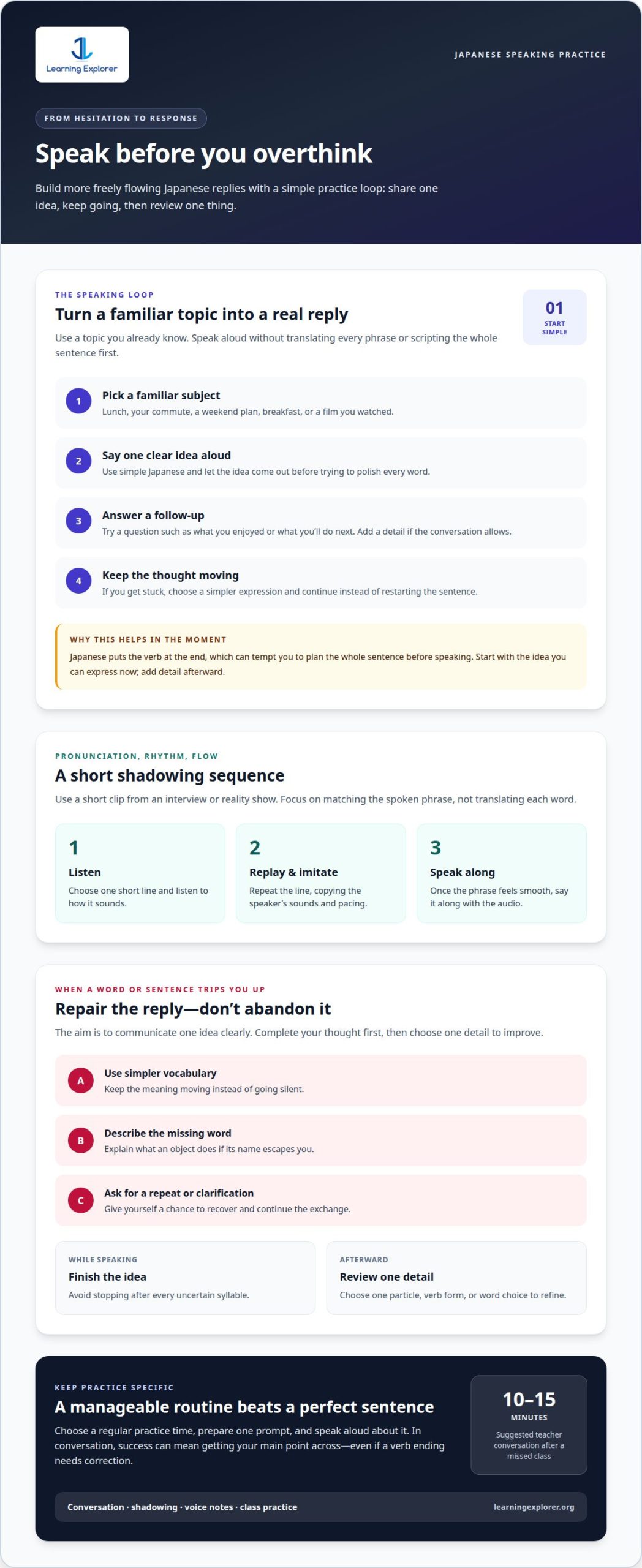
Understanding Japanese conversation doesn’t always make replying easy. You may know the vocabulary but pause while trying to assemble a perfect sentence. Japanese also places the verb at the end, unlike typical English word order, which can tempt you to plan the whole sentence before speaking. Practise sharing one clear idea first, then add a detail if the conversation allows.
For a daily speaking exercise, choose a familiar topic such as lunch, your commute, or a weekend plan. Talk about it aloud in Japanese without stopping to translate every phrase into English. Then answer a simple follow-up, such as what you enjoyed or what you’ll do next. A regular practice time, even for one hour, can make speaking part of your routine rather than an occasional test.
Shadowing can help you practise pronunciation, rhythm, and flow by speaking along with natural Japanese. Choose a short clip from an interview or reality show. Listen to one line, replay it, and imitate the speaker’s sounds and pacing. Repeat the line until you can say it smoothly, then speak along with the audio. Focus on matching the spoken phrase, not translating every word.
Use prompts to practise responding more quickly. Pick a topic such as ordering food, introducing yourself, or describing your day. Give yourself a moment to form an answer, then say a simple sentence aloud. For example, describe a meal you had and give one reason you liked it. If you get stuck, use a simpler expression and keep going instead of restarting the sentence.
Conversation practice lets you respond to another person rather than only repeat prepared lines. In a language exchange, partners can take turns speaking Japanese and English and correcting each other’s mistakes. Before an online lesson, prepare one topic, such as a recent film or a place you visited. This gives you a starting point, while follow-up questions help you practise reacting spontaneously.
Keep the routine manageable and specific: choose a daily time, prepare one prompt, and speak aloud about it. If you miss a Japanese class, speak with your teacher for 10 to 15 minutes before the next class. Use that conversation to revisit a recent topic and practise answering without scripting every sentence. A consistent rhythm gives you repeated chances to retrieve words, shape an idea, and respond with less hesitation.
One learner said they understood most of what their Japanese classmates said but often overthought their responses and ended up saying nothing. This can happen when a learner first forms an idea in Japanese, rearranges it into English word order, and only then speaks, making it hard to keep up. Try responding with the idea as it comes, using simple Japanese instead of polishing it internally.
Vary your speaking practice: try conversation, shadowing anime or dramas, or attending a class. Online games with Japanese players, Japanese friends, shadowing, and a structured course can also provide regular practice. Prepare a topic before an online lesson so you have something to say. Practise at a regular time each day, even if the session is only one hour.
2. Perfectionism and fear of making mistakes
Fear of mistakes can keep you silent, even when you know what you want to say in Japanese. The pressure to produce a grammatically perfect sentence can turn every reply into a test. You might know the words for ordering lunch but stay quiet while checking every particle. That pause may help you avoid an error, but it also takes away the chance to practise expressing your meaning aloud.
Set a smaller goal for each conversation: communicate one idea clearly. If you’re describing a film, start with its genre or your reaction. Add a reason only if you can do so without losing your thought. This gives you a practical definition of success: the other person understands your main point, even if a verb ending needs correction.
Separate your first attempt from your review. During a short speaking exercise, finish your thought before correcting yourself. Afterward, note one detail to improve, such as a particle, verb form, or word choice. If you stop after every uncertain syllable, you practise stopping. Complete the idea first, then review the error without letting it take over the whole exchange.
Use repair strategies instead of going silent. If a word escapes you, explain the idea with simpler vocabulary or describe what the missing word does. For instance, if you can’t recall a word for a kitchen utensil, explain how someone uses it. You can also ask the other person to repeat a phrase or clarify a point. These strategies keep communication going while giving you time to recover.
Choose practice situations where mistakes feel manageable. Start by recording a short voice note about a familiar subject, such as breakfast or a film you watched. Listen once for meaning, then replay it and identify one sentence to refine. In a conversation, ask for feedback on one target, such as word order. Focused correction is easier to apply than trying to fix every part of your Japanese at once.
Treat an error as information, not a verdict on your ability. Notice what caused it: a missing word, an unfamiliar structure, or a rushed response. Then create one corrected example and use it in another sentence. If you confuse a past action with a present one, make a fresh example about yesterday. That small repair turns an uncomfortable moment into a clear next step.
For practice with supportive feedback, explore structured Japanese speaking practice. A guided conversation can help you focus on sharing meaning, then work through corrections without expecting flawless speech from the first sentence.
3. Practising for understanding and long-term memory
Recognising a Japanese word while reading is different from recalling it in conversation. To strengthen recall, study a short passage, close it, and explain its main idea aloud. Next, turn one sentence into a question and answer it without looking. This shifts practice from recognising words to retrieving meaning and expressing it yourself.
Try working with the same material in different ways. After reading a dialogue, cover the answers and respond to its questions. Then write a new question using a phrase from the dialogue. Revisit the material after a few days to see what you can still recall and what needs review. Spaced repetition can also reduce unnecessary reviews of vocabulary you already remember.
English education in Japan has traditionally emphasised accurate reading and listening in paper tests. These activities can build comprehension, but speaking also requires spontaneous responses and clear communication. If your practice mainly involves reading explanations or listening passively, add tasks that require you to retrieve and use the language. For example, listen to a short clip, summarise its message aloud, then answer a question about it.
Online English conversation practice offers a useful contrast: one learner practised it for a total of about 9 months. The transferable lesson is to use conversation for active retrieval, not simply exposure. In Japanese, discuss a familiar topic, listen to the other person’s reply, and respond to what they actually said. That exchange tests understanding and speaking together.
A tutor, language partner, and AI practice tool each serve a different purpose. A tutor can guide a lesson and focus feedback; a language partner offers a mutual exchange; AI can provide a low-pressure way to rehearse prompts. A human conversation brings another person’s natural reactions, while each format can support a different part of your practice.
How much speaking practice do you need for fluency? There’s no single amount that suits every learner. Regular retrieval and meaningful interaction matter more than one long, passive session. If time is tight or native speakers aren’t nearby, answer a prompt aloud, record a voice note, or practise with an online conversation partner. In Singapore, Japanese classes, language exchanges, and online lessons are practical ways to practise conversation.
Make each session active: listen for meaning, answer from memory, and revisit difficult material after a few days. Spending 14 hours watching videos, saving lectures, and downloading PDFs still leaves little practice if you never use the language. Add one spoken response to each study session, and you’ll build a clearer link between what you understand and what you can express.
4. Choosing a structured study sequence
Japanese study can feel busy without building skills that transfer into conversation. Some learners spend 30 to 40 minutes deciding what to study instead of studying. A sequence removes that repeated choice. For example, move from reviewing a phrase to hearing it in context, then using it in a spoken response. Each activity prepares you for the next.
Start with a clear communication goal, such as describing a weekend plan. Choose vocabulary and sentence patterns that support that goal instead of collecting unrelated words. Practise the patterns with a few examples, then listen for them in a dialogue. Finish by using them to describe your own plan aloud. This connects what you study to a real speaking task.
Keep your learning sequence consistent: review, understand, retrieve, apply. First, revisit words or grammar from an earlier lesson. Next, read or listen to an example and identify how the phrase works. Then cover the material and recall its meaning. Finally, use it in a new sentence, such as adapting a sample plan to your own Saturday.
Use one main topic across different activities. If you’re learning to talk about food, read a short menu dialogue, listen to the exchange, and answer a related question. Then describe a meal you enjoy using the same expressions. This varied practice tests whether you can understand and use the material, not just recognise it on a page.
Choose resources based on the skill you need next, not their novelty. If you recognise a phrase but can’t say it, pause new vocabulary study and practise recalling that phrase aloud. If its meaning is still unclear, return to an example sentence or recording. This keeps your sequence responsive and prevents a pile of unfinished lessons and saved materials.
Plan a study session before opening a textbook or app. Set a specific outcome, such as asking for directions or explaining a recent outing. Gather only the dialogue, vocabulary, and exercise needed for that outcome. Move from comprehension to recall, then finish with a short spoken response. A defined endpoint makes it easier to see what you practised.
At the end of a session, note what needs another pass. You might understand a question about directions but struggle to form an answer. Make that your next review focus instead of restarting an entire chapter. A consistent sequence gives each session a purpose and helps connect Japanese knowledge with practical speaking.
Learners may feel stuck after one, two, or three months. After a break from studying, Japanese can feel rusty and grammatical errors may return. Practise at a regular time each day, even for one hour.
5. Tracking evidence of progress
Speaking can seem unchanged if you judge progress only by confidence. Keep dated recordings of short speaking samples instead. Describe the same familiar topic, such as your weekday routine, and compare recordings later. Notice whether you pause less, complete more thoughts, or explain ideas more clearly. These signs can reveal changes that a general feeling of “better” might miss.
Track different skills separately. After a conversation, note one thing you understood, one response you gave, and one point that caused difficulty. For example, you might follow a question about dinner but need time to explain what you cooked. This record distinguishes listening comprehension from spoken recall, helping you target the skill that needs attention next.
Measure your actions as well as your results. Record whether you started a conversation, asked a follow-up question, or kept speaking after forgetting a word. These actions show whether you’re using Japanese more actively, even before your speech feels smooth. A simple log can include the date, topic, speaking situation, and one observation. Keep entries factual, such as “answered without notes” or “needed help with a verb.”
Listening time can provide useful context, but it isn’t a speaking score. One learner’s listening hours increased by 194 after moving to Japan. That figure describes listening exposure, not a guaranteed change in speaking ability. If you track listening, pair it with a separate speaking sample or conversation note. This helps you see whether greater exposure is also supporting your ability to respond.
Compare similar tasks under similar conditions. Use a familiar prompt, such as describing a usual morning without reading notes, for each recording. Then listen for one feature at a time. First, check whether you finish your main idea. In another review, notice whether you connect ideas or retrieve familiar words more quickly. A focused comparison makes progress easier to identify than searching for every possible error.
Review your notes after several practice sessions and look for recurring patterns. If “I couldn’t answer follow-up questions” appears repeatedly, make follow-up responses your next target. If the same grammar issue keeps coming up, create a fresh example and listen for that structure in conversation. Let the evidence guide your next step instead of changing your whole study plan after one difficult exchange.
Choose measures that guide action, not self-criticism. A recording with pauses can still show that you expressed a complete idea without notes. Track one strength alongside one next step, such as “explained my route clearly; practise asking for directions.” For support turning these observations into focused Japanese conversation practice, explore guided speaking practice.
Learning Explorer: Conversational Japanese Course
Learning Explorer’s Conversational Japanese Course offers a structured next step if solo practice hasn’t helped you speak more confidently. Guided conversation gives you opportunities to express ideas, respond in Japanese, and build on what you’ve learned. It can suit learners who understand Japanese but want more chances to use it aloud.
Bring a practical goal to your learning, such as handling everyday conversations or sharing your opinions. Regular, interactive practice can connect vocabulary and sentence patterns with real communication. Choose the course if you’d benefit from learning with an instructor and want a clearer path from study to speaking.
Contact Learning Explorer to discuss the Conversational Japanese Course.
Make your next Japanese conversation count
Progress doesn’t have to come as a sudden leap. It can start with one conversation where you share an idea, recover from forgetting a word, or notice that you needed less time to respond. These moments give you a practical way to keep moving, even when your confidence hasn’t caught up.
If you’re still asking why your Japanese speaking is not improving, consider what happens between studying and real communication. Knowledge needs opportunities to become usable speech. Choose a situation you want to handle more comfortably, then use it to guide your next practice session. A clear purpose can make each attempt more relevant and easier to sustain.
If guided practice would help you turn that goal into conversation, connect with Learning Explorer about Japanese speaking practice. Bring the situations you want to discuss and the parts of speaking that feel challenging. Your next step doesn’t need to be perfect. Keep showing up, keep expressing your ideas, and let each conversation build on the last.
Frequently Asked Questions
What are the most common reasons Japanese speaking skills stop improving?
Speaking can stall when your practice doesn’t match the conversations you want to handle. If you can answer rehearsed questions but struggle to explain an unfamiliar choice, practise organising your thoughts beyond memorised phrases. If you understand a conversation but contribute little, focus on expressing your own ideas. Identifying where communication breaks down helps you choose a targeted exercise instead of adding more study materials.
How do I overcome fear of making mistakes when speaking Japanese?
Give yourself a simple way to keep communicating when you’re unsure. Rephrase the idea using words you know, or say you need a moment to think. Afterward, write down the phrase you wanted and practise using it in a new example. This turns an uncertain moment into a useful follow-up task without making every conversation depend on flawless grammar.
How can I tell whether my Japanese speaking level is improving?
If you’re wondering why your Japanese speaking isn’t improving, compare what you can do now with an earlier real-life task. For example, note whether you can explain a preference, give a reason, and respond to a related question without switching languages. Progress may show up as clearer explanations or more flexible phrasing, even if you still make errors. Write a brief reflection after conversations to spot changes over time.