What if the right language course matters less than the conversations your team needs to have? A programme focused on meetings, client calls, professional emails or presentations can make learning more useful from day one. Yet choosing corporate language training packages singapore can feel complicated when employees have different language needs and busy schedules.
It’s understandable to wonder whether to focus on one language or several, and whether private, group or intensive lessons will suit your team. This guide will help you connect training goals to real workplace communication, choose among English, Mandarin, Japanese, Korean, Spanish, Thai and Vietnamese, and compare learning formats. You’ll also find practical ways to set clear objectives and review progress, including using workplace tasks and proficiency benchmarks. Learning Explorer works with corporate clients to tailor language learning to employee and business needs, so you can make a considered choice that supports confident communication without adding unnecessary complexity.
Key Takeaways
- Start with the workplace conversations employees need to handle, then shape learning goals around those tasks.
- Compare private, group, and intensive classes by learner needs, interaction style, and scheduling considerations.
- Use a practical framework to assess language priorities, employee needs, curriculum relevance, and progress review.
- Set observable goals, such as contributing to a meeting or writing a professional email, instead of relying on vague fluency targets.
- Explore how corporate language training packages singapore can be tailored to different teams, languages, and communication priorities.
Goals of Corporate Language Training in Singapore
Clearer meetings, stronger client conversations and more confident collaboration are practical goals for corporate language learning. A corporate language package is structured instruction shaped around employees’ language levels, roles and workplace communication needs. Rather than treating learning as a general classroom subject, it connects practice to situations employees actually face, helping them communicate with greater confidence across Singapore-based and international teams.
That connection matters in a multilingual business environment. English may be the working language for internal discussions, while employees also need to build rapport with Mandarin-speaking customers or collaborate with regional partners in another language. A company-wide language policy can help clarify how an organisation approaches multilingual communication. The overview of Corporate Language Policy discusses its relationship with HR and language training.
Start with the communication situations employees face
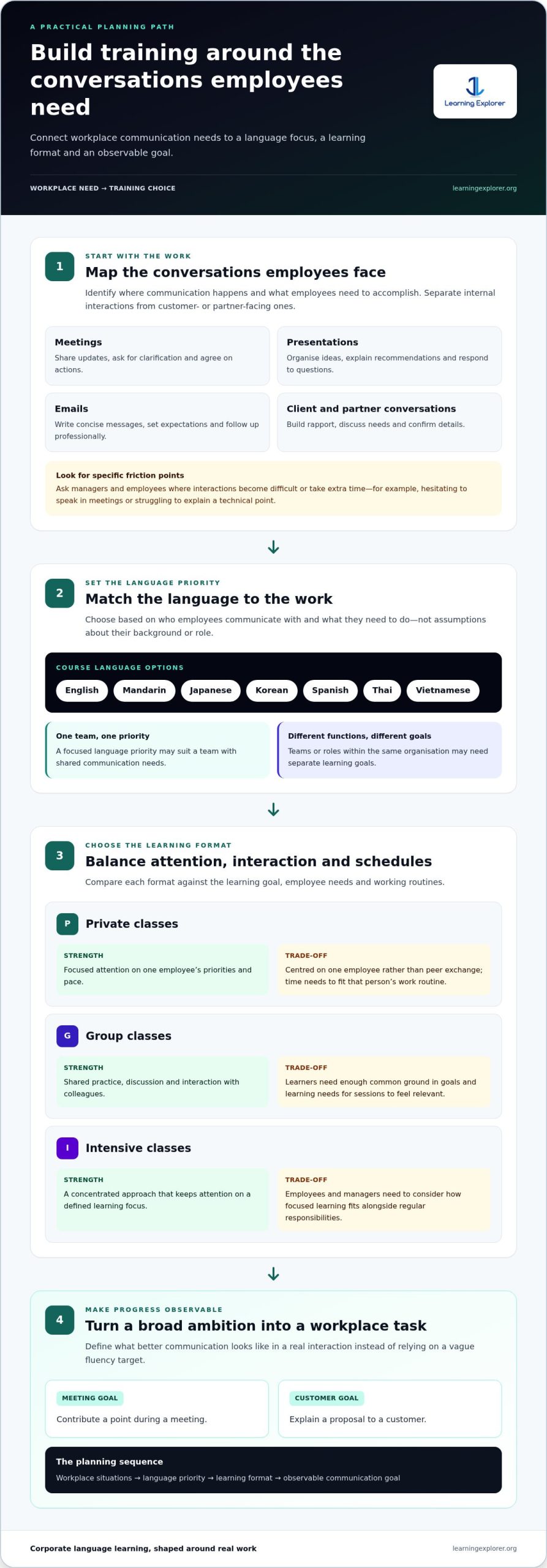
Begin by identifying where communication takes place and what employees need to do. Map recurring situations, then distinguish internal needs from customer-facing or partner-facing interactions. A team that contributes to cross-border project meetings may need practice expressing opinions and clarifying next steps. Employees who handle client conversations may have different priorities, such as explaining a service or responding to questions clearly.
- Meetings: Sharing updates, asking for clarification and agreeing on actions.
- Presentations: Organising ideas, explaining recommendations and responding to questions.
- Emails: Writing concise messages, setting expectations and following up professionally.
- Client and partner conversations: Building rapport, discussing needs and confirming details.
Ask managers and employees where these interactions become difficult or take extra time. Look for specific friction points, such as hesitating to speak in meetings or struggling to explain a technical point. Those observations give the programme a useful starting point without assuming every employee has the same needs.
Match the language focus to the team
Choose a language based on the work employees need to do, not assumptions about their background or role. Course options include English, Mandarin, Japanese, Korean, Spanish, Thai and Vietnamese. One team may prioritise Business English for workplace communication; another may need Mandarin or Japanese to support conversations with clients or partners. Different roles within the same organisation can also have distinct priorities.
For corporate language training packages singapore, this means defining the context before selecting the course: who employees communicate with, what they need to accomplish, and which language will help them do it. A focused language priority may suit one team, while different functions may require separate learning goals. Explore the Singapore language courses guide for broader context on language-learning options.
Keep the first goal observable. Instead of asking employees to “be fluent,” define what better communication would look like in a real interaction, such as contributing a point during a meeting or explaining a proposal to a customer. Clear goals make it easier to connect training with work and review whether it’s helping.
Compare corporate language training formats and learning approaches
The right format makes learning easier to take part in and easier to connect with work. Consider how much individual attention employees need, whether peer practice would help, and how learning can fit around their responsibilities. A private class may suit a specific individual priority, while group learning can bring colleagues together around shared communication goals. Intensive classes offer a more concentrated approach when focused learning is the priority.
Private classes
Strength: Focused attention on an individual’s priorities and pace.
Practical trade-off: Learning is centred on one employee rather than peer exchange, and time needs to be arranged around that person’s work routine.
Group classes
Strength: Shared practice, discussion and interaction with colleagues.
Practical trade-off: Learners need enough common ground in their goals and learning needs for sessions to feel relevant to the group.
Intensive classes
Strength: A more concentrated learning approach that can keep attention on a defined learning focus.
Practical trade-off: Employees and managers need to consider how a more focused period of learning fits alongside regular responsibilities.
Choose a format that fits the people and the work
Private, group and intensive classes each create a different learning experience. Private learning can help an employee concentrate on role-specific communication. Group classes allow colleagues to practise together and learn from one another’s contributions. An intensive approach can suit learners who benefit from sustained focus. Learning Explorer offers these formats for corporate clients, with course planning shaped around employee and business needs.
Before deciding, weigh the learning goal against employees’ working routines. A group may need protected time that works for its members; individual learning may be easier to align with one person’s priorities. Avoid choosing a format simply because it seems convenient. The useful question is whether it gives learners enough opportunity to practise the communication they need at work.
Make class activities feel relevant
Build practice around real workplace situations identified in the needs assessment. For example, learners could role-play a customer asking for clarification, discuss how to respond to a colleague’s concern, or practise explaining a change in a project update. These are activity ideas, not promised business outcomes. The aim is to give employees a supported space to use language in context and receive guidance as they practise.
Consider varying activities to keep participation active. A discussion can help learners express and respond to ideas; a role-play can rehearse a particular exchange; a realistic scenario can bring vocabulary and communication choices together. Match the activity to the class format. Private instruction can focus closely on an individual’s practice, while group discussions make room for peer interaction.
Use these comparisons to narrow down the learning approach that suits your employees and objectives. For a closer look at course options, explore Learning Explorer’s language courses. A well-matched format gives corporate language training packages singapore a practical foundation, with learning activities connected to work and organised around employees’ needs.
How to evaluate a corporate language training package before choosing
A useful evaluation starts with the work employees need to do, then checks whether the programme’s content and structure support it. Compare packages by how well they fit the brief, not by a format label or a broad promise of fluency. This helps decision-makers choose corporate language training packages singapore that are relevant to real roles and practical to organise.
Use this framework to compare options:
- Learning goals: Define the communication tasks employees should handle with greater confidence.
- Learner needs: Consider employees’ current proficiency, roles and learning priorities.
- Language: Select the language that fits the team’s actual communication context.
- Format: Assess the interaction and scheduling needs of learners, then consider which class approach supports them.
- Progress review: Decide how you’ll observe learning, such as through practice tasks that reflect the original goals.
Curriculum relevance is the link between that framework and a useful learning experience. If employees need to contribute to project discussions, course activities should give them practice expressing ideas, asking for clarification and responding to others. If their priority is written communication, activities can focus on composing and refining work-related messages. The more clearly lessons reflect identified situations, the easier it is for learners to connect practice with their day-to-day responsibilities.
Assess curriculum and instructor fit
Learning Explorer’s curriculum is strategically aligned with global standards. Courses are taught by certified native-speaker instructors who are also bilingual. As you assess a programme, look for a clear connection between its learning activities and the team’s objectives. Consider whether employees will practise the kinds of communication they need, and whether the course can be shaped around their learning priorities.
Compare delivery choices by their workplace fit, not by their names alone. Consider who needs to participate, how much individual attention learners need, and whether employees benefit from learning with colleagues. A format is only useful if learners can engage with it alongside their work responsibilities and get relevant opportunities to practise.
Compare package scope and practical requirements
Before deciding, clarify the package scope: the language, proficiency level, learning format and course duration. Also consider whether customisation is needed, where training will take place, and how many employees are included. These factors can affect corporate fees, alongside the language and level of instruction. Review them together so a cost comparison reflects the actual learning brief rather than a headline figure alone.
For teams focused on workplace English, the corporate English learning guide offers related context. A well-defined brief makes it easier to compare curriculum, instructor fit and practical requirements, then select a programme that supports employees’ communication needs.
Plan employee participation and measure progress in corporate language training
A programme is easier to sustain when employees understand why they’re learning, can fit classes around their work, and know what progress looks like. Keep planning practical. A simple review process can help managers see whether learning remains connected to workplace needs without creating a heavy reporting burden.
Set useful learning goals before classes begin
Translate business priorities into tasks employees can practise. Instead of setting a broad aim such as “improve fluency,” define what learners should be able to do, such as give a concise project update, ask follow-up questions in a meeting, or write a clear customer response. Agree on goals by learner group, since roles and communication needs may differ. Keep each goal realistic, work-related and easy for employees to understand.
Plan participation and review progress
Use this sequence to move from planning to programme review:
- Assess needs. Gather input from managers and learners about communication tasks, current challenges and priority roles.
- Set observable goals. Describe the actions learners will practise, such as summarising a discussion or responding to a customer question.
- Plan participation. Match the selected class format to employee roles, schedules and learning needs. Share expectations early so participants can make space for classes and practice.
- Collect simple review inputs. Track attendance, invite learner feedback and observe performance on practice tasks linked to the goals.
- Review and adjust. Check whether the learning remains relevant, then refine priorities if roles or workplace communication needs change.
Use a practice task as a useful point of comparison. For example, employees could respond to a workplace scenario near the start of learning and revisit a similar task later. Managers can look for observable changes, such as clearer explanations or more complete responses, without treating one exercise as proof of overall proficiency. Pair task observations with learner feedback: employees can explain which situations feel easier and where they still want support.
Keep check-ins focused. A brief discussion with learners or team leads can reveal whether the course content still reflects their work and whether participation is manageable. If a team’s responsibilities shift, update the practice priorities rather than letting lessons drift away from daily communication. The aim is a useful feedback loop, not extra paperwork.
For corporate language training packages singapore, these planning steps make progress easier to discuss because goals are tied to observable workplace tasks. Clear expectations also help employees understand how class activities connect with their roles, which can support more purposeful participation.
Ready to shape a programme around employee goals and progress review? Explore corporate language learning with Learning Explorer.
Build a Singapore corporate language programme with Learning Explorer
A well-planned corporate programme brings together a clear communication goal, the right language focus and a format employees can take part in. Learning Explorer is a Singapore language school that works with corporate clients to shape structured learning around employee and business needs. Start with the situations your teams need to handle, then use those priorities to guide the programme brief.
Choose language and format around the organisation’s needs
Set out who employees communicate with and what they need to do. A team that works with regional partners may have different language priorities from colleagues who mainly communicate with customers in Singapore. Choose a language focus according to those roles and interactions, rather than assuming every team has the same needs.
Next, consider how employees learn and work. Private classes can centre on individual priorities, group classes can support shared learning, and intensive classes provide a more concentrated format. Think about learner needs, workplace schedules and opportunities to participate before settling on an approach. The format should make it practical for employees to engage with learning, not add avoidable friction to their working routines.
Programme fees are tailored to project factors rather than a single standard figure. The language, proficiency level, course duration, group size, customisation and training location can all shape the brief. Clarifying these details helps employers define what the programme needs to cover and compare its scope with their objectives.
Take the next step with a clear training brief
Before discussing next steps, gather a few essentials. A concise brief gives the programme a useful starting point and helps keep planning organised:
- Learning goals: Identify the workplace communication tasks employees want to practise.
- Employee context: Note relevant roles, learner needs and how participation could fit into work routines.
- Language priorities: Name the language focus linked to those communication needs.
- Preferred format and location: Consider private, group or intensive learning, along with where classes would take place.
- Practical requirements: Outline the intended course duration, group size and any customisation needs.
With those details in hand, you can have a more focused conversation about how goals, learners and delivery can come together. Explore corporate language training with Learning Explorer and share your organisation’s learning goals to discuss the next steps. A clear brief supports organised learning for employees and creates a practical foundation for more confident workplace communication.
Turn your training decision into a confident first step
Before moving ahead, choose one team or role where stronger communication would make a meaningful difference. Agree on what employees need to do, how learning can fit into their working week, and what observable progress would look like. A focused starting point can make planning more manageable and give your organisation a clearer basis for shaping corporate language training packages singapore.
Keep the brief practical. Note the priority communication needs, learner context and preferred next steps, then use them to guide the programme conversation. The aim isn’t to solve every language need at once. It’s to create a thoughtful path that employees can engage with and managers can review.
Take the next step with Learning Explorer’s corporate language training. A clear starting point can help your organisation move from uncertainty to purposeful learning, while supporting employees as they build confidence in workplace communication.
Frequently Asked Questions
Can one corporate language training programme cover multiple languages?
Yes. An organisation can plan learning for different employee groups, with each group working toward a relevant communication goal. For example, one department might need to prepare for regional client discussions while another focuses on communicating with colleagues across offices. Map the audiences employees speak with and the tasks involved, then organise goals by team. This makes it easier to coordinate learning without assuming every employee shares the same priorities.
How should a company assess employees’ language learning needs?
Start by asking employees to describe recent communication situations that felt difficult or took extra effort. Managers can add context about role requirements, while learners can point to moments where they wanted more confidence or clarity. Compare both perspectives, then note the recurring needs. A short, role-based summary can help distinguish an individual development goal from a shared team priority and give course planning a useful, evidence-based starting point.
Are group classes or private classes better for corporate language training?
The best choice depends on how employees need to participate and what support helps them practise. Consider whether learners share similar responsibilities, whether they need personal feedback, and how comfortable they may feel speaking in front of colleagues. A pilot discussion with managers and prospective learners can surface these preferences before planning. Use what you learn to select an arrangement that employees can realistically attend and engage with.
How much do corporate language training packages in Singapore cost?
Fees depend on the scope of the programme, so there isn’t one standard amount for every organisation. To make a budget comparison useful, write down the requested course content, learner profile, intended duration, group size, customisation and training location. Then compare proposals against that same brief. This helps decision-makers understand what each fee covers and whether the proposed scope matches the organisation’s priorities, without relying on an unsupported benchmark.
How can employers measure whether language training is helping employees?
Choose a small set of observable indicators that reflect the programme’s purpose. These might include whether learners complete relevant practice activities, how they rate their confidence in a target situation, and what managers notice in appropriate workplace interactions. Review the indicators at planned check-ins and ask employees what still feels challenging. The combined feedback can guide adjustments while keeping evaluation grounded in the outcomes the organisation set.
Which languages can employees study with Learning Explorer?
Learning Explorer offers structured courses across its language programme for individuals and corporate clients. To decide which option to prioritise, consider the conversations employees handle, the people they communicate with and the goals attached to their roles. Keep language choice separate from decisions about learner participation and course organisation, then bring these elements together in the programme brief. This keeps planning focused on business communication needs rather than assumptions about employees.