What if clearer Mandarin pronunciation came from hearing contrasts, not repeating syllables until they feel familiar? If mā, má, mǎ and mà seem almost alike at first, you’re not alone. Mandarin tones practice for beginners can feel frustrating when tone marks on a page don’t match what you hear, or when repetition gives you no clear sense of progress. The good news is that you can train your ear and voice in small, focused steps.
Build a short routine around listening, speaking and review. Notice how each of the four tones moves, along with the neutral tone. Then practise hearing and saying tone pairs so you can recognise how tones sound together in real words. A short recording and a focused replay can help you spot what’s becoming clearer and what needs another try.
This guide shows you how to make tone practice purposeful, with simple drills you can repeat without turning study into a chore. You’ll learn to connect tone marks with spoken pitch, practise useful contrasts and bring clearer tones into beginner conversations. Start small, listen closely and let steady practice build your confidence.
Key Takeaways
- Understand how pitch patterns can change a syllable’s meaning, and what to focus on as a beginner.
- Make mandarin tones practice for beginners more manageable by focusing on a small contrast at a time.
- When sounds seem alike, check whether the challenge comes from pitch, initials, finals or syllable timing.
- You don’t need perfect tones to start speaking. Aim for clearer, more attentive speech as you build confidence.
- Revisit familiar tone contrasts as you learn new phrases, and use guided conversational practice when you want feedback.
Why Mandarin tones matter, and what beginners need to practise first
A Mandarin tone is the pitch pattern used when saying a syllable. Because pitch can distinguish one word from another, the syllable’s sounds alone may not be enough to identify its meaning. This can make listening and speaking challenging at first. Tones are learnable through focused listening and speaking practice, not by memorising tone marks alone.
In Singapore, you can work on standard Mandarin pronunciation with a practical goal: understanding and being understood in everyday conversation. Start by noticing how your voice moves, then connect that sound to the pinyin mark and the word you’re learning. This gives mandarin tones practice for beginners a clear purpose beyond getting a mark right on the page.
What are the four Mandarin tones and the neutral tone?
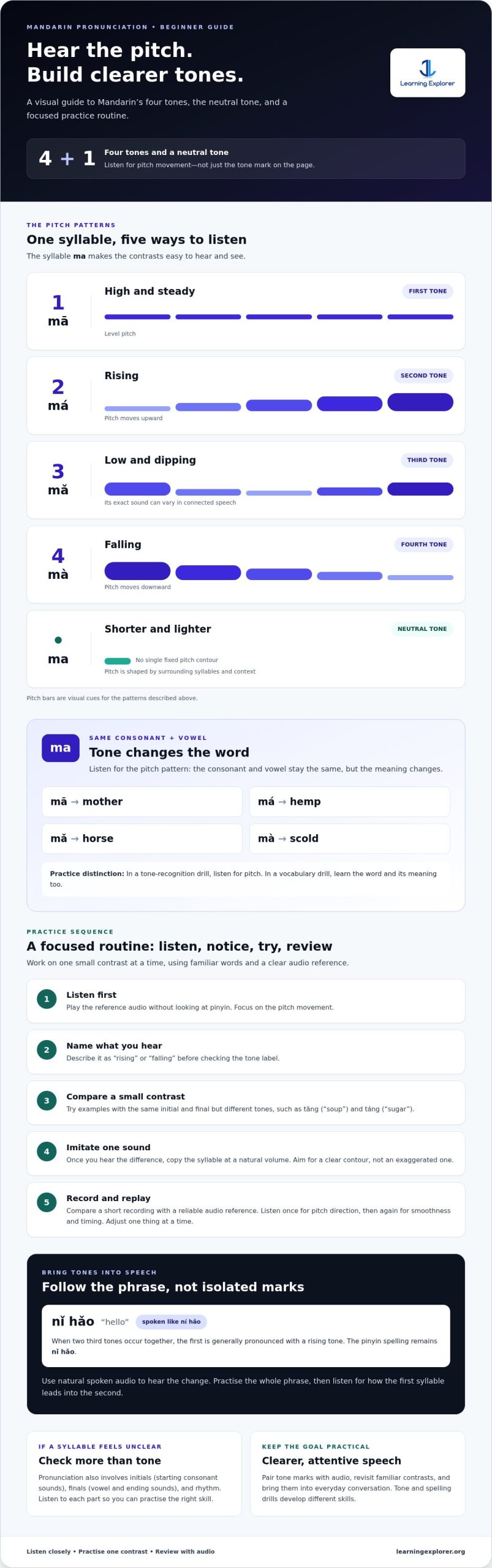
Hanyu Pinyin uses tone marks to show pitch patterns. The syllable ma makes the contrasts easy to see: mā has the first tone, má the second, mǎ the third and mà the fourth.
- First tone: high and steady, as in mā.
- Second tone: rising, as in má.
- Third tone: low and dipping, as in mǎ. Its exact sound can vary in connected speech.
- Fourth tone: falling, as in mà.
- Neutral tone: shorter and lighter, without one fixed pitch contour. Its pitch is shaped by the surrounding syllables and context.
For a more detailed phonetic overview, see Mandarin Tones in Standard Chinese Phonology. Use tone marks as visual cues, but pair them with audio so you learn how each pattern sounds.
Why can a tone change the meaning of a syllable?
The four ma examples show why tone matters: mā means “mother,” má means “hemp,” mǎ means “horse,” and mà means “scold.” The consonant and vowel stay the same, but the tone changes the word. These examples are also vocabulary, so separate the two learning tasks. In a tone-recognition drill, listen for the pitch pattern. In a vocabulary drill, learn the word and its meaning as well.
Tone is one part of pronunciation, alongside initials, or starting consonant sounds, finals, or vowel and ending sounds, and rhythm. If a syllable seems unclear, don’t assume tone is the only issue. Listen carefully to each part so you can practise the right skill and build clearer Mandarin speech over time.
How to hear and produce Mandarin tones more clearly
Build the sound in two steps: listen for the pitch movement, then try to reproduce it. If you jump straight to repeating, you may copy the syllable without noticing whether its pitch rises, falls or stays level. A focused routine trains your ear and voice together, giving each practice attempt a clear goal.
Train your ear before repeating the sound
Choose two examples with the same initial and final but different tones, such as tāng (“soup”) and táng (“sugar”). Listen and identify the direction of the pitch before naming the tone or speaking. First, keep the tone marks visible as prompts. Then hide them, replay the examples in a mixed order and see whether you can recognise each sound without relying on a memorised sequence.
Keep the contrast small. Ask yourself, “Did the pitch stay level or rise?” before trying to label it as first or second tone. This trains sound recognition rather than recall of a numbered list. Once you can hear the difference, imitate one syllable at a natural volume. Avoid stretching it or making your voice movement larger than the reference. Aim for a clear contour, not a theatrical one.
Practise tone pairs and tone changes in context
When individual tones feel more familiar, move to two-syllable words and phrases. Mandarin’s pitch patterns flow together in speech, so listening to tones in context helps you prepare for conversation. A useful example is nǐ hǎo, “hello.” When two third tones occur together, the first is generally pronounced with a rising tone, so the phrase sounds like ní hǎo. The pinyin spelling remains nǐ hǎo.
Use natural spoken audio to hear this change rather than trying to force each written mark into an isolated sound. Practise the whole phrase, then listen again for how the first syllable leads into the second. Tone combinations are easier to produce when you follow the phrase’s flow instead of treating every syllable as a separate pitch exercise.
Record a short attempt on your phone and compare it with a reliable audio reference. Listen once for pitch direction, then again for whether the syllable sounds smooth and well timed. Make one adjustment at a time. Pronunciation practice trains what you hear and say; spelling drills help you recognise and write tone marks. Both are useful, but they develop different skills.
For mandarin tones practice for beginners, short, repeated comparisons are more useful than trying to fix every sound at once. If you’d like guided feedback as you bring these contrasts into conversation, explore Conversational Mandarin practice.
A simple mandarin tones practice routine for beginners
A repeatable routine turns tone study into focused practice instead of a long list of sounds to memorise. Keep each session centred on one small contrast, such as a level tone against a rising one. Use familiar beginner vocabulary and a clear audio reference so you can focus on the sound rather than guessing what a new word means.
Build a short practice session step by step
Follow this sequence with a small set of syllables:
- Listen: Play the reference audio without looking at the pinyin. Focus on the pitch movement.
- Identify: Say what you hear, such as “rising” or “falling.” Then check the tone mark.
- Imitate: Repeat each syllable naturally, one at a time. Keep the sound clear and relaxed.
- Record: Record one attempt on your phone, using the same syllables and order as the reference.
- Compare: Replay the reference and your recording. Listen for one difference, such as a pitch that does not rise enough.
- Review: Repeat the hardest contrast and write down one specific target for next time.
A simple progress log can include the date, the contrast practised and your next target. For example: “second versus fourth tone, listen for a clearer fall.” This makes practice measurable without turning it into a test. Revisit an earlier recording later to notice what has changed.
Progress from syllables to useful Mandarin phrases
Begin with individual syllables, then combine familiar ones into tone pairs and short phrases. Choose words you already recognise, so you’re not trying to learn a new meaning and produce an unfamiliar tone at the same time. Once a phrase feels more comfortable, say it in a short sentence. That connects a drill to real communication.
For example, practise a familiar greeting as a phrase, then use it in a simple spoken exchange. Keep your attention on the tone contrast you chose, rather than trying to correct every part of your pronunciation at once. This is the heart of mandarin tones practice for beginners: focused listening, a careful attempt and a useful review.
To extend your drills into broader speaking practice, explore this conversational Mandarin learning guide. It can help you connect familiar phrases with everyday conversation while you build confidence one contrast at a time.
What to do when Mandarin tones still sound alike
If two tones still blur together, it doesn’t mean you’re failing or need to wait until your pronunciation is perfect before speaking. Treat the confusion as useful information. A small, specific adjustment is easier to practise than judging every part of a syllable at once.
How can you tell which tone is causing difficulty?
Compare a short recording of your voice with a reliable reference. Listen once for the pitch contour, then again for how clearly the syllable begins and ends. Ask yourself whether the pitch direction differs, or whether the initial, final or timing makes the whole sound hard to recognise.
Try the same tone in isolation and in a familiar short phrase. If it sounds clear alone but less clear in the phrase, focus on how the syllables connect and keep their timing. If the pitch direction is off in both, make that your practice target. Change one thing at a time.
A simple listening log can reveal patterns without turning mistakes into failures. Note the date, the contrast you practised, what you heard in your recording and one next step. For example:
- Contrast: rising versus falling.
- Observation: the pitch rise is clear alone, but less distinct in a phrase.
- Next target: keep the rise audible while saying the phrase smoothly.
After a few sessions, look for contrasts that appear repeatedly in your notes. That’s a practical cue for what to revisit in mandarin tones practice for beginners.
When should you seek guided pronunciation feedback?
If replaying your attempts and comparing them with a reference doesn’t clarify a recurring contrast, guided feedback can help. An instructor can model how to shape the syllable, show the pitch direction and demonstrate how to say it naturally in a phrase. You can then hear the difference, try it yourself and get support refining your attempt.
Use self-practice to build awareness, and treat instructor guidance as a supportive next step rather than a requirement before you begin speaking. For a broader look at structured language study in Singapore, explore this Mandarin learning guide for Singapore.
For focused feedback as you practise speaking, explore Conversational Mandarin classes. Guided conversation can help you work through difficult tone contrasts while using Mandarin in context.
Keep building tone confidence through real Mandarin conversation
Tone drills build awareness, but conversation gives you a reason to use that awareness. Keep revisiting familiar contrasts as you learn new phrases and vocabulary. You don’t need to perfect every syllable before speaking. Aim to notice pitch more carefully and make your speech clearer over time.
Turn tone drills into everyday speaking practice
Choose a greeting or short exchange you already know. Listen for a tone you’ve practised, say the phrase slowly enough to shape it clearly, then repeat it at a natural pace. Before using a difficult word in conversation, review its pronunciation briefly. Afterward, note whether the tone stayed clear when you spoke at normal speed.
As your vocabulary grows, bring old and new words together in short sentences. This helps you revisit familiar tone contrasts without separating pronunciation practice from communication. Keep your goal realistic: attentive speech and steady progress, not instant perfection. Consistent practice matters more than getting every tone right on the first try.
Choose a learning format that supports your next step
Independent practice can take you a long way. If you’d like feedback and more chances to speak, instructor-led learning is an optional next step. Private classes offer an individual learning format, group classes create opportunities to practise with others, and intensive classes provide another format for focused study. Choose based on the kind of practice that suits your goals.
Learning Explorer’s Conversational Mandarin classes in Singapore are taught by certified native-speaker instructors. Guided language practice can help you hear how tones work in phrases and build confidence using Mandarin in conversation, while you continue practising at your own pace between lessons.
Keep your mandarin tones practice for beginners simple and connected to the conversations you want to have. When you’re ready to build on your independent drills, explore Conversational Mandarin classes with Learning Explorer.
Take your Mandarin practice into conversation
Clearer tones grow through focused listening, careful imitation and review, not memorisation alone. Keep practice manageable by working on one contrast at a time, recording your attempts and noting a specific next step. Then bring familiar tones into useful phrases and everyday speaking. With mandarin tones practice for beginners, steady attention matters more than instant perfection.
If you’d like guided practice, Learning Explorer offers Conversational Mandarin and Business Mandarin courses taught by certified native-speaker instructors. Choose from private, group or intensive learning formats to support the way you want to practise and speak.
Explore Conversational Mandarin classes with Learning Explorer, and keep building confidence one conversation at a time.
Frequently Asked Questions
How do beginners practise Mandarin tones at home?
Practise at home with a brief, repeatable listening-and-speaking routine. Choose one tone contrast, listen to a few familiar syllables and identify the pitch before checking the pinyin. Repeat the examples, record yourself, then compare your attempt with clear reference audio. Revisit the same contrast before adding new sounds, and note what remains difficult. For mandarin tones practice for beginners, focused, frequent review makes progress easier to notice than an occasional long session.
What are the four Mandarin tones for beginners?
Standard Mandarin has four lexical tones: the first is high and level, the second rises, the third generally dips and the fourth falls sharply. Pinyin tone marks show these patterns in mā, má, mǎ and mà. Mandarin also has a neutral tone, which is shorter and lighter. Listen to audio as you study the marks, since recognising the written symbol and hearing the sound are related but distinct skills.
Can I learn Mandarin tones without a teacher?
Yes, you can begin learning tones independently with clear reference audio, pinyin prompts, focused listening and recordings of your own speech. Compare one contrast at a time instead of trying to correct every sound together. If a tone remains difficult, or you want to practise in natural conversation, an instructor can provide useful guidance. In Singapore, Learning Explorer offers Conversational Mandarin classes with certified native-speaker instructors as one option for supported speaking practice.
How long does it take to learn Mandarin tones?
There’s no single timeline for learning Mandarin tones. Your progress can depend on your listening experience, language background and practice habits. Start by noticing whether a tone stays level, rises, dips or falls, then practise producing it in familiar words and phrases. A consistent routine helps you spot changes and recurring challenges. Think of tone learning as an ongoing part of speaking Mandarin, rather than a skill you need to complete in one sitting.
What is the best way to practise Mandarin tone pairs?
Start with audio and listen for each syllable’s pitch before repeating the pair. Choose familiar vocabulary so you can focus on pronunciation rather than learning new meanings at the same time. Practise slowly, record yourself and compare your attempt with a reference. Then listen to the pair in natural speech. Include tone changes such as third-tone sandhi using a reliable spoken example, because tones in connected phrases may sound different from isolated syllables.
Why do Mandarin tones sound different in words than in isolation?
In connected speech, tones sit within a phrase, so pitch and timing can shift with neighbouring syllables and natural rhythm. Third-tone sandhi is one example of a tone changing in context. Practise a tone first in an isolated syllable, then listen to it in a familiar word or short phrase. Clear audio helps you notice both the basic tone pattern and how it flows in speech. Avoid expecting every syllable to sound exactly as it does alone.
Is it normal to confuse Mandarin tones as a beginner?
Yes, it’s normal to need time to distinguish unfamiliar pitch patterns, especially while also learning new syllables and words. Work with a small contrast, listen before repeating and choose one correction target for each practice session. If the same confusion keeps returning, compare a recording with clear reference audio or seek instructor feedback. A recurring mistake isn’t a sign to stop speaking; it’s a helpful clue about what to practise next.