A few confident Mandarin exchanges can make a client meeting feel more personal without requiring you to work beyond your language ability. For Singaporean lawyers dealing with China clients, Mandarin can help with rapport, everyday exchanges and showing consideration for a client’s preferred language. It does not replace legal judgment, precise drafting or clarity about the language used for substantive advice. A practical approach to mandarin for singaporean lawyers dealing with china clients starts with knowing where conversational confidence helps and where precision must come first.
Legal work can make it difficult to fit general language study into your schedule, especially if you are unsure which skills you will use. This article helps you prioritise useful communication skills, from greetings and listening to asking for clarification and summarising a non-technical point. It also explains how to choose between conversational and business-focused Mandarin learning, and how to weigh in-person and online classes. The aim is to help you build a manageable learning plan for client interactions, not to suggest you need to master everything before you begin.
Key Takeaways
- Identify the client interactions where Mandarin could make communication more comfortable, then focus your learning on those situations.
- Build from listening and speaking basics towards asking clear questions, checking understanding and summarising discussions.
- Distinguish language ability from bilingual legal practice, interpretation and translation when deciding what support a matter requires.
- For mandarin for singaporean lawyers dealing with china clients, choose a practical learning goal and compare class formats based on how you prefer to practise.
- Explore Business Mandarin or Conversational Mandarin at Learning Explorer, with native-teacher instruction and communicative teaching methods.
Why Mandarin for Singaporean lawyers dealing with China clients can matter
Start by identifying the interactions where Mandarin could be useful: greeting a client, introducing colleagues, moving between agenda items or making conversation before a formal discussion. For Singaporean lawyers, professional Mandarin means being able to communicate in relevant client situations. It is not a substitute for legal expertise. Developing this ability gives you another way to connect and clarify, while keeping the purpose and limits of each exchange clear.
Where Mandarin may support client communication
Brief exchanges can help a meeting flow. You might greet a client, introduce the people present or signal that the discussion is moving to the next topic. These are practical situations to practise, not assumptions about what a particular client prefers. The benefit is having another way to communicate when the moment calls for it.
Listening is just as important as speaking. Practise following a basic response, asking someone to repeat or clarify a point, and checking that you have understood. For example, ask the other person to explain a point another way, then summarise your understanding in simple language. This gives both people a chance to address uncertainty before the conversation moves on.
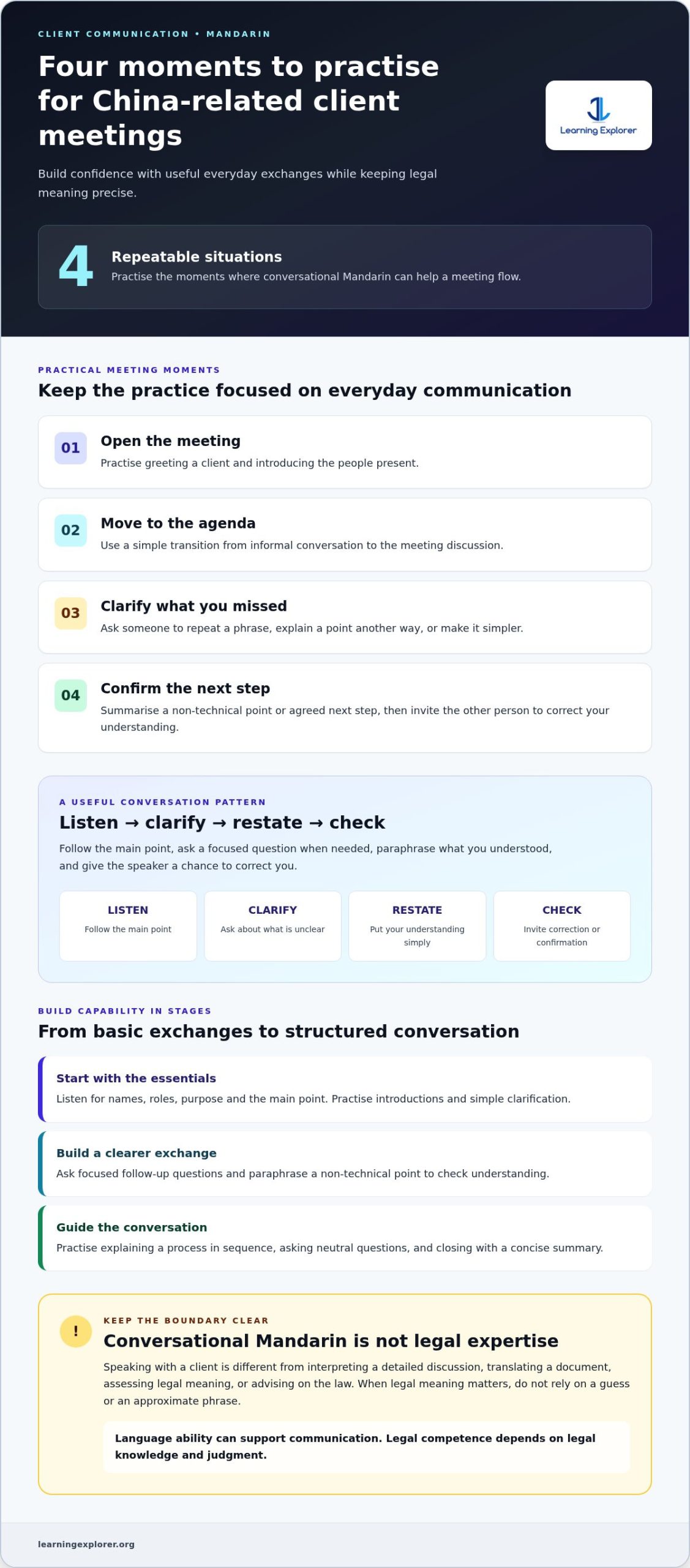
Useful practice can focus on a few repeatable situations:
- Opening a meeting and introducing participants.
- Moving from informal conversation to the meeting agenda.
- Asking a clear follow-up question when you have not understood.
- Confirming the next step or summarising a non-technical point.
These skills give mandarin for singaporean lawyers dealing with china clients a practical focus: everyday communication rather than trying to learn every term used in legal practice. Choose situations that match your work, then practise listening and responding until the exchanges feel more familiar.
What language proficiency does not establish
Conversational ability does not, by itself, qualify someone to interpret legal matters. Speaking with a client is different from interpreting a detailed discussion, translating a document, assessing its legal meaning or advising on the law. Each task requires its own expertise and care. Being able to hold a basic conversation is not evidence that you can accurately convey technical legal meaning between languages.
Language proficiency supports communication; legal competence comes from legal knowledge and judgment. Keep that distinction clear in client interactions. Be precise about whether you are making conversation, asking a clarifying question, discussing a legal issue or summarising a point. When the meaning matters, do not rely on a guess or an approximate phrase. Make sure everyone understands the role, scope and language of substantive communication.
This boundary does not diminish the value of learning. It helps you use Mandarin where it can support the relationship, while preserving care and precision when legal meaning is at stake.
Which Mandarin skills are useful in China-related legal work?
A staged learning plan is practical for a busy lawyer. Start by following the shape of a conversation, then build towards describing processes and understanding more specialised vocabulary. You do not need to tackle every legal term at once. Prioritise exchanges that fit your role, and treat language practice as a way to communicate more clearly, not as a shortcut to legal expertise.
Start with listening, introductions, and clarification
Build a foundation in listening and speaking around information that helps you follow a meeting: names, roles, purpose and the main point under discussion. Practise asking someone to repeat a phrase, clarify a point or explain it in simpler terms. These skills are useful when you catch the general idea but miss a detail.
Next, practise paraphrasing what you have understood. Restate the purpose of a meeting or a non-technical point, then invite the speaker to correct you. This creates a simple check before the conversation moves on. A practical goal is to understand the main point, ask focused follow-up questions and summarise agreed next steps in familiar situations.
Build toward structured professional conversation
When basic exchanges feel more manageable, practise describing a process in sequence, asking neutral questions and closing a discussion with a concise summary. For example, practise explaining what happens next in a meeting or asking which point the other person would like to address first. These tasks help you guide a conversation without requiring you to make a legal conclusion in Mandarin.
Legal vocabulary takes time to learn. A familiar-looking word may not carry the same meaning in every context, and translating terms word for word can create false confidence. Use glossaries as prompts for further study, not as substitutes for checking how a term is used in context. For instance, Essential Chinese Legal Terms can help you identify vocabulary to explore. Keep precise legal explanations in the language and process appropriate to the matter.
- Practise one process explanation at a time, using clear sequence words.
- Prepare neutral follow-up questions for points you need to understand better.
- Summarise next steps plainly, then check that your summary has been understood.
These priorities make mandarin for singaporean lawyers dealing with china clients more manageable: strengthen everyday comprehension first, then expand into professional exchanges and carefully contextualised terminology. If structured speaking practice would help you build that foundation, explore Business Mandarin learning alongside your legal work.
Mandarin learning versus bilingual legal support: understand the difference
Improving your Mandarin can make some client conversations more accessible, but language learning and legal support serve different purposes. You can develop listening, speaking and relevant vocabulary without becoming qualified to interpret legal matters or translate documents. Keep the distinction clear, particularly when a conversation moves from relationship-building to advice, negotiation or the meaning of a written instrument.
| Type of support | What it involves | What it does not establish |
|---|---|---|
| Mandarin learning | Practising listening, speaking, vocabulary and confidence in suitable interactions. | Legal, translation or interpretation competence. |
| Bilingual legal practice | Using language ability alongside legal knowledge and professional judgment in legal work. | That every bilingual speaker has the same legal expertise or experience. |
| Interpretation | Conveying spoken communication between languages. | That conversational Mandarin alone is enough to interpret legal meaning accurately. |
| Translation | Conveying written content from one language to another. | That speaking ability alone is sufficient to translate legal documents. |
What Mandarin study can help a lawyer practise
Language study can strengthen listening, speaking and vocabulary for interactions that fit your role. You might practise following a client’s general point, making an introduction, asking a neutral follow-up question or discussing a familiar process. Practice based on situations you encounter can make learning more relevant. Course participation remains language education, not evidence of legal or translation competence.
That distinction matters for mandarin for singaporean lawyers dealing with china clients: study can support communication, but it does not change the nature of the work you are undertaking. A conversational exchange and a legal explanation call for different levels of precision.
When legal meaning needs more than language confidence
A casual conversation may leave room to pause, rephrase and check understanding. Advice, negotiation, document interpretation and other formal legal work can turn on precise wording, context and the roles of the people involved. A phrase that seems clear in everyday speech may not carry the intended meaning in a legal discussion. Speaking with confidence is valuable, but it does not replace appropriate expertise or careful review.
Conversational proficiency helps you speak with a client; legal interpretation requires more than conversational proficiency. Be clear about whether you are making conversation, explaining a legal position or conveying another person’s words. If a point has legal significance, use the language and process appropriate to the matter. Do not rely on an approximate translation or an unverified assumption. This keeps communication useful while making the limits of your language ability clear.
How to choose a Mandarin learning approach around legal work
Begin with your working day, not an abstract goal of becoming fluent. Identify the exchanges you want to handle more comfortably, then choose a manageable way to practise them. For mandarin for singaporean lawyers dealing with china clients, a focused plan helps you make progress without turning language study into another demanding project.
- Define the situations. Note where Mandarin could help, such as introductions, informal conversation or following the general discussion in a meeting.
- Assess your current ability. Consider what you can already understand and say, and where you tend to lose confidence.
- Set a practical practice goal. Choose one observable task, such as introducing yourself or summarising a non-sensitive point.
- Compare learning formats. Decide how you prefer to practise and what can fit around your professional responsibilities.
Match learning format to your work rhythm
Private classes can provide individual attention, while group classes give you opportunities to interact with other learners. Consider which setting will help you practise speaking and listening consistently. Learning Explorer offers in-person and online classes in Singapore. Choose the format that fits your routine and makes it easier to return to your learning goal, rather than relying on occasional bursts of study.
Keep practice sustainable. Review useful phrases between classes or say a question pattern aloud to connect study with real communication needs. If you would like ideas for building everyday speaking skills, the article Mastering Conversational Mandarin in Singapore: The 2026 Learner’s Guide offers a related starting point.
Set measurable language-learning goals
Choose a goal you can observe, rather than a broad promise to “get better.” For example, practise introducing yourself clearly, recognising key details in a short exchange or summarising a non-sensitive meeting point in simple Mandarin. Keep the task language-focused. It should measure communication practice, not your ability to deliver legal advice or handle a matter in another language.
Review your progress by noticing whether you can follow more of the main point, speak with greater ease or use a useful question pattern without searching for every word. If one skill is still difficult, narrow your next practice task. Work on listening for names and roles before trying to follow a longer discussion, for example. Small, specific goals make it clearer what to practise next.
Learning Explorer offers Business Mandarin and Conversational Mandarin, taught using communicative methods by native-speaking teachers. To explore a learning option alongside your work, explore Mandarin classes in Singapore.
Explore Business Mandarin learning with Learning Explorer in Singapore
Choose a learning direction by turning your communication priorities into a clear starting point. Consider the settings where you want to use Mandarin, the skills you would like to strengthen and the kind of practice that feels manageable alongside legal work. Keep the aim educational: build language ability in a way that supports your goals without treating study as legal-specialist preparation.
A practical next step for Mandarin learners
Before you begin, write down one interaction you would like to feel more prepared for and one language skill that could help. You might want to follow a general discussion or speak more comfortably in a professional setting. The article Mandarin for Business: Build Client Rapport offers another perspective as you consider which communication situations matter to you. Use that reflection to set a focused learning goal and make your next step achievable.
Learn in Singapore with a clear starting point
Learning Explorer’s Mandarin teaching materials are sourced from Hanban, and the centre has operated in Singapore since 2015. Its CBD location is 10 Anson Road #22-07, International Plaza, Singapore 079903, directly above Tanjong Pagar MRT. This gives you a clear local reference if you are considering in-person language learning.
Keep your plan simple: choose a communication goal, make space for steady practice and note what you would like to improve next. Learning Explorer offers Business Mandarin and Conversational Mandarin in Singapore. Explore Mandarin learning with Learning Explorer and take a focused first step.
Make your next Mandarin practice count
Progress does not have to begin with fluency. Start with one communication moment you would like to approach with greater ease, then make it the focus of your next learning step. For mandarin for singaporean lawyers dealing with china clients, steady, role-aware practice can build confidence without blurring the line between language ability and legal judgment.
Give yourself room to learn gradually. Notice which phrases come more naturally, where listening still takes effort and what you would like to practise next. This reflection keeps learning purposeful alongside a demanding legal schedule. The aim is not to say everything perfectly. It is to become more comfortable using Mandarin in appropriate interactions while staying clear about the scope of each conversation.
Choose a learning direction that fits the communication skills you want to develop. Explore Mandarin courses at Learning Explorer and take a manageable next step towards more confident client communication.
Frequently Asked Questions
Can Mandarin help Singaporean lawyers communicate with China clients?
Yes. Mandarin may help you participate more naturally in brief exchanges, such as acknowledging a point or indicating that you are following along. It can also help you notice when you have missed part of a conversation and need to slow down. Treat these moments as opportunities to communicate more comfortably, not as a measure of how much legal work you can conduct in Mandarin.
Do Singapore lawyers need fluent Mandarin to work with China clients?
No single level of fluency suits every lawyer or client interaction. Decide what you want to manage independently, then build towards that specific task. You might aim to understand routine exchanges before meetings while recognising that unfamiliar or technically demanding conversations may require a different approach. For mandarin for singaporean lawyers dealing with china clients, a realistic target is more useful than treating fluency as an all-or-nothing requirement.
What Mandarin should lawyers learn first?
Start with spoken Mandarin that helps you stay oriented: familiar greetings, common meeting language and phrases for indicating that you need a moment. Practise hearing the same phrase at different speeds, then saying it clearly yourself. One useful exercise is to listen to a short passage and note its main subject before trying to catch every word. This builds confidence without overwhelming your study time.
Is Business Mandarin different from conversational Mandarin?
The practical distinction is the context for practice. If your goal is to participate in workplace exchanges, focus on professional situations and polite, clear phrasing. If you want wider everyday speaking practice, use varied daily-life scenarios. The skills can overlap, so you do not need to treat them as entirely separate. Let the situations you expect to encounter guide the vocabulary and speaking tasks you prioritise.
Can Mandarin lessons teach me to translate Chinese legal documents?
Mandarin lessons develop language skills, but they should not be treated as preparation to translate legal documents. Use study to note unfamiliar terms and the context in which you encountered them, then follow up through an appropriate source. Avoid relying on a rough word match to explain a document’s meaning. Keep language practice distinct from any task that depends on precise legal wording.
Are Mandarin classes in Singapore available online and in person?
Yes. Learning Explorer offers online and in-person classes in Singapore. As you choose a setting, consider where you can concentrate, participate actively and maintain a regular routine. Think about practical details such as travel time, your work calendar and whether you prefer joining a class from your usual study space. The right fit is one that makes learning alongside your responsibilities realistic.
How can a busy lawyer practise Mandarin consistently?
Link practice to an existing habit, such as reviewing a phrase after lunch or listening to Mandarin during your commute. Keep a short note of expressions to revisit, and use each one in a new sentence rather than only rereading it. If a busy week interrupts your routine, resume with one familiar task instead of trying to catch up all at once. Small, repeatable steps can make practice more consistent.