The most intensive Mandarin training isn’t always the best fit for your workplace. What matters is whether it prepares you for the conversations you actually need to have. For Singapore professionals and teams, choosing a business mandarin course singapore option starts with matching learning goals to meetings, client interactions, and day-to-day collaboration.
It’s understandable to focus first on vocabulary and speaking practice. Yet language alone may not explain how tone, hierarchy, and relationship-building shape professional exchanges. A course, private lessons, or a focused workshop can each suit different schedules and goals, while cultural context helps learners use new language with greater awareness and confidence.
This guide compares business Mandarin learning options by workplace objective and teaching format, then explores cultural considerations that can influence communication. You’ll also find a practical way to assess what suits an individual or corporate team. Learning Explorer Language Centre offers a Business Mandarin Course and corporate language training, with physical and online classes. Its communicative approach and Mandarin materials sourced from Hanban provide a local starting point for building work-ready language skills.
Key Takeaways
- Start with the work situations learners need to handle, then shape language practice around those priorities.
- Explore how introductions, meetings, and other professional interactions can raise etiquette questions beyond vocabulary.
- Compare structured courses and topic-led workshops by learning goal, participant needs, format, and cultural focus.
- Use a clear checklist to identify who needs training, how they use Mandarin now, and which workplace situations matter most.
- Learn how a business mandarin course singapore option or corporate training can support workplace language development.
Why business Mandarin training in Singapore needs more than vocabulary
Knowing words is useful. Knowing which words fit a workplace situation is what makes practice relevant. Business Mandarin learning focuses on communication for professional purposes, such as introducing yourself to a client, contributing to a meeting, or discussing a work issue. General conversational practice can build everyday exchanges, but may not give enough attention to the vocabulary, tone, and goals involved in these tasks.
Start with the work, not an abstract idea of proficiency. A team that needs to welcome Mandarin-speaking visitors may prioritise introductions and polite questions. Colleagues who take part in project discussions may need practice explaining progress, clarifying a point, or responding to a concern. These examples help define useful learning goals; they aren’t claims about specific course content or guarantees of fluency.
Singapore teams can also bring different starting points to training. One employee may use Mandarin with customers, while another has studied the language but rarely speaks at work. Roles, confidence, current ability, and opportunities to communicate all affect what practice will be useful. Defining these differences can help individuals and organisations choose a format and focus that fit their needs.
What makes Mandarin communication business-focused?
Professional exchanges usually have a clear audience and purpose. A casual conversation with a colleague might invite an open-ended chat; a meeting update needs a concise account of progress and next steps. The same idea may call for different vocabulary or levels of formality depending on whether you’re speaking to a teammate, a manager, or a client.
Try turning a work task into a practice prompt. For example, practise making a request, checking that you understood a deadline, or summarising a proposal. These are illustrative scenarios, not a description of Learning Explorer course materials. A business mandarin course singapore learners consider is more likely to support their goals when its language practice connects to the situations they actually face.
Where do etiquette and cultural context fit?
Etiquette means noticing how context, expectations, and professional relationships may shape an interaction. It can prompt useful questions: How should you open a conversation? When is it helpful to ask for clarification? How might you disagree respectfully? An overview of Asian business etiquette can offer broad background, but it covers diverse settings and shouldn’t be treated as a rulebook for every Mandarin speaker.
Culture is context, not a substitute for language skills. Understanding a possible expectation doesn’t automatically give a learner the words to respond, and fluent vocabulary alone may not explain how a message could be received. Pair cultural awareness with communication practice: learners can consider the situation, choose suitable wording, and reflect on how tone and purpose work together. This balanced approach helps teams prepare thoughtfully without relying on stereotypes or assuming every interaction follows the same pattern.
What a Chinese business etiquette and culture workshop can help learners explore
A workshop can give a team room to examine the human context around workplace communication. Its value comes from connecting cultural questions to situations participants recognise, not from handing out a fixed list of rules. Possible discussion priorities include introductions, relationship-building, meetings, presentations, and professional correspondence. These are examples of topics a workshop might address, not confirmed inclusions in Learning Explorer’s Business Mandarin Course.
Begin with a practical question: where do people in your organisation need to communicate, and what feels uncertain? A sales professional preparing to meet a new contact may want to discuss ways to open a conversation. A project team might focus on contributing to meetings or following up after a discussion. A manager may want to consider how to phrase feedback clearly while remaining respectful. The right focus depends on the work, the participants, and the interactions they actually encounter.
Which workplace situations are useful to discuss?
Choose situations from participants’ real roles rather than trying to cover every possible business custom. For each one, identify what needs to happen, who is involved, and what communication challenge the team wants to understand. For example, a presentation may raise questions about how to invite discussion, while professional correspondence may prompt a conversation about clarity and tone. These are prompts for learning, not universal instructions for behaviour.
- Introductions: Consider how participants introduce themselves and explain their role in a first meeting.
- Relationship-building: Discuss how colleagues establish rapport while respecting individual preferences and the purpose of the interaction.
- Meetings and presentations: Explore ways to contribute, ask questions, clarify a point, or respond to feedback.
- Professional correspondence: Look at how audience and purpose affect the wording of a request, update, or follow-up.
Prioritise the situations that matter most to the group. A team with frequent client meetings may benefit from a different discussion focus than colleagues whose main need is internal coordination. This simple choice makes the session more relevant and helps participants connect ideas to work they do.
How can learners apply cultural context thoughtfully?
Use cultural context as a lens, not a prediction. A general observation may help learners consider possible expectations, but it can’t tell them exactly how one person will communicate. Encourage participants to observe the interaction, listen for cues, ask respectful questions when appropriate, and adapt to individual preferences. Avoid turning broad cultural ideas into rules about how every Mandarin speaker behaves.
Keep language practice central when participants need to communicate directly in Mandarin. A workshop might help them think through the context of a conversation, while sustained language learning helps them build the words and structures to take part. The formats serve different goals: a focused workshop can support discussion of selected etiquette questions; a structured course provides a learning path for developing language skills over time.
For individuals or organisations seeking continued workplace Mandarin learning, explore Learning Explorer’s Business Mandarin Course alongside the team’s specific communication priorities.
How to compare business Mandarin courses, workshops, and learning formats
Compare the learning goal first, then consider who’s taking part and how they’ll engage. A structured course and a topic-led workshop aren’t interchangeable: one supports ongoing language development, while the other can focus discussion on selected workplace questions. Online and in-person classes are delivery formats, so weigh them against access, interaction preferences, and practical constraints such as travel or joining from different work locations.
| Option | Goal | Learner profile | Format | Cultural focus | Evaluation questions |
|---|---|---|---|---|---|
| Structured language course | Develop Mandarin skills over time | Individuals or teams with ongoing communication needs | Online or in person | May relate to language practice and workplace context | Which skills matter: speaking, listening, reading, or writing? How does learning connect to work tasks? |
| Topic-led workshop | Explore selected professional or etiquette questions | Learners with a defined discussion priority | A focused session, with delivery depending on the provider | Can be the central topic | Which specific situations should the discussion address? Is cultural exploration the main priority? |
| Online or in-person participation | Choose an accessible way to take part | Learners balancing location, schedules, and interaction preferences | Online or at a physical venue | Depends on the learning content, not only the delivery method | Which option makes attendance and participation practical for this group? |
When might a course suit the learning goal?
Consider a course if learners want a more structured path for developing language skills. A team may need to practise listening during discussions, speaking to share updates, or reading and writing work-related material. The right emphasis depends on participants’ needs; don’t assume every course follows the same syllabus. Compare options by how clearly their stated learning focus aligns with the skills employees need in their roles.
For a business mandarin course singapore buyers are considering, useful evaluation questions include whether the learning focus reflects participants’ responsibilities and current Mandarin use. Also consider whether online or in-person participation better suits the team. Online delivery can reduce the need to travel to a shared venue; in-person learning may better suit people who prefer being together in one setting. Neither is automatically the better choice.
When might a workshop format suit the goal?
A workshop may fit a defined priority, such as discussing introductions, meeting participation, or professional correspondence. Its focused scope can make room for shared reflection, while a course is generally the more relevant format for continued language development. Compare the breadth of topics with the time available for discussion and Mandarin practice. A session centred on cultural questions may not provide the sustained language work learners need to communicate directly.
Make the decision by naming the main outcome. If the priority is exploring a particular workplace topic, a workshop format may be a useful fit. If learners need to build communication skills over time, consider a structured course. Organisations can weigh corporate training against individual learning needs so the chosen format works for both participants and their day-to-day responsibilities.
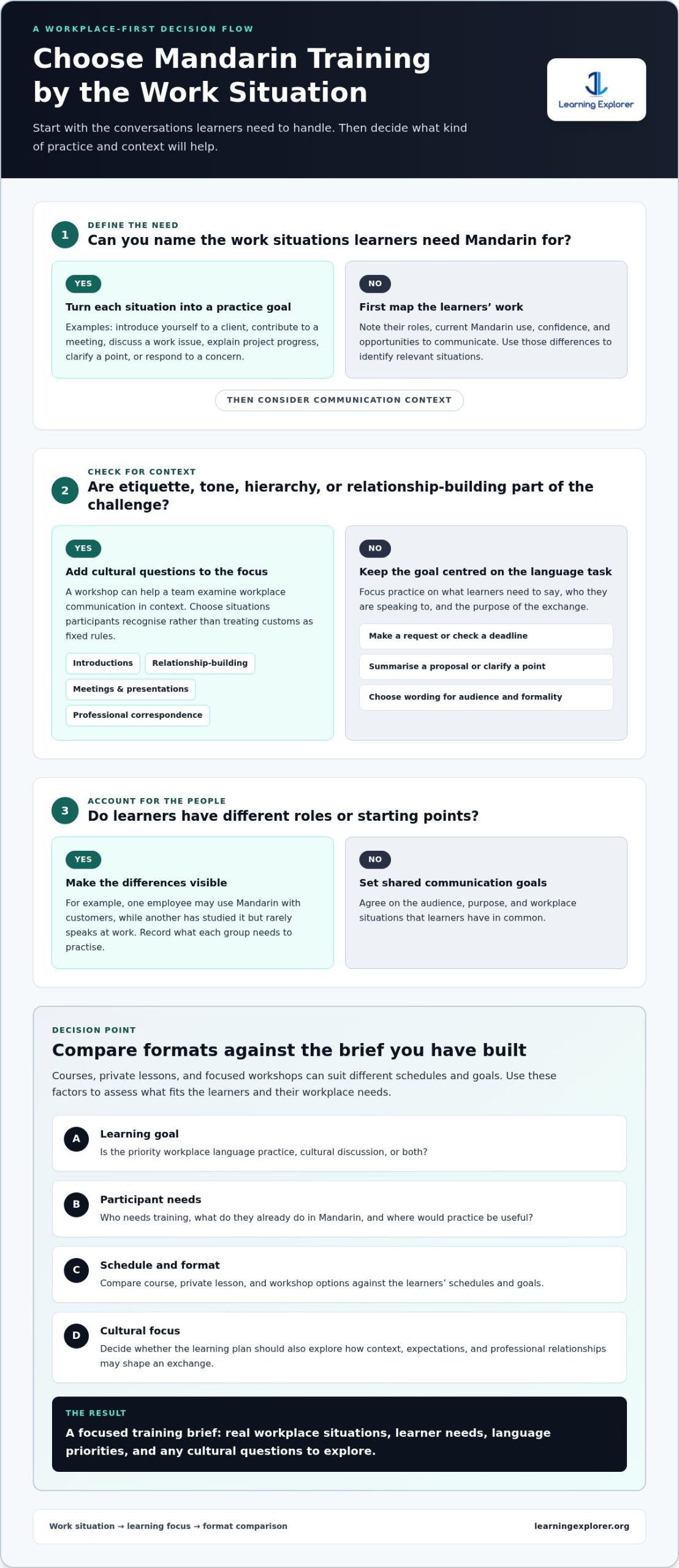
A Singapore buyer’s checklist for choosing Mandarin training
A short needs assessment can turn a broad interest in Mandarin into a useful training brief. For an individual, that brief might focus on one task that feels challenging. For an organisation, it can help separate what employees need in common from the support different roles may require. Use the steps below to prepare for a focused discussion about learning priorities.
How should an organisation define its training needs?
Begin with employees’ day-to-day responsibilities. A staff member who handles written enquiries may have different priorities from a colleague who joins client conversations. Record both shared needs and individual goals, so a team plan doesn’t overlook differences in role or experience. This gives organisations a clearer foundation for discussing corporate training options.
- Identify the participants. Note the roles involved and whether learners are taking part as individuals, a work group, or a wider team.
- Map current Mandarin use. Ask when employees use the language, what they can already manage, and where they hesitate. Keep the focus on practical tasks rather than broad labels such as beginner or advanced alone.
- Select priority work situations. Name the interactions that matter most to each role. Examples might include responding to a customer query, understanding a spoken update, or drafting a short message.
- Separate language and cultural aims. Specify whether learners need to build speaking, listening, reading, or writing skills, or explore how context may shape an interaction. This helps avoid treating cultural discussion as a replacement for language learning.
- Choose a learning format. Consider how participants will take part, what suits their routines, and whether the goal calls for ongoing learning or a focused discussion.
- Document intended progress. Describe what learners hope to do more confidently, such as follow the main points in a work conversation. Use these aims to guide planning, not as a promise of results or a fixed timeline.
How can learners compare delivery and learning resources?
Think about what makes participation manageable. Travel time, work locations, preferred ways of interacting, and the ability to concentrate in a shared setting can all influence whether physical or online learning fits better. Discuss these practical considerations with participants before settling on a format, especially if the group has varied routines.
Learning resources deserve a similarly practical review. Consider whether the materials appear relevant to the learners’ level and intended use of Mandarin, and how they support practice between explanations. Ask how lessons encourage learners to use the language actively, and whether the approach matches the team’s priorities. These questions help buyers compare learning options without assuming that one resource or format suits every group.
With your priorities outlined, explore Mandarin training options for individual or corporate learning needs.
Explore Learning Explorer’s Business Mandarin Course in Singapore
Choosing training becomes easier when you bring a clear purpose to the decision. Before taking the next step, write down the work communication task you want to approach with greater confidence and what would make practice relevant to it. For an individual, that could mean identifying a recurring challenge in their own role. For an organisation, it could mean distinguishing shared priorities from needs that vary between employees.
What Learning Explorer’s confirmed course information tells buyers
Use the information provided about a learning option to understand its stated approach, then compare that with your own priorities. Keep confirmed details separate from assumptions: a general interest in workplace culture, for instance, doesn’t by itself establish that etiquette topics form part of a course. This helps individuals and teams make a more informed choice about the kind of learning they want to pursue.
Learning Explorer gives Singapore learners a place to continue exploring Mandarin learning with a professional focus. Rather than expecting one course to answer every workplace question, use your identified needs to decide what you want language learning to support. That keeps the decision grounded in your own role, team responsibilities, and preferred direction.
How to take the next step in Singapore
Choose an action that matches your starting point. If your priority is building broader Mandarin foundations, focus on general language development. If you’re selecting learning for colleagues, bring your organisation’s priorities into the decision so the next discussion stays connected to employees’ work. You can also revisit your goals as learners gain experience and their needs become clearer.
Whether you’re planning for yourself or considering learning for a team, explore the available information and decide what best aligns with your aims. Explore Learning Explorer’s language training to take the next step toward more purposeful Mandarin learning in Singapore.
Turn workplace priorities into a confident next step
Give your Mandarin learning a clear starting point: choose one professional situation you want to handle more comfortably, then decide what progress would look like in practice. It might mean taking a more active role in a discussion or expressing a work-related idea with greater clarity. A specific aim can help you stay focused and make learning feel connected to your day-to-day responsibilities.
If you’re considering a business mandarin course singapore option for yourself or your team, use your priority to guide the next decision. Think about who will learn, what they need to practise, and which format feels workable. You don’t need to have every detail mapped out before taking that first step.
Explore Learning Explorer’s language training and find a direction that supports your professional goals. Every purposeful conversation you prepare for is progress worth building on.
Frequently Asked Questions
What is the difference between a business Mandarin course and a Chinese business etiquette workshop?
A business Mandarin course focuses on developing language skills for professional communication, while an etiquette workshop centres on discussing workplace expectations and context. For example, a learner preparing to understand a Mandarin exchange may need language practice; someone unsure how to approach a cross-cultural meeting may want guided discussion. If both needs matter, identify which one requires sustained attention and which one calls for focused exploration.
Can a beginner take a business Mandarin course in Singapore?
Beginners can approach Mandarin learning with workplace goals in mind, but their starting needs differ from those of learners who already use the language. Before choosing a business mandarin course singapore option, note whether the learner is starting from the basics or can already manage simple exchanges. That distinction helps clarify whether foundational vocabulary and sentence practice should come before more specialised work communication goals.
What should a business Mandarin workshop cover?
A useful workshop should be shaped by the questions its participants need to explore, rather than a generic list of customs. A team might discuss how to open a first meeting, invite clarification, or follow up after a presentation. Treat these as possible priorities, not universal rules. Ask participants to bring a real communication concern, then use it to keep discussion relevant and grounded.
Is online or in-person business Mandarin training better for a corporate team?
Neither format is automatically better; the right fit depends on how employees can participate consistently. Online classes may be practical if staff work across different locations or have limited time for travel. In-person classes may suit teams that prefer a shared learning setting. Learning Explorer offers both formats. Consider employees’ routines, location, and preferred way of interacting before selecting a format.
How can a company identify its employees’ Mandarin training needs?
Ask employees which work tasks involve Mandarin and where they feel least prepared. A short internal needs check could ask whether they need to understand spoken updates, contribute to discussions, read messages, or write replies. Compare responses by role rather than assuming everyone shares the same priorities. This helps distinguish individual development aims from communication needs that several colleagues have in common.
Does Learning Explorer offer business Mandarin training for organisations?
Yes. Learning Explorer offers corporate language training, as well as a Business Mandarin Course. For an organisation, a useful first step is to outline the roles involved and the work communication needs employees have in common. This gives the training conversation a practical focus, while allowing individual learners’ starting abilities and priorities to remain visible instead of treating the team as one uniform group.
How does cultural awareness support professional communication in Mandarin?
Cultural awareness helps learners consider how context may affect the way a message is understood, without assuming it predicts an individual’s preferences. If a colleague gives an indirect response, for example, a learner can avoid jumping to conclusions and use a polite Mandarin question to clarify the next step. That combination of attentiveness and language practice supports clearer, more respectful exchanges.