What if you could start speaking Thai before learning to read every character? Unfamiliar sounds and phrases can feel like a lot to take in, especially if you’re worried that grammar will hold you back. If you’re considering a conversational Thai course in Singapore, you can start with practical speaking skills and build from there.
Everyday conversation grows from useful building blocks: greetings, introductions, simple questions, and careful listening. Practising short exchanges regularly can help you get comfortable speaking, even with a full schedule. You don’t need a perfect routine. A manageable one that you can return to is a strong place to start.
This guide covers what to learn first, how to practise around daily commitments, and how guided lessons can support your progress. Thai Explorer offers conversational Thai learning in Singapore. Learning Explorer’s language schools use communicative teaching methods and native-teacher instruction, providing a structured way to practise speaking. You’ll come away with a clearer sense of how to start building everyday Thai conversation skills.
Key Takeaways
- Conversational Thai focuses on understanding and responding in everyday spoken situations, not mastering every aspect of the language first.
- Build speaking confidence by connecting listening, pronunciation, useful vocabulary, and simple sentence patterns.
- Compare lessons, self-study, and a blended routine to find an approach that fits your schedule and learning needs.
- Use a repeatable routine of listening, noticing, speaking, adapting a phrase, and reviewing to make short practice sessions more purposeful.
- A conversational Thai course in Singapore provides guided speaking practice. Learn how Thai Explorer’s communicative teaching approach supports language learning.
What does conversational Thai involve for a beginner in Singapore?
Conversational Thai is the ability to understand and use spoken Thai in common everyday interactions. It involves exchanging simple information, responding to another person, and keeping a conversation going even when you don’t understand every word.
For a beginner, useful goals are practical: greet someone, introduce yourself, make a simple request, or ask for help understanding a response. You don’t need to speak perfectly before you can communicate. A conversation can succeed with a short phrase, a relevant reply, and the willingness to ask someone to repeat or clarify.
These goals differ from fluency, which involves communicating across a wider range of situations, and from literacy, which involves reading and writing. Formal study may include grammar and written exercises, but conversational learning keeps spoken interaction at the centre. For context on the language and its writing system, see this Thai language overview.
Which everyday situations can beginner Thai support?
Start with familiar exchanges, such as greeting someone, sharing your name, or asking for something simple. Short phrases can also help you manage a misunderstanding instead of losing the thread of a conversation.
- Greeting: สวัสดีครับ (sawatdi khrap) or สวัสดีค่ะ (sawatdi kha), “Hello.”
- Asking for repetition: พูดอีกครั้งได้ไหมครับ (phuut iik khrang dai mai khrap), “Could you say that again?”
- Making a request: ขอน้ำหน่อยได้ไหมครับ (kho nam noi dai mai khrap), “Could I have some water?”
The polite ending shown varies with the speaker. Practise each phrase aloud and listen for the response, not just your own words. A simple follow-up, such as a nod or another short question, can help make the exchange more natural.
Do beginners need to learn Thai script first?
No. You can begin practising spoken phrases through listening and speaking without first learning to read Thai. Romanised pronunciation can serve as a temporary prompt, but it may not show every sound or tone precisely. Pair it with audio or guidance when possible.
Thai script adds valuable context: it lets you read written words and see how the language is represented. You can study it alongside speaking or focus on it later, depending on your goals. If conversation is your immediate aim, begin with useful spoken phrases and build reading skills at a pace that suits you. A conversational Thai course in Singapore can help keep speaking at the centre of your learning while you decide how much literacy to include.
Which building blocks help you speak and understand Thai?
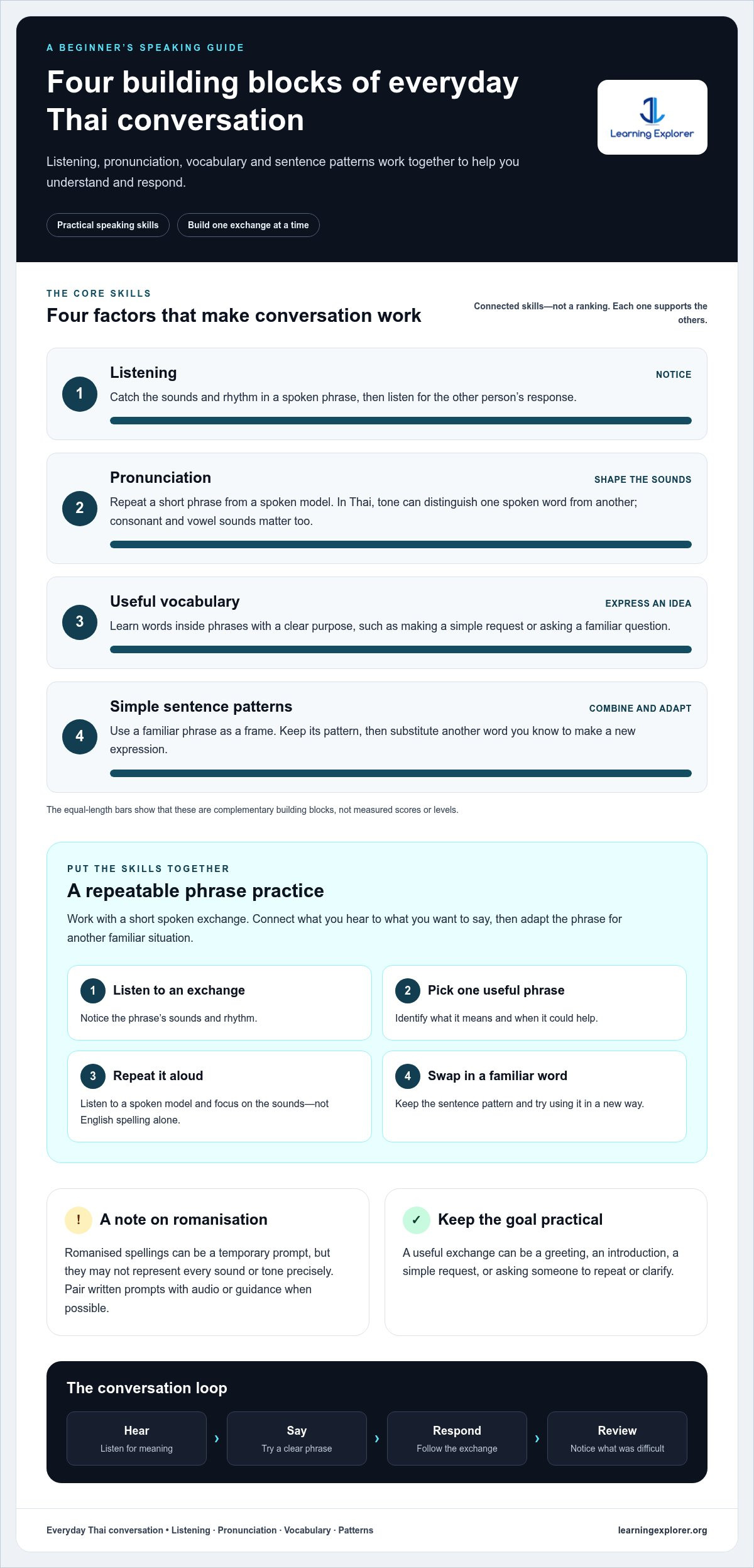
Speaking and understanding Thai draw on several skills working together. Listening helps you notice a phrase’s sounds and rhythm. Pronunciation helps you shape those sounds, while useful vocabulary gives you words to express an idea. Sentence patterns show you how to combine them so another person can follow what you mean.
Practise these skills together rather than treating them as separate checkboxes. Take a short spoken exchange, identify one phrase, repeat it, then try using its pattern with a different familiar word. This gives vocabulary a purpose and helps connect what you hear with what you want to say.
How do tones and pronunciation shape spoken Thai?
A tone is the pitch pattern used across a syllable. It can distinguish one spoken word from another. In Thai, changing a syllable’s tone can change the meaning of the word being spoken. Pronunciation also includes consonant and vowel sounds, so pitch is one part of speaking clearly, not the whole task.
Listen to a reliable spoken model, then repeat a short phrase and compare your attempt with it. Focus on the sound rather than guessing from English spelling. Romanised spellings can be useful prompts, but conventions vary and may not represent every tone or sound precisely. Treat them as a reminder, not a replacement for listening.
How do vocabulary and sentence patterns become usable?
Learn words inside phrases that have a clear purpose. For instance, มีชาไหม can be used to ask, “Do you have tea?” The romanisation mii chaa mai? is a simple reading aid and doesn’t mark tones. Pair written prompts with a spoken example so you can connect the phrase’s meaning to its sound.
Once a phrase feels familiar, keep its sentence pattern and substitute a different word you know. This turns a memorised expression into a flexible tool. Practise a brief exchange aloud, then note which part was difficult to hear or say. If you’re considering a conversational Thai course in Singapore, explore how conversational Thai learning can give you a setting to work on real exchanges and refine your speaking through practice.
Thai lessons, self-study, or both: what supports conversation practice?
Each learning format asks you to take a different role. Lessons can give your study a clear sequence, while self-study lets you decide what to revisit and when. A blended routine pairs planned learning with independent review. Compare the options by considering how much structure you want, how you prefer to organise practice, and how often you want to speak with someone else.
| Approach | Feedback | Flexibility | Speaking opportunities | Learner responsibility |
|---|---|---|---|---|
| Guided lessons | Questions and attempts can receive a response | Follows a learning sequence | Practice with a teacher or other learners | Prepare and take part |
| Self-study | Depends on the resources you use | Choose when and what to review | Often requires arranging interaction | Plan, select, and track practice |
| Blended routine | Combine lesson feedback with personal review | Mix planned learning with flexible practice | Use independent time to prepare for interaction | Connect lesson topics to review goals |
Use the comparison to identify what might fit your life now, rather than looking for one universally best method. If you value outside structure, lessons can help keep learning organised. If your week varies, self-study gives you more control over when you practise. Combining formats can offer both, provided the routine stays manageable.
What can guided Thai lessons contribute?
A teacher can help organise what to tackle next, clarify a question that stalls your practice, and point out a pronunciation or sentence-pattern detail to revisit. Consider guided lessons if you want a planned learning path or prefer to work through questions with guidance. Before you begin, identify what kind of support would make practice more useful to you.
When is self-study useful alongside lessons?
Independent review is useful for returning to material between lessons. Replay a short listening example, revisit a phrase list, or make a voice recording to compare with a spoken model. These activities can fit into spare moments, but they don’t provide the same give-and-take as interaction. Choose a review task that connects directly to what you’re studying.
If you’re considering a conversational Thai course in Singapore, think about how guided learning could complement your own routine. Explore Thai conversation lessons as a way to bring structured study and personal review together.
How can you practise conversational Thai between lessons?
Make practice small enough to return to. A useful routine doesn’t need to fill a long evening or cover every new phrase. Choose a few words or expressions from your learning, then work through a simple cycle: listen, notice, repeat, adapt, and review. The goal is to make language more familiar and usable, not to prove you can recall everything perfectly.
- Listen. Replay a short, clear example and focus on its overall sound and meaning.
- Notice. Pick out one useful phrase or sentence pattern. Write down when you might use it.
- Repeat. Say it aloud, first alongside the model and then on your own.
- Adapt. Change one familiar detail, such as the item in a request, to practise using the phrase flexibly.
- Review. Return to the phrase later and note any question or difficulty to revisit in a lesson.
Keep a short phrase record with the expression, its meaning, and a situation where it might help. Add questions too, such as “How would I respond if someone says no?” This turns review into preparation for communication rather than a test of perfect recall.
What does a simple weekly speaking routine look like?
Use a flexible rhythm, not a rigid timetable. At the start of your week, listen to a short example. Later, practise saying a few phrases aloud and adapt one to a new situation. Near the end of the week, revisit earlier material and try a short exchange without looking at your notes. Shift the sessions around work, study, and home commitments. Consistency should feel manageable.
Keep the exchange brief. For example, practise asking a prepared question, pausing for an answer, and giving a simple response. If no partner is available, say both parts aloud to rehearse the flow. Then note which words came readily and which ones you want to review. This gives your next practice session a clear focus without turning it into a long checklist.
How can beginners practise when they feel self-conscious?
Start in private. Repeat a phrase quietly, then speak it at a natural volume and try a prepared exchange. Feeling hesitant is understandable, especially with unfamiliar sounds. Pauses and corrections are part of learning to speak, so give yourself time to try again rather than stopping at the first stumble.
As you feel ready, practise in a supportive learning setting where guided communication gives you a chance to use language and receive feedback. A conversational Thai course in Singapore provides a structured place to practise, while short reviews help you revisit material between lessons. Adapt your routine as needed. It can support steady practice, but it can’t guarantee a particular pace or result. Explore Thai conversation learning to take a guided next step.
Explore conversational Thai learning with Thai Explorer in Singapore
Choosing a learning option is easier when you start with your own purpose. Think about where you hope to use Thai, what you’d like to be able to say, and how you prefer to learn. Those priorities can help you decide what to explore next, without needing to map out every stage before you begin.
Thai Explorer offers Thai language learning in Singapore. Learning Explorer’s wider mission is to provide language courses strategically aligned with global standards. As you consider a conversational Thai course, focus on the exchanges you want to practise and the kind of learning environment that feels supportive.
What is the Learning Explorer approach to language learning?
A useful learning goal is concrete and personal. You might want to feel more comfortable taking part in a simple exchange, follow a familiar question, or speak up when you need help. These aims can help you stay focused as you explore Thai learning and decide what you want your practice to support.
Learning Explorer’s global-standards mission provides a broader context for its language learning work. Make that context practical by considering which speaking situations matter to you and what would help you participate more confidently.
What is a useful next step for a Singapore learner?
Write down a few situations where you’d like to use Thai. Then note what you want to practise, whether that’s starting an exchange, understanding a response, or keeping a conversation going. These notes can help you focus on the course information that matters to your goals.
A conversational Thai course in Singapore is a useful next step if you’re ready to explore guided learning. Take a look at Thai Explorer’s Thai course information and consider how it aligns with the speaking goals you’ve set. A clear, manageable starting point can make beginning feel much more achievable.
Take your first step towards speaking Thai
Your first milestone doesn’t need to be a long conversation. Choose one everyday situation you’d like to handle in Thai, then let that goal guide what you practise next. A clear, personal reason for learning can make it easier to stay engaged and notice when you’re ready to say a little more.
If you’re considering a conversational Thai course in Singapore, use your goal as a starting point for exploring structured learning. Think about the kinds of exchanges you hope to manage and how guided practice could fit into your routine. You can take that next step at your own pace.
Explore conversational Thai learning with Thai Explorer and take a practical first step towards your speaking goals.
Frequently Asked Questions
Is Thai difficult for English speakers to learn?
Thai may feel challenging at first, but the level of difficulty depends on your experience and what you’re practising. You might recognise a familiar phrase before you can say it comfortably. Keep a short note of sounds or expressions that feel tricky, then revisit one at a time. Avoid comparing your progress with someone else’s. Steady attention to your own learning is more useful.
Can I learn conversational Thai without learning to read Thai?
Yes, you can begin spoken practice without first being able to read Thai. If your goal is to manage a simple exchange while travelling, for example, focus on understanding spoken prompts and responding aloud. Keep notes in a format that helps you remember what a phrase means, and use spoken examples to guide your pronunciation. You can add reading practice as your goals expand.
How long does it take to speak basic conversational Thai?
There isn’t one timeline that applies to every learner. Your starting point, practice habits, and definition of “basic conversation” all matter. Make progress easier to notice by setting a small, observable target, such as introducing yourself in a role-play without checking your notes. Record what feels comfortable and what still needs support, then adjust your next practice goal. That’s more useful than relying on a promised timeframe.
Do I need to learn Thai tones to have a conversation?
Include tone and pronunciation in your learning, but you don’t need to wait until every detail feels perfect before trying to communicate. Pay attention to how a word sounds in a complete spoken example rather than treating pitch as a matter of speaking louder or softer. If a phrase is unclear, invite a correction and try it again. A supportive learning environment can make that practice feel less daunting.
Is a Thai course better than learning by myself?
Neither approach is automatically better. It depends on what helps you practise consistently and where you need support. Independent review can suit learners who want to revisit material in their own time, while guided practice can help when you’re unsure how a phrase sounds or works in an exchange. If you’re considering a conversational Thai course in Singapore, think about whether feedback, structure, or flexible review would help you most.
What should I practise first for everyday Thai conversations?
Start with a situation you’re likely to encounter and practise both sides of the exchange. If you’re preparing to make a simple request, consider what you might say if the other person asks a follow-up question. This helps you practise listening and responding, not only delivering a memorised line. Keep a record of useful phrases and questions, then choose the next item based on what you want to handle more comfortably.