Japanese for MICE industry professionals in Singapore is most useful when it reflects the conversations you actually handle, not a long list of general vocabulary. If you coordinate registration, welcome delegates, support exhibitors or liaise with clients, start with the situations your role calls for. With event deadlines filling your calendar, comparing courses can feel like one more task, so a clear set of priorities helps.
This guide explains how to identify practical communication goals, compare private and group Japanese lessons, and decide whether in-person or online learning suits your routine. It also covers what to look for in a structured course, including its teaching approach and learning materials. Japanese lessons through Japanese Explorer use native-teacher instruction and communicative teaching methods, with a syllabus and materials sourced from AJALT. Use these details alongside your own work needs to make a considered choice.
Key Takeaways
- Choose Japanese learning goals based on the guest, exhibitor or client interactions that matter in your MICE role.
- Separate everyday exchanges from more formal professional communication when setting priorities.
- Compare course options by learning goals, format, schedule fit and teaching approach.
- Use a short checklist to distinguish immediate work-related priorities from longer-term Japanese learning goals.
- Explore Japanese lessons through Japanese Explorer, the Japanese-language school within the Learning Explorer group.
Where Japanese Fits into MICE Work in Singapore
Event deadlines, client requests and daily coordination already compete for your attention. To decide whether Japanese is worth studying for your role, start with the conversations you handle or expect to handle. The answer depends on your responsibilities, not on an assumption that every MICE professional needs the same language skills.
In Singapore, MICE work can bring planners, venue teams, exhibitors and hospitality staff into contact with international clients, delegates and business partners. The term MICE tourism covers meetings, incentives, conferences and exhibitions, but language needs differ across roles and events. A practical starting point for Japanese for MICE industry professionals in Singapore is to list the situations where Japanese could help you communicate more effectively.
Which MICE roles may involve Japanese-language interactions?
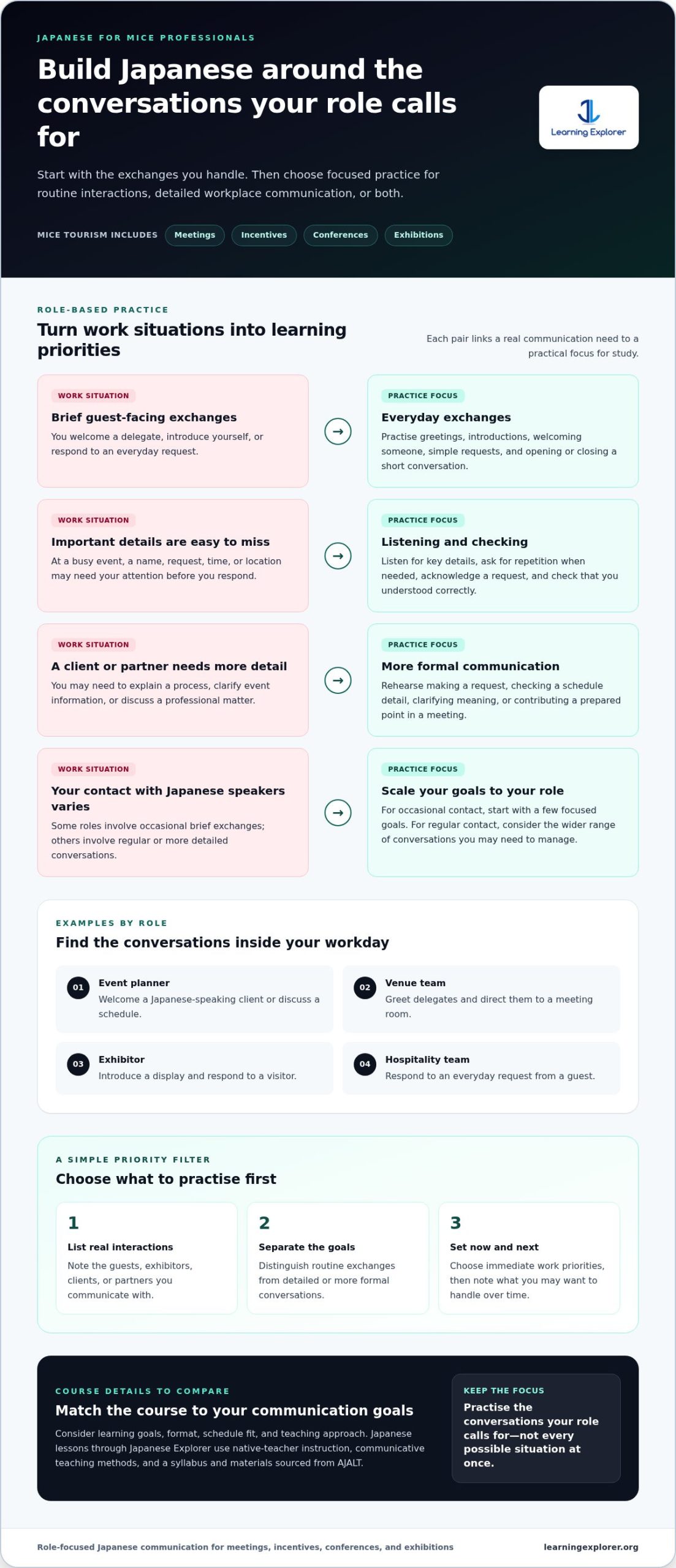
Think through the exchanges connected to your responsibilities. An event planner might welcome a Japanese-speaking client or discuss a schedule. Venue staff might greet delegates and direct them to a meeting room. An exhibitor might introduce a display, while a hospitality team member might respond to a visitor’s everyday request.
These examples are prompts for identifying your own learning needs, not a claim that Japanese is part of every role. Consider how often you meet Japanese-speaking clients or guests, what you need to communicate, and whether those exchanges are brief or detailed. If contact is occasional, a few focused communication goals may be enough to guide your initial study. If it is a regular part of your work, consider the wider range of conversations you may need to manage.
What can Japanese learning contribute to professional communication?
Some goals involve short social exchanges, such as greeting someone, introducing yourself, expressing thanks or making a simple request. Others involve more detailed workplace communication, such as explaining a process, clarifying event information or discussing a professional matter. These situations call for different vocabulary and practice, so identify the specific conversations you want to prepare for.
Start with your responsibilities. If you mainly welcome guests, focus on the brief exchanges you are likely to have. If you liaise with clients or business partners, consider the topics you discuss and the level of formality those conversations require. Japanese study can give you structured language practice, but your goals should reflect your role rather than an expectation to cover every possible situation.
Useful Japanese learning starts with the conversations your role calls for, then builds towards the communication you want to handle next.
You do not need to change your workflow to set a learning direction. Note the interactions you already handle, identify which ones you would like to approach in Japanese, and separate routine exchanges from more complex conversations. That list gives you a practical basis for comparing course goals and formats in the sections ahead.
Japanese Skills to Prioritize for MICE Professional Situations
Begin with the communication you want to practise rather than a proficiency label. Your study could focus on short, familiar exchanges or more structured workplace conversations. For Japanese for MICE industry professionals in Singapore, priorities depend on your responsibilities, the people you interact with and the level of detail you need to communicate.
Listening is as important as speaking. At a busy event, you may need to catch a name, request, time or location before responding. Practise asking a clear follow-up question when you have not caught a detail instead of relying on a guess. Polite expressions can also be a useful learning goal, provided they fit the situation and the kind of communication you want to develop.
Everyday exchanges at meetings and events
For routine interactions, consider practising greetings, introductions and simple conversation. You could work on introducing your role, welcoming someone or making a straightforward request. It can also help to prepare how to open and close a short exchange, so you have a clear starting point for practice.
Pair speaking practice with listening for key details. For example, practise a short exchange where you listen for a person’s name or meeting location, then respond or ask for repetition. You can also practise acknowledging a request and checking that you have understood it. Focus on conveying one idea at a time, and choose expressions that fit your goals rather than trying to prepare for every possible conversation at once.
More formal communication with clients and partners
If your work involves detailed professional conversations, define their purpose before setting learning priorities. You might want to practise making a request, checking a schedule detail, clarifying what someone means or contributing a prepared point in a meeting. Each goal calls for relevant vocabulary, listening practice and an appropriate level of formality.
Build practice around realistic situations and the information you might need to exchange. Rehearse how you would ask someone to repeat a detail, confirm your understanding or explain a next step. For instance, you could practise checking a time or location before passing that information on. Separate situations you handle now from those you may want to prepare for over time. A course provides structured language practice, but it should not be treated as a guarantee of professional fluency or business success.
Keep cultural guidance practical. Avoid treating broad assumptions about Japanese people as fixed rules for every individual or interaction. Pay attention to the context, listen carefully and choose expressions that suit the purpose of the conversation. If you are unsure how to phrase something, practise asking a clear, respectful question.
Write down two or three communication situations that matter most to you. Use them to compare a general conversational focus with more work-related practice. To explore structured Japanese lessons in Singapore, review Japanese lessons in Singapore and consider how the course’s learning approach fits your priorities.
How to Compare Japanese Courses for MICE Professionals
Start your comparison with what you want to learn and how you prefer to study. For Japanese learning related to MICE work, consider the situations you want to practise, the kind of interaction that helps you learn and the routine you can maintain around work. Comparing these factors helps you choose a course based on your needs rather than assuming one format suits every professional.
| Comparison factor | What to consider | How it can guide your choice |
|---|---|---|
| Learning goals | Are you focusing on everyday exchanges, workplace conversations or both? | Prioritise content that connects with the communication you want to practise. |
| Class format | Do you learn more comfortably with individual attention or shared interaction? | Choose a setting that supports your preferred way to participate. |
| Schedule fit | How do work patterns and event periods affect your study routine? | Look for an arrangement that remains realistic when work gets busy. |
| Teaching approach | Does the course offer a clear learning structure and opportunities to use Japanese? | Consider how the approach matches your learning preferences and goals. |
Private or group Japanese classes: which format fits?
Private classes may suit you if you prefer individual attention and a quieter learning setting. Group classes can be a better fit if you value shared practice and learning alongside others. Consider how comfortable you feel speaking in each environment and what kind of interaction helps you stay engaged. Neither format is automatically better. Japanese Explorer offers private and group Japanese classes, so weigh your preferences against the way you want to practise.
In-person or online lessons around event schedules
Think about how travel, work patterns and your preferred study environment affect your choice. An in-person class gives you a set place to study outside the workplace. Online classes let you learn without travelling to a classroom. Consider what feels manageable during event-heavy periods, not only when your calendar is clear. Japanese Explorer offers both in-person and online classes in Singapore.
Course structure matters, too. Look at how topics are organised and whether the learning materials give you a clear reference as you practise. Decide whether you want to build through core language skills or focus your attention on particular communication goals. Japanese lessons through Japanese Explorer use a syllabus and materials sourced from AJALT, along with native-teacher instruction and communicative teaching methods. These are concrete details to weigh alongside the course format and your own learning priorities.
Choose a course whose learning focus matches your goals and whose format you can sustain. Balance flexibility with the kind of interaction you want, then consider how each option fits your work routine. To explore Japanese lessons, review Japanese learning options and use your priorities to guide your choice.
A Practical Checklist for Choosing Japanese Training
A simple decision process keeps course research focused on your own needs. Start with the situations you encounter at work, decide what you want to handle first, then choose a learning arrangement that fits your routine. This makes Japanese for MICE industry professionals in Singapore a personal development goal, rather than an attempt to prepare for every possible workplace conversation at once.
Turn work situations into clear learning goals
Review your responsibilities and separate immediate priorities from longer-term ambitions. Your personal goals may differ from your organisation’s training objectives, so define what matters to you before comparing courses.
- Recall real interactions. Think about conversations you have had or are likely to have as part of your role. Note where Japanese might be useful, without assuming it applies to every task.
- Choose a manageable focus. Select a small number of communication priorities to work on first. A focused goal gives you a clearer basis for comparing courses than a broad aim such as learning everything for business.
- Separate now from later. Identify the skills that matter most to your current responsibilities and those that belong to a longer-term goal. Keep personal priorities distinct from wider team objectives, even when they overlap.
Match goals to learning structure and materials
Once your priorities are clear, consider the learning structure that will help you stay engaged. Think about how you like to participate, where you concentrate best and how much routine your work calendar allows. These preferences can help narrow your options without assuming that the same approach works for every learner.
- Plan for changing workloads. Consider how event deadlines affect your available time. Choose a study routine that feels manageable during both busy and quieter periods, rather than one that depends on an unusually light schedule.
- Choose your learning format. Decide what balance of interaction, convenience and study environment works for you. Base your choice on your priorities and realistic routine, not just on which format sounds ideal in theory.
Before deciding, check that your preferred option aligns with the goals you wrote down and leaves room for work commitments. Japanese Explorer offers Japanese lessons in Singapore in both in-person and online formats, with private and group class options. You can use your priorities to decide which learning arrangement best fits the way you want to study.
Learn Japanese with Learning Explorer in Singapore
Choosing Japanese training is easier when you connect your work priorities to a clear learning plan. Learning Explorer Language Centre is part of the Learning Explorer group, and Japanese Explorer is the group’s Japanese-language school. Keeping the two names distinct makes it clear where to look when exploring Japanese lessons.
What to expect from Learning Explorer’s Japanese lessons
Begin by defining what you want your Japanese study to support. You might want to prepare for a particular kind of conversation or build a broader foundation for future communication. A specific goal gives you a practical way to assess course fit without assuming one learning path suits every MICE professional.
Japanese lessons through Japanese Explorer use native-teacher instruction and communicative teaching methods. The Japanese syllabus and materials are sourced from AJALT. Consider these course details alongside your own goals, preferred class format and the situations you want to practise. If you are new to the language, a beginner’s guide to Japanese language learning in Singapore can help you think through a starting point.
Take the next step with a Singapore-based language school
Use the comparison and checklist in this guide to turn your work-related interests into a considered next step. Learning Explorer Language Centre provides language learning in Singapore, while Japanese Explorer focuses on Japanese lessons. Keep your communication goals at the centre of your decision and choose a learning direction that feels relevant to your responsibilities.
Explore Japanese lessons through Learning Explorer and use your priorities to shape your next step.
Make Your Next Step Count
Professional development can begin with a small, deliberate choice: identify one interaction you would like to handle in Japanese, then use that goal to guide your first step. You do not need to solve every future communication challenge before you start. A clear priority gives your study a purpose and helps you decide what to practise alongside the demands of event work.
For Japanese for MICE industry professionals in Singapore, a useful learning plan connects to real responsibilities and fits your routine. Treat your first goal as a starting point, not a limit. As your role and experience evolve, your priorities can change too. Choose a routine that can accommodate busy periods, so your plan does not depend on having a perfect week.
Focus on the communication you want to develop and the way you prefer to learn. A specific first goal, such as practising an introduction or confirming a meeting detail, gives you a practical basis for exploring Japanese lessons.
Build momentum one practical goal at a time. Your next conversation can be the start.
Frequently Asked Questions
Is Japanese essential for working in Singapore’s MICE industry?
No. Japanese is not a universal requirement for MICE roles in Singapore. Whether it is a useful skill for you depends on your responsibilities and the people you communicate with. If your role involves regular contact with Japanese-speaking delegates, relevant language practice may be a worthwhile personal priority. If those interactions are rare or outside your remit, another learning goal may be more useful. Start with your own work context.
Can I learn Japanese while working in a busy events role?
Yes. Set a focused goal and choose a learning arrangement that fits your routine. Japanese Explorer offers in-person and online Japanese classes, with private and group options. Consider your actual work patterns: online learning may suit you when event periods make travel difficult, while a classroom routine may help you set aside time to study. Choose a plan that feels manageable during both busy and quieter periods.
What Japanese should a MICE professional learn first?
Begin with a communication task that matters in your role, then make it specific. You could practise confirming a person’s name, asking someone to repeat a detail or responding to a short question. Pick one immediate goal instead of building a long list of hypothetical situations. Once you have worked out what you want to handle first, add other priorities as your responsibilities or interests develop.
Are private or group Japanese classes better for professionals?
Neither format is automatically better. The right choice depends on how you prefer to learn. Private classes may suit you if individual attention matters, while group learning offers a shared setting for practice with others. Japanese Explorer offers private and group Japanese classes. Before choosing, consider whether you are more comfortable practising one-to-one or alongside other learners, and how each option fits your work routine.
Should I learn Japanese writing before speaking it at work?
Not necessarily. Let the communication tasks you care about guide the balance. If your main goal is to take part in spoken exchanges, listening and speaking may be your first priorities. If your work also involves reading or composing written information, those skills may deserve attention too. Think about where language appears in your tasks, then use that to set a learning focus rather than assuming every MICE role needs the same mix of skills.
What does AJALT have to do with Japanese lessons at Learning Explorer?
Japanese Explorer sources its Japanese syllabus and materials from AJALT. This gives you a concrete detail to consider when comparing course structure and learning resources. It does not indicate a particular learning result or qualification. Weigh this information alongside your communication priorities and your preference for private or group learning.
Can a beginner take Japanese lessons for professional goals?
Yes. You can set a professional communication goal while building your Japanese progressively. Start with a manageable task, such as preparing an introduction or practising how to ask someone to repeat a point. Use that goal to shape what you study next. Your work context can provide direction even if your longer-term ambitions are still taking shape, so begin with the interactions that feel most relevant to you.