A career change doesn’t make you inexperienced. It gives you a different set of strengths to connect to the role. Strong English for job interviews in Singapore means explaining how your past work applies, naming what you’re still learning, and showing why you’re ready for the next step. Identify three responsibilities in the job and link each one to a related task you’ve handled before. That turns a career shift into a clear, credible story.
It’s understandable to worry that the interviewer will focus on what you haven’t done yet. Prepare a concise explanation of your move, then practise it aloud so your transferable skills come through naturally. This guide will help you shape your career-change answer, prepare two or three thoughtful questions, and practise common interview responses without memorising a script. You’ll also learn how to discuss salary expectations and your start date clearly, so you can approach each part of the conversation with more confidence.
Key Takeaways
- Prepare thoughtful questions that show you understand the role and want to learn how success is measured.
- Use calm, clear phrases to clarify an interview question or repair a misunderstanding without losing your composure.
- Record and review practice answers to spot where you can sound more concise, specific, and natural.
- Discuss salary expectations and your potential start date in direct, professional English, with wording ready before the interview.
- Use the job advertisement and role requirements to focus your preparation on the communication skills the position calls for.
Preparing questions for the interviewer
Prepare two or three questions before your Singapore interview. Thoughtful questions help you understand the role and show how your experience could contribute. Choose questions that invite specific answers, not details already covered in the job advertisement.
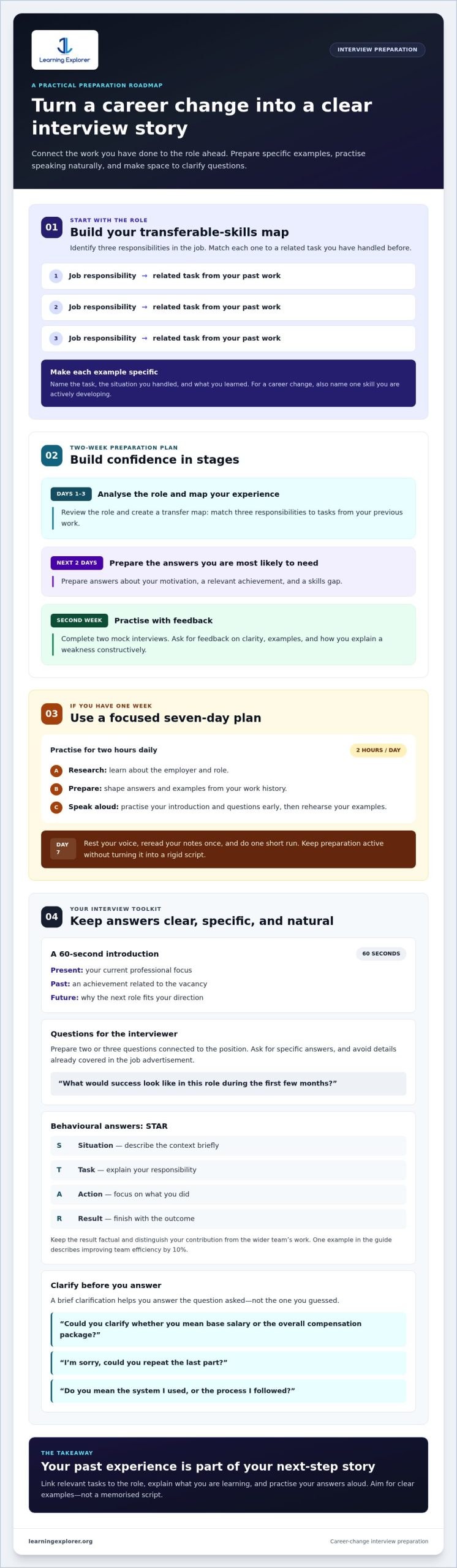
When changing careers, connect your previous work to the employer’s actual needs. A clear talking point names a related task, the situation you handled, and what you learned.
Use this short CNA Insider video for another perspective on answering challenging interview questions:
- Write two or three questions that connect to the position. For example, ask, “What would success look like in this role during the first few months?” Or ask how the team works across departments. Pick questions that help you judge whether the role fits your strengths and career direction. Avoid questions answered clearly in the job advertisement. Keep one question about the role’s priorities, and another about the team’s working approach.
- Research the employer’s website and note two details relevant to the role. These might include a service, customer group, or stated business priority. Prepare one talking point that links a detail to your experience: “I noticed your team supports regional clients. In my previous role, I coordinated requests across several markets.” Use the actual information you found. This makes your motivation specific rather than interchangeable with an answer for another company.
- Build a 60-second introduction with a present-past-future structure. Start with your current professional focus, then share a past achievement that relates to the vacancy. Finish by explaining why this next role fits your direction. For a career change, name one transferable skill and one area you’re actively developing. Use complete, polished sentences, and save detailed work history for follow-up questions.
- If you have two weeks to prepare, spend the first three days analysing the role and creating a transfer map. Identify three responsibilities, then match each to a task from previous work. Use the next two days to prepare answers about motivation, a relevant achievement, and a skills gap. In the second week, complete two mock interviews. Ask for feedback on clarity, examples, and how to explain any weakness constructively.
- If you have one week, use a focused seven-day plan. Practise for two hours daily, dividing the time between research, answer preparation, and speaking aloud. Prepare your introduction and questions early, then rehearse examples from your work history. On Day 7, rest your voice, reread your notes once, and do one short run. This final review keeps your preparation active without turning it into a rigid script.
How should I answer a question about salary expectations in English?
- Identify what the interviewer is asking. “What are your salary expectations?” asks about your compensation expectations, while “What is your current salary?” asks about your existing pay. Listen to the exact wording before answering. If the question is unclear, say, “Could you clarify whether you mean base salary or the overall compensation package?” That brief pause helps you respond to the question rather than guess under pressure.
- Use a composed, flexible answer. You might say, “Based on the responsibilities and my experience, I’m looking for a competitive salary that reflects the role. I’d be glad to discuss the full package.” If you have researched a range, state it clearly in Singapore dollars, then explain the experience and role scope behind it. Avoid apologising for your expectations or naming a figure before you understand the position’s responsibilities.
- Clarify unfamiliar terms without losing your flow. For a technical question, repeat the key phrase and ask for context: “Do you mean the system I used, or the process I followed?” If you miss a detail, say, “I’m sorry, could you repeat the last part?” Then answer in a simple structure: main point, example, result. A direct clarification sounds more confident than answering a question you haven’t understood.
- Use STAR for behavioural interview questions. STAR means Situation, Task, Action, and Result. Describe the situation briefly, explain your responsibility, focus on the action you took, and finish with the outcome. For example, explain how you reorganised a handover process and helped improve team efficiency by 10%. Keep the result factual, and distinguish your contribution from the wider team’s work. This method also helps you explain the reason behind a decision.
- Practise common questions aloud. Prepare concise answers to “Tell me about yourself,” “Why do you want this role?” and “What is one weakness you’re working on?” For a weakness, name a real development area and the step you’re taking, such as practising clearer project updates. Ask a partner to interrupt with a follow-up question, then practise clarifying and repairing misunderstandings. If workplace speaking practice would help, a Business English Course can support clearer professional communication.
Recording, reviewing, and repeating practice answers
Use a short practice loop to make spoken answers clearer and more natural. For English interview practice in Singapore, focus on one answer at a time, then apply feedback to your next recording.
-
Practise Concise Spoken Answers
Choose a common interview question and answer it aloud in one focused practice round. For “What was your contribution to the project?”, name your responsibility, describe an action, and explain the result. Keep each sentence direct, and remove background details that don’t help the interviewer understand your point. A concise answer leaves room for follow-up questions and keeps the conversation moving.
Listen for long openings, repeated phrases, and sentences that carry several ideas. If you start with “Basically, what happened was,” replace it with the actual situation. Use workplace language you can say comfortably, rather than technical terms you can’t explain clearly. Practise career-goal answers aloud in under 30 seconds, then check whether the main point is easy to identify.
-
Record and Review Practice Answers
Record one answer each day for seven days, then review it with a specific question in mind. Check whether your first sentence answers the question, your example shows your responsibility, and your final sentence explains your contribution. Notice unclear pronunciation or pauses, but don’t judge your voice as a whole. Choose one useful change for your next recording.
Use a 10-20-minute aloud practice loop to keep review manageable. Spend two minutes planning the answer, then record it. Take three minutes to review one improvement, such as replacing a vague phrase with a concrete example. Listening for one skill at a time makes feedback easier to apply, and prevents the review from becoming a search for every small mistake.
-
Repeat Practice Answers
Repeat the same answer after choosing one improvement from your recording. Spend three minutes practising that change, such as stating the outcome earlier or using a shorter sentence. Keep the key facts consistent, but don’t memorise every word. A rigid script can sound unnatural when the interviewer asks a follow-up or phrases the question differently.
Record the revised version and compare it with your first attempt. Check whether the new sentence sounds clear and your example still explains the situation and your action. If the change makes the answer less natural, simplify it. Repeat the process with a different question, such as a workplace challenge, a strength, or a skill you’re developing.
-
Use Mock Interviews and English Courses
Ask a practice partner to run a mock interview using common questions and follow-ups. Try a 15-minute run through ten questions, then ask for feedback on clarity, relevance, and sentence structure. A partner can also flag moments when your answer doesn’t address the question. Practise repairing that moment with a simple phrase: “Let me clarify the point I’m making.”
In Singapore, an English course can provide structured conversation practice for workplace communication. Choose practice that helps you explain responsibilities, describe achievements, and respond to follow-up questions in your own words. A mock interview at a university career centre is another way to practise the interview format, while candidates targeting senior roles can turn to executive coaching firms like Simon Lead LLC to sharpen leadership communication. Use feedback from each session to choose the next answer to record, rather than rehearsing every question at once.
Discussing salary expectations and start dates
- Prepare a clear salary response. Before the interview, consider the role’s responsibilities, your relevant experience, and the expectations in the job advertisement. If asked about your expectations, you could say, “I’m looking for compensation that reflects the responsibilities and my experience. I’d be happy to discuss the overall package.” If you have a target range, state it in Singapore dollars and explain the factors behind it. Keep your tone matter-of-fact, not apologetic.
- Connect your motivation to the opportunity. Explain why the role interests you and what you can contribute. For example: “I’m motivated by the opportunity to use my client support experience while developing my project coordination skills.” This shows how your past work relates to the position. Keep your reason specific to the role, and avoid making compensation your only explanation for applying.
- Discuss your start date honestly. Know your notice period and any commitments that affect your availability before answering. You might say, “I can start after completing my notice period, and my earliest available date is…” Singapore employers may value candidates who can start quickly after an offer. Your timing depends on your actual obligations and, where relevant, work authorisation. If you need about one month to obtain a work visa and start working, explain your timeline clearly.
- Present a skills gap with a learning plan. If the position requires a tool or process you haven’t used, name the gap and describe how you’re addressing it. For example: “I haven’t used that reporting platform yet. I’ve learned similar systems, and I’m building my skills through guided practice.” Separate what you can already demonstrate from what you still need to learn. This makes your response practical without overstating your experience.
- Describe a strength and a weakness with evidence. Choose a strength that matches the job, then support it with a brief example: “My strength is prioritising urgent client requests. In my last role, I organised the queue so the team could respond consistently.” For a weakness, share a genuine development area and the action you’re taking. In Singapore, 85 percent of employers value self-awareness and a proactive mindset when candidates discuss weaknesses. Keep the answer focused on progress.
Professional English and Singapore’s job market
For job interviews in Singapore, prioritise clear explanations, relevant examples, and precise answers to follow-up questions. If an advertisement is written in English, prepare to discuss your experience in English. A stated requirement for good English signals that employers expect strong English skills.
- Make your meaning easy to follow. Start with a direct answer, then add one supporting example. For “Why are you interested in this position?”, state your reason before describing a relevant achievement. Use familiar language and shorter sentences when explaining complex work. Clear communication helps interviewers focus on your evidence and expertise instead of working to interpret an unclear answer.
- Show how your language supports your professional skills. More than 60% of local professionals in Singapore want to avoid having their technical mastery overshadowed by a lack of linguistic precision. Prepare to describe technical work in plain English. For example, explain what problem you solved, what action you took, and how the result helped your team or customer.
- Use evidence instead of a memorised script. Prepare key points, not paragraphs to recite. Choose an example that demonstrates your judgement, collaboration, or ability to solve a problem. Then adapt the details to the question. A flexible structure helps you stay relevant when an interviewer asks for more context or phrases the question differently.
- Connect your communication to Singapore’s international workplaces. Over 80% of regional headquarters operate in Singapore, as described for the 2026 job market. This context makes it useful to practise explaining your work to people with different roles or backgrounds. For example, describe a project update in terms of its goal, your contribution, and the next action, without relying on unexplained internal jargon.
- Practise for the language demands in the job advertisement. Highlight phrases such as “present findings,” “coordinate with clients,” or “write reports.” Prepare one spoken example for each requirement, using vocabulary you can explain naturally. If professional conversations feel difficult, build confidence in workplace English through focused language practice. This helps you communicate your experience with clarity and stronger evidence.
Learning Explorer: Conversational English Course
Learning Explorer offers a Conversational English Course for learners who want to build confidence in spoken English. If you can prepare interview answers but find it difficult to express them naturally, conversational practice can help you work on clearer, more fluent responses. For professionals focused on workplace communication, the Business English Course is another relevant option.
Choose the course that best matches your goal: practise everyday spoken English or develop English for professional situations. Use your interview preparation to guide your practice, such as explaining your experience, responding to follow-up questions, and describing your strengths aloud. Learning Explorer also offers Conversational Mandarin and Business Mandarin courses for learners pursuing those language goals.
Contact Learning Explorer to explore the course that fits your communication goals.
Take Your Next Interview with Greater Confidence
Your next interview is a chance to make your experience easier to understand, one clear answer at a time. Build your English for job interviews in Singapore by practising moments that feel unfamiliar, such as explaining a decision or responding to an unexpected follow-up. Focus on communicating your thinking, not delivering a flawless script.
After each conversation, note a question that challenged you and a response you’d like to make clearer. Turn those notes into a short practice routine before your next opportunity. Consistent, purposeful practice can help you bring your ideas forward with greater ease and show employers the professional behind your answers.
If you’d like support strengthening your spoken English for work, explore learning options with Learning Explorer. Contact Learning Explorer to take the next step at a pace that feels right for you. Each interview can help you learn, refine your approach, and move closer to the role you want.
Frequently Asked Questions
How do I explain a career change without sounding inexperienced?
Present your career change as a deliberate move that builds on what you already know. Connect a previous responsibility to the new role, then name a skill you’re developing. For example, someone moving from customer support to operations might explain how resolving recurring issues sparked an interest in improving processes. This shows a clear reason for the change while staying honest about experience you’re still gaining.
How good does my English need to be for a job interview?
For English for job interviews in Singapore, focus on understanding questions and explaining your experience clearly. You don’t need elaborate vocabulary if your answer is accurate and easy to follow. Practise describing a work task in plain English, then explain why you chose a particular approach. Check the job advertisement for its communication expectations, since language demands can vary with the role and its responsibilities.
Is my accent a problem in a job interview?
An accent by itself doesn’t stop you from showing your qualifications. Prioritise clear speech: use a steady pace, finish important words, and pause between ideas. Practise explaining a familiar task, such as preparing a report, and ask a listener which parts were difficult to follow. You don’t need to imitate another accent. Aim to make your meaning understandable and respond calmly if the interviewer asks you to repeat something.
Should I memorize my interview answers word for word?
No. A memorised script can make it harder to adapt when an interviewer asks a follow-up or phrases a question differently. Instead, remember a few prompts for each example, such as the challenge, your action, and what you learned. Practise expressing those points in different ways. This keeps your response organised while helping it sound like a genuine conversation, not a speech delivered from memory.
Should I mention that I am improving my English?
Mention your language development if it’s relevant to a question about learning or professional communication. Keep the focus on what you’re doing, such as practising concise updates after meetings. Avoid presenting your English as an apology or raising it unnecessarily. If the interviewer asks about your ability to communicate, give a practical example of how you share information, clarify a point, or contribute during a team discussion.
What should I do if I don’t understand an interview question?
Ask the interviewer to repeat or rephrase the part you missed. For example, say, “Could you explain what you mean by ‘stakeholder management’ in this role?” If you understand the topic but want to check your interpretation, ask, “Are you asking how I handle competing priorities?” A brief clarification helps you answer accurately instead of guessing and giving an unrelated example.
Where can adults in Singapore take English courses focused on job interviews?
Adults in Singapore can explore Learning Explorer’s Conversational English Course and Business English Course to strengthen spoken English for personal or professional communication. Practise interview questions alongside your learning, using examples from your target role and describing your experience aloud. Preparing in English for job interviews in Singapore can be a practical way to apply language skills to a professional goal.
How much do job interview English courses cost in Singapore?
Course fees depend on the course, language, proficiency level, and duration. Learning Explorer’s tuition fees vary according to those factors, and registration or learning-material fees may also apply. Request a quote for a current price and describe the course you’re considering and your learning needs. This helps you understand the relevant costs without relying on a general estimate that may not match your circumstances.