You don’t need to wait for a role to require Mandarin before you start learning. Beginning conversational Chinese for professionals in Singapore ahead of time gives you room to build confidence in everyday workplace exchanges, rather than starting under pressure when a specific task arises.
It’s understandable to put another commitment on hold when work is already busy. The right course should match how you’ll use Mandarin, the time you can set aside and the format that helps you practise consistently.
This guide explains how to compare courses by learning goals, schedule and format, and what topics and cultural context you may encounter. You’ll also learn how conversational study differs from exam-focused preparation, so you can choose a path that supports communication at work and in daily life.
Key Takeaways
- Match your course to the conversations you need for work, travel or everyday life, then choose a class format and schedule you can sustain.
- Look for practical speaking activities that help you rehearse introductions, meetings, directions and other real-world exchanges.
- Compare Singapore language centres by how their teaching approach, course focus and learning environment fit your goals.
- Build cultural awareness alongside vocabulary so you can communicate with greater confidence and sensitivity.
- Before enrolling, understand how your current level is assessed and review the course’s registration and cancellation terms.
Choosing a course based on goals, schedule and format
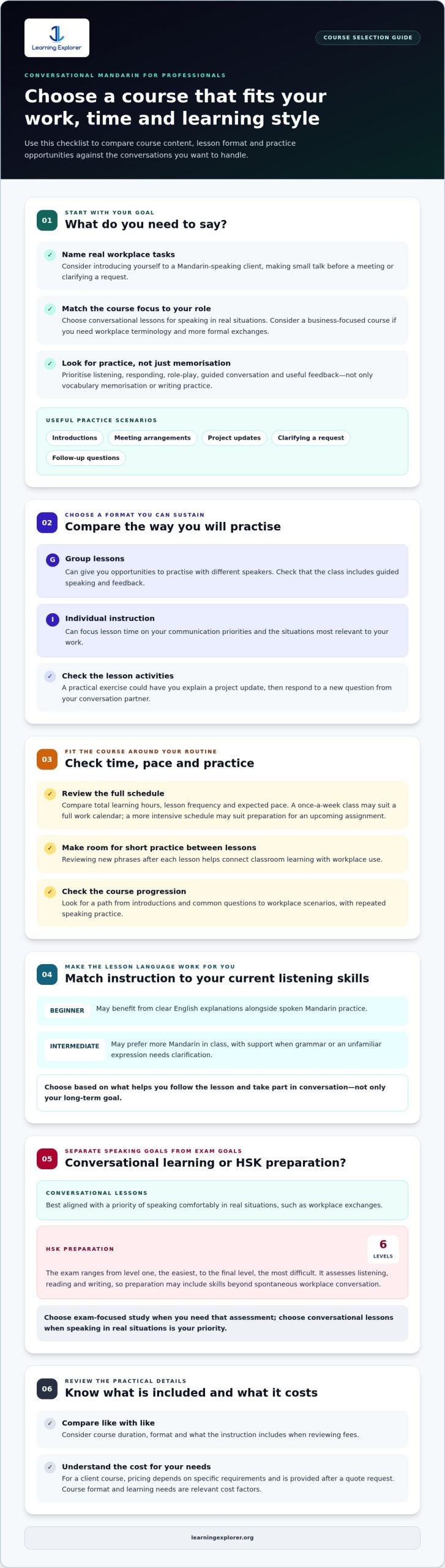
Start with the conversations you need at work, then compare course content, timing and format against those goals. A useful course builds speaking confidence and gives you a realistic way to practise between lessons.
Learning Goals and Course Format
Choose a course around specific tasks: introducing yourself to a Mandarin-speaking client, making small talk before a meeting or clarifying a request. A conversational Mandarin course should give you opportunities to listen and respond, not just memorise vocabulary or practise writing. If you need workplace terminology and more formal exchanges, consider whether a business-focused course better matches your role.
Next, compare the teaching format. Group lessons can give you practice with different speakers, while individual instruction can focus on your communication priorities. In either format, look for role-play, guided conversation and useful feedback. For example, practise explaining a project update, then respond to a new question from your conversation partner.
Course Duration and Instruction Language
Check the total learning hours, lesson frequency and expected pace before committing. A course that meets once a week may suit a full work calendar, while a more intensive schedule may suit someone preparing for an upcoming assignment. Set aside time for short practice sessions between classes. Reviewing new phrases after each lesson helps connect classroom learning with workplace use.
Also consider how the instructor uses English and Mandarin during lessons. Beginners may benefit from clear English explanations alongside spoken Mandarin practice. Intermediate learners may prefer more Mandarin in class, with support when a grammar point or unfamiliar expression needs clarification. Match the language of instruction to your current listening skills, not just your long-term goal.
Course structure matters as much as the timetable. Look for a progression from introductions and common questions to workplace scenarios, with repeated speaking practice. A practical lesson might introduce phrases for arranging a meeting, model a short exchange, then let learners adapt it to their own work situations. Check that listening, pronunciation and conversation receive enough attention for your intended use.
If certification is part of your goal, distinguish HSK preparation from conversational training. HSK has six levels, from level one as the easiest to the final level as the most difficult. It assesses listening, reading and writing, so preparation may involve skills beyond spontaneous workplace conversation. Choose exam-focused study when you need that assessment, and conversational lessons when your priority is speaking comfortably in real situations.
Compare course fees by considering duration, format and what instruction includes. Ask how any external funding or employer support applies to your circumstances, and calculate the remaining cost before enrolling. For a client course, pricing depends on the specific requirements and is provided after a quote request. Course format and learning needs are relevant cost factors.
Business, travel, and everyday conversation topics
Build Mandarin around real exchanges, from a workplace introduction to asking for directions in Singapore. Practical examples connect vocabulary and cultural context with speaking confidence.
Business Conversation Expressions
Start with useful exchanges for meetings: greeting a colleague, introducing your role, confirming a time and asking someone to repeat a point. Practise complete phrases rather than isolated vocabulary, then adapt each example to your workplace. For instance, rehearse a concise project update and a follow-up question. This develops listening and speaking skills together.
Include polite ways to clarify details, express thanks and close a conversation. In a role-play, one learner can suggest a meeting time while another checks the date and location. These short exchanges offer a repeatable structure for speaking with teammates, clients or executives.
Cultural Context and Etiquette
Singapore’s professional settings bring together people with varied language backgrounds and communication preferences. Avoid assuming that one style suits every conversation. Notice how your counterpart addresses you, follow their lead on formality and use clear, respectful wording when making a request. Lessons can help you practise these choices through greetings, introductions and courteous follow-ups.
Etiquette also shows in the details: listen without interrupting, confirm important information and allow space for a response. For example, after discussing a deadline, summarise the agreed next step. This practical approach treats cultural context as a communication skill, not a fixed rule about every Mandarin speaker.
Professional Business Chinese
Business Mandarin can focus on tasks such as presenting a proposal, discussing timelines and responding to questions. Choose scenarios from your actual role, then practise explaining the same point in a formal meeting and a brief workplace conversation. Comparing the two helps you adjust tone and vocabulary without making each exchange sound like an academic exercise.
To track progress, keep a short list of phrases you can use independently and those that still need practice. Review a recorded or written role-play if the class activity includes one, and identify where listening or word choice caused difficulty. The goal is usable communication, not simply learning specialist terms.
Travel and Everyday Conversation Themes
Everyday topics help learners keep conversations going beyond the office. Practise ordering a meal, asking for directions, arranging transport or making small talk about weekend plans. In Singapore, a realistic exercise might involve asking where a meeting venue is, then confirming the route with a colleague.
These scenarios also help you practise common question-and-answer patterns. Use a simple sequence: listen for the key detail, respond with a complete phrase, then ask a relevant follow-up. Repeating that sequence across travel and social situations can make Mandarin practice more purposeful and engaging.
Choose topics that reflect the people and situations you expect to meet. For example, combine a client introduction with a meal conversation, then practise moving naturally between the two. To turn these scenarios into guided speaking practice, explore ways to practise Mandarin conversations.
Chinese language centres in Singapore
Compare Singapore Chinese language centres by the learning experience they provide, not just their location. Start by matching each centre’s course focus to your goal, such as speaking confidently in meetings or handling everyday conversations.
Look for teaching that makes speaking a regular part of class. For example, a lesson might have learners introduce their role, ask a follow-up question and respond to a colleague’s request. This helps you judge whether classroom activities reflect situations you expect at work.
Consider how a centre supports different starting levels. A beginner may need clear explanations and guided practice, while an advanced learner may benefit from longer discussions and more complex workplace scenarios. Find out how learners are placed in suitable classes and how teaching accommodates someone who already knows basic Mandarin.
Review the course outline for balance. A conversational Mandarin programme might include listening, pronunciation, useful vocabulary and paired speaking practice. If the outline focuses mainly on written exercises, consider whether that matches your goal. Someone preparing to welcome Mandarin-speaking visitors, for instance, may need more live dialogue practice.
Practical access matters in Singapore, especially when lessons follow a workday. Before enrolling, map the journey from your office or home to the centre and consider how class timing fits your routine. A convenient route may make it easier to attend consistently than a location that requires a difficult cross-city trip.
Ask what a typical lesson looks like, then picture yourself taking part. Does the teacher model a phrase, explain its use and give learners time to practise it aloud? A clear sequence connects new language with real communication. For example, learners could rehearse a short introduction before adapting it for a client meeting.
Also compare how progress is discussed. Useful feedback can identify a specific next step, such as improving tones in a greeting or asking clearer questions during a conversation. When a centre explains learning goals and classroom expectations, it’s easier to understand what you’ll practise and how each activity supports speaking.
Finally, read the enrolment and attendance terms before committing. Note the course schedule, lesson format, materials and cancellation conditions, then compare them with your calendar. A working professional who travels often, for example, may need to weigh fixed in-person lessons against a predictable work routine before choosing.
Cultural etiquette and social context
Good Mandarin learning involves more than vocabulary: it helps you choose suitable words, tone and timing. In Singapore, practise adapting a greeting or request to the setting, such as a first client meeting or a familiar team conversation.
Start with introductions. A beginner can practise stating their name and role, then asking how to address a new contact. In a workplace role-play, listen for the other person’s preferred form of address and follow their lead. This builds a practical habit without assuming every Mandarin speaker has the same preferences.
Polite phrasing also matters when asking for help or clarifying a point. Instead of repeating a short command, practise framing it as a courteous request. For example, ask a colleague to explain a project detail again, then confirm what you understood. A Chinese course that includes these exchanges gives learners language for both the request and the follow-up.
- Opening: Greet a new contact and introduce your role.
- Clarifying: Ask someone to repeat a date, name or task detail.
- Responding: Thank a colleague and confirm the agreed next step.
These examples connect culture with communication instead of presenting etiquette as a fixed checklist. A curriculum can use paired practice to compare a formal introduction with a casual exchange at lunch. Learners can notice how word choice changes with familiarity, then practise listening for cues before responding.
Workplace context shapes what feels appropriate. During a meeting, a learner might practise waiting for a pause before contributing, then offering a concise opinion and supporting reason. In a one-to-one discussion, the same learner can practise asking a follow-up question. These situations develop awareness of turn-taking while strengthening spoken Mandarin.
Social conversations offer another useful area for practice. Role-play meeting a colleague before an event, discussing a meal or responding to an invitation. Focus on natural exchanges: acknowledge what the other person said, add a relevant detail and ask a question. This sequence supports everyday conversation without relying on memorised lines alone.
When comparing an institute’s teaching approach, look for realistic scenarios and feedback on tone, clarity and word choice. A strong learning activity explains why a phrase suits a particular setting, then lets you practise adapting it. This helps professionals build cultural awareness alongside speaking confidence while staying attentive to the individual and context.
What are the enrollment requirements, placement tests, and cancellation policies?
Prepare for enrolment by identifying your current Mandarin level, learning goal and preferred class schedule. For example, note whether you can introduce yourself, follow a simple conversation or already discuss familiar workplace topics. These details help you choose a suitable starting point and understand what information the registration process requires.
Before submitting a registration form, review the course description and class format. Have your name, contact details and schedule preferences ready, and note any learning goal you want the course to address. If you’re registering through an employer, clarify internally who handles payment and attendance arrangements. A short checklist can prevent avoidable delays.
A placement test, when included, helps match learners with an appropriate starting level. It could assess listening, speaking, vocabulary or basic sentence formation. For example, a short conversation about your role can show whether you’re ready for workplace scenarios or need more foundational practice. Treat the result as a guide to class fit, not a measure of professional ability.
- Before assessment: Describe your Mandarin experience and the situations you want to handle.
- During assessment: Answer naturally, and ask for clarification if you don’t understand a prompt.
- After assessment: Use the feedback to identify the class level and skills to practise.
Read the cancellation and transfer terms before paying or reserving a place. Look for the notice period, how to submit a cancellation and any conditions affecting refunds or class transfers. For example, determine whether missing one lesson differs from withdrawing from the entire course. Keep a copy of the terms and any written confirmation with your registration records.
Check how schedule changes are handled, too. A business trip, client meeting or shifting work roster can disrupt attendance. Find the stated steps for notifying the organiser, and note whether a missed lesson can be made up or transferred. Don’t assume an absence automatically changes your enrolment or payment obligations; follow the course’s written conditions.
Use this sequence before committing: compare the course description with your level, complete any assessment, review the schedule, then read the cancellation terms. For instance, a beginner who travels often for work should weigh class timing and absence conditions together. This review helps you choose with a clearer picture of the learning commitment.
Ready to take the next step? Explore your Mandarin learning options and choose a course path that fits your goals.
Learning Explorer: Conversational English Course
Learning Explorer offers language courses for professionals who want to communicate more confidently at work. If your workplace goals include clearer English conversations, the Conversational English Course focuses on everyday spoken communication, while the Business English Course suits professional exchanges.
For Mandarin, choose the Conversational Mandarin Course for spoken interactions or the Business Mandarin Course for work-focused communication. Matching the course to the language and situations you need keeps learning relevant, whether you’re preparing for team discussions, client conversations or daily workplace exchanges.
Contact Learning Explorer to discuss which course best fits your communication goals.
Make Your Next Conversation a Starting Point
Choose one upcoming interaction where Mandarin could help, such as welcoming a client or joining a discussion with colleagues. Use that situation to define what you want to say, understand and respond to. A focused goal gives your learning a clear purpose and makes it easier to notice progress in real conversations.
For professionals in Singapore, conversational Chinese can be a practical skill to develop before a new responsibility makes it urgent. Keep your first objective manageable: prepare an introduction, ask a clear question or follow a familiar exchange with greater confidence. Then build from that foundation as your communication needs evolve.
If you’re ready to shape a learning path around your workplace goals, connect with Learning Explorer. Take the next step at a pace that works for you, and bring more confidence to the conversations ahead.
Frequently Asked Questions
Why should I learn Mandarin now rather than waiting until I need it for a specific role?
Starting before a role requires Mandarin gives you time to build familiarity without the pressure of an immediate workplace task. You can identify relevant vocabulary, practise listening to different speakers and develop a steady learning routine. For example, if your responsibilities may include regional client communication, begin with professional introductions and common requests, then expand your practice as those responsibilities become clearer.
Does learning Mandarin actually improve career prospects in Singapore?
Mandarin can strengthen your fit for roles that involve speaking with Mandarin-speaking colleagues, clients or customers in Singapore. It may also help you contribute more comfortably to workplace interactions. Career outcomes still depend on the role’s requirements and your other experience, so treat language learning as a practical skill to add to your professional toolkit, not as a substitute for relevant expertise or a promise of promotion.
What conversational Chinese courses for professionals are available in Singapore?
Learning Explorer offers a Conversational Mandarin Course and a Business Mandarin Course. The conversational option suits learners seeking general spoken communication, while the business option is relevant when workplace communication is the priority. Before choosing, consider which interactions matter most in your work, such as speaking with colleagues or handling professional exchanges. Use that goal to decide which course focus best matches your needs.
Which Singapore providers offer business Chinese or workplace Mandarin classes?
Learning Explorer offers a Business Mandarin Course for learners focused on professional settings, alongside its Conversational Mandarin Course. To choose between them, start with the communication tasks you expect to handle. If you want broader spoken practice, consider the conversational focus; if your goal centres on work, explore the business course. This gives you a clear starting point without comparing unrelated course types.
How much do conversational Chinese classes for professionals cost in Singapore?
Course fees depend on the course and the learner’s needs, and the price is provided after a quote request. Relevant factors can include language, proficiency level, course duration and delivery format. For corporate training, group size, curriculum customisation and training location can also affect fees. When planning, consider the full course commitment and any registration or learning-material charges alongside tuition.
What course formats are available in Singapore: group, private, online, or in-person?
Learning Explorer provides physical, in-person and online classes, with private, group and intensive learning formats available. The right setup depends on how you prefer to practise and what fits your routine. For example, online lessons may work for a learner with a changing commute, while in-person classes offer a classroom setting. Compare format and course focus together when deciding which option suits your learning needs.
What are the class schedules and locations for working adults in Singapore?
Learning Explorer’s training centre is at 10 Anson Road, level 22, International Plaza, Singapore 079903, directly above Tanjong Pagar MRT. For scheduling, use the timetable for the course you’re considering and compare it with your work commitments before enrolling. If you’re balancing meetings or travel, note which lesson format and location make attendance practical, then plan your route and study time around that choice.
What Chinese proficiency levels and skills do professional courses cover?
Course levels may range from beginner foundations to more advanced communication, depending on the programme. For reference, the HSK has six levels and assesses listening, reading and writing. A professional learner focused on conversation should also consider spoken interaction, pronunciation and workplace vocabulary. Before selecting a course, describe your current ability in practical terms, such as whether you can follow a basic exchange or discuss familiar topics.