Learning Thai is worthwhile for travel, and a Thai language course for travel near Bedok can help you build practical speaking skills before your trip. With daily practice alongside a qualified speaker, learners can pick up basic conversational Thai within 3 months. Even elementary phrases can make everyday interactions feel more comfortable and help you approach travel situations with greater confidence.
It’s understandable to wonder whether learning a new language is worth the time when you mainly need it for a trip. You don’t need to master Thai to benefit: start with greetings, introducing yourself, numbers and telling the time. Focused practice can give you a foundation for everyday exchanges during your travels.
This guide explains what an elementary Thai course can cover and how to weigh class schedules, learning materials and certificates as you plan. You’ll also see how practical conversation topics can support your travel goals and help you decide whether beginner-level learning is the right next step.
Key Takeaways
- See how basic Thai phrases can support travel, and which everyday situations are useful to practise first.
- Explore the elementary foundations, from greetings and introductions to numbers, telling time and Thai tones.
- Compare the listed beginner class schedules to see how different study formats may fit around your routine.
- Learn what course materials and attendance certificates can mean when planning your learning experience.
- Use practical conversation topics, such as asking for directions, to make your preparation more purposeful.
Is learning Thai worth it?
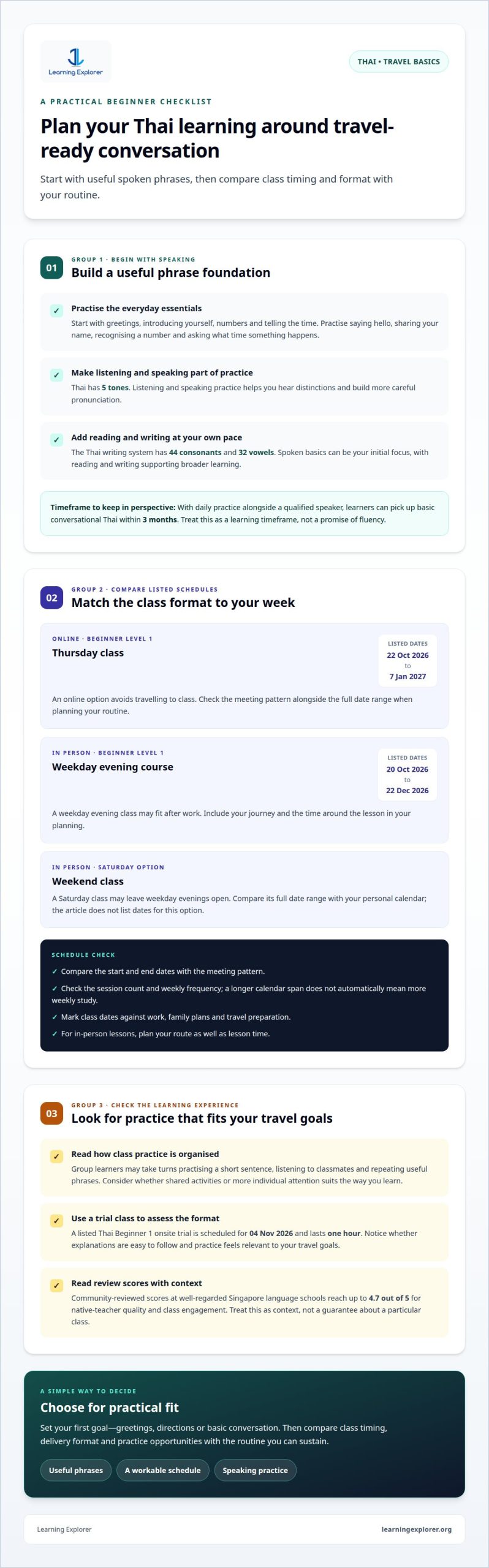
Yes, learning Thai can make a trip more engaging and everyday exchanges easier. A beginner course can help you practise useful spoken phrases before travelling, rather than relying only on gestures or translation tools. With daily practice alongside a qualified speaker, learners can pick up basic conversational Thai within 3 months. Treat that as a learning timeframe, not a promise of fluency.
For travel, start with practical conversation. Greetings, introductions, numbers and telling the time are useful building blocks for simple interactions. Practise saying hello, sharing your name, recognising a number or asking what time something happens. These examples can help you decide what you want from beginner conversational Thai classes: guided speaking practice, clear explanations and chances to repeat phrases aloud.
A Thai language course for travel near Bedok, Singapore, is most useful when its beginner content matches your intended situations. Look for lessons that develop understanding and self-expression in everyday contexts, rather than focusing only on memorising isolated words. Thai has 5 tones, so listening and speaking practice matters alongside vocabulary. Tone awareness can help you hear distinctions and build more careful pronunciation from the start.
Beginner Thai language courses in Singapore can also introduce learners to the writing system. Thai has 44 consonants and 32 vowels. That may feel like a lot at first, so consider your travel priorities: spoken basics can be your initial focus, while reading and writing support broader learning. A structured elementary course can give you a sequence, helping you practise one useful skill before layering on another.
Reviews can help you compare learning experiences, but read what each score measures. Community-reviewed scores at well-regarded Singapore language schools reach up to 4.7 out of 5 for native-teacher quality and class engagement. Use that figure as context, not as a guarantee about a particular class. Look for comments that describe teaching clarity, speaking opportunities and how lessons support beginners.
A trial class can help you experience the lesson format before deciding. A listed Thai Beginner 1 onsite trial is scheduled for 04 Nov 2026 and lasts one hour. Use that session to notice whether explanations are easy to follow and whether practice feels relevant to your travel goals.
To choose a beginner course near Bedok, first decide what you want to practise, such as greetings, directions or basic conversation. Then compare the class timing and location with your routine, and follow the registration steps for your chosen class. This keeps your decision focused on practical fit, not just the course label.
Thai group class sizes and schedules
Near Bedok, compare the course dates, delivery format and weekly timing before choosing. Options listed include an online Thursday class, a weekday evening course and a Saturday class.
Group Class Sizes
Class size affects how much speaking time each learner gets and how group practice feels. In a Thai group class, learners can take turns practising a short sentence, listening to classmates and repeating useful phrases. Consider whether you learn best through shared activities or prefer individual attention. The schedule and format also shape how actively you can participate in each session.
Read the class description to understand how learning is organised, then match the format to your goals. Someone preparing for a Thailand trip, for example, may value opportunities to practise simple travel conversations aloud. If you prefer to listen first, look for time to follow examples before speaking. Focus on the practice format rather than assuming every group class works the same way.
Course Schedules and Session Counts
A course date range shows when classes begin and end, while the session count indicates the total commitment. These details are not interchangeable: a longer calendar span doesn’t automatically mean more weekly study. Check the meeting pattern alongside the start and end dates. A Thursday course, for instance, calls for a different routine from a weekday evening class.
Listed options include an online Beginner Level 1 class on Thursdays from 22 Oct 2026 to 7 Jan 2027, and a weekday evening Beginner Level 1 course from 20 Oct to 22 Dec 2026. Use those dates to map lessons around work, family plans or travel preparation. If you need a particular number of sessions, compare the course calendar and meeting frequency before committing.
Weekday and Weekend Timing
Weekday and weekend schedules suit different routines. A weekday evening class may fit after work, while Saturday lessons can leave weekday evenings open. A weekend class may suit you if Saturday lessons fit your routine. Compare its full date range with your personal calendar, not just the first class date.
When choosing a schedule near Bedok, consider the full journey as well as lesson time. An online Thursday option avoids travelling to class, while in-person lessons require you to plan your route. Class duration matters too: set aside time for the lesson and the transition around it. Match the format to your available study time, then use the course dates to plan consistent attendance.
Build a simple schedule before enrolling: mark each listed class date, note work or family commitments, and identify any conflicts. If you’re comparing options, consider whether online learning or a Saturday routine better supports your travel preparation. You can also explore Thai learning options as you decide which study format fits your plans.
Course materials and attendance certificates
Course materials shape how you review Thai between lessons. A course book can bring vocabulary, explanations and practice activities together, making it easier to revisit them than to search through scattered notes. Mark a new phrase after class, for example, then return to it during your next review. Consider whether the materials suit the way you plan to study.
For two people taking Basic Thai classes, the listed fee includes a course book. This can help travelling companions plan their learning and practise together outside class. Decide how each person will use the book: one learner might review vocabulary while the other practises reading a sample sentence aloud. A shared resource can also keep revision focused.
Separate course fees from material fees when comparing options. A course may include a book, or materials may be itemised separately, so identify what the stated fee covers. The price depends on the course arrangement, number of learners and required materials, and is provided after a quote request. This helps you compare options based on the actual learning setup.
Before starting, make a simple materials checklist. Note whether you need a course book, digital files or a notebook for new words. During each lesson, record a practical example, such as a greeting or a number, then revisit it before the next class. Organised notes make it easier to track what you have practised and where you need more repetition.
An attendance certificate records that a student attended a course. It is different from a proficiency result: attendance alone does not show how well someone can speak, understand or read Thai. If you need evidence of participation for your records, find out whether the course provides an attendance certificate and what information it records.
Keep the question of certificates separate from course materials. A book supports learning; a certificate documents attendance. A student preparing for travel, for example, may value a book for reviewing useful language, while someone maintaining a learning record may value documented participation. Decide which outcome matters to you, then compare the course information with that purpose.
Before enrolling, check three things: what materials you need, whether they are included and what attendance documentation means. For a pair of Basic Thai learners, the included course book is a concrete detail to note. For certificates, focus on the attendance record itself rather than assuming it demonstrates conversational ability or a particular level of Thai.
After each lesson, use the book alongside your own notes. Revisit one example, practise it aloud and write down a question for the next class. This routine turns your materials into an active study tool, while a clear understanding of attendance documentation helps you keep your learning records accurate.
Travel, directions and everyday conversation topics
A useful travel syllabus centres on speaking and understanding in everyday situations. With proper lessons and regular practice, learners can become fairly comfortable with everyday conversation within 3 months.
Near Bedok, compare class formats by the guided speaking practice they provide. Private lessons give you individual turn-taking, while group classes can include exchanges with other learners.
Survival Thai for Travel
Survival Thai focuses on phrases for handling simple interactions during a trip. Practise listening to a short question, responding clearly and asking for repetition when needed. For directions, rehearse asking where a place is and understanding a short reply. These exchanges build a practical routine without requiring advanced grammar.
Make your practice relevant by choosing travel situations you expect to encounter. Rehearse asking for directions, understanding a time or introducing yourself to someone you meet. A teacher can guide your pronunciation and help you repeat a phrase until it feels more natural. Regular practice between lessons helps turn familiar examples into spoken responses.
Travel Conversation Syllabus
An elementary syllabus can develop understanding and self-expression in everyday situations through conversational practice in greetings, self-introductions, numbers and telling time. These foundations support short exchanges, such as introducing yourself before asking a simple question. When comparing courses, look for a clear progression from understanding a phrase to using it aloud.
For travel directions, build on those foundations with practice questions and short replies. A sentence becomes easier to use when you understand its purpose, identify its key words and rehearse it in context. Pair each new expression with a realistic situation, such as asking where to go or confirming a time. This gives your practice a clear travel focus.
Grammar supports conversation by showing how words work together. Beginners can focus on sentence patterns used in short exchanges, then practise changing one detail at a time. Keep a familiar question structure and swap in a different place or time, for example. Reading practice can help you recognise written forms, while speaking practice prepares you to respond in the moment.
Online and in-person lessons offer different practice settings. Online learning lets you practise from home, while in-person lessons take place in a classroom. For either format, consider whether the session includes listening, speaking and chances to repeat examples. A conversational lesson should give you active practice, not just explanations to read.
To choose a travel-focused course, write down the situations you want to handle, such as directions or everyday introductions. Then compare the syllabus and lesson format with those goals. If you prefer individual attention, private tutoring offers a one-to-one structure; if you learn through shared practice, group lessons provide partner exchanges. Regular practice supports progress toward everyday conversation over 3 months.
Elementary Thai language course
An elementary Thai course builds foundational skills in a clear sequence: listening, speaking, vocabulary, then reading. Thai’s writing system includes 44 consonants and 32 vowels, so beginners benefit from learning patterns instead of memorising every symbol at once. Start with sound recognition, connect sounds to written forms, and practise using them in short exchanges. This step-by-step approach keeps each new skill connected to practical communication.
Consonants are grouped by sound class, a useful foundation for understanding how written Thai works. The groups contain 9 mid consonants, 24 low consonants and 11 high consonants. Rather than treating these as three unrelated lists, learn a few examples from each group and practise identifying them in familiar vocabulary. A teacher can model pronunciation while you compare the written character with its sound.
Vowel learning also has structure. Thai is described as having 24 regular vowel sounds and 8 special vowel sounds. Practise hearing a sound, repeating it, and then recognising its written form. Short review exercises can help: read a character aloud, listen to the teacher’s model, then repeat it in a simple word. This links listening, speaking and reading without asking you to master the full writing system immediately.
For travel, connect vocabulary to useful situations. Choose a small set of expressions, practise saying each clearly and use them in a short conversational exchange. You could rehearse a phrase, listen for its pronunciation, then use it in a brief role-play. A clear elementary syllabus progresses from recognition to guided practice, helping you turn new vocabulary into usable speech.
Thai’s sound system deserves deliberate attention. The language has 5 tones, so listening closely and repeating a teacher’s examples can help beginners notice tonal differences. Practise one short expression at a time, then say it again in a complete sentence. Focus on both the individual sound and the sentence around it. This makes pronunciation practice more purposeful than repeating isolated vocabulary without context.
A beginner lesson can combine speaking and writing in manageable steps. First, listen to a model; next, repeat the phrase; then identify a sound or character; finally, use the phrase in a short exchange. For instance, practise introducing yourself while noticing how a written example relates to spoken language. This sequence gives each lesson a practical outcome and a clear point to review afterwards.
Choose an elementary course by checking how it balances conversation with Thai sound and script foundations. If travel is your goal, prioritise guided speaking practice while building reading skills gradually. Begin your Thai learning journey with a clear focus, then practise each new sound, word and sentence consistently.
Learning Explorer: Conversational English Course
Learning Explorer offers the Conversational English Course for learners who want to practise everyday spoken English. After building Thai travel vocabulary, you may also want more confidence communicating in English in Singapore or while travelling. The course offers a separate learning pathway focused on conversation. Choose it when improving your English speaking skills matters alongside your Thai preparation.
For work-related communication, Learning Explorer also offers Business English Course, Conversational Mandarin Course and Business Mandarin Course. These options serve different language goals, so consider which language and context you want to practise. To learn more about the Conversational English Course, visit Learning Explorer online or contact Learning Explorer.
Turn Your Travel Plans Into a Learning Goal
Before you begin, choose a few moments from your trip when speaking Thai would help you feel more prepared. Think about the situations you’ll encounter and use them to guide your practice. A clear goal can help you stay focused and make each study session feel connected to the journey ahead.
If you’re ready to take the next step, Learning Explorer offers its Conversational Thai Course. A Thai language course for travel near Bedok can give your preparation a practical direction, while regular practice helps you build confidence using what you learn. Start with the situations that matter most and let them shape your learning priorities.
Contact Learning Explorer about Thai to explore your next step. Your travel preparation can begin with one useful phrase and grow from there.
Frequently Asked Questions
Are there Thai classes near Bedok MRT for beginners?
Beginners can study through a conversational Thai course in Singapore, with online and physical class formats available. The learning centre is at 10 Anson Road, level 22, International Plaza, Singapore 079903, above Tanjong Pagar MRT, not Bedok MRT. If you live in Bedok, compare the journey for onsite learning with the convenience of studying online. Start by choosing the format that fits your routine.
How much are Thai language course fees near Bedok?
Course fees depend on the course, learning level and duration, and the price is provided after a quote request. Registration and material fees may also apply, so distinguish tuition from books or supplementary materials when planning. For a useful quote, identify whether you want group or individual tuition and share your preferred course level. This helps clarify what the fee covers before you enrol.
Should I choose online or in-person Thai lessons near Bedok?
Choose online lessons if avoiding travel from Bedok is your priority, or in-person classes if you prefer learning at a physical location. Both formats are available in Singapore. Consider whether you can focus comfortably at home or would rather set aside time for a classroom visit. Factor in your commute and routine too, as these practical details can affect how consistently you attend.
Are Thai lessons near Bedok available for adults and small groups?
Thai classes are suitable for adult learners, with group and private formats available. Group lessons offer a shared class setting, while private tuition provides individual instruction. Don’t assume every class is small. Consider whether you prefer learning alongside others or receiving individual instruction, then choose the format that best supports your goals and schedule.
Thai language course reviews near Bedok
Community-reviewed scores at well-regarded Singapore language schools reach up to 4.7 out of 5 for native-teacher quality and class engagement. Read what each score measures and look for comments on teaching clarity and speaking opportunities.