A few well-chosen Mandarin phrases can make a first conversation feel easier. A Chinese-English word guide can help you connect nǐ hǎo (“Hello”), xiè xie (“Thank you”), and zài jiàn (“Goodbye”) with the moments when you might use them. These everyday expressions are useful starting points for greetings, introductions, and farewells.
It’s natural to pause when you’re unsure what to say next, especially when a phrase sounds different from its English meaning. Learning a translation alongside the situation gives you a clearer way to begin and respond.
Explore common Chinese words and phrases for meeting someone, offering well-wishes, and handling everyday exchanges. Translated example sentences show how expressions fit into a conversation, helping you build confidence one phrase at a time.
Key Takeaways
- Match common Mandarin greetings and farewells to the moment, so you can start and close conversations with confidence.
- Use short translated phrases to handle everyday exchanges, from asking someone to speak more slowly to saying thank you.
- Understand how Chinese-influenced English differs from expressions translated directly from Mandarin.
- Explore familiar English words with Chinese-language roots and learn how their origins vary.
- Build practical speaking skills by choosing an English or Mandarin course that fits your communication goals.
Example sentences translated into Chinese
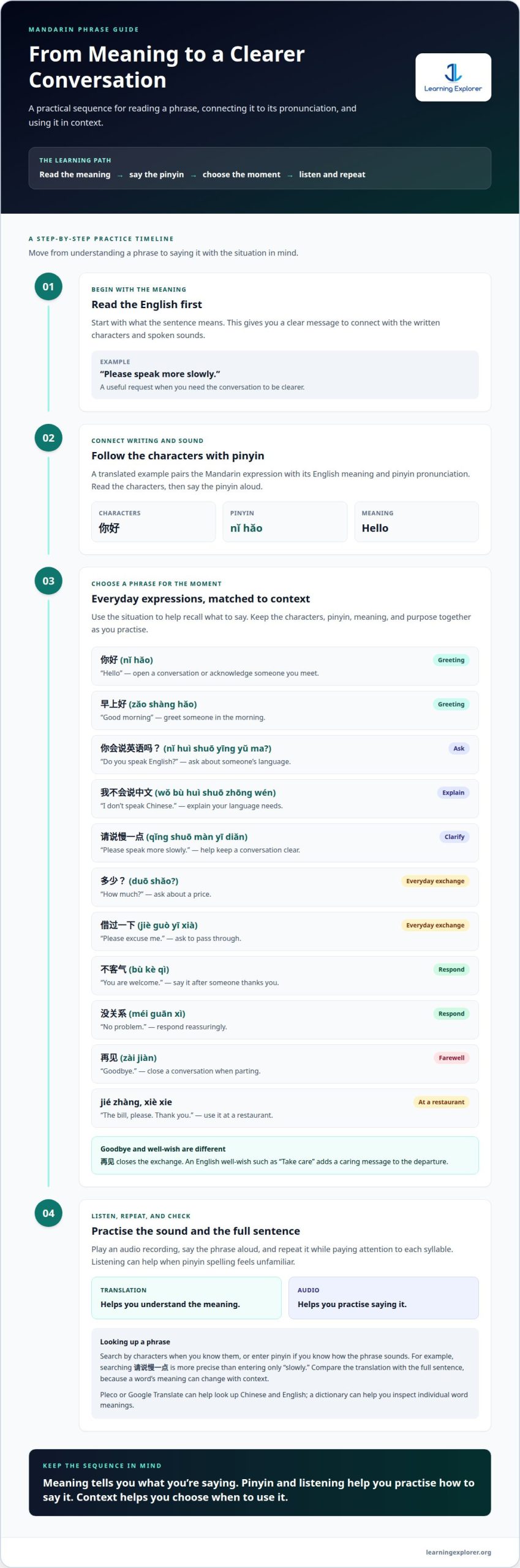
A translated example sentence pairs a Mandarin expression with its English meaning and pinyin pronunciation. This format helps you connect the written characters, spoken sounds, and intended message.
Use these everyday examples as a starting point. Read the English meaning first, then say the pinyin aloud. To practise a more natural sound, listen to a recording and repeat the phrase, paying attention to each syllable.
- 不客气 (bù kè qì) means “You are welcome.” Use it after someone says thank you.
- 我不会说中文 (wǒ bù huì shuō zhōng wén) means “I don’t speak Chinese.” It helps explain your language needs.
- 你会说英语吗? (nǐ huì shuō yīng yǔ ma?) means “Do you speak English?” Use it to ask about someone’s language.
- 请说慢一点 (qǐng shuō màn yī diǎn) means “Please speak more slowly.” It can help keep a conversation clear.
- 多少? (duō shǎo?) means “How much?” Use it when asking about a price.
- (jié zhàng, xiè xie.) means “The bill, please. Thank you.” It’s useful at a restaurant.
- 没关系 (méi guān xì) means “No problem.” Use it to respond reassuringly.
- 借过一下 (jiè guò yī xià) means “Please excuse me.” Say it when asking to pass through.
A Chinese-English dictionary or translation app can help you find meanings, pinyin, and examples of usage. Search by characters when you know them, or enter pinyin if you know how the phrase sounds. For instance, searching “请说慢一点” is more precise than entering only “slowly.” Compare the suggested translation with the full sentence, since a word’s meaning can change with context. Tools such as Pleco or Google Translate can help you look up Chinese and English, while a dictionary can make individual word meanings easier to inspect.
Audio recordings pair written phrases with pronunciation you can hear. Play a phrase such as “不客气,” then repeat it aloud and compare your rhythm with the recording. Listening is especially useful when pinyin spelling feels unfamiliar. A translation gives you the meaning; audio helps you practise saying it.
Common Chinese English grammar mistakes include leaving out English articles, as in “I bought book” instead of “I bought a book,” and using Chinese-style word order. Check whether the sentence needs an article or a helping verb, or a different subject-verb order.
In Singapore, Chinese English can describe English shaped by Chinese languages and local multilingual speech. People may move between English, Mandarin, and Chinese dialects in conversation, but usage varies by speaker and setting.
English words borrowed from Chinese languages include “tofu,” “feng shui,” “kung fu,” “wok,” “dim sum,” and “ginseng.” Their origins include Mandarin, Cantonese, and Hokkien, so a familiar English word may reflect different Chinese-language histories.
Farewells and well-wishes
再见 (zài jiàn) means “Goodbye” in Mandarin. Use it to close a conversation, whether you expect to meet the person again or simply want to part politely. It’s a clear, practical farewell without a separate well-wish.
A well-wish adds a kind thought to a goodbye, such as “Take care” or “Have a good day.” These English phrases do more than mark the end of a conversation; they also show consideration for the person leaving. Keep the distinction in mind: “Goodbye” closes the exchange, while a well-wish adds warmth.
For a simple spoken exchange, you could say “再见 (zài jiàn)” as you leave. To express a specific wish in Mandarin, learn that phrase separately rather than assuming every English farewell has a direct equivalent. This keeps your meaning clear and helps you avoid combining words you haven’t learned.
Use the phrase in context. After a brief chat with a neighbour, “再见” signals that you’re leaving. At the end of a longer conversation, you can thank the other person in English, then use “再见” to close. The order makes the farewell easy to follow, even if you speak only a little Mandarin.
- 再见 (zài jiàn): Say it when you’re parting. Remember the pinyin alongside the characters to connect the written phrase with its pronunciation.
- “Good bye”: Use this English meaning to recall the phrase’s basic function. It’s a farewell, not a general greeting or a thank-you.
- “Take care”: Use this English well-wish when you want your goodbye to sound more personal. It adds a caring message to the departure.
Practise with a short routine: read 再见, say “zài jiàn,” then recall “Goodbye.” Repeat the sequence in a realistic moment, such as ending a conversation before leaving a café. This links the phrase to an action instead of leaving it as an isolated vocabulary item.
Pronunciation practice also benefits from listening and repetition. Say “zài jiàn” slowly, then repeat it at a natural pace. Keep the English meaning in mind, but don’t substitute English sounds for the Mandarin syllables. Pairing the sound with the situation helps you recall the phrase when a conversation ends.
In Singapore, people may use English and Mandarin in different conversations. Choose the farewell that fits the language you’re using, and keep “再见” ready for a Mandarin exchange. A simple, well-timed phrase can close the interaction clearly without turning a brief goodbye into a complicated sentence.
Greetings and introductions
你好 (nǐ hǎo) means “Hello” in Mandarin. Use it to open a conversation or acknowledge someone you meet. Pair the characters with pinyin as you practise, connecting the greeting to its spoken form. In Singapore, it can start a brief Mandarin exchange at work, in a shop, or among neighbours.
早上好 (zǎo shàng hǎo) means “Good morning.” Use it to greet someone in the morning. It gives your opening a time-specific tone, while 你好 works as a general hello. To practise, say each phrase aloud and notice how the pinyin helps you remember its pronunciation.
你好吗? (nǐ hǎo ma?) means “How are you?” Use it after a greeting to ask about someone’s well-being. A simple response is 我很好 (wǒ hěn hǎo), meaning “I’m fine.” Together, these phrases form a short exchange: greet the person, ask how they are, then respond.
For example, one speaker can say “你好。你好吗?” The other can answer “我很好。” This gives you a short conversational pattern to rehearse. Practise the question and response together rather than memorising each phrase alone. The sequence helps you recall what to say after the first hello.
欢迎 (huān yíng) means “Welcome.” Use it when receiving someone or inviting them into a place. It serves a different purpose from 你好: one welcomes a person, while the other greets them. Keep the distinction in mind when choosing a phrase for a visit or arrival.
很高兴见到你 (hěn gāo xìng jiàn dào nǐ) means “Pleased to meet you.” Use it when meeting someone for the first time. In an introduction, greet the person with 你好, say your name in English, then add this Mandarin phrase. That order keeps the exchange clear and friendly.
“Long time no see” is an English expression used when meeting someone again after an absence. A calque translates the parts of an expression into another language. Use “long time no see” when meeting someone again after an absence. It’s an English phrase, not a Mandarin greeting to pronounce as written.
Practise with a simple routine: choose a situation, select its phrase, then say it aloud. For a morning meeting, try 早上好. For a first introduction, use 很高兴见到你. For reconnecting in English, say “long time no see.” Matching each expression to a specific moment makes it easier to recall naturally in Singapore conversations.
欢迎 (huān yíng) means “Welcome,” while 很高兴见到你 (hěn gāo xìng jiàn dào nǐ) means “Pleased to meet you.” As you practise, connect each expression to its purpose: one is for receiving someone, and the other is for meeting someone for the first time.
Try saying each phrase in a short imagined exchange, leaving a pause before responding. You can also practise switching between them as the situation changes, so the words come to mind when they fit. Speaking them aloud and recalling the pinyin can help you rehearse a smooth, friendly opening without blending a welcome with an introduction.
What is the difference between Chinese English and Chinglish?
Chinese English is English shaped by contact with Chinese languages, including Mandarin. The term can describe a range of language features, not one fixed way of speaking. A speaker might use familiar English vocabulary while reflecting Chinese patterns in sentence structure, pronunciation, or emphasis. These features vary between individuals and situations.
Chinglish is an informal label often applied to English translated too literally from Chinese or phrased unnaturally in a particular context. The label can sound dismissive, so describe the specific wording instead. For example, “Open the light” may reflect a direct translation, while “Turn on the light” is the usual English phrasing.
The key difference is how people use the labels. “Chinese English” can refer broadly to language shaped by Chinese influence, while “Chinglish” often points to an individual phrase considered nonstandard or awkward. Neither label tells you by itself whether a speaker’s whole conversation is clear or effective.
Consider the example “I very like it.” The intended meaning is clear, but standard English usually places “really” before “like”: “I really like it.” This illustrates how word choice and placement can differ. It doesn’t mean every Chinese-speaking learner will make the same choice.
A calque is an expression formed by translating the parts of a phrase into another language. The English expression “long time no see” is a calque from Mandarin 好久不見 (hǎojiǔbùjiàn). Unlike an accidental error, a calque can become an established expression that English speakers understand and use.
Singapore adds another useful distinction. Singlish is an informal name for local Singapore English, shaped by the country’s multilingual setting. It is not simply another name for Chinese English or Chinglish. A Singaporean speaker may use local expressions in one conversation and standard English in a formal email.
To describe a phrase accurately, follow three steps:
- Identify the example, such as “Open the light.”
- Explain the issue, such as a direct translation of the verb.
- Offer the intended phrasing: “Turn on the light.”
This approach focuses on meaning rather than judging a speaker. In Singapore, whether a phrase fits can depend on the audience and setting. “Can, can” may work as an informal confirmation between familiar speakers, while “Yes, I can” suits a more formal exchange. Context helps distinguish local usage, Chinese influence, and wording that needs revision.
What are examples of loanwords from Chinese used in English?
A loanword is a word adopted from another language. English has words with Chinese-language origins, but they didn’t all follow the same route. Some came through Mandarin, Cantonese, or Hokkien. Others passed through an intermediary language or translated an expression’s meaning. A Chinese English word can enter English through borrowing or translation, so its history isn’t always apparent from its spelling alone.
- Tofu is an English word transmitted through Sino-Japanese. It comes from 豆腐, romanised in Japanese as tōfu. Its route shows how a word written with Chinese characters can reach English through Japanese.
- Feng shui is an English term from Mandarin 風水. Its Mandarin romanisation is fēngshuǐ. The English spelling offers a familiar written form of the Mandarin term.
- Kung fu is an English term from Cantonese 功夫. English uses it collectively for Chinese martial arts. Its source is Cantonese, rather than Mandarin.
- Wok is an English word from Cantonese 鑊. Its Cantonese romanisation is wok6. The spelling reflects a Cantonese form that became established in English.
- Kowtow comes from Cantonese 叩頭, romanised as kau3 tau4, meaning “knock head.” In English, “kowtow” can refer to excessive submission. The word carries a figurative meaning beyond its literal source.
- Ginseng comes from Hokkien 人參, romanised as jîn-sim. It demonstrates that English words with Chinese-language roots can come from Hokkien, not only Mandarin or Cantonese.
- Dim sum comes from Cantonese 點心, romanised as dim2 sam1. Its familiar English spelling represents the Cantonese phrase.
- Wushu comes from Mandarin 武術, romanised as wǔshù. This term entered English from Mandarin, unlike “kung fu,” which came from Cantonese.
- Chopsticks comes from Chinese Pidgin English “chop chop.” Its history follows a different path from direct borrowing from Mandarin or Cantonese.
- Brainwash is a calque of Chinese 洗腦, literally meaning “wash brain.” A calque translates the parts of an expression instead of adopting its sound.
These examples show why tracing a Chinese English word means looking beyond its modern spelling. “Wok” reflects Cantonese, while “wushu” comes from Mandarin; “tofu” travelled through Japanese. “Brainwash” represents translation, not sound-based borrowing. Compare each term’s source language and route to see how words carry different histories into English. This distinction also helps separate a loanword from a phrase shaped by direct translation.
Kung fu is a reminder that a borrowed term may function as a broad label in English: it comes from Cantonese 功夫 and is used collectively in English to describe Chinese martial arts. The example shows why it’s useful to consider a word’s source and use separately. Its point of entry can differ from how English speakers apply it, so identifying its origin doesn’t fully explain its role in English.
A separate historical detail concerns Chinese pickled-fish-and-spice concoctions called kôe-chiap or kê-chiap, which date to the 17th century. The alternative forms are a reminder that names can appear in more than one spelling. Keeping this detail distinct from the routes described for other terms avoids assuming that every Chinese-associated expression arrived in English in the same way. The forms and the date are useful details in their own right, without treating them as interchangeable with the Cantonese and Mandarin examples above.
Learning Explorer: Conversational English Course
Learning Explorer offers a Conversational English Course for learners who want to practise speaking beyond memorised phrases. It can be a useful next step if you’re building confidence with everyday conversations, clearer wording, or natural responses in Singapore. For workplace communication, the Business English Course focuses on professional English needs.
If you’re also learning Mandarin, the Conversational Mandarin Course can help you develop spoken skills alongside your English practice. Choose the course that matches the situations you want to handle, such as meeting people, joining conversations, or communicating at work. Regular practice can help turn vocabulary knowledge into more fluent communication.
Contact Learning Explorer to discuss which course best fits your learning goals.
Turn useful phrases into confident conversation
Knowing a Chinese English word is a starting point; using language comfortably takes practice in real conversations. Choose a situation you want to handle more easily, then build the vocabulary and speaking habits to support it. Learning Explorer offers a Conversational English Course, a Business English Course, and a Conversational Mandarin Course for different communication goals.
Whether you’re developing everyday fluency or preparing for workplace exchanges, a clear learning focus can help you take the next step with purpose. Contact Learning Explorer to learn more about the course that fits your goals. Keep practising, stay curious, and let each conversation build your confidence.
Frequently Asked Questions
What does “Chinese English” mean?
“Chinese English” generally describes English influenced by Chinese languages or communication between Chinese and English. The term can refer to patterns in pronunciation, vocabulary, or phrasing, and its meaning depends on context. It doesn’t automatically mean a speaker’s English is incorrect. In Singapore, multilingual speakers may adapt their language to different settings, from casual conversations with friends to formal workplace discussions.
What are common Chinese English words and their meanings?
Useful Mandarin signs and expressions include 入口 (rù kǒu), “Entrance”; 出口 (chū kǒu), “Exit”; 厕所 (cè suǒ), “Toilets”; and 抱歉 (bào qiàn), “Sorry.” These are Mandarin words or phrases with English meanings, rather than English words borrowed from Chinese. Learn the characters alongside the pinyin and meaning. This makes each phrase easier to recognise on a sign or use in conversation.
How can I improve English as a Chinese speaker?
Build a short daily routine around real communication. Choose a situation, such as introducing yourself at work, and write a few sentences you might use. Read them aloud, record yourself, then listen for unclear words or pauses. Practise the same exchange with a conversation partner and ask for feedback on one specific point, such as verb tense or word order. Reusing corrected phrases in new situations helps make them more natural.