You don’t have to erase your accent to speak more clearly. English pronunciation and accent neutralisation in Singapore can focus on making sounds, word stress and rhythm easier to follow while preserving your individual voice and connection to local identity.
If you sometimes repeat yourself or feel less confident speaking at work, targeted pronunciation practice can help you identify what to work on and build clearer habits. Accent modification may suit people who want to be better understood in conversations, presentations or other speaking situations, whether they’re learning English or already speak it fluently. This guide explains how practice develops pronunciation, pace and intonation, and why the aim can be clear, effective speech rather than sounding like someone else. It also explores how Standard Singapore English can support intelligibility while leaving room for the Singaporean character in your voice.
Key Takeaways
- Practise word stress and rhythm to help listeners follow your meaning more easily.
- Build pronunciation skills with focused sound practice, listening and regular use in real conversations.
- Consider accent modification if you want clearer speech for work or everyday communication, not a different identity.
- Use recording and feedback to notice patterns in your pace, intonation and pronunciation.
- Understand how Standard Singapore English can support intelligibility while your local voice remains part of how you speak.
1. English vocabulary stress patterns and rhythm
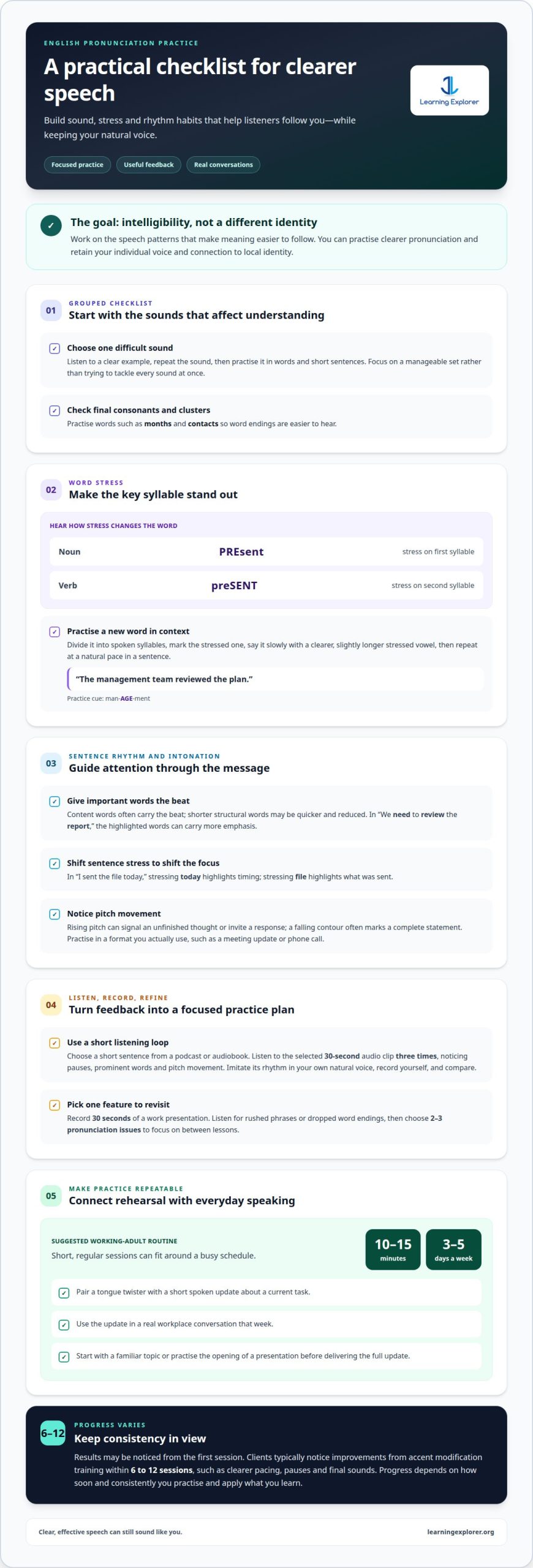
Clear speech depends on more than forming individual sounds. English listeners also use stress, rhythm and intonation to follow meaning. Word stress gives one syllable greater prominence, often through extra length, volume or pitch. In PREsent, the first syllable is stressed when the word is a noun. In preSENT, the second syllable is stressed when it is a verb. Shifting that emphasis can make a familiar word harder to recognise, even when its consonants are accurate.
Practise the stress pattern when learning each difficult word. First, divide it into spoken syllables. Then mark the primary stress with a line or capital letters: man-AGE-ment. Say the word slowly, making the stressed vowel clearer and slightly longer. Repeat it at a natural pace, then use it in a sentence such as, “The management team reviewed the plan.” This connects the vocabulary pattern to real communication instead of leaving it as an isolated sound exercise.
English is commonly described as stress-timed: prominent content words carry the beat, while shorter structural words are often reduced. In “We need to review the report,” a speaker may emphasise need, review and report. Words such as to and the may be quicker, with a reduced vowel like the neutral schwa in about. This contrast helps the sentence flow. Giving every word equal weight can make the rhythm feel laboured and obscure the key message.
Sentence stress works alongside word stress, while intonation shapes the movement of pitch across a phrase. Compare “I sent the file today” with emphasis on today or file. The first highlights timing; the second highlights what was sent. Rising pitch can signal an unfinished thought or invite a response, while a falling contour often marks a complete statement. Context matters, so practise a phrase in the format you actually use, such as a meeting update or phone call.
Use a short routine with new vocabulary: mark the stressed syllable, exaggerate its vowel during oral rehearsal, then read the whole sentence aloud. Keep unstressed syllables lighter instead of making every sound equally strong. For example, practise “Please confirm the delivery date” with emphasis on confirm and date, then shift the stress to delivery to change the focus. These patterns make speech easier to follow without requiring you to remove your accent.
2. Pronunciation training for beginners and advanced speakers
Pronunciation coaching results are typically seen in the first session, though progress depends on how soon and consistently you practise and apply what you learn. Clients typically notice improvements from accent modification training within 6 to 12 sessions, such as clearer pacing, pauses and final sounds.
Start with the sounds that most affect understanding. A beginner can isolate a difficult sound, listen to a clear example, then repeat it in words and short sentences. Learners can practise unfamiliar English sounds separately before using them in words and sentences. Next, work on final consonants and clusters in words such as months and contacts. Keep practice focused rather than trying to tackle every sound at once.
Advanced speakers can refine speech beyond individual sounds. They might work on linking words smoothly, varying intonation, or making a presentation easier to follow. Record 30 seconds of a work presentation and listen for rushed phrases or dropped word endings. Then choose 2–3 pronunciation issues to focus on between lessons. This turns general feedback into a practical plan for the next conversation, meeting or briefing.
Listening builds a useful model for practice. Select a short sentence from a native English speaker in a podcast or audiobook, and listen to the chosen 30-second audio clip three times. Notice where the speaker pauses, which words stand out and how the pitch moves. Then imitate the sentence, keeping its rhythm while using your own natural voice. Compare your recording with the original and choose one feature to practise again.
For working adults, short, regular sessions can fit around a busy schedule. Practise for 10–15 minutes, 3–5 days a week, instead of relying on one long session. A simple routine might pair a tongue twister with a short spoken update about a current task. Use the update in a real workplace conversation that week. Applying a new skill in a practical setting helps connect careful rehearsal with everyday speaking.
Children and non-English speakers can also benefit from targeted practice, with activities suited to their current language level. A child might repeat a short rhyme, while a new English learner practises useful phrases for introductions. In either case, clear feedback should identify one manageable next step. Friends, teachers or language partners can offer constructive feedback and help learners notice how their speech sounds to another listener.
Confidence grows when speaking practice moves from rehearsal into real conversations. Begin with a familiar topic, such as explaining a daily routine, then try a short question-and-answer exchange. If a presentation feels difficult, practise its opening aloud before delivering the full update. For ongoing, structured English speaking practice, choose activities that connect pronunciation work with the conversations you want to handle more clearly.
3. Who Should Consider Accent Modification?
Accent modification may help when your speech sounds clear to you but listeners often ask you to repeat key details. A Singapore professional might notice this during client calls, team briefings or presentations. English learners may also want focused support with sounds that differ from those in their first language. English pronunciation and accent neutralisation in Singapore can focus on improving intelligibility without judging how someone speaks. Consider training when a specific speech pattern makes an important exchange harder to manage.
Begin by defining the communication problem, not by trying to change everything. If a colleague misunderstands a project handover, for example, the goal might be to make instructions easier to follow. If a customer struggles to understand your name or a product term, the focus could be clearer articulation. Recording your speech can help you notice clarity, pace, intonation and mispronunciations, then choose which issue matters most in your everyday setting.
A first pronunciation coaching session can include a general speech and language analysis, followed by practice on the areas identified. This gives the learner a starting point and turns observations into practical goals. For instance, if a learner’s questions sound like statements, practice might explore pitch movement in questions such as, “Could you explain that step?” The analysis should guide the learning goal, rather than treating every difference as an error.
Common habits can affect clarity even when a speaker knows the right words. Someone may blend words together, speak too softly at the end of a sentence, or use the same intonation for a question and a statement. In “I’ll send the revised schedule,” unclear word boundaries can make the message harder to follow. Feedback can identify which habit affects understanding, then guide practice using phrases from the learner’s actual conversations.
Accent reduction may suit adults who want greater control over how their speech is understood at work, in social settings or during public speaking. English pronunciation and accent neutralisation in Singapore can also be a focus for learners with a specific communication goal. Useful targets include making questions easier to recognise, saying names clearly, or explaining a process in a steady, understandable way. These goals improve control without requiring anyone to imitate another person.
Phonetic guidance can help a learner understand how mouth position shapes an unfamiliar sound. For example, someone who mixes up the vowel sounds in ship and sheep can practise hearing and producing the contrast, then use both words in original sentences. A role-play can apply that distinction in context, such as confirming which item a customer requested. Choose a real speaking situation to make practice relevant and measurable.
4. Will accent reduction make me sound like a different person?
No. Accent reduction can focus on clearer, more intelligible speech without removing a person’s accent or individual voice. In Singapore, a useful goal may be Standard Singapore English: clear, fluent-sounding speech with correctly stressed words and a hint of Singaporean-ness. Training can reduce features of a foreign accent without eliminating them.
General pronunciation training and accent reduction overlap, but their focus can differ. A learner may work on a difficult sound, such as “th” in think, without seeking broader accent changes. Accent training may also address speech patterns, intonation, rhythm and stress. Both approaches can support clarity; the right focus depends on whether a learner wants to refine particular sounds or communicate more effectively across speaking situations.
Pronunciation coaching should connect practice with a real communication goal. For example, someone preparing for international presentations might want listeners to follow key terms, transitions and conclusions. A coaching session can identify patterns in a speech sample, practise a targeted change, then apply it to a presentation excerpt. Feedback should be specific, such as pointing out a rushed phrase or unclear ending, rather than asking someone to imitate another speaker entirely.
To choose an English pronunciation coach or course in Singapore, look for learning that addresses your own speech goals, includes specific feedback and gives you opportunities to practise real conversations. A good fit should make the focus clear, whether that is pronunciation, intonation, pacing or presentation delivery. Consider whether the practice connects to situations you actually face, such as a team update or client discussion.
In Singapore, the cost of English pronunciation and accent coaching classes depends on the learner’s goals, lesson format and amount of coaching, and is given after a quote request. Those factors shape the scope of instruction: work on a few recurring speech patterns differs from support for a series of presentations. Focus first on what you need to communicate more clearly, then consider the learning format that fits that goal.
Accent-reduction tutoring can be useful when a learner wants focused attention on particular speech patterns. In a class, a short role-play can reveal whether a request sounds clear, while feedback guides the next attempt. For example, practise asking for clarification, then repeat the exchange with more deliberate pacing and intonation. This keeps the learner’s natural voice while building greater control over how speech comes across.
5. Standard Singapore English and local accent identity
Clearer pronunciation doesn’t require giving up a Singaporean voice. Training can aim for Standard Singapore English: clear, fluent-sounding speech with correctly stressed, intelligible words and a hint of Singaporean-ness. That target connects effective communication with identity, rather than treating local speech as something to remove. For adults and students, the practical goal is greater control over how speech sounds in different settings.
Accent alone is not a universal requirement across Singapore workplaces, schools and professional settings. Communication needs differ by role and situation, so focus on being understood in the settings that matter to you. For example, an adult leading an international presentation may want key points to sound clear, while a student might prioritise answering questions in class.
Local identity also shows in how people adapt their language to context. A relaxed conversation with friends may sound different from a formal briefing to colleagues. That doesn’t mean one voice is wrong. Instead, learners can practise adjusting pace, pronunciation and formality to suit the audience while keeping familiar features of their Singaporean speech.
A practical way to set a goal is to choose one real speaking situation. First, identify what listeners need to understand, such as a project update or a question in class. Next, select a specific focus, such as clearer word endings or more deliberate pacing. Then practise the same message in conversational and formal formats. This approach makes progress relevant without asking learners to copy an international accent.
Adults returning to a course after years of using English at work may have established speech patterns. Students may be building confidence in presentations or group discussions. In both cases, a useful learning target is observable: explain a process clearly, make a question easy to follow, or deliver a short update at a steady pace. Feedback can address that target while respecting each speaker’s voice and background.
Singapore English can be both locally grounded and clear to a wider audience. For instance, practise introducing a local project to colleagues from different backgrounds. Keep the natural voice, then adjust any sound or phrase that makes the key message harder to follow. That balance, rather than accent erasure, is the central takeaway for pronunciation training in Singapore. Build confidence in spoken English through practice that supports clear communication and local identity.
Learning Explorer
Learning Explorer helps learners build practical English skills through its Conversational English Course and Business English Course. These courses support clearer spoken communication in everyday conversations and professional settings, including meetings and presentations.
If you want to practise English in context, choose the course that best matches where you use the language. Conversational English focuses on everyday communication, while Business English aligns with workplace situations. Both provide a learning pathway to strengthen how you express ideas while keeping your own voice and identity.
For more confident English communication in Singapore, contact Learning Explorer to discuss your learning goals.
Choose a speaking goal that feels like your own
Your next step can be small and personal: choose one conversation where you want your ideas to come across more clearly. It might be explaining a decision, contributing in a meeting, or speaking with someone unfamiliar. Keep your Singaporean identity in the goal. The purpose of practice isn’t to borrow another voice, but to make your own easier to understand.
For English pronunciation and accent neutralisation in Singapore, a useful learning plan starts with the situations you face and the speech patterns you want to refine. Decide what matters most, such as speaking clearly during work discussions or feeling more at ease in everyday conversations. That focus can keep learning relevant while leaving room to develop your own communication style.
Learning Explorer can help you continue developing communication skills through language learning. If you’re ready to discuss a learning direction that fits your needs, contact Learning Explorer. Take the next step at a pace that respects both your goals and your voice.
Frequently Asked Questions
Who Should Consider Accent Modification?
Consider accent modification if listeners regularly misunderstand words or ask you to repeat key details. It may be useful when preparing to lead meetings, explain technical information or speak with international clients. You don’t need to aim for a different-sounding voice. Start by identifying one challenging situation, then decide whether clearer pronunciation, pacing or intonation would help you communicate your message.
👉 How can I improve my English pronunciation?
Improve your English pronunciation by practising a specific sound or phrase, then using it in a real exchange. For example, choose a sentence you might say during a team discussion, record it, and listen for unclear words. Repeat the sentence, changing one thing at a time. Short, focused practice makes it easier to notice what changes and carry that skill into everyday speaking.
Will accent reduction make me sound like a different person?
No. Accent reduction can make speech easier to understand without asking you to replace your identity or natural voice. You might refine how you say a key name or make a presentation more deliberate while keeping your familiar way of speaking. A helpful learning goal focuses on communication, such as making a request clear, rather than copying a particular person or accent.
What is Pronunciation Coaching?
Pronunciation coaching is guided practice to make spoken words clearer and more effective. It can focus on an individual sound, a word that causes confusion, or how speech comes across in a particular setting. For example, a learner might practise saying a colleague’s name clearly before introducing them at a meeting. Feedback connects the practice to a specific communication goal.
What are the most effective methods to improve English pronunciation and clarity?
Use a mix of focused repetition, careful listening and real speaking practice. Choose a short line from a work conversation, listen for how its words connect, then say it aloud in your own voice. Practise it again in a new sentence rather than memorising only the original line. This helps carry a pronunciation skill into new conversations instead of limiting it to one rehearsed example.
Which English pronunciation or accent coaching courses are available in Singapore?
Learning Explorer offers a Conversational English Course and a Business English Course. The conversational option suits everyday exchanges, while the business course fits learners who want to develop English for workplace communication. Choose based on where you want to use English, such as social conversations or contributing in a meeting. A course offers a structured way to keep developing your spoken language skills.
Are there one-to-one, group, online, and in-person accent coaching options in Singapore?
Learning Explorer offers in-person and online classes, with private and group learning formats. These options can suit different routines and learning preferences. A private format allows attention to an individual learning focus, while group classes create opportunities to practise exchanges with other learners. Consider which setting helps you speak more often and use English in situations you want to handle confidently.
How do Singapore English and Singlish pronunciation differ from internationally understood English?
Singapore English includes speech choices used in more formal or broadly understood communication, while Singlish is a familiar local way of speaking in informal settings. The difference isn’t a measure of intelligence or identity. A speaker may choose different expressions depending on the audience, just as they might adjust their tone for a presentation versus a chat with friends. The aim is to communicate clearly while respecting local speech.