An after-work English course in Jurong Business Park can fit around your working week, but progress depends on more than class timing. With regular practice, you may notice small improvements in workplace English after a few weeks; stronger gains in speaking confidence and writing accuracy often take a few months.
It’s understandable to want a schedule that won’t add pressure to an already full day. The right format, a practical location and a course duration suited to your goals can make it easier to learn consistently.
This guide explains what to consider when comparing schedules, class formats and locations, and how course duration can shape progress. You’ll also learn how workplace-focused English lessons can support clearer conversations, more confident participation and stronger written communication.
Key Takeaways
- Choose a timetable that fits your working week so regular practice is easier to sustain.
- Class format and opportunities to speak can shape how much you practise during each lesson.
- Compare in-person and live online learning based on your routine and preferred study setting.
- Coaching can be structured around 10, 20 or 30 hours, with the pace depending on session frequency.
- Regular lessons may bring small improvements within four to six weeks, while stronger workplace communication can take longer to develop.
Course timetables and flexibility for work schedules
Some community clubs in Jurong East offer basic English classes, giving working adults a local option. Before registering, be ready to share your contact details, current English ability, learning goals and preferred schedule. This information can help guide class placement.
When comparing an after-work English course in Jurong Business Park, consider lesson timing alongside your commute, work demands and practice goals. A timetable that makes regular attendance practical can help you build English skills around your professional responsibilities.
Flexible Scheduling for Working Professionals
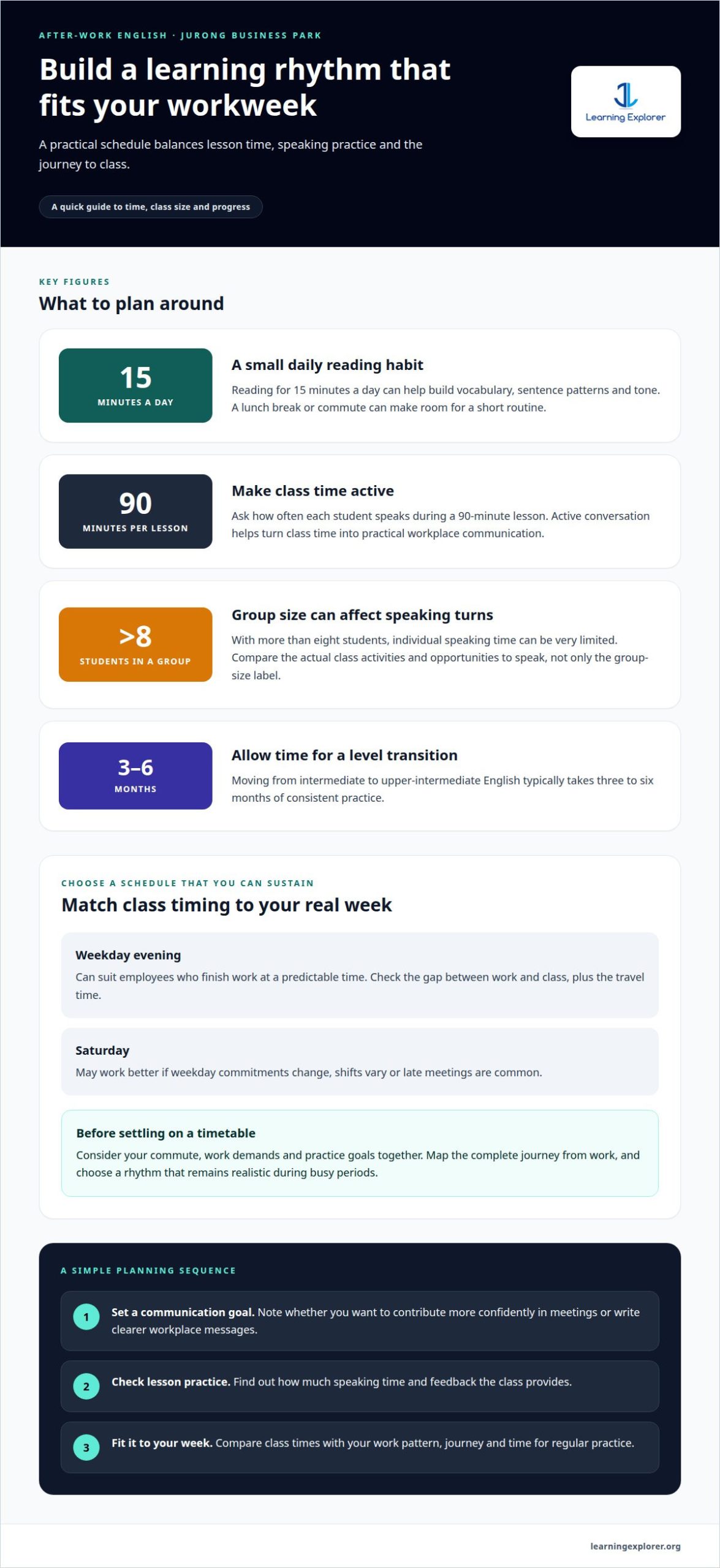
Flexibility means finding lessons that fit your real workweek, not just choosing a convenient start time. Check whether classes follow a fixed weekly schedule, how long it takes to travel from work and whether lessons leave room for speaking practice. If late meetings are common, for example, a Saturday session may suit you better than a weekday evening.
Course Duration and Timetable Options
Course duration and weekly frequency shape how learning fits into your calendar. Moving from intermediate to upper-intermediate English typically takes three to six months of consistent practice. Ask how often each student speaks during a 90-minute lesson, since active conversation helps turn class time into practical workplace communication. Regular attendance also creates a rhythm for receiving feedback and developing listening skills.
Evening and Saturday Classes
Evening lessons can suit employees who finish work at a predictable time, while Saturday classes may work better for people with changing weekday commitments. Compare the full timetable, including travel time and the gap between work and class. If a session starts too soon after your workday, it may be harder to attend consistently.
Schedule reading practice as well as lessons. Reading for 15 minutes a day can help build vocabulary, sentence patterns and tone. A short daily routine can fit into a lunch break or commute, while class time can focus on conversation, listening and feedback. Choose a practice rhythm that remains realistic during busy work periods.
Location matters as much as class hours. If you work in Jurong Business Park, weigh a nearby venue against a convenient route home or a classroom close to an MRT station. Map the complete journey from work, then consider how evening traffic or a longer workday could affect your arrival. The most practical timetable is one you can attend regularly.
Before registering, write down your learning goals, current English challenges and preferred class times. For instance, note whether you want to contribute more confidently in meetings or write clearer workplace messages. This preparation makes the registration conversation more focused and helps connect your schedule with the skills you want to practise.
Small-group classes with weekday and weekend options
In Singapore, adult English learners can choose between group and individual lessons. Structured classes can develop speaking skills through guided conversation, while private lessons offer a more individual focus. Compare how each format supports the practice you need for meetings, workplace messages and everyday situations.
Small groups create opportunities to hear different speakers and respond in conversation. Class size matters: with more than eight students, individual speaking time can be very limited. A smaller group may allow more turns, peer interaction and direct feedback. When comparing options, look at the learning activities, not just the label “small group.”
Private academies may organise adult classes by language ability or learning objective. The Common European Framework of Reference for Languages describes levels such as A2, B1 and B2. A structured placement process can use a learner’s conversation, listening comprehension, reading and writing to identify strengths and gaps. The result helps match lesson content to a practical starting point.
Are there trial classes, placement tests, or course certificates? Trial lessons are common at English tuition centres, and an initial assessment can help identify a suitable level. Some programmes provide a Certificate of Achievement after learners complete at least 20 hours; the certificate depends on the programme.
Weekday and weekend classes suit different routines. A weekday class may work if your workday ends consistently, while a weekend lesson can help if you have changing shifts or late meetings. Consider whether the format offers enough speaking practice for your needs. If you want to contribute in team discussions, look for opportunities to practise complete responses.
Course fees depend on the class format, course duration and materials. Compare what each course includes, such as lesson hours, group or individual instruction, and learning resources. An hourly rate alone does not show how much guided speaking practice or feedback you’ll receive. Assess the full course against your schedule and workplace goals.
To choose a suitable class, connect three decisions: your current English level, the communication skill you want to develop, and the time you can attend consistently. A learner who needs clearer email writing may prioritise structured writing feedback; someone aiming to speak up in meetings may value conversation practice. Explore English class formats as you consider which learning approach fits your goals.
Course locations and learning formats
Some community clubs in Jurong East offer basic English classes. Live online lessons are another option if you can’t attend a physical class.
For travel information, the training center is at 10 Anson Road, level 22, International Plaza, Singapore 079903, directly above Tanjong Pagar MRT. From Jurong Business Park, compare rail and bus routes using your actual starting point, destination and class time. The best route depends on your journey and any transfers.
If you’re based in Jurong East, compare nearby community classes with online lessons or travelling to a central location. Each format affects the time and effort needed to get to class. For example, if you finish work near Jurong Business Park, a live online session may be more practical. If you’re already travelling towards Tanjong Pagar, an in-person lesson may fit your journey.
Location is only one part of the decision. Consider how each format supports your learning goals, especially if you’re a beginner building vocabulary for workplace situations. In-person lessons offer face-to-face conversation and listening practice. Live online classes let you learn with a teacher without travelling to a classroom.
Match the format to the communication skills you need most. If you’re preparing to speak with colleagues, focus on listening, clear responses and everyday workplace vocabulary. If you need to understand instructions, guided practice with common situations may help. These priorities can help you decide whether in-person classes or live online lessons better suit your goals.
Before choosing a classroom, map the journey from your workplace to the venue. Check the nearest MRT station or bus stop, then consider transfers and the time needed to reach the classroom. Learning Explorer is at International Plaza, directly above Tanjong Pagar MRT, which can simplify planning for learners travelling from Jurong East.
Online learning removes the commute, but you’ll still need a reliable time and a quiet setting. Before an after-work lesson, prepare a suitable space and keep your materials ready. For in-person classes, allow for travel time and the walk from the station. Compare these practical details with your work routine before choosing a format.
Whether you choose Jurong East, International Plaza or live online lessons, connect the location with your learning needs. As a beginner, you may value structured vocabulary practice; as a professional, you may prioritise workplace conversation. Choose a setting that makes regular participation practical and gives you time to practise the English you use in daily life.
English coaching packages and durations
Compare English coaching by total lesson hours, weekly pace and workplace skills covered. Business English courses are available in 10, 20 or 30 hours. Choose a commitment that fits your career goals and the time you can consistently set aside. The package length describes instruction time, while the timetable determines how that time fits your calendar.
A 30-hour course can follow two schedules. Two 1.5-hour sessions each week complete the course in 10 weeks. One 1-hour session each week takes 30 weeks. Both provide 30 hours of instruction, but distribute practice differently. A faster weekly rhythm suits learners who can protect regular study time. A slower pace spreads lessons around work demands.
The 10-hour and 20-hour options let learners choose a different total commitment. Consider the communication skill you want to develop and how much guided practice it may need. A focused objective, such as improving grammar in workplace emails, can help shape a shorter learning plan. Broader career communication goals may call for a longer period of practice and feedback.
Business English courses are offered across five levels, from Elementary (A2) to Advanced (C1). These labels help describe language ability and provide a reference when planning learning. A beginner may need stronger foundations in grammar and vocabulary, while an advanced learner may focus on precise workplace expression. The course level and coaching duration answer different questions: current ability and time commitment.
Calendar length also affects how learners build skills between lessons. A 10-week schedule brings sessions closer together than a 30-week plan. Between-session reading, listening and workplace practice can reinforce class learning. For example, a learner can note which meeting phrases felt difficult, then use the next lesson to work on clearer responses. Teachers can use those examples to focus feedback.
Progress in workplace English takes consistent effort. Stronger gains in speaking confidence and writing accuracy often take a few months. A longer course offers more opportunities to practise, receive feedback and revisit challenging language, but the longest option isn’t automatically the right one. Match the course hours and weekly pace to the skills you want to strengthen.
To compare packages, consider three factors: total hours, session frequency and the communication goal. A learner who can attend two 1.5-hour sessions weekly may prefer the 10-week structure for 30 hours. Someone with limited weekly availability may value the one-hour weekly schedule, which takes 30 weeks. Choose a flexible pace that supports steady learning alongside work.
English courses for working adults and professionals
For working adults in Singapore, workplace English can support meetings, customer conversations and written updates. English is widely used in Singapore workplaces, so practical communication matters across many roles. A useful course connects classroom learning to tasks you handle at work. For example, practise summarising a project update aloud, then writing a concise follow-up message.
Set a specific goal before choosing course content. “Improve English” is broad; “explain project delays clearly in meetings” gives lessons a practical direction. Prepare examples from your role, such as answering a client’s question or clarifying an instruction. This helps focus speaking practice and writing feedback on relevant skills rather than disconnected exercises.
Adults often need a manageable practice rhythm alongside work. Regular classes can help build familiarity with workplace language, while short practice between sessions keeps new expressions active. Adults attending weekly English classes typically notice small improvements within four to six weeks. The timeframe describes early progress, not mastery; continued practice supports more confident communication.
Choose learning activities that address mistakes constructively. If you often use unclear verb tenses in emails, review the grammar, revise sample sentences and seek feedback. If you hesitate during discussions, rehearse common responses in pairs or group classes. Connect each activity to a real communication need so the practice is easier to apply at work.
Short workshops and longer courses serve different purposes. A two-day workshop in Singapore can sharpen one workplace English skill, but may not be enough to build confident communication. Focused preparation may help with presentation structure, for example, while broader speaking and writing development calls for continued practice. Match the format to the depth of change you want.
Before enrolling, review the course’s terms for refunds, cancellations and attendance. Check the requirements for cancellation notice, missed lessons, make-up arrangements and refunds, especially if work travel could disrupt your attendance.
Progress depends on your starting level, regular practice, course focus and opportunities to use English at work. If you practise meeting phrases between lessons, you may apply them sooner than if you only attend class. Track a practical outcome, such as making a clear point in a team discussion, then use teacher feedback to plan what to work on next.
Build a learning plan around your role, available time and communication priorities. If workplace conversations are the main challenge, begin with speaking goals; if written updates cause difficulty, focus preparation on writing. Explore workplace English learning options and choose a direction that fits the skills you want to strengthen.
Learning Explorer
Learning Explorer helps working adults connect English learning with their professional goals and schedules. If you’re weighing class formats, coaching duration or workplace communication priorities, its Conversational English Course and Business English Course provide relevant learning paths. The focus might be everyday conversations or clearer communication at work, depending on what you want to practise.
Use the options discussed above to identify your preferred learning format and the skills you want to strengthen. Contact Learning Explorer to discuss which English course best fits your goals and working routine.
Choose a next step that fits your workday
Choosing an after-work English course in Jurong Business Park is an opportunity to build communication skills you can use throughout your career. Start with one workplace situation you want to handle more confidently, such as contributing in a meeting or making a clear request. That goal can guide what you practise and make your learning purposeful.
Learning Explorer offers a Conversational English Course, a Business English Course and a Conversational Mandarin Course. Consider which course best matches your communication priorities and the conversations you want to feel more prepared for. A clear goal gives your learning a meaningful starting point, even if you haven’t mapped out every detail.
Contact Learning Explorer to discuss your learning goals and course options. Take the next step at a pace that works for you, and build toward more confident communication at work.
Frequently Asked Questions
How long does it take to improve workplace English?
With regular practice, adults may notice small changes within a few weeks, while stronger workplace communication can take a few months. Progress depends on your starting point, attendance and opportunities to use English between lessons. Practise summarising a meeting aloud, for example, and note which phrases felt difficult. Bring that challenge to class so you and your teacher can focus on a specific skill.
Can I fit lessons around work, or take them online?
Yes. Online lessons and in-person classes offer working adults different ways to fit learning into a routine. Consider your workday, commute and preferred setting. If your schedule changes, avoiding travel may be useful; if you learn best through face-to-face interaction, a classroom may suit you better. Choose the format that makes regular attendance and practice between sessions practical.
What English course levels and types are available near Jurong Business Park?
English options include conversational learning and Business English, with levels described from Elementary (A2) to Advanced (C1) across five levels. A starting level helps match lesson content to your current ability, while the course type reflects your communication goals. For instance, choose a workplace focus if presentations or professional writing are priorities. A conversational focus may better suit everyday exchanges and confidence speaking with others.
What are the class schedules and lesson durations for evening English courses nearby?
Lesson times and session length depend on the timetable and course format you choose. Plan around your work finish, travel time and the frequency you can maintain. A 30-hour course can be spread across a shorter or longer calendar period, depending on weekly session frequency. Before enrolling, align the schedule with recurring work commitments so attendance remains manageable during busy periods.
How much do after-work English courses near Jurong Business Park cost?
Course fees depend on the learning format, level, duration and materials. Registration or material charges may also apply, so compare the full course package rather than tuition alone. Ask Learning Explorer about pricing for the course you’re considering, so you can understand the cost based on its details rather than relying on a general estimate.
Are courses taught in person, online, or in a hybrid format?
Learning Explorer offers in-person and online classes. Choose the classroom format for face-to-face learning, or online lessons if avoiding travel better suits your work routine. A hybrid arrangement combines both formats, but the available formats described here are in-person and online. Consider your preferred interaction style, study environment and commute before choosing how you want to learn.
How do nearby English schools compare by location, price, class size, and reviews?
Classes with more than eight students offer very limited individual speaking time. Another in-person option is available for comparison.