Your first Korean conversation doesn’t need to be perfect. You might know a few words but still freeze when it’s time to build a sentence. That’s normal: speaking means connecting words, choosing an appropriate level of politeness, and getting comfortable with how Korean sounds.
To speak Korean with less hesitation, practise short exchanges in everyday situations instead of memorising phrases in isolation. This guide shows you how to turn familiar words into useful sentences, practise pronunciation without expecting perfection, and build a manageable speaking routine. Guided lessons can add structure and regular opportunities to practise.
Start with simple introductions and everyday requests, then build towards short conversations. Learning Explorer offers physical classes in City Centre, Jurong East, and Tampines. Its Korean course syllabuses and materials are produced by Seoul National University. Start with one useful exchange, repeat it in context, and build confidence one conversation at a time.
Key Takeaways
- Build spoken Korean through clear sounds, useful vocabulary, sentence patterns, and listening, rather than waiting for perfect grammar.
- Choose practice that fits your level, from shadowing and scripted role-play to language exchanges and guided lessons.
- Use a simple routine to review a phrase, listen to it, say it aloud, and reuse it in context.
- To speak Korean with less hesitation, practise short, realistic exchanges and gradually make them your own.
- Consider structured Korean lessons when you want regular guidance and purposeful speaking practice.
Why Speaking Korean Feels Difficult, and How to Start Anyway
You don’t need perfect grammar to start speaking. Conversation develops as you listen for meaning, choose useful words, put them into a pattern, and make the sounds clear enough to understand. At first, focus on completing one clear exchange rather than aiming for fluency or error-free speech. A pause or correction is part of learning to communicate, not a sign that you aren’t ready.
Written words can feel easier because you can look at them, take your time, and recognise familiar vocabulary. Conversation is different. You have to retrieve words while listening, decide what to say next, and respond in the moment. Recognising a word on a page is useful, but recalling it during a live exchange takes practice of its own.
Korean also requires choices about sentence endings and politeness. The verb often comes at the end of a sentence, so you may need to hold the main action in mind while assembling the rest. Choosing an appropriate level of speech takes attention, too. This overview of Korean honorifics and speech levels explains why formality matters in conversation. You don’t have to master every choice before you begin. Start with a simple, polite exchange and build from there.
What does it mean to speak Korean as a beginner?
A practical first milestone is greeting someone and answering a simple question, such as how you are or what you like. The aim is to make your meaning understandable, not to deliver a long, polished response. Short connected ideas often communicate more than isolated memorised words: answer the question, then add one relevant detail. If you lose a word, switch to a simpler idea you can express.
Progress can include pauses, self-corrections, and unfamiliar vocabulary. If you give a brief answer, notice a gap, and try another way to express yourself, you’re already using conversation skills. The goal isn’t to speak korean perfectly from the start. It’s to keep the exchange moving and make your meaning clearer with practice.
Why do learners freeze when it is time to speak?
In a conversation, several decisions come at once: which word fits, how to arrange the sentence, which ending sounds appropriate, and how to pronounce it clearly. Worrying that a mistake will be embarrassing can make it harder to retrieve words you already know. Freezing is a response to pressure, not a measure of your ability.
Make your response smaller. If explaining a favourite activity feels difficult, state a simple preference and give one reason instead of trying to explain every detail. A clear, short reply gives the other person something to respond to and gives you room to continue. Treat mistakes as information: notice what was hard, try again with simpler wording, and listen for the next cue.
Build the Korean Skills That Make Conversation Possible
A conversation is a chain of small skills working together. You hear a sound, recognise a word, understand how it fits the sentence, then respond with sounds another person can follow. If one link feels shaky, the whole exchange may slow down. That’s why useful speaking practice combines listening, vocabulary, pronunciation, and sentence patterns rather than treating them as separate subjects.
Korean can feel demanding because its structure and sound patterns differ from English. The U.S. Department of State’s Foreign Service Institute language difficulty rankings place Korean among the most challenging languages for English speakers to learn. That context helps explain why progress takes practice, but it doesn’t mean you need to master every skill before you begin speaking.
Use Hangul and pronunciation to make yourself understood
Learn Hangul, the Korean writing system, to recognise how words are written and pronounced. Romanized spellings can serve as a temporary reference, but they may not show Korean sounds consistently. Pair written forms with a reliable audio model: listen to a short phrase, repeat it aloud, then listen again and compare the rhythm and sounds. Aim for clarity, not a perfect accent.
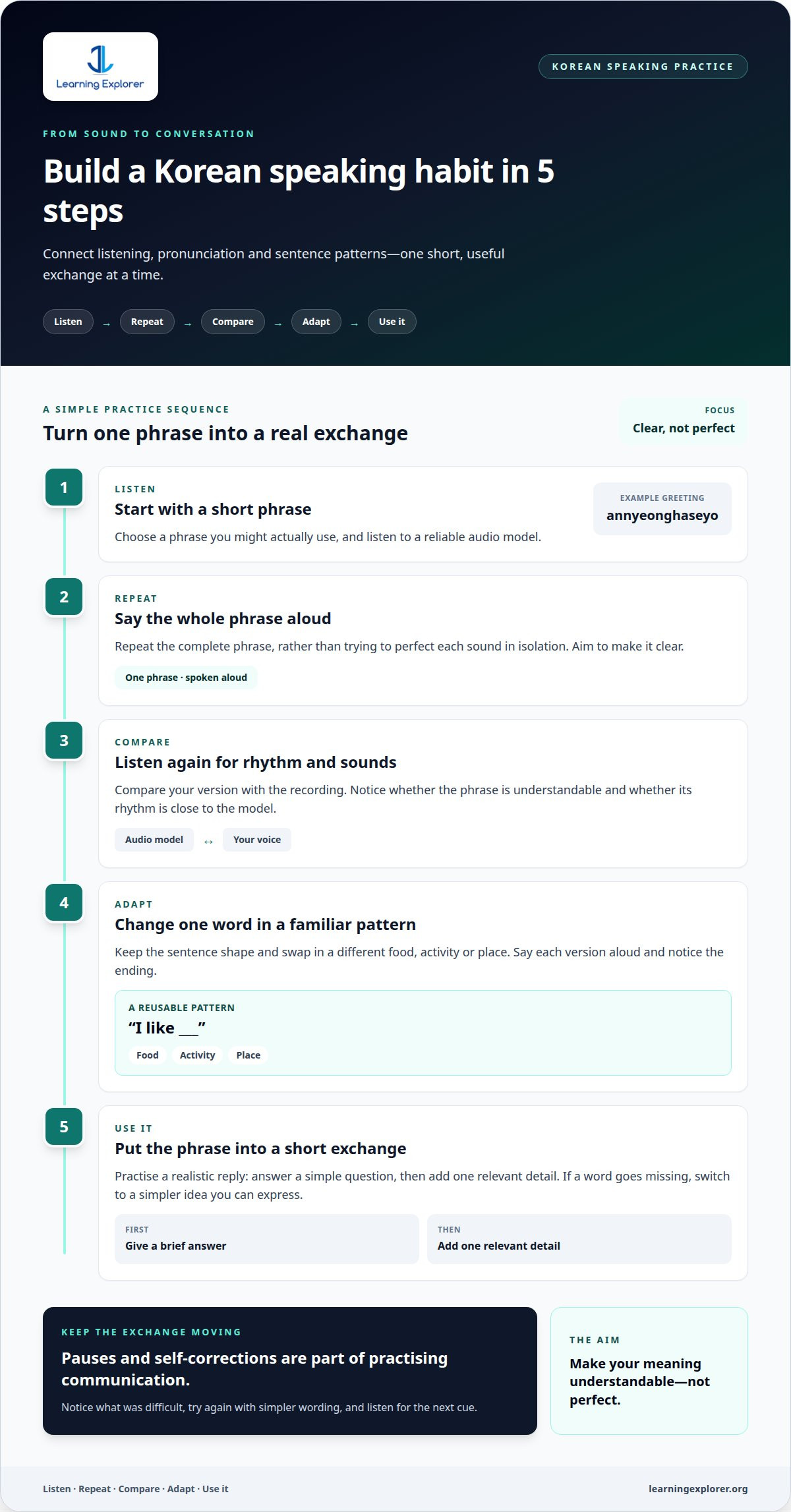
For example, practise the romanized phrase “annyeonghaseyo,” commonly used as a polite greeting. Listen to a reliable audio model, repeat the whole phrase, then compare your version with the recording. Focus on whether the greeting is clear and whether its rhythm is close to the model, rather than trying to perfect each sound in isolation.
Learn sentence patterns and polite speech in context
Korean often places the verb at the end, unlike the usual English subject-verb-object order. “I drink coffee” follows that English order; a simple Korean pattern is closer to “I coffee drink.” Noticing where the action lands can help you follow a sentence and build your own replies. Everyday Korean also uses polite endings depending on the situation and relationship, so learn them in complete expressions rather than as detached grammar rules.
Start with one familiar pattern, then swap a word to make a new message. For instance, keep the idea “I like ___” and change the item to a food, activity, or place. Say each version aloud and listen for the ending. This small substitution exercise gives vocabulary a purpose: you’re using it to express an idea, not just memorising a list.
A useful speaking habit is to listen to one short Korean phrase, repeat it aloud, then change one word to make it your own. Use this sequence with phrases you might actually need, and connect each new word to a complete sentence. The more deliberately you link sound, meaning, and structure, the more useful each practice round becomes. For guided practice, explore conversational Korean lessons with structured materials and speaking activities.
Choose Korean Speaking Practice That Fits Your Level
You don’t have to wait until you’re advanced to start speaking. Good practice gives you enough support to try while leaving room to respond in your own words. If you’re building confidence, begin with a model or prepared lines. As they become familiar, add a partner, a follow-up question, or a new detail.
Each format serves a different purpose. Use the comparison below to choose based on how much interaction you want, how much preparation helps, and what you’re ready to practise today.
| Practice format | Interaction | Preparation | Useful beginner starting point |
|---|---|---|---|
| Solo shadowing | Listen and repeat independently | Choose a short audio model | Copy a greeting or everyday phrase and focus on clear sounds |
| Scripted role-play | Practise a prepared exchange with a partner or alone | Review the prompts and responses | Rehearse a simple café order or introduction |
| Language exchange | Respond to another speaker in a live conversation | Prepare a familiar topic and a few questions | Talk about food, hobbies, or daily routines |
| Structured classes | Practise with guidance and planned learning activities | Follow the lesson’s materials and focus | Use guided prompts to practise familiar phrases and build replies |
Match the format to your current confidence and the conversation you want to handle next. You don’t need one method for every situation. Solo practice helps you get words out; interactive practice gives you experience listening and responding. Move between them as your needs change.
When do solo speaking exercises help most?
Solo practice is useful when you want a low-pressure way to repeat or recall familiar language. Shadow a short audio phrase, narrate a simple routine as you get ready, or answer a familiar prompt aloud. Record one attempt, then listen for whether the key words are clear and where you hesitate. Set a specific endpoint, such as describing one routine, rather than aiming for fluency in a single session.
When is interactive Korean conversation useful?
Role-play can bridge the gap between repeating prepared phrases and answering spontaneously. Try a familiar situation, such as greeting someone or ordering a drink. A partner or instructor can provide context, respond naturally, and give you a reason to continue beyond a memorised line. Keep the theme familiar so you can focus on listening and replying instead of searching for unfamiliar vocabulary.
After a role-play, note one phrase that felt easy and one moment when you needed more words. Reuse the comfortable phrase next time, then prepare a simple alternative for the difficult moment. This makes practice purposeful without turning each conversation into a test. Choose a format that helps you take the next manageable step, whether that means speaking aloud alone today or trying a short exchange with someone else.
Follow a Simple Weekly Plan to Practise Speaking Korean
A speaking routine works best when it’s easy to return to, even during a busy week. You don’t need a strict timetable or long sessions. Choose one everyday situation, practise a few useful phrases, and finish with a note about what came easily and what you want to revisit. The aim is steady, purposeful practice, not simply checking off a vocabulary target.
Use this four-step cycle whenever you practise. Keep the same phrase set for a while, then change the situation when your responses feel familiar.
- Review a phrase. Choose one useful expression for your situation and recall what it means before looking at your notes.
- Listen. Hear a reliable audio example and notice the phrase’s sounds and rhythm.
- Speak aloud. Repeat it, then say it again without reading. Focus on making the message clear.
- Reuse it in context. Adapt the phrase for a new detail or respond to a related prompt, so you practise more than recitation.
Turn new phrases into spoken responses
Start with a familiar situation, such as introducing yourself. Select a few phrases for greeting someone, giving your name, and asking the other person’s name. Listen to each one, say it aloud, then cover the prompt and recall its meaning. Next, change one detail: introduce yourself to a classmate rather than a neighbour, or add where you live. This helps you use a pattern flexibly.
For example, build a short introduction from a greeting, your name, and one personal detail. Practise the pieces separately, then connect them without stopping to read each line. If you forget a phrase, check it and try again. Completing one short introduction is a useful endpoint for the session. Return to it later and see whether you can express the same idea with less reliance on your notes.
Review, reflect, and keep the routine sustainable
Close each session by recording two things: one phrase you recalled and one question to revisit. Your question might be about a pronunciation detail, a word you couldn’t remember, or which ending fits the situation. This record shows what you’ve practised and gives your next session a clear starting point. It’s more useful than counting words without checking whether you can say them.
Bring earlier phrases into new contexts. Reuse your introduction when meeting a new conversation partner, or adapt a greeting for a different everyday exchange. Keep the routine flexible: repeat a familiar task when you need confidence, or add a new prompt when you feel ready. If confidence is a wider challenge, the same patient approach can support efforts to overcome fear of speaking English, too.
For structured support and guided speaking practice, explore conversational Korean lessons.
Continue Your Korean Speaking Journey with Structured Learning
Self-practice can help you repeat familiar language, but it may be harder to decide what to work on next or how to use a phrase in a new situation. Structured lessons provide a planned sequence and opportunities to ask questions. They can help when you want regular guidance, clear learning goals, and speaking activities connected to what you’re studying.
Guided practice can also help you understand why a response sounds different from what you expected. Bring a question about a phrase or sentence you’ve tried, then practise adapting it to a new exchange. This gives you a purposeful next step without turning each conversation into a test or promising a particular learning speed or result.
What can structured Korean lessons add to self-practice?
A planned curriculum organises learning around connected skills, so you can work on listening, vocabulary, sentence patterns, and speaking in a purposeful way. Instructor-guided activities give you a chance to try an expression, hear a response, and ask how to use it. Between lessons, return to one phrase or prompt that challenged you and practise using it in a fresh example.
Explore Korean learning options in Singapore
Korean Explorer offers physical classes in City Centre, Jurong East, and Tampines. These locations give you options for considering how structured study might fit into your routine in Singapore. Think about the everyday conversations you want to practise, the questions you’d like guidance with, and the learning setting that helps you stay engaged. A clear personal goal makes it easier to choose a useful next step.
If you’re comparing language-learning pathways in Singapore, consider what you want to do with Korean and how you prefer to learn. You might identify a familiar situation where you’d like to respond more naturally, then use it as a focus for guided practice.
Keep your next step practical: bring one speaking goal and one question you want to work through. To explore guided Korean study, Explore Korean lessons with Korean Explorer.
Make Your Next Korean Conversation Count
Choose one small, real-life goal for your next practice, such as introducing yourself or asking a simple question. Give yourself permission to pause, rephrase, and learn as you go. Each exchange is a chance to speak Korean with more intention, not a test you have to pass. Keep the goal manageable, then build on it when you’re ready.
If you’d like guidance as you turn practice into purposeful conversation, take the next step with Korean lessons. A clear learning pathway can give your speaking practice structure while leaving room to grow at your own pace. Start with one conversation goal and keep showing up for it. Confidence can grow one exchange at a time.
Frequently Asked Questions
Can I learn to speak Korean if I am a complete beginner?
Yes. You can start speaking Korean before you’ve studied every grammar rule. Choose a small goal, such as greeting a classmate or asking for directions, and prepare a few words to complete that task. Try the exchange aloud, then change one detail, such as the place or person. That gives you a practical first step without waiting until you feel fully prepared.
Do I need to learn Hangul before speaking Korean?
No. You can listen to and repeat simple expressions while learning Hangul. The writing system helps you connect written words with Korean sounds, so it’s useful alongside listening practice. Pick a short phrase, read it, listen to an audio example, then say it without looking. Use romanization only as a temporary aid, since it may not show Korean pronunciation consistently.
How can I practise Korean speaking by myself?
Practise with a short prompt tied to a familiar activity, such as describing what you plan to eat or do after work. Listen to a clear example, then respond aloud without reading a script. Record yourself if that helps, and replay the response once to check one specific point, such as whether you finished the sentence clearly. Note a missing word to revisit later.
Can I speak Korean without living in Korea?
Yes. You can build a speaking routine wherever you live by combining Korean audio, spoken practice, and opportunities to respond to another person. For example, listen to a short everyday exchange, pause before the reply, and answer aloud before hearing the model response. Online lessons can also provide guided practice from Singapore. Living in Korea isn’t a prerequisite for practising real-world situations.
How do I stop feeling nervous when speaking Korean?
Start with a speaking task small enough to complete even if you feel unsure. Before a conversation, choose one opening line and one question you can ask. If you lose your place, pause, simplify your message, or ask the other person to repeat themselves. Treat each attempt as practice rather than a performance, and give yourself time to become more comfortable.
Is Korean sentence order different from English?
Yes, Korean sentence order often differs from English, and the verb commonly appears at the end. A simple structural illustration is “I the bus take,” rather than the English order “I take the bus.” Use short model sentences to notice the pattern, then change one part, such as the transport or destination. This helps you practise building Korean sentences without translating every word in sequence.
What is a good first topic for a Korean conversation?
Choose a familiar subject that gives you something simple to say, such as your usual commute or plans for the weekend. Prepare a short opening and one follow-up question, then practise responding to a likely answer. You might describe how you travel to work and ask how the other person gets around. Familiar details make it easier to focus on the exchange instead of inventing a topic.