You walk into a high-stakes boardroom in Ho Chi Minh City, and suddenly, the simple act of saying hello feels like a minefield of potential social errors. It’s natural to feel anxious about mispronouncing a tonal word or accidentally disrespecting a senior partner by greeting people in the wrong order. Mastering vietnamese greetings for business meetings is about more than just vocabulary; it’s about signaling respect and showing that you value the local culture as much as the deal itself.
We understand the pressure of getting these initial moments right to build “face” and rapport. This guide provides the tools you need to navigate these interactions with grace, ensuring you build immediate trust with your Vietnamese counterparts. We’ll explore the essential verbal phrases, the subtle art of the two-handed handshake, and the correct way to honor seniority. For those seeking hands-on practice, our Conversational Vietnamese Course at 10 Anson Road, level 22, International Plaza, Singapore 079903, situated directly above Tanjong Pagar MRT, offers the personalized coaching required to lead every meeting with total confidence.
Key Takeaways
- Understand how the concept of “face” (giữ thể diện) serves as the foundation for professional rapport and why your initial greeting sets the tone for any partnership.
- Master the nuances of vietnamese greetings for business meetings by moving beyond simple phrases to include essential honorifics based on gender and age.
- Navigate complex organizational hierarchies with confidence by learning to identify and address the most senior partners first during introductions.
- Perfect your non-verbal communication, from the respectful two-handed exchange of business cards to the subtle bow of the head used with elders.
- Gain a competitive edge in the Singapore-Vietnam trade corridor by practicing these cultural skills with native instructors in the heart of the CBD.
The Importance of Greetings in Vietnamese Business Culture
Vietnamese business culture is built on a foundation of mutual respect and long-term harmony. While Singaporean professionals often value efficiency and getting straight to the point, their Vietnamese counterparts place a higher premium on the initial social exchange. Your choice of vietnamese greetings for business meetings serves as a litmus test for your cultural intelligence. It’s the moment where you prove you’ve done your homework and respect the local way of doing business.
The root of this emphasis lies in Confucianism, which dictates clear social roles and a deep respect for seniority. In a corporate setting, this means the order in which you greet people and the specific titles you use are not mere formalities; they are essential social signals. Getting these right demonstrates that you understand the internal hierarchy of the organization you’re dealing with.
To better understand this concept, watch this helpful video:
The Concept of Face and Professional Rapport
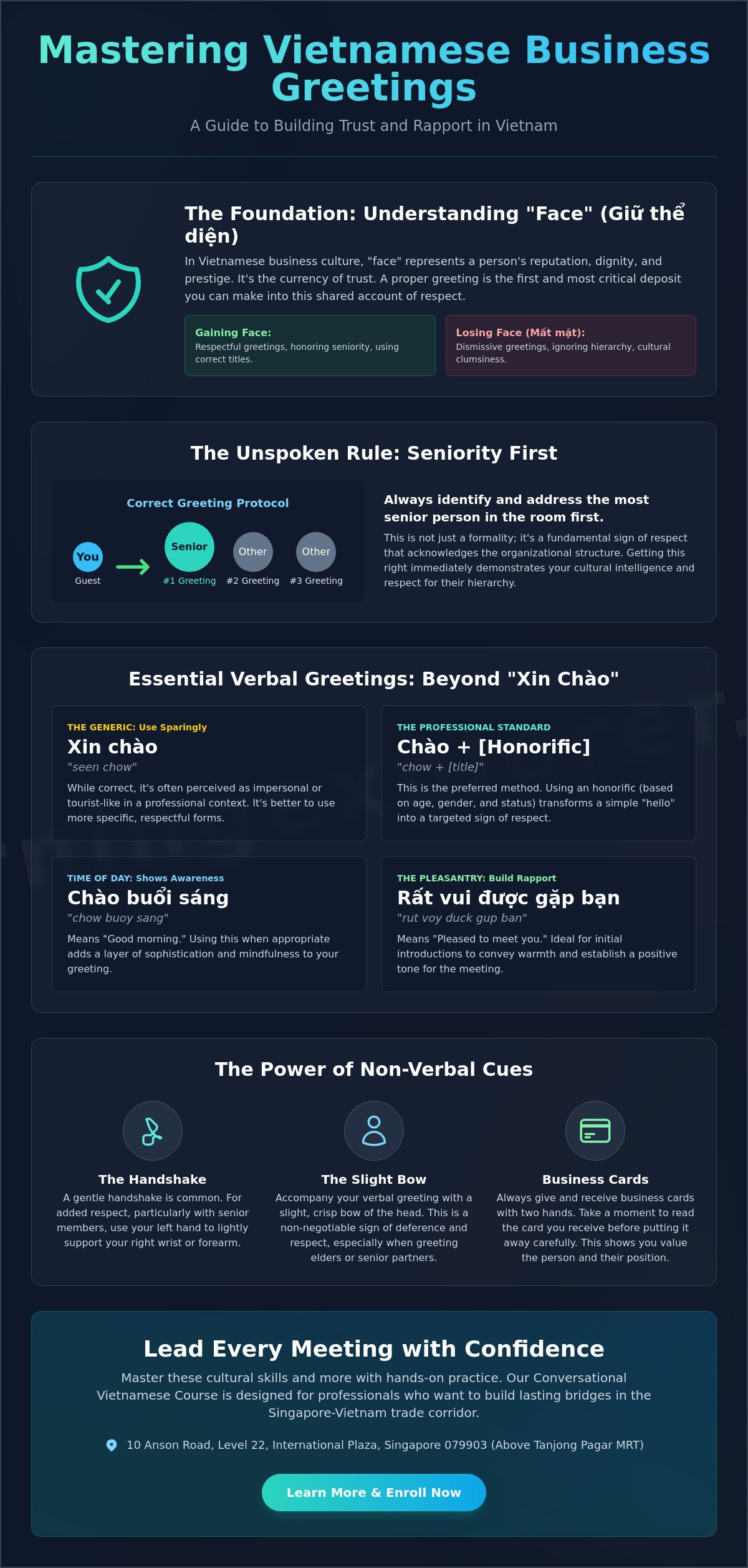
Face is the ultimate currency of trust in Hanoi and Ho Chi Minh City. Think of it as a collective bank account for the whole company rather than just a personal trait. When you offer a respectful greeting, you’re making a deposit into that account. Conversely, a clumsy or dismissive introduction can cause a partner to lose face (mất mặt), which can derail a deal before the first slide of your presentation is even shown. A successful greeting ensures everyone’s dignity remains intact, creating a safe environment for negotiation.
Why Language Efforts Matter to Vietnamese Partners
Showing effort matters more than achieving perfection. Mastering vietnamese greetings for business meetings is a powerful way to demonstrate commitment to the partnership. With 86% of the population speaking Vietnamese as their primary tongue, your willingness to use the local language carries immense weight. Even if your pronunciation isn’t flawless, the act of trying signals that you aren’t just there for a quick transaction. You’re there to build a lasting bridge.
By understanding Vietnamese naming conventions, you avoid the common mistake of using the wrong part of a partner’s name. This is a frequent pain point for foreign managers that can lead to unintended disrespect. This level of cultural empathy provides a distinct competitive advantage for Singaporean entrepreneurs looking to expand into the region. For founders who want a broader strategic foundation, exploring basic vietnamese for entrepreneurs in singapore can help you build the language skills and cultural awareness needed to turn introductions into lasting partnerships. To refine your approach and practice these interactions, our Conversational Vietnamese Course at 10 Anson Road, level 22, International Plaza, Singapore 079903, situated directly above Tanjong Pagar MRT, provides the specific training needed for these high-stakes professional environments.
Essential Verbal Greetings: Beyond “Xin Chao”
“Xin Chao” (pronounced seen chow) is the first phrase any visitor learns. While it literally translates to “hello,” using it exclusively in a boardroom can make you sound a bit like a tourist. In high-level vietnamese greetings for business meetings, professionals prefer using “Chào” followed by a specific honorific. This subtle shift transforms a generic greeting into a targeted sign of respect. When you deliver these words, accompany them with a slight bow of the head. This physical gesture is a non-negotiable sign of deference, especially when meeting senior partners for the first time.
Understanding these nuances is part of the broader cultural dos and don’ts in Vietnam that define successful international partnerships. By moving beyond the basics, you signal that you’re a serious partner committed to a deep professional relationship.
Standard Professional Greetings
If your meeting takes place before noon, use “Chào buổi sáng” (pronounced Chow boy sang) to say good morning. This shows you’re aware of the time and adds a layer of sophistication to your arrival. When the meeting concludes or during initial introductions, “Rất vui được gặp bạn” (pronounced Rut voy duck gup ban) means “Pleased to meet you.”
Deliver these phrases with a calm, moderate tone. Avoid being overly loud or boisterous. Vietnamese business culture values a steady demeanor, as it reflects emotional control and reliability. If you want to perfect these tones before your next trip, consider joining a Conversational Vietnamese Course at 10 Anson Road, level 22, International Plaza, Singapore 079903, situated directly above Tanjong Pagar MRT, to practice with native speakers.
How to Introduce Yourself Formally
Establishing your identity clearly is the next step. The standard professional structure is: [Greeting] + [Honorific] + [Your Name]. For example, if you’re greeting an older male partner, you might say “Chào Anh [Name].” Following this with your company name immediately establishes your authority and professional context.
Vietnamese names follow a Last-Middle-First order. While you’ll likely be addressed by your first name preceded by a title, acknowledging their full name correctly on a business card shows immense attention to detail. This structured approach to vietnamese greetings for business meetings ensures you start every conversation on a footing of mutual respect and clarity.
Navigating Hierarchy: The Role of Honorifics and Titles
Mastering vietnamese greetings for business meetings requires a shift from Western-style egalitarianism to a structured, hierarchical approach. In Vietnam, pronouns aren’t just grammar; they’re the social glue that defines your relationship with everyone in the room. Unlike English, where “you” is universal, Vietnamese uses a system based on age and seniority to show respect. Identifying where you stand in relation to your partner is the first step toward a successful negotiation.
When you enter a boardroom, always greet the most senior person first. This is usually the oldest individual or the person with the highest corporate rank. If you aren’t sure who holds the most authority, observe the seating arrangement or wait for your host to facilitate introductions. This orderly approach prevents anyone from “losing face” and establishes you as a culturally aware professional.
Using “Anh” and “Chi” Correctlly
The most common honorifics you’ll use are “Anh” (pronounced: Ang) for men and “Chi” (pronounced: Chee) for women who are older than you or of equal rank. These terms translate to “older brother” and “older sister.” Using them creates a sense of familial trust that is essential for long-term deals. It signals that you view the partnership as a deep, supportive relationship rather than just a cold transaction.
Be extremely cautious with the term “Em.” While it means “younger sibling,” using it for a business partner can be risky. It implies a lower status and can accidentally sound patronizing. Unless you are significantly older or in a much higher position of authority, stick to “Anh” or “Chi” to remain safe and respectful.
Professional Titles and Formal Address
In formal settings, combining a professional title with a person’s first name is the standard. For example, a Director named Long should be addressed as “Giam doc Long” or “Anh Giam doc Long.” If the meeting is conducted entirely in English, you can use “Mr.” or “Ms.” followed by their first name. Remember, Vietnamese names are structured as Last-Middle-First, but the first name is what people use in conversation.
- Giam doc: Director
- Chu tich: Chairman
- Pho Giam doc: Deputy Director
Navigating these titles can feel overwhelming at first. Our Conversational Vietnamese Course helps you practice these distinctions in a low-pressure environment. You can find us at 10 Anson Road, level 22, International Plaza, Singapore 079903, situated directly above Tanjong Pagar MRT. Learning these nuances before you fly to Hanoi ensures you lead every interaction with authority and grace.
Non-Verbal Etiquette: Handshakes and Business Cards
Your physical presence communicates just as much as your spoken words during vietnamese greetings for business meetings. While Western business culture often prizes a firm, bone-crushing handshake, the Vietnamese approach is generally more subdued. Aim for a grip that is firm but gentle. If you are greeting a woman, wait for her to extend her hand first. If she doesn’t, a polite bow of the head is the appropriate substitute. When meeting an elder or a high-ranking official, using both hands to clasp their hand is a powerful sign of deference that won’t go unnoticed.
Attire also plays a critical role in non-verbal communication. In the urban business hubs of Hanoi and Ho Chi Minh City, “Business Professional” is the gold standard. Even if the weather is humid, showing up in a suit or formal office wear signals that you take the meeting seriously. Dressing down can be interpreted as a lack of respect for your host, potentially damaging the “face” you’ve worked hard to build through your verbal greetings.
The Two-Hand Business Card Ritual
The exchange of business cards, or Danh Thiếp, is a ritualized ceremony rather than a casual swap. Always present your card using both hands, with the text facing the recipient so they can read it immediately. When you receive a card, accept it with both hands and take a few seconds to study the details. This shows you value the person’s identity and position. Never slide a business card into your back pocket or write notes on it in front of the owner. These actions are seen as major signs of disrespect to the person’s professional standing.
- Presentation: Use both hands, thumbs on the top corners.
- Observation: Read the card for 3 to 5 seconds before placing it on the table.
- Storage: Place cards in a dedicated holder or on the table in front of you.
Physical Space and Eye Contact
In many Western cultures, intense eye contact is a sign of honesty. In Vietnam, however, prolonged or very direct eye contact can sometimes be perceived as a challenge or a sign of aggression. It’s better to maintain a steady but soft gaze. Use a “social smile” to diffuse tension and signal your friendly intentions. This smile isn’t necessarily a sign of agreement; it’s a tool to maintain harmony and keep the negotiation atmosphere positive.
Understanding these subtle physical cues is a core part of the language courses Singapore professionals use to prepare for regional expansion. Mastering the body language alongside the vocabulary ensures your message isn’t lost in translation. If you want to refine these physical and verbal skills, our Conversational Vietnamese Course provides the perfect practice ground. Visit us at 10 Anson Road, level 22, International Plaza, Singapore 079903, situated directly above Tanjong Pagar MRT, to start your journey toward cultural fluency.
Mastering Business Vietnamese for Singapore Professionals
Building a bridge to the Vietnamese market requires more than just a phrasebook. While understanding the theory of vietnamese greetings for business meetings is a vital first step, the true test happens when you step into that boardroom. You need the muscle memory to deliver tones accurately and the confidence to navigate social hierarchy without hesitation. Singaporean professionals often face the challenge of balancing a packed schedule with the need for high-level cultural competency. That’s why we’ve designed our training to fit the rhythm of the CBD, ensuring you gain the skills you need without the administrative burden.
Small linguistic efforts yield massive professional dividends. A correctly placed honorific or a respectful two-handed card exchange can be the catalyst for a multi-year partnership. By investing in your cultural intelligence, you signal a level of commitment that few competitors can match. This transition from the labor of seeking to the satisfaction of discovery is what defines a successful international leader. For professionals specifically targeting Ho Chi Minh City partnerships, enrolling in a vietnamese pronunciation class for southern dialect ensures your spoken greetings resonate authentically with HCMC-based counterparts.
Flexible Learning at International Plaza
Time is your most valuable asset. Our training center at 10 Anson Road, level 22, International Plaza, Singapore 079903, is situated directly above Tanjong Pagar MRT, making it an ideal stop for busy managers. We offer private and intensive class options tailored specifically for those with upcoming business trips or high-stakes negotiations. Instead of struggling with unorganized online resources, you get a structured path that respects your limited time. These sessions focus on immediate professional impact, helping you lead every interaction with authority and grace.
Bridging the Cultural Gap
Our native-speaking instructors do more than teach vocabulary; they understand the specific nuances of the Singapore-Vietnam trade corridor. They help you translate the subtle emotional cues that define Vietnamese business etiquette. Our Conversational Vietnamese Course prepares you for real-world scenarios, from the initial handshake to the final gift-giving ceremony. We invite you to visit our CBD center for a trial session to experience our supportive, practitioner-led teaching style firsthand. Book a consultation for your corporate team today to ensure your next expansion is backed by genuine cultural expertise.
Mastering vietnamese greetings for business meetings is your first step toward long-term success. Don’t let the fear of mispronunciation hold you back from building “face” and rapport. Take the lead, practice with experts, and enter your next meeting with the confidence of a seasoned partner.
Elevate Your Professional Impact in Vietnam
Mastering vietnamese greetings for business meetings is the catalyst for building trust and protecting “face” in every boardroom interaction. You’ve learned that choosing the right honorific and perfecting the two-hand business card ritual are more than just etiquette; they are strategic investments in your professional future. By respecting hierarchy and showing genuine cultural effort, you position yourself as a reliable partner rather than just a visitor.
Ready to turn these insights into second nature? Our native-speaker bilingual instructors provide the hands-on practice you need to lead with confidence. We offer tailored corporate training modules designed to meet the specific needs of your team. Our convenient CBD location at Tanjong Pagar MRT makes it easy to fit high-impact learning into your busy schedule. Master Vietnamese for your next business meeting—enroll at Learning Explorer today.
The path to successful regional expansion starts with a single, respectful hello. We’re here to help you get it right every time. Start your journey toward cultural fluency and watch your professional relationships flourish.
Frequently Asked Questions
How do I say “hello” in a formal Vietnamese business meeting?
Use the word “Chào” followed by the appropriate honorific for the most professional greeting. For a male partner, say “Chào Anh” followed by their first name. For a female partner, use “Chi” instead. This targeted approach is far more effective than a generic greeting because it acknowledges the individual’s status and seniority immediately.
Do I need to bow when greeting someone in Vietnam?
A slight bow of the head is the standard sign of respect during vietnamese greetings for business meetings. You don’t need a deep bow from the waist. Instead, a graceful nod while you offer your handshake or business card signals your deference to the other person’s position. This small physical gesture goes a long way in building initial rapport.
What is the correct order for Vietnamese names in a business introduction?
Vietnamese names are structured in the order of Family Name, Middle Name, and then First Name. Despite this, people are almost always addressed by their first name in professional settings. If you’re introducing yourself, state your first name clearly. If you’re addressing a partner, use their first name preceded by a respectful title like “Mr.” or “Anh.”
Is it okay to use “Xin Chao” for everyone in the office?
While “Xin Chao” is a safe fallback, it often sounds impersonal or overly formal in a corporate environment. It’s better to use specific honorifics based on the person’s age and gender relative to yours. Using “Anh” or “Chi” shows that you’ve put effort into understanding the local culture, which helps you stand out from other foreign professionals.
How should I receive a business card from a Vietnamese partner?
Always accept a business card with both hands. Take a moment to read the card’s details before placing it respectfully on the table in front of you. Never write on the card or tuck it into your back pocket. These actions are seen as a direct sign of disrespect to your partner’s “face” and professional reputation.
Should I use “Mr.” or “Ms.” or use local honorifics like “Anh” and “Chi”?
Local honorifics like “Anh” and “Chi” are preferred for building deep rapport during vietnamese greetings for business meetings. These terms create a sense of professional kinship that “Mr.” or “Ms.” cannot match. If the meeting is conducted entirely in English, Western titles are acceptable, but using the local terms demonstrates a higher level of cultural commitment. Founders who want to go further can complement this knowledge with a comprehensive guide to basic vietnamese for entrepreneurs in singapore, which covers the essential phrases and deal-making etiquette needed to build trust from the very first interaction. If your meetings are focused on the southern region, pairing this knowledge with targeted training in the Vietnamese pronunciation of the southern dialect will give you an even stronger foundation for connecting with HCMC partners.