Have you ever landed in Ho Chi Minh City, used your carefully practiced Vietnamese, and still felt like a complete stranger? It’s a common frustration for many who find that standard language apps often teach a formal version that doesn’t quite match the vibrant, rhythmic flow of the South. Enrolling in a specialized vietnamese pronunciation class for southern dialect is the most effective way to bridge this cultural gap. Our training programs are designed specifically for Singaporean professionals who need to move beyond sounding robotic and start speaking with the natural confidence required for high-stakes business meetings and social gatherings.
We believe that clear communication is the foundation of trust. You don’t just need to know the words; you need to master the melody of the HCMC accent to truly connect with your partners. This article explores how targeted training helps you distinguish Southern tones and master the specific phonetics of the region. Discover how our adult-focused curriculum transforms your speech, ensuring you’re understood the moment you step into a boardroom in District 1.
Key Takeaways
- Understand why the Southern dialect is a strategic asset for building professional trust and rapport during business networking in Ho Chi Minh City.
- Master distinct phonetic shifts, such as the Southern “V” to “Y” sound, by enrolling in a specialized vietnamese pronunciation class for southern dialect.
- Identify and overcome the “Textbook Trap” to ensure your speech sounds natural rather than overly formal or robotic to native speakers.
- Experience the impact of real-time feedback and interactive drills with native instructors to perfect your mouth positioning and tonal accuracy.
- Discover how a tailored conversational Vietnamese course helps you transition from basic phrases to confident, melodic communication in professional settings.
Why Choose a Vietnamese Pronunciation Class for Southern Dialect?
Success in the Vietnamese market often begins in the bustling streets of Ho Chi Minh City. While Northern Vietnamese is the official “standard” used in national media, the Southern dialect is the heartbeat of trade, tech, and daily life in the South. If you use a formal Northern accent in a Saigon boardroom, you might sound like a news anchor rather than a peer. This creates a subtle but real barrier to rapport. You want to sound like a partner who understands the local culture, not just a visitor following a script.
Choosing a vietnamese pronunciation class for southern dialect allows you to bridge this gap quickly. Mastering regional nuances isn’t just about phonics; it’s about signaling respect and a long-term commitment to your local partners. A deep dive into Vietnamese phonology reveals that the two dialects differ significantly in initial consonants and tone shapes. Understanding these technicalities ensures you won’t be caught off guard when a business partner uses a “y” sound where your textbook expected a “v”.
To better understand this concept, watch this helpful video:
Connecting Singapore to Ho Chi Minh City
Singapore has consistently been a top investor in Vietnam, with HCMC serving as the main gateway for this capital. For Singaporean professionals, the ability to speak “Giọng miền Nam” is a strategic tool. It transforms a standard meeting into a collaborative partnership. When you use Vietnamese greetings for business meetings with the correct Southern inflection, you demonstrate cultural intelligence. This effort doesn’t go unnoticed. Our training sessions at 10 Anson Road, level 22, International Plaza, Singapore 079903, are designed to give you this exact competitive edge right in the heart of the CBD.
The Melodic Appeal of the Southern Accent
Many students find the Southern accent more “relaxed” and approachable for daily conversation. It features a softer tonal system that feels more rhythmic and less staccato than the Northern variety. Southern speech is famous for its creative use of slang and informal contractions that make the language feel alive. A professional vietnamese pronunciation class for southern dialect helps you navigate these nuances. You’ll learn why certain words are shortened and how to mimic the rising and falling tones that characterize HCMC speech. This focus on practical, real-world usage ensures you don’t just learn the language; you learn to live it. You’ll move beyond rigid grammar and start speaking with the natural flow that builds genuine connections.
Southern vs. Northern: Key Phonetic Differences
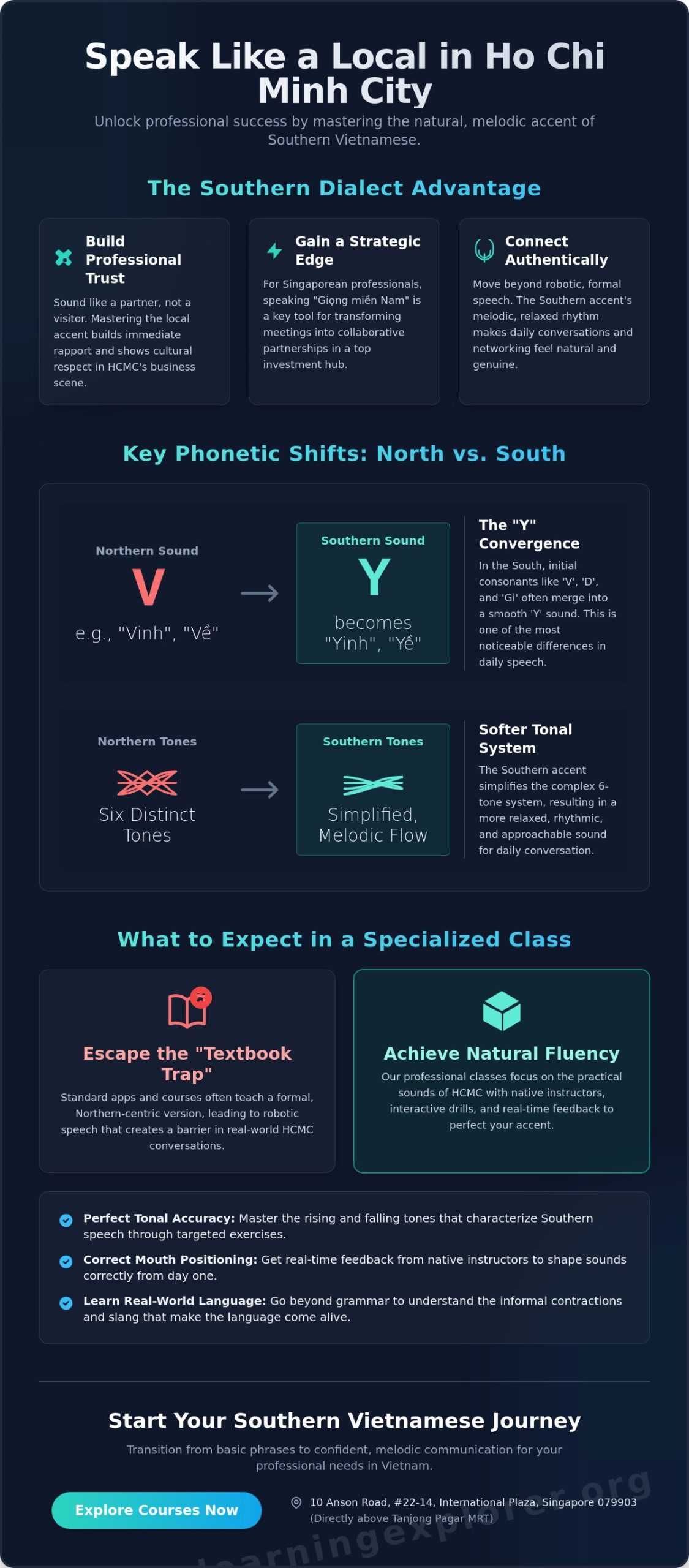
If you’ve ever listened to a news broadcast from Hanoi and then tried to order coffee in Saigon, you’ve likely felt an immediate disconnect. While the written language remains the same, the spoken “shape” of words changes dramatically as you move south. The most striking difference is the “Y” sound. In the South, the letters “V”, “D”, and “Gi” often converge into a smooth, semi-vowel “Y”. For instance, the name “Vinh” transforms into “Yinh”, and “Về” (to return) sounds like “Yề”. Joining a vietnamese pronunciation class for southern dialect helps you master these nuances through targeted drills that break your reliance on Northern-centric textbooks.
Another area where learners often stumble is with consonant endings. In Southern speech, the distinction between “N” and “NG” at the end of words is often softened or merged depending on the preceding vowel. This can lead to confusion if you’re used to the crisp, distinct endings taught in standard courses. Mastering these variations is essential for professional clarity. If you’re ready to move past the textbook and start sounding like a local, explore our conversational Vietnamese course for personalized guidance that focuses on these real-world sounds.
Mastering the Five Southern Tones
Southern speakers simplify the complex six-tone system of the North into five distinct tones. The “Hỏi” (dipping-rising) and “Ngã” (high-rising glottal) tones merge into one smooth, dipping sound. Singaporean learners, especially those familiar with the four tones of Mandarin, often find this merger a welcome relief. However, the glottal stop at the end of certain tones can still feel unnatural. We focus on helping you find the right pitch and duration to ensure you sound melodic rather than robotic.
The “Y” Factor in Southern Consonants
To avoid sounding like a formal news anchor, you must embrace the “Y” factor. In a professional vietnamese pronunciation class for southern dialect, you’ll practice replacing the hard “D” and “V” sounds with the softer Southern “Y”. We also tackle the unique “Tr” and “Ch” sounds, which are often pronounced identically in the South, unlike the distinct “Tr” (retroflex) used in the North. These subtle shifts are the secret to building instant rapport with HCMC locals, making your speech feel warm and accessible.
Common Challenges for Learners in Singapore
Many Singaporean learners fall into the “Textbook Trap” early in their journey. Most digital apps and standard curriculum materials prioritize the Northern dialect because it’s considered the formal standard. You might spend months perfecting your pronunciation only to find that your business partners in Ho Chi Minh City speak with an entirely different rhythm. This is why a specialized vietnamese pronunciation class for southern dialect is so vital. It helps you bypass the confusion and focus on the sounds you’ll actually hear in the South.
Unlearning previous habits is often harder than starting from scratch. If you’ve been taught to pronounce the letter “V” with hard friction, switching to the Southern “Y” sound requires conscious effort and muscle memory adjustment. Singaporeans also struggle with the influence of English or Mandarin phonics. While Mandarin has tones, the “rising” tone in Vietnamese doesn’t map perfectly to the Chinese second tone. These subtle differences can make you sound robotic or, worse, completely misunderstood. You need a guide who understands these specific cross-linguistic hurdles. Founders entering the Vietnamese market will also benefit from reviewing basic Vietnamese for entrepreneurs in Singapore to build the essential vocabulary and cultural awareness needed alongside strong pronunciation.
Unlearning Northern Habits
To sound natural in a business-social setting, you must adjust your tongue placement for Southern vowels. Northern vowels are often “tighter” and more forward in the mouth. In contrast, Southern speech is more relaxed and open. You’ll need to identify “Hanoi-isms” in your current vocabulary, such as words that change pronunciation or even meaning when you cross into the South. Transitioning from a stiff academic tone to a fluid Southern flow is a significant psychological hurdle. Our instructors guide you through this transition with empathetic, professional support designed for the Singaporean learner.
Ear Training for the Mekong Delta
Southern Vietnamese often sounds faster to the untrained ear because of frequent contractions and the merging of tones. While Northern speech is more staccato, Southern speech flows like a melody. This makes listening comprehension a major hurdle for many professionals. You might recognize a word in a quiet classroom but lose it entirely in a crowded HCMC cafe. Ear training involves exposure to various Southern sub-dialects, from the urban Saigon accent to the softer tones of the Mekong Delta. We use interactive drills to help you pick out keywords amidst the fast-paced rhythm. Mastering this skill ensures you don’t just speak correctly; you react and engage naturally in any conversation.
What to Expect in a Professional Pronunciation Class
Walking into a classroom offers something an app cannot: immediate, human feedback. Enrolling in a vietnamese pronunciation class for southern dialect means moving beyond passive listening. You’ll engage in interactive drills that mimic the high-energy environment of a Saigon marketplace or a District 1 office. Small group settings foster social confidence, allowing you to practice with peers who face the same linguistic hurdles. This collaborative atmosphere is a core reason why many choose our language school in Singapore over isolated online platforms.
Feedback is instant. You’ll receive real-time guidance on your mouth positioning. Instructors observe how you shape your lips or where your tongue sits for the Southern “V” sound mentioned earlier. These physical adjustments are the difference between being understood and being ignored. We use multimedia tools to record your speech, letting you compare your progress against native benchmarks. This data-driven approach ensures you aren’t just trying to speak; you’re actively refining your vocal mechanics in a focused, professional environment.
The Role of Native Southern Instructors
Bilingual teachers are essential for explaining phonetic nuances. They can translate the complex mechanics of Vietnamese tones into concepts that make sense to English or Mandarin speakers. Our HCMC native instructors provide deep cultural context, explaining when to use certain informal contractions. They help you correct your accent without losing your unique voice. This empathetic guidance reduces the administrative burden of self-study and keeps you inspired throughout your journey.
Curriculum Focused on Practicality
We move beyond the alphabet to focus on real-world sentence structures. You’ll role-play business scenarios, from airport arrivals to boardroom pitches, using high-frequency industry terms. Weekly milestones ensure steady improvement in clarity and confidence. This structured path transforms the labor of seeking the right words into the satisfaction of discovery. You’ll finish each session with actionable skills you can use immediately. Ready to transform your speech? Explore our conversational Vietnamese course to find a schedule that works for you.
Start Your Southern Vietnamese Journey at Learning Explorer
You’ve explored the phonetic shifts and the strategic value of the HCMC accent. Now, it’s time to take action. Choosing a vietnamese pronunciation class for southern dialect at Learning Explorer means choosing a partner dedicated to your professional growth. We don’t just teach words; we build the confidence you need to lead a meeting in Ho Chi Minh City. Our expert native-speaker instructors specialize in adult education. They understand the taxing nature of professional tasks and design lessons that reduce your administrative burden. Every drill is a creative catalyst for better outcomes in your international ventures.
Professional Training in the Heart of the CBD
Efficiency matters when you’re balancing a busy career in Singapore’s financial district. Our center is conveniently located at 10 Anson Road, level 22, International Plaza, Singapore 079903. Because we’re situated directly above Tanjong Pagar MRT, you can easily incorporate your sessions into your weekly routine without added stress. We provide modern facilities designed for interactive and fun language learning that respects your limited time. We offer flexible class schedules tailored specifically for working professionals in the CBD. You won’t find the coldness of a typical software company here. Instead, you’ll find a supportive environment that feels both authoritative and kind.
Join a Community of Global Learners
Learning a language is more than just a solitary task. It’s an opportunity to network with other visionary professionals targeting the Vietnamese market. By joining our conversational Vietnamese course, you gain access to high-quality materials specifically for the Southern dialect. These vetted resources distinguish our curriculum from the unorganized and overwhelming nature of external sources. We help you move from the labor of seeking the right sounds to the satisfaction of genuine discovery. You’ll join a community of global learners expanding their horizons and increasing their professional impact across Southeast Asia. Take the next step today and transform your communication skills with a reliable ally.
Elevate Your Professional Impact in Vietnam
Mastering the melodic flow of the HCMC accent is a strategic bridge to deeper professional relationships. You now understand how the Southern “Y” sound and merged tones differ from standard textbook Vietnamese. By choosing a dedicated vietnamese pronunciation class for southern dialect, you move past the frustration of being misunderstood. You’ll start speaking with the confidence of a local partner who truly understands the culture and rhythm of the South.
Our adult-focused interactive curriculum ensures you gain practical skills you can use immediately in the boardroom. With native Southern Vietnamese instructors and a central location at International Plaza, right above Tanjong Pagar MRT, your journey toward fluency becomes an inspiring part of your professional routine. It’s time to stop feeling like an outsider and start connecting with the vibrant energy of Ho Chi Minh City. We’re here to help you turn your language goals into a reality and increase your impact abroad.
Book Your Southern Vietnamese Trial Class at Learning Explorer Today!
Frequently Asked Questions
Is the Southern dialect harder to learn than the Northern dialect?
No, many learners actually find the Southern dialect more accessible because it simplifies the tonal system. While Northern Vietnamese uses six distinct tones, the Southern variety merges two of them, leaving you with only five tones to master. This reduction in vocal complexity makes it easier for beginners to achieve a natural, melodic flow during their vietnamese pronunciation class for southern dialect.
Can I use Southern pronunciation if I already learned Northern Vietnamese?
Yes, you can certainly adapt your speech, though it requires focused practice to adjust your phonetic habits. Most residents in Ho Chi Minh City will understand a Northern accent, but using Southern sounds helps build immediate rapport and trust. Our instructors specialize in helping you identify specific “Hanoi-isms” and replacing them with the relaxed, rhythmic sounds typical of the South.
How long does it take to see improvement in my pronunciation?
Most professionals notice a clear difference in their tonal accuracy and vocal confidence within 8 to 12 weeks of consistent training. Because pronunciation is a physical skill, improvement depends on regular practice and real-time feedback. By the end of a standard term, you’ll feel much more comfortable navigating basic business socializations and daily interactions in HCMC without being misunderstood.
Are the teachers at Learning Explorer native Southern speakers?
Yes, our instructors are native speakers from Southern Vietnam who have extensive experience in adult education. They provide the authentic regional nuances and cultural context that you won’t find in a standard textbook. This ensures you’re learning the exact version of the language used in the offices and streets of Ho Chi Minh City today.
Do I need to learn the Vietnamese writing system to improve my pronunciation?
While you can learn basic phrases through transliteration, learning the Vietnamese script is the most effective way to master pronunciation. The writing system is entirely phonetic, meaning the diacritics tell you exactly which tone and vowel shape to use. This visual guide is a powerful tool in any vietnamese pronunciation class for southern dialect, helping you achieve long-term clarity.
What is the difference between Southern and Northern tones?
The primary difference is the merger of the “Hỏi” and “Ngã” tones in the South. In Northern Vietnamese, these are two distinct sounds, one dipping and one rising sharply with a glottal stop. Southern speakers pronounce both as a smooth, dipping-rising sound. This shift contributes to the softer and more rhythmic quality that characterizes Southern speech.
Is this class suitable for absolute beginners?
Yes, our conversational Vietnamese course is designed to support learners starting from zero. We begin with the fundamental sounds and tones of the Southern dialect before moving into practical, high-frequency vocabulary. This ensures you build a strong phonetic foundation from day one, preventing the development of “robotic” habits often picked up from self-study apps.
How do I know if I should learn the Southern or Northern dialect?
Your choice should depend on your primary destination and professional goals. If you’re a Singaporean professional targeting investment opportunities in Ho Chi Minh City or the surrounding provinces, the Southern dialect is the strategic choice. If your work is centered in Hanoi or involves national government sectors, the Northern dialect may be more beneficial for your specific context.