What if the most powerful tool in your next Bangkok boardroom meeting isn’t your pitch deck, but a single politeness marker at the end of a sentence? Many Singaporean professionals feel a sharp spike of anxiety when meeting Thai executives, fearing that a misplaced pronoun or an incorrect tone might accidentally signal disrespect. It is a valid concern in a culture where hierarchy and “face” are central to every transaction. You want to build trust quickly, yet the complexity of the script and those five elusive tones can feel like a significant barrier to entry. Mastering the thai business vocabulary essentials is the first step toward turning that hesitation into professional confidence.
We understand these daily challenges and are here to help you navigate them with ease. This guide will help you master the core phrases and cultural nuances needed to bridge the gap and secure your professional reputation. You’ll learn the essential vocabulary for professional settings, the nuances of hierarchical pronouns, and the specific etiquette required to transform a cold introduction into a lasting partnership. Whether you are visiting us at 10 Anson Road, level 22, International Plaza, Singapore 079903, or preparing for your next flight, these insights will ensure your next Thai collaboration is a success.
Key Takeaways
- Understand the cultural engine of “Greng Jai” and how simple politeness markers instantly elevate your professional image in any Thai boardroom.
- Navigate workplace seniority with confidence by learning how to use age-based titles and identifying key executive roles during formal introductions.
- Acquire the thai business vocabulary essentials needed to open meetings, set clear agendas, and discuss project deadlines with precision.
- Professionalize your digital communication by mastering formal email greetings and the specific etiquette required for successful business phone calls.
- Discover why immersive, face-to-face training in Singapore provides the nuanced feedback and cultural context that mobile apps often miss.
Foundations of Thai Business Communication: Politeness and Pronouns
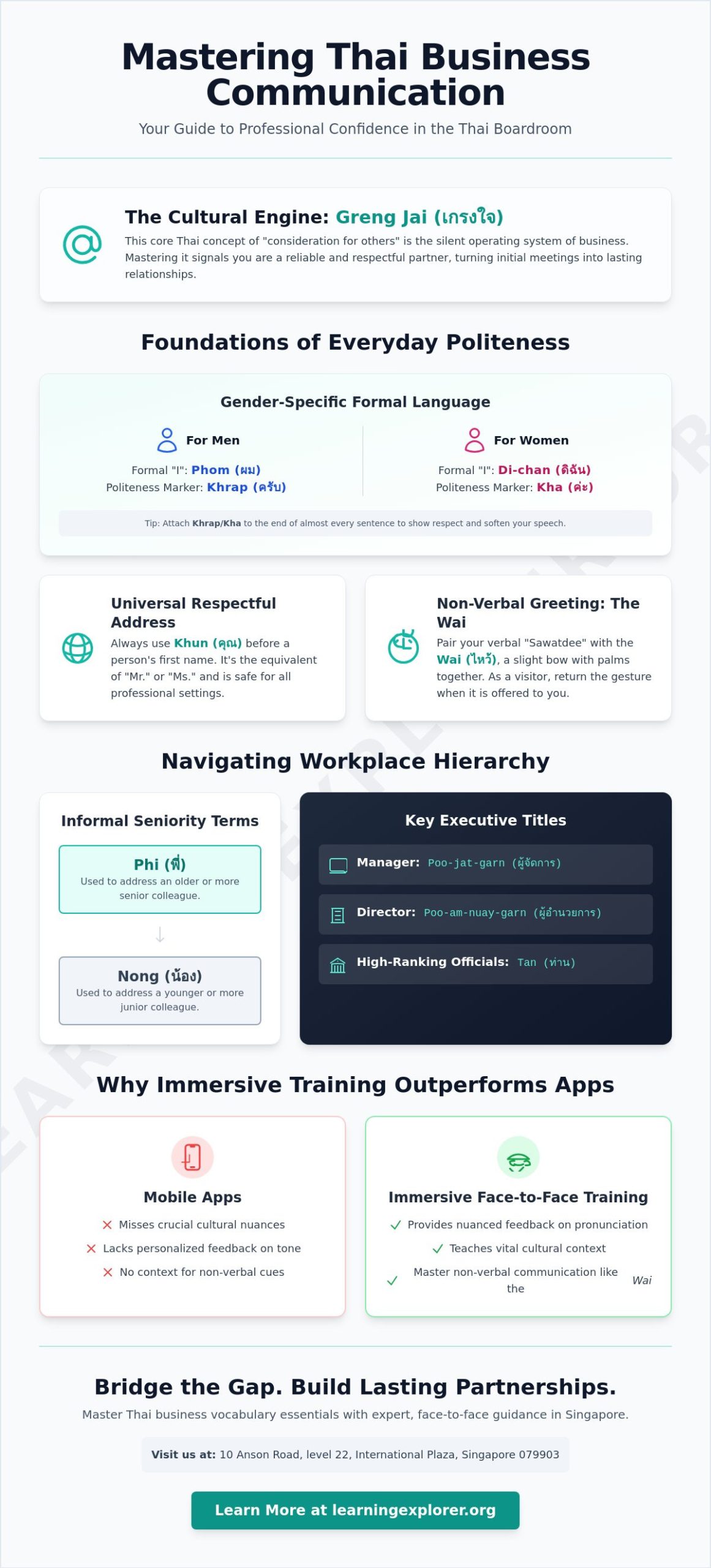
Success in the Thai market requires more than just a firm handshake. It demands an understanding of Greng Jai. This concept translates roughly to “consideration for others” or “the desire not to bother someone.” In a professional context, it means anticipating your partner’s needs and avoiding direct confrontation. Mastering Thai honorifics and politeness is the foundation of this cultural intelligence. It’s the silent operating system that keeps business relationships running smoothly from Singapore to Bangkok. When you respect this social fabric, you’re not just speaking a language; you’re signaling that you’re a reliable partner.
When you begin learning thai business vocabulary essentials, start with your own identity. Unlike English, where “I” is universal, Thai requires gender-specific formal pronouns. Men use Phom, while women use Di-chan. Using these instead of more casual terms shows you respect the professional setting. Additionally, always use the prefix Khun before a partner’s first name. It serves as a respectful “Mr.” or “Ms.” and is the safest way to address anyone from a junior associate to a senior manager. At our training facility at 10 Anson Road, level 22, International Plaza, Singapore 079903, we emphasize these small shifts in language because they lead to massive shifts in trust.
The Role of Politeness Markers in Every Sentence
Think of the markers Khrap (for men) and Kha (for women) as the “social glue” of your conversation. These aren’t just words; they are essential signals of respect. You must attach them to the end of almost every sentence. They soften requests, acknowledge instructions, and demonstrate your awareness of the hierarchy. A common mistake for Singaporeans is omitting these markers during fast-paced negotiations. Without them, your speech can sound blunt or even aggressive to Thai ears. Using them consistently proves you value the relationship over the transaction. It’s one of the most vital thai business vocabulary essentials you’ll ever master.
Non-Verbal Vocabulary: The “Wai” and Your Words
Your physical presence communicates as much as your verbal vocabulary. The Wai, a slight bow with palms pressed together, is a silent but powerful greeting. Always pair your verbal “Sawatdee” with this gesture when meeting Thai counterparts. As a visitor, you don’t need to initiate the Wai with everyone you meet. Generally, let the more junior person or the host initiate the gesture. When you receive a Wai, simply return it with your hands at chest level. This small act of cultural alignment builds rapport faster than any technical presentation ever could. It shows you’ve moved beyond the “seeking” phase and are ready to engage as a knowledgeable peer.
Navigating Workplace Hierarchy: Titles and Seniority Terms
Singaporean professionals often find the Thai office hierarchy more layered than the corporate structures back home. While we focus on performance, Thai culture places heavy emphasis on seniority and age. This social contract is built into the language itself. One of the most critical thai business vocabulary essentials is the use of Phi (older sibling) and Nong (younger sibling). Even in a high-tech Bangkok firm, you will hear a junior staff member refer to their manager as Phi followed by their name. This isn’t just about family; it is a sign of respect that acknowledges the other person’s experience and position.
When dealing with top-tier leadership, you need to know the official titles. A Manager is Poo-jat-garn, a Director is Poo-am-nuay-garn, and the CEO is often referred to by their specific title or simply as the “boss.” If your work involves government officials, the level of formality increases significantly. You might use the term Tan to address high-ranking individuals, a practice deeply rooted in Thai business customs. Learning these distinctions helps you avoid the “accidental offense” many foreigners fear. If you want to master these interactions, enrolling in a Conversational Thai Course can provide the safe space you need to practice these thai business vocabulary essentials.
Addressing Your Counterparts Correctly
In Thailand, legal names are for documents; nicknames are for people. It is standard practice to address a business partner as Khun followed by their nickname. This strikes the perfect balance between professional respect and personal warmth. Before a meeting starts, take a moment to observe who is the most senior person in the room. Acknowledging them first with a respectful greeting is expected. If you are introduced to a high-ranking executive, use the phrase Yin dee tee dai roo-jak (Pleased to meet you) to set a positive tone.
Departmental and Team Vocabulary
Navigating a large corporate building requires specific departmental terms. Knowing how to ask for the right office is a practical skill for any visiting professional. Common departments include:
- Marketing: Gar-talaad
- Finance: Gar-ngern
- Human Resources: Panaek-book-kon
If you are looking for the “team leader” or “project manager,” those terms are often used in English, but knowing the Thai equivalents shows extra effort. Our instructors can help you refine these pronunciations to ensure you are understood perfectly during your next regional visit.
Essential Vocabulary for Thai Business Meetings and Negotiations
When you sit down in a Bangkok conference room, the atmosphere shifts from social to professional. Start the session with Rerm prachum (Let’s start the meeting). This signals you’re ready to lead or participate actively. Mastering these thai business vocabulary essentials ensures you don’t just sit in silence while the conversation moves around you. You’ll need to discuss the Wa-ra (agenda) and define the Pao-mai (goals) clearly. If you need to set a Gam-nod-wa-la (deadline), doing so in Thai shows a level of commitment that resonates with local teams. It proves you’ve done the work to understand their professional world.
In a Singaporean context, we are often direct and efficiency-driven. In Thailand, directness can be perceived as abrasive if not cushioned with the right words. While Hen-duay means “I agree,” saying Mai-hen-duay (I disagree) should be handled with extreme care. This is where a guide to business culture in Thailand becomes an essential resource. It teaches you that harmony is often prioritized over being “right” in the moment. If you feel lost during a fast-paced discussion, use the phrase Chuay itai eek tee (Please repeat) to buy time and ensure you’ve understood the nuance correctly before responding.
Negotiation and Agreement Phrases
Negotiations often center on the Ra-ka (price). If you’re seeking a Suan-rod (discount), present your request as a step toward a long-term Sun-ya (contract). A key strategy in Thai business is the “soft no.” Instead of a blunt refusal that might cause someone to lose face, use the phrase Kor kid doo gon (I’ll think about it). This allows both parties to maintain a positive relationship while you evaluate the proposal. The ultimate goal of any meeting should be Kwam-ruam-mue, or a partnership built on mutual benefit and collaboration.
Practical Meeting Etiquette for Singaporeans
Before diving into the technical details, spend five to ten minutes on rapport building. Using conversational thai for business trips sg can help you navigate this “small talk” phase effectively. Be aware that a Thai “Yes” (chai) often just means “I’m listening,” not “I agree with your terms.” Always verify commitment before concluding the session. When you finish, summarize the next steps and thank the team for their time. This shows you are organized, visionary, and deeply respectful of their schedule. These thai business vocabulary essentials turn a standard meeting into a catalyst for better outcomes.
Professional Thai for Emails, Phone Calls, and Presentations
Digital communication is the lifeline of the Singapore-Bangkok business corridor. Whether you’re drafting a formal proposal or sending a quick update via messaging apps, your choice of words defines your professional persona. Mastering thai business vocabulary essentials for remote communication ensures your message isn’t lost in translation or, worse, seen as disrespectful. In the fast-paced business environment of 2026, where digital interactions often precede face-to-face meetings, getting the tone right from the first “send” is paramount. It reduces administrative friction and builds a bridge of trust before you even board your flight. Preparing with a comprehensive set of thai phrases for business travel ensures you are ready for every professional interaction from the moment you land in Bangkok.
When drafting emails, the opening sets the entire mood. For formal correspondence with someone you haven’t met, use Rian followed by their name or title. This is the equivalent of “Dear” or “To the attention of.” If you’ve already established a relationship, a polite Sawatdee followed by a politeness marker is acceptable. To conclude with maximum respect, use the sign-off Korแสดงkwamnabteu. On the phone, always answer with Sawatdee khrap/kha. If you need to ask for someone specific, use the phrase Kor sai kab Khun… (May I speak with Khun…). These small linguistic investments yield high returns in professional rapport.
Digital Communication: LINE and Messaging Etiquette
In Thailand, the LINE app is the primary tool for business communication, often replacing internal emails. This shift requires a balance of speed and politeness. While messaging is more informal, don’t forget your politeness markers. Using stickers is actually encouraged in Thai business culture; they soften the tone of requests and help maintain a friendly atmosphere. However, keep the vocabulary professional until your counterpart shifts to a more casual style. If you want to master these digital nuances, sign up for our Conversational Thai Course to practice real-world scenarios.
Presentation Essentials
When presenting to a Thai audience, start by introducing yourself and your company with a formal Phom/Di-chan chue… ma jak bor-ri-sat…. Clear transitions keep your audience engaged. Use Tor-pai to signal the next slide and Suan-nee when you want to focus on a specific part of your data. To discuss performance, use Perm-kuen for an increase and Lod-long for a decrease. End your session strongly by saying Khob-khun sam-rab kwam-son-jai (Thank you for your interest). Visit us at 10 Anson Road, level 22, International Plaza, Singapore 079903 to refine these thai business vocabulary essentials before your next major regional pitch.
Mastering Thai Business Vocabulary Essentials in Singapore’s CBD
Language apps are excellent for learning how to order street food or find a restroom, but they often fall short when the stakes involve a multi-million dollar regional contract. For the Singaporean professional, mastering thai business vocabulary essentials requires a level of nuance that an algorithm simply cannot provide. The five tones of the Thai language carry distinct meanings; a slight mispronunciation in a boardroom can shift your message from “selling” to “bad luck.” Face-to-face instruction allows you to receive immediate feedback on these critical phonetic details, ensuring your first impression is one of competence rather than confusion.
Choosing a learning environment that understands the unique Singapore-Thai business corridor is vital. Our native-speaker instructors don’t just teach words; they translate the corporate culture that exists between our two nations. They understand that a professional at Tanjong Pagar has different communication needs than a casual tourist. By focusing on thai business vocabulary essentials within a local context, you bridge the gap between academic study and real-world application. This structured approach reduces the administrative burden of self-study and replaces it with the satisfaction of rapid, vetted progress. For busy CBD professionals, finding thai lessons for working adults near me that fit around demanding schedules is often the deciding factor between committing to a program and abandoning the goal entirely.
Tailored Business Thai Training
Every industry has its own lexicon. Whether you operate in the high-frequency world of Finance, the rapid iterations of Tech, or the complex logistics of Manufacturing, your vocabulary should reflect your specific expertise. We prioritize role-playing real-world Singapore-to-Thailand business scenarios, such as pitching to a Bangkok venture capital firm or negotiating with a factory manager in Rayong. Investing in high-quality language courses singapore is a strategic move for career upskilling, positioning you as a visionary leader who respects regional partners enough to speak their professional language.
Learning Near Tanjong Pagar MRT
Efficiency is the hallmark of the Singaporean workforce. We’ve designed our curriculum to respect your limited time, offering flexible scheduling that fits into a busy CBD calendar. Our training center is located at 10 Anson Road, level 22, International Plaza, Singapore 079903, situated directly above Tanjong Pagar MRT. This central location allows you to integrate Thai lessons into your lunch break or immediately after work without the stress of a long commute. Make 2026 the year you move beyond “seeking” a connection and start “discovering” the results that come from true linguistic and cultural alignment. Reach out to us at International Plaza to begin your transition from a visitor to a valued regional partner.
Elevate Your Professional Impact in the Thai Market
Mastering the nuances of Thai professional culture is a transformative journey that begins with a few key phrases. By prioritizing politeness markers and understanding the subtle dynamics of workplace hierarchy, you position yourself as a respectful and visionary partner. Whether you are leading a presentation or negotiating a contract, your command of thai business vocabulary essentials will serve as the catalyst for better outcomes and stronger regional relationships. You have the tools to move beyond simple transactions and build deep, lasting rapport with your counterparts in Bangkok.
You don’t have to navigate this learning curve alone. Our curriculum is aligned with global language standards and delivered by certified native-speaker instructors who understand the unique demands of the Singaporean workplace. We invite you to Master Thai for business at Learning Explorer in the Singapore CBD. Conveniently located at International Plaza above Tanjong Pagar MRT, we provide the expert guidance you need to turn linguistic challenges into professional advantages. Start your journey today and watch your business impact grow across the border.
Frequently Asked Questions
Is business Thai significantly different from everyday conversational Thai?
Business Thai uses more formal pronouns and politeness markers than everyday speech. While the core grammar remains the same, you’ll swap casual terms for formal equivalents like “Phom” or “Di-chan” to maintain professionalism. Mastering these thai business vocabulary essentials helps you transition from a tourist mindset to a corporate partner.
What is the most important phrase to know for a Thai business dinner?
How do I address a Thai business partner if I don’t know their title?
Use “Khun” followed by their first name or nickname as a safe, respectful default. It functions as a universal title for both men and women in professional settings. If you discover they have a specific rank, like a doctorate or a government title, you can adjust your address later to show deeper respect.
Do I really need to learn Thai script for business, or is phonetics enough?
Phonetics are sufficient for speaking, but learning the script provides a massive advantage for reading signs and office directories. While you don’t need to be fluent in reading immediately, recognizing key characters helps you navigate Bangkok more independently. Most professionals start with phonetics to build immediate conversational confidence.
How can I politely say “no” in a Thai business negotiation without being rude?
Avoid saying “no” directly; instead, use the phrase “Kor kid doo gon” which means “I’ll think about it.” This allows your partner to maintain “face” while giving you space to decline later. It’s a key part of thai business vocabulary essentials that prevents tension during difficult negotiations.
What are the most common mistakes foreigners make in Thai business etiquette?
Forgetting politeness markers and failing to acknowledge seniority are the most frequent errors. Singaporeans often value directness, but in Thailand, bluntness can be perceived as a lack of respect. Always end your sentences with “khrap” or “kha” to soften your tone and demonstrate cultural awareness.
Can I learn basic business Thai vocabulary in a few weeks?
You can certainly learn high-impact phrases and basic etiquette in a few weeks of intensive study. While fluency takes time, mastering introductions and meeting openers is achievable with focused practice. We suggest immersive sessions that focus on real-world scenarios rather than just memorizing lists. Professionals who search for thai lessons for working adults near me will find that CBD-based programs with flexible scheduling make it far easier to maintain consistent study habits alongside a demanding career.
Why is the concept of “Face” important when using business vocabulary?
“Face” represents a person’s reputation and dignity, and your vocabulary choices directly impact it. Using respectful titles and avoiding public disagreement protects the “face” of your Thai counterparts. This builds a foundation of trust and long-term loyalty that is essential for successful regional partnerships. Before your next trip, reviewing a dedicated guide to thai phrases for business travel can help you reinforce these cultural principles with practical, ready-to-use language.