Your most valuable asset in a Bangkok boardroom isn’t your pitch deck; it’s the respect you show through a simple, well-timed greeting. While English is common in global commerce, the effort you invest in learning thai phrases for business travel signals a deep commitment to your local partners. We understand the anxiety that comes with tonal languages. You don’t want to make a cultural faux pas or stumble over gender particles like “khrap” and “ka” when the stakes are high. It’s natural to feel overwhelmed by the nuances of a new culture while managing a demanding travel schedule.
This guide promises to reduce that friction by providing the essential tools you need to build rapport with confidence. You’ll discover how to master the basics of the Wai greeting, make a professional first impression, and handle business dinners with grace. If you’re looking to sharpen these skills before your flight, our team at 10 Anson Road, level 22, International Plaza, Singapore 079903, right above Tanjong Pagar MRT, is ready to help. Prepare to transform your professional interactions from stressful encounters into meaningful opportunities for growth and collaboration.
Key Takeaways
- Master the essential “Khrap” and “Ka” particles to instantly elevate your professionalism and show respect in any Thai boardroom.
- Navigate logistics with ease by learning specific thai phrases for business travel designed for seamless airport transfers and hotel check-ins.
- Build immediate rapport during introductions by combining the traditional Wai greeting with the proper verbal exchange of business cards.
- Command respect during business lunches by understanding local dining etiquette, including the correct use of utensils and group ordering phrases.
- Transition from basic phrases to long-term regional success by discovering how structured conversational training serves as a catalyst for Singaporean entrepreneurs.
The Foundation of Thai Business Polite Forms
Building rapport in Thailand begins with the language of respect. While your technical expertise gets you in the door, your command of thai phrases for business travel determines how long you stay there. Thai culture is deeply hierarchical, and your speech must reflect that. Using the correct level of formality isn’t just a courtesy; it’s a strategic business move that signals your awareness of local norms. Mastering Thai honorifics and polite forms is the first step toward building trust with your counterparts before the first slide of your presentation even appears.
To better understand how these forms translate into real-world professional settings, watch this helpful video:
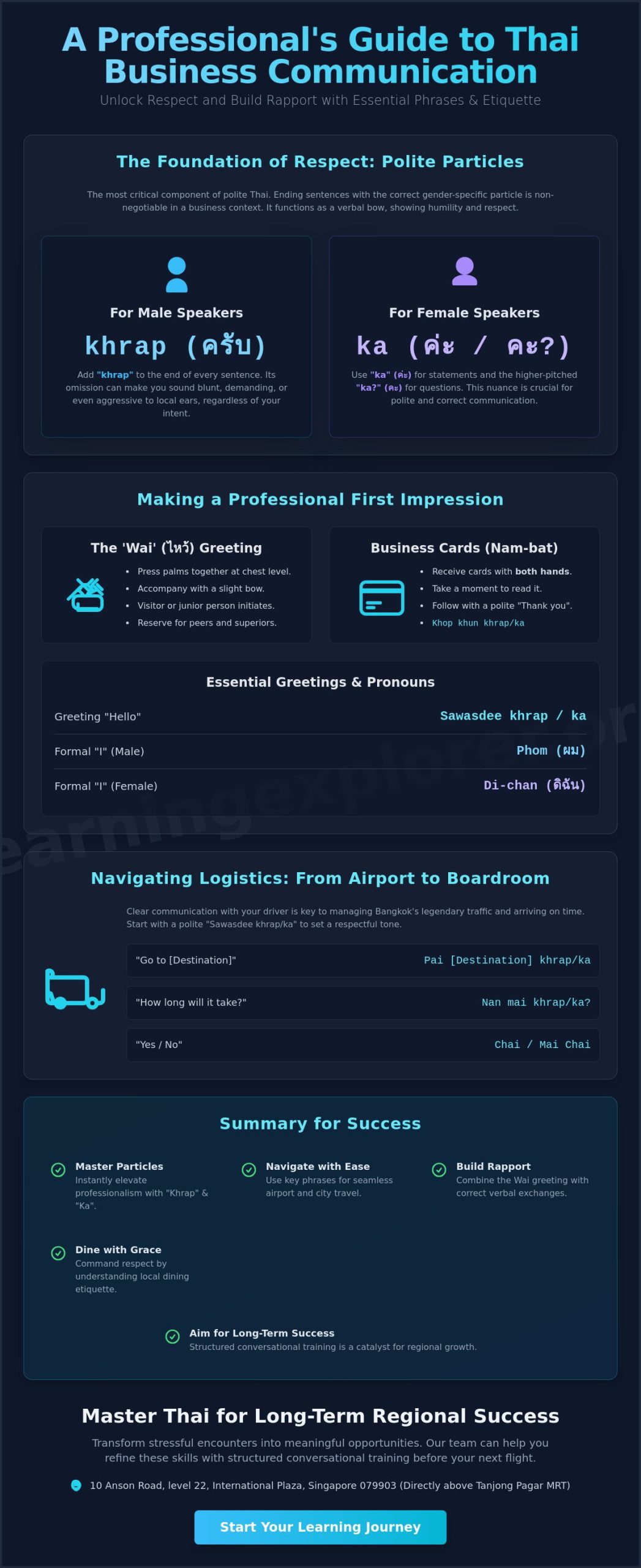
Choosing the right pronouns is your next priority. In professional circles, the “Sawasdee” greeting is more than a simple hello; it’s a bridge-builder. When you arrive at a meeting, saying “Sawasdee khrap” or “Sawasdee ka” with a slight bow indicates you value the occasion. Use formal pronouns to maintain professional distance. Men should use Phom and women should use Di-chan. These words replace the casual “I” used in daily life, ensuring you don’t accidentally sound too familiar or disrespectful during a high-stakes negotiation.
Gender Particles: The Secret to Instant Respect
The most critical component of polite Thai is the gender-specific particle. If you are male, end your sentences with Khrap. If you are female, use Ka for statements and the higher-pitched Ka? for questions. These particles function as a verbal bow in Thai culture, softening your statements and showing humility. In a boardroom, ending every sentence with a particle is non-negotiable. Omitting them can make you sound blunt, demanding, or even aggressive to local ears, regardless of your actual intent.
The Wai: Combining Phrases with Physical Etiquette
Physical gestures are just as important as the thai phrases for business travel you use. The Wai greeting involves pressing your palms together at chest height and bowing slightly. In business, the visitor or the person of lower status usually initiates the Wai first. Many Singaporean professionals make the mistake of bowing too low or Wais-ing everyone they see, including service staff. Keep your Wai reserved for peers and superiors. When exchanging business cards, or Nam-bat, use both hands to receive the card and follow it with a polite “Khop khun” (thank you) and the appropriate particle. This small gesture validates your partner’s status and sets a positive tone for the rest of the meeting. If you want to refine these skills before your flight, our instructors at 10 Anson Road, level 22, International Plaza, Singapore 079903, located right above Tanjong Pagar MRT, can help you practice these movements alongside the language.
Navigating Logistics: From Changi to the Boardroom
Your journey from Changi Airport to the heart of Bangkok’s business district is the first test of your professional preparation. While many travelers rely solely on mobile apps, using specific thai phrases for business travel can significantly smooth your transition from the arrival gate to your first appointment. Bangkok’s traffic is legendary. Managing it requires clear communication with your driver to avoid unnecessary delays. Start with a polite “Sawasdee khrap/ka” the moment you enter a taxi or Grab car. This simple gesture sets a respectful tone for the ride ahead.
Transportation and Arrival Phrases
To reach your destination, say “Pai [Building Name] khrap/ka.” If the driver asks for clarification or suggests a specific route, use “Chai” for yes and “Mai Chai” for no. To manage your schedule effectively, ask “Nan mai khrap/ka?” which means “How long will it take?” This is vital for meetings in areas like Sukhumvit or Silom where gridlock is common. For a deeper look at professional interactions and expectations, refer to the U.S. guide to Thai business customs. It highlights why being punctual is respected, even if your hosts are occasionally flexible with their own timing.
Hotel and Office Reception Etiquette
Arriving at your hotel or a client’s headquarters requires a formal introduction. Use the phrase “Phom/Di-chan cheu [Your Name] khrap/ka” followed by “Mee nat gap khun [Host’s Name]” to indicate you have an appointment. If the front desk staff speaks too quickly, don’t panic. Simply say “Pood cha-cha noi khrap/ka,” which politely asks them to speak a bit slower. Once you’re settled, you’ll likely need connectivity. Ask “Kor rahat Wi-Fi noi khrap/ka?” to stay productive. These small linguistic efforts reduce administrative friction and show you’re a partner who values local engagement. If you find these nuances challenging, a Conversational Thai Course can provide the structured practice you need to feel truly prepared.
Time management in Thailand is a delicate balance. While you should aim to be on time, understanding that transport delays are common will help you stay calm. If you’re using the BTS Skytrain or MRT Subway, asking “Sata-nee [Station Name] pai thang nai khrap/ka?” will help you find the right exit for your office building. These practical steps ensure your focus remains on the business at hand rather than the stress of getting there. Fares for the BTS range from 16 to 59 THB per trip, so having small change and a few key phrases ready will make your commute much easier.
Professional Networking: Greetings and Introductions
The first 60 seconds of a business meeting in Thailand are the most critical for establishing your professional standing. While you’ve already mastered the Wai from our previous discussion, your verbal introductions carry equal weight in defining the relationship’s hierarchy. Using specific thai phrases for business travel during these initial moments shows your Thai counterparts that you value their culture and status. A simple “Yin dee tee dai roo-jak khrap/ka” (Pleased to meet you) goes a long way in breaking the ice and building an atmosphere of mutual respect.
Small talk is a vital component of Thai business culture before diving into technical details. It’s common to discuss the weather or your journey to the office. You might say “A-kat ron noi” (The weather is a bit hot) or ask “Pen yang-ngai bang khrap/ka?” (How are things?). These essential Thai phrases for business help transition from a formal greeting to a more relaxed, personable conversation. Building this personal rapport is often the catalyst for successful long-term collaboration and trust.
The Business Card Exchange Ritual
In Thailand, the business card, or Nam-bat, is treated as an extension of the person’s professional identity. When presenting your card, use both hands and say “Nee nam-bat phom/di-chan khrap/ka” (Here is my business card). This ritual is about more than just contact info; it’s a demonstration of respect for the recipient’s position. Always take a moment to read the card you receive before placing it on the table in front of you. Never shove it into your pocket immediately. You can follow up by acknowledging their title or department, which shows you’ve paid attention to their specific role within the organization.
Meeting Room Essentials
During the actual discussion, active listening is key to maintaining face for both parties. If you agree with a point, use “Phom/Di-chan hen duay khrap/ka” (I agree). If a proposal is intriguing, “Na son jai” (That is interesting) is a perfect response. If you find yourself lost in a rapid-fire conversation, it’s better to admit it politely than to nod blindly. Use “Mai koi kao-jai khrap/ka” (I don’t quite understand) to seek clarification without causing embarrassment. For more detailed terminology, explore our Thai Business Vocabulary Essentials to expand your meeting room repertoire.
As the meeting concludes, expressing gratitude is essential. Use “Khob khun khrap/ka” for a general thank you, or “Khob khun ma-ak” for significant help. Close the interaction by reiterating that it was a pleasure to meet them. This final touch ensures you leave a lasting, positive impression as a reliable and visionary partner. If you want to perfect your delivery before your next trip, visit us at 10 Anson Road, level 22, International Plaza, Singapore 079903, situated directly above Tanjong Pagar MRT, for personalized coaching.
The Art of the Thai Business Lunch
In Thailand, the dining table is an extension of the boardroom where the real work of building trust happens. Establishing a personal connection over a meal is often more important than the technical details discussed earlier in the day. Mastering thai phrases for business travel specifically for dining scenarios prevents awkward silences and demonstrates cultural fluency. Observe your host’s lead during the meal. Use your spoon as the primary utensil, holding it in your right hand, and use the fork in your left only to push food onto the spoon. Knives are rarely necessary as most dishes are served bite-sized.
Engage your counterparts by asking for their expertise on the menu. Use the phrase “Mee arai nae-num bang khrap/ka?” to ask for recommendations. This shows you value their local knowledge and are open to new experiences. If you have dietary restrictions, communicate them clearly but professionally. Say “Mai sai pong-choo-rot khrap/ka” to request no MSG, or “Phom/Di-chan pae [ingredient]” if you have a specific allergy. When the meal concludes, the person of highest status or the host typically pays. If you wish to host, say “Phom/Di-chan liang khrap/ka” (It’s my treat) before asking the server “Gep tang khrap/ka” (Please bring the bill).
Ordering and Enjoying the Meal
Show appreciation for the food frequently. A simple “Aroi ma-ak khrap/ka” (Very delicious) signals to your host that the outing is a success. If you need a break or a refill, ask “Kor nam plao noi khrap/ka” for water or “Hong nam pai thang nai khrap/ka?” to locate the restroom. Remember to avoid using your fork to put food directly into your mouth; this is a common etiquette slip for visitors. For more practical scenarios, read our guide on Conversational Thai for Business Trips.
Social Bonding and Toasts
Business lunches often involve celebratory toasts, especially after a successful negotiation. Use “Chai-yo!” when raising your glass with the group. Once you’ve finished, signal your satisfaction by saying “Im laew khrap/ka” (I am full). This is the perfect time to transition back to light business talk or confirm the next steps of your partnership. To ensure you handle these social nuances with total confidence, consider enrolling in our Conversational Thai Course to practice real-world dialogue before your next flight.
Mastering Thai for Long-Term Regional Success
Memorizing a handful of thai phrases for business travel is an excellent first step, but it’s just the beginning for Singaporean entrepreneurs looking for sustained regional growth. While a few polite particles can open a door, the ability to sustain a conversation is what keeps you in the room. To truly navigate the complexities of a partnership, you must move beyond isolated phrases. Transitioning to structured sentence patterns allows you to express complex ideas and respond dynamically to your Thai counterparts. This shift from rote memorization to functional fluency is what distinguishes a visitor from a visionary partner.
We understand that your time is a finite resource. That’s why our Conversational Thai Course is designed specifically for the high-pressure schedules of professionals. By working with native-speaker instructors, you gain insights into the subtle nuances that a translation app simply cannot provide. You’ll learn to anticipate reactions and adjust your tone to match the hierarchy of the room. This level of preparation reduces the administrative burden of constant clarification and increases your overall engagement with the local market. For professionals who want to understand the broader career advantages of language learning, our guide on upskilling with a second language in Singapore reveals how this investment can translate into measurable salary growth and regional promotions.
Why Learn Thai in Singapore’s CBD?
Convenience is the catalyst for consistency. Our training center is located at 10 Anson Road, level 22, International Plaza, Singapore 079903, situated directly above Tanjong Pagar MRT. This prime location allows you to integrate learning into your daily routine without the friction of a long commute. Our bilingual instructors understand the Singaporean business mindset perfectly. They bridge the gap between local corporate culture and Thai expectations, providing a supportive environment where you can practice without fear of judgment. Additionally, learning in a cohort of fellow professionals offers unique networking opportunities with others expanding into the same region. If you’re searching for thai lessons for working adults near me that fit around a demanding CBD schedule, our Tanjong Pagar center is designed precisely for that need.
Your Next Steps to Fluency
Taking the next step is straightforward and efficient. You can book a trial class or a proficiency assessment to find the right level for your current skills. We offer flexible formats to suit your needs. Private classes provide a bespoke experience for executives with very specific goals, while group classes offer a collaborative atmosphere. If your entire organization is expanding into Thailand, we provide customized corporate training. This ensures your whole team operates with the same level of cultural intelligence and linguistic respect. Start your journey today and transform your thai phrases for business travel into a powerful tool for long-term success.
Elevate Your Professional Impact in Thailand
Mastering a few strategic thai phrases for business travel is about more than just vocabulary; it’s about signaling your reliability and respect as a regional partner. From the nuanced use of gender particles to the intricate etiquette of the business lunch, your effort to adapt builds a bridge of trust that technical expertise alone cannot provide. These small linguistic investments reduce the friction of daily logistics and pave the way for successful, long-term collaborations. You’ve already seen how a well-placed greeting can set the tone for an entire negotiation.
We are here to be your knowledgeable guide in this transition. Our native-speaker, bilingual instructors provide a customised business curriculum designed specifically for busy professionals who value efficiency and impact. Start your Thai language journey at our Tanjong Pagar center today! You’ll find us conveniently located at 10 Anson Road, level 22, International Plaza, Singapore 079903, directly above Tanjong Pagar MRT. Don’t let the fear of a cultural faux pas hold you back from regional growth. Step into your next meeting with the confidence to truly engage and inspire your partners.
Frequently Asked Questions
Is it necessary to learn the Thai script for a short business trip?
Learning the Thai script isn’t necessary for a brief professional visit. Most business travelers find that focusing on phonetic transliteration is far more efficient for mastering spoken communication. Since major office buildings and transport hubs like the BTS include English signage, your time is better spent perfecting your pronunciation of key greetings and polite particles to build rapport during meetings.
What is the most respectful way to address a Thai business partner?
Use the honorific “Khun” followed by their first name to show proper respect. In Thai culture, the first name is the primary identifier, and “Khun” serves as a polite title for both men and women. Even in formal boardrooms, this approach is standard. It strikes the perfect balance between professional distance and the personable warmth that Thai business relationships often require.
How do I handle the tones in Thai if I have no musical ear?
Focus on the context of the conversation and the length of your vowels rather than perfect pitch. While Thai is a tonal language, native speakers are very adept at understanding foreigners through situational clues. If you’re unsure, aim for a clear, middle tone. Most partners will appreciate your effort to speak the language and won’t be offended by minor tonal slips.
Can I use ‘Sawasdee’ at any time of the day?
Yes, “Sawasdee” is a versatile greeting that works perfectly for any time of day or night. It functions as hello, good morning, and even goodbye in some contexts. The key to keeping it professional is to always pair it with your gender particle. Saying “Sawasdee khrap” or “Sawasdee ka” ensures you remain respectful regardless of when your meeting takes place.
What should I do if I forget to use the ‘Khrap’ or ‘Ka’ particle?
Simply offer a warm smile and ensure you include the particle in your very next sentence. Thai people are famously forgiving of linguistic mistakes, especially when they see you’re making a genuine effort. Your use of thai phrases for business travel is seen as a sign of respect, so a single omission won’t ruin your professional reputation or the meeting’s momentum.
Are there specific phrases I should avoid in a Thai business meeting?
Avoid using casual pronouns like “Goo” or “Meung” as these are considered highly offensive in a professional setting. You should also steer clear of discussing sensitive topics like politics, religion, or the monarchy. Stick to the formal “Phom” or “Di-chan” for yourself and “Khun” for others to ensure your communication remains within the bounds of corporate etiquette.
How do I say ‘Singapore’ in Thai correctly?
Pronounce it as “Sing-ka-poh” to sound more natural to local ears. While most Thai professionals will understand the English name, using the local pronunciation demonstrates an extra level of cultural awareness. It’s a small but effective way to show you’ve done your homework. This often serves as an excellent icebreaker when you’re introducing your company’s regional background.
What is the best way to practice Thai phrases before my flight from Changi?
Engaging in structured role-play with a native speaker is the most effective way to build confidence. This method helps you internalize the rhythm of the language and reduces the anxiety of speaking in a high-stakes environment. Focusing on thai phrases for business travel through conversational practice ensures that you can handle real-world logistics and networking scenarios with ease the moment you land. For Singaporean professionals balancing full workdays with upskilling goals, exploring Thai lessons for working adults near me that are conveniently located in the CBD is the most practical way to stay consistent with your preparation.