You haven’t hit a natural limit in your language journey; you’ve simply outgrown the methods that got you this far. For many professionals, the transition from intermediate to advanced Mandarin feels like running through sand. It’s exhausting to put in consistent effort only to feel lost during native-speed business discussions or high-stakes negotiations. We understand the frustration of feeling like your vocabulary has stalled despite your best intentions.
The good news is that overcoming mandarin learning plateau obstacles in 2026 isn’t about working harder, but working smarter with modern, context-driven strategies. You deserve to feel confident and articulate in every professional interaction. This article promises to reveal why your progress has slowed and how to break through to true proficiency by shifting your focus toward nuance and immersion. We’ll preview the latest HSK 3.1 updates, discuss the high-leverage power of the first 1,000 most-frequent words, and explain how targeted training at 10 Anson Road, level 22, International Plaza, Singapore 079903, can transform your communication skills. It’s time to move past the plateau and start seeing the results your hard work deserves.
Key Takeaways
- Understand that a stall in progress is often a sign of your brain building complex neural pathways rather than a true stopping point.
- Shift your focus from “Horizontal Learning” to “Vertical Learning” by deep-diving into vocabulary specific to your professional industry.
- Discover actionable 2026 strategies for overcoming mandarin learning plateau challenges by replacing generic textbooks with authentic, high-stakes business media.
- Learn how to audit your daily input and increase your output frequency in a safe, interactive environment to build real-world confidence.
- Identify why a structured, expert-led course provides the curation and accountability necessary to reach advanced Mandarin fluency efficiently.
What is the Mandarin Learning Plateau and Why Does it Happen?
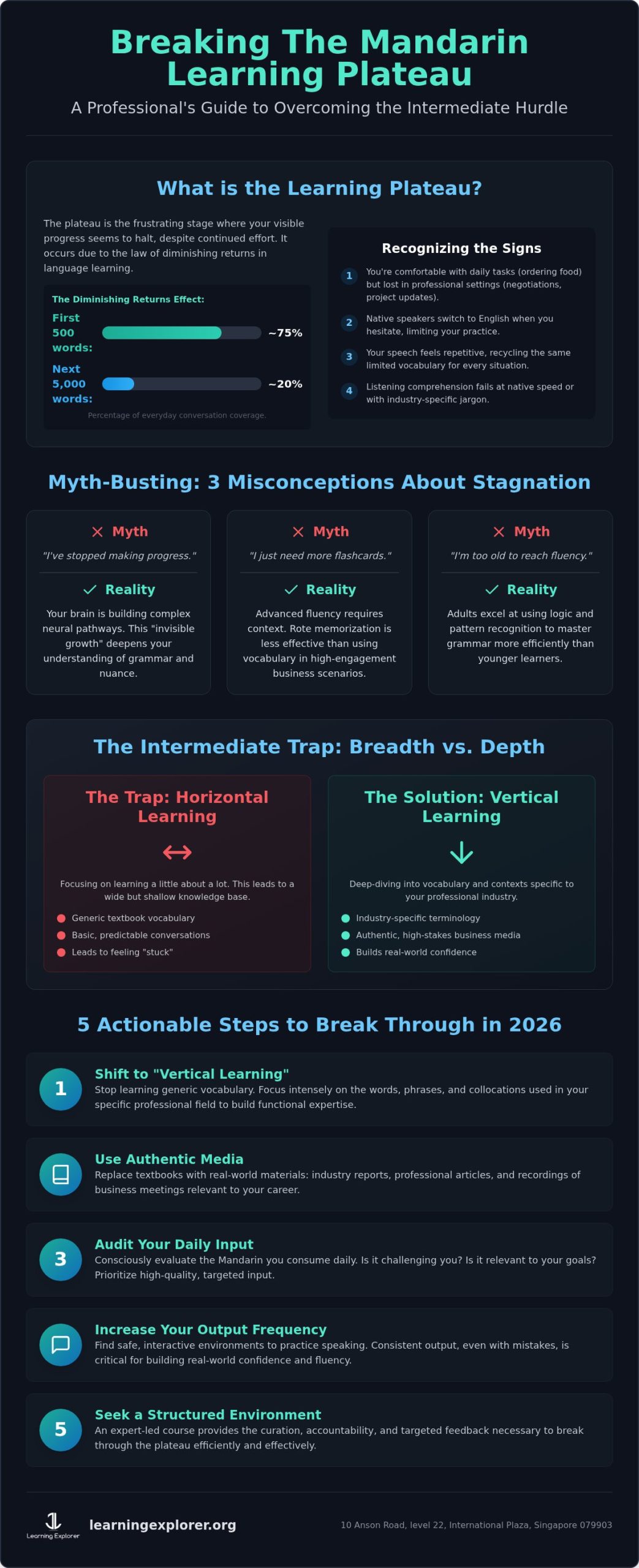
The Mandarin learning plateau is that frustrating stage where your visible progress seems to grind to a halt despite your continued effort. It’s a common experience for professionals who’ve moved past the basics but find themselves unable to reach true fluency. This phenomenon occurs because of the law of diminishing returns in language acquisition. While the first 500 words you learn might cover 75% of everyday conversation, the next 5,000 words only offer incremental gains in nuance and specific professional terminology. Overcoming mandarin learning plateau hurdles starts with understanding that your brain isn’t failing; it’s simply adjusting to a much steeper climb.
Many busy workers in Singapore’s CBD feel a heavy psychological weight when they hit this wall. You’ve invested time and energy, yet you still feel “stuck” at a conversational level that doesn’t serve your career goals. Moving from survival Mandarin to professional mastery requires a completely different toolkit. You aren’t just learning a language anymore; you’re learning to project authority and build trust in a second tongue. Our team at 10 Anson Road, level 22, International Plaza, Singapore 079903, sees this daily. We help students realize that the strategies used for beginner levels won’t bridge the gap to the boardroom.
The Shift from Quantity to Quality
At the intermediate level, simply memorizing more characters isn’t the solution. True fluency comes from mastering collocations and natural phrasing. You need to know which words belong together to sound like a native professional. Raw vocabulary is a foundation. However, business contexts expose gaps in your knowledge through complex social hierarchies and indirect communication styles. Quality of input becomes more important than the quantity of words on your flashcards.
Recognizing the Signs of a Plateau
Identify the plateau early. You might notice these specific indicators in your daily interactions:
- You’re comfortable ordering lunch at a hawker center but feel completely lost when trying to negotiate a contract or explain a complex project.
- Native speakers often switch to English the moment you hesitate, which limits your opportunities for real-world practice.
- You feel like you’re recycling the same 200 words for every situation, making your speech feel repetitive and unpolished.
- Your listening comprehension stalls when speakers use native-level speeds or industry-specific jargon.
If these signs feel familiar, it’s a signal that your current study routine needs a strategic update. Recognizing these patterns allows you to pivot toward high-impact learning that actually moves the needle. It’s about shifting from accidental learning to intentional mastery.
Myth-Busting the 3 Biggest Misconceptions About Stagnation
Believing common myths about language acquisition can be the biggest barrier to overcoming mandarin learning plateau challenges. These misconceptions often discourage professionals before they reach their full potential. When you understand the reality of how adults learn, you can stop blaming yourself and start adjusting your strategy. These myths frequently prevent learners from exploring resources like business mandarin for beginners sg, which are specifically designed to bridge the gap between basic speech and professional fluency.
Myth 1: “I’ve stopped making progress.” In reality, your brain is busy building complex neural pathways that aren’t immediately visible. This period of “invisible growth” is when you’re internalizing grammar patterns and tone nuances that will eventually become second nature. Just because you aren’t learning 50 new characters a week doesn’t mean your proficiency isn’t deepening through consolidation.
Myth 2: “I just need more flashcards.” Rote memorization only takes you so far. To reach the next level, you need context and high-engagement usage. Flashcards can create an illusion of competence where you recognize a word in isolation but struggle to use it to influence a meeting or negotiate a timeline effectively.
Myth 3: “I’m too old to reach native-like fluency.” While children learn through immersion, adults possess superior logic and pattern recognition skills. You can use these cognitive strengths to master Mandarin grammar and structure more efficiently than a younger learner might. Your professional experience actually gives you an edge in understanding the logical frameworks behind business communication.
The Illusion of Non-Progress
This phase is where the most important work happens. You might feel like you’re standing still, but you’re actually refining your understanding of the language’s architecture. Redefine your progress using professional benchmarks, such as how well you followed a fast-paced conversation or your ability to recognize a specific business idiom. The plateau is a consolidation phase where your brain organizes existing knowledge before moving to the next level of complexity.
Why Self-Study Apps Fail at the Intermediate Level
Gamified learning apps are excellent for building basic vocabulary but fall short in professional communication. They lack the nuanced feedback loop required to correct subtle errors in tone or etiquette. To truly “own” a word, you need real-time interaction that digital interfaces can’t provide. This is why professionals choose a dedicated language school for expert-led guidance in high-stakes environments. If you’re ready for real conversation, a structured class is a natural next step.
The Intermediate Trap: Breadth vs. Depth in Professional Mandarin
Many professionals fall into the “Intermediate Trap” because they continue to expand their vocabulary horizontally rather than vertically. Horizontal learning involves picking up a wide range of general words that don’t necessarily help you lead a team or close a complex deal. While knowing the Chinese names for every fruit is helpful at a local market, it won’t help you navigate a high-stakes board meeting. Overcoming mandarin learning plateau hurdles requires a strategic pivot toward vertical learning, where you deep dive into the specific language used within your professional domain.
Focusing your energy on mandarin for building client rapport is a high-leverage strategy. It moves you away from generic textbook scenarios and into the nuanced world of professional relationship management. This shift isn’t just about words; it’s about mastering the cultural nuances that signal respect and competence to your Chinese-speaking counterparts. When you prioritize depth over breadth, you start to see the immediate impact of your studies on your career trajectory.
Mastering Domain-Specific Vocabulary
Stop wasting time on “general” Mandarin that you’ll never use in your daily work. If you work in fintech, your top 50 phrases should revolve around digital payments and regulatory compliance rather than weather patterns or household items. Identify the specific terms used in your Singapore business sector. You’ll find that transitioning from literal translations to idiomatic professional expressions creates an immediate boost in your perceived authority and expertise.
The Power of Active Listening in the CBD
Your daily environment is a goldmine for progress. If you’re working in the heart of the city, use your commute through Tanjong Pagar to sharpen your ear. Pay attention to how native speakers phrase their requests or handle disagreements in the lift or at the coffee shop. Try “shadowing” these speakers by mentally or quietly repeating their sentences to mimic their rhythm and tone. This practice bridges the gap between clean classroom audio and the fast-paced, real-world Mandarin you hear in the CBD. It’s about moving from passive recognition to active, confident usage in any setting.
5 Actionable Steps to Break Through the Plateau in 2026
Breaking the cycle of stagnation requires a tactical shift. Generic advice often suggests simply “trying harder,” but for a busy professional, time is your most valuable currency. Overcoming mandarin learning plateau obstacles in 2026 demands precision. Follow these five steps to reclaim your momentum and see tangible results in your professional life.
- Step 1: Audit your current input. Stop relying on generic textbooks. Swap them for authentic professional media like industry-specific podcasts, financial news, or business case studies in Mandarin.
- Step 2: Increase your output frequency. You need a safe space where making mistakes is part of the process. The more you speak, the faster you’ll bridge the gap between “knowing” and “using.”
- Step 3: Focus on Functional Fluency. Instead of counting study hours, set goals based on specific professional tasks. When you focus on functional outcomes, overcoming mandarin learning plateau frustrations becomes a logical process rather than an emotional struggle.
- Step 4: Get professional feedback. Self-study can’t replace the nuanced correction of an expert who understands the logic behind the language.
- Step 5: Leverage the community at our training hub. Join the network of professionals practicing in the heart of the city. Our center is situated directly above Tanjong Pagar MRT, making it a convenient destination for CBD workers to practice together.
Setting Micro-Goals for Macro-Progress
Large goals are overwhelming. Use SMART criteria to set micro-goals that lead to macro-progress. For example, rather than saying “I’ll get better,” commit to a specific task: “I will lead the first five minutes of Monday’s meeting in Mandarin.” Tracking these small, non-linear wins keeps your motivation high during the “invisible growth” phases mentioned earlier. It’s about celebrating the ability to handle a specific client request or understand a nuanced joke in the office. These small victories prove that your skills are actually deepening.
The Role of Native Speaker Instructors
A bilingual instructor is essential because they explain the logic behind the language. They help you understand “why” certain phrases are used in specific professional contexts. In a conversational mandarin singapore setting, immediate correction prevents errors from becoming fossilized habits. This professional guidance also helps you overcome the “shame barrier.” It’s much easier to take risks when you have a reliable guide helping you navigate the complexities of business etiquette. Ready to transform your communication? View our upcoming course schedule and take the first step toward advanced fluency today.
Why a Structured Environment is the Ultimate Plateau-Killer
Self-study often feels like a second job. You spend more time searching for the right materials than actually practicing. A structured environment offers the curation advantage, where experts have already vetted high-quality resources for you. This allows you to focus entirely on the act of learning rather than the administrative burden of planning. For many professionals, overcoming mandarin learning plateau frustrations is simply a matter of switching from an unorganized self-study routine to a disciplined, expert-led path.
Accountability is the secret weapon of successful learners. While apps are easy to ignore, a fixed schedule at a language school singapore provides the external commitment needed to stay consistent. You aren’t just learning in a vacuum; you’re progressing alongside other professionals who share your challenges. This social element creates a supportive network that turns a solitary struggle into a shared journey toward mastery. It’s about moving from the labor of seeking to the satisfaction of discovery.
Convenience for the Busy CBD Professional
Time is your most limited resource. Our training center is situated directly above Tanjong Pagar MRT, making it incredibly easy to fit a session into your corporate schedule. You can join lunchtime classes to maximize your break or attend evening sessions before heading home. This central location also doubles as a networking hub. You’ll meet peers from various industries, from finance to tech, all working toward the same goal. We offer both private and group formats to ensure the curriculum matches your specific learning style and professional needs.
Transforming Labor into Discovery
We want to help you move from the “work” of learning to the joy of professional discovery. Our mission-driven approach is designed to inspire confidence and reduce the mental load of language acquisition. Instead of feeling like another task on your to-do list, your Mandarin journey becomes a creative catalyst for better career outcomes. It’s about the satisfaction of finally understanding a complex business discussion or building a deeper connection with a client. The next step is simple. Book a proficiency assessment to see where you truly stand. Reframe this plateau not as a wall, but as the launchpad for your advanced career.
Master the Nuance of Advanced Mandarin
Your journey to fluency doesn’t have to be a solo struggle against invisible barriers. By shifting from horizontal vocabulary growth to vertical domain mastery and embracing authentic professional media, you’re already ahead of the curve. Remember that the plateau is simply a consolidation phase where your brain prepares for the next level of complexity. Overcoming mandarin learning plateau challenges is entirely possible when you pair your professional drive with a proven, structured strategy.
Ready to elevate your communication? Break through your Mandarin plateau with Learning Explorer’s expert-led courses. Our native-speaker instructors bring real-world corporate experience to every session, ensuring you learn in a fun, interactive, and professional environment. Located directly above Tanjong Pagar MRT at International Plaza, we provide the perfect setting for CBD executives to thrive.
You’ve put in the hard work; now it’s time to see the results. We’re here to help you turn your intermediate knowledge into advanced professional influence. Your path to mastery starts with a single, strategic step forward.
Frequently Asked Questions
How long does the intermediate Mandarin plateau typically last?
The duration of the intermediate plateau varies significantly based on your exposure and study intensity. Many learners find this phase lasts between six months to a year. It represents a period where your brain consolidates fundamental rules before tackling complex nuances. Instead of worrying about the timeline, focus on shifting your study methods. Consistency remains the most important factor in navigating this transition and reaching the next level of fluency.
Is it possible to overcome the plateau through self-study alone?
Overcoming mandarin learning plateau obstacles through self-study is possible but often inefficient for busy professionals. Without real-time feedback from an expert, you might reinforce incorrect tones or awkward phrasing. A structured environment provides the necessary curation and accountability that apps lack. Working with a native-speaker instructor ensures you receive immediate corrections, which is vital for mastering the high-stakes communication required in a corporate setting.
What is the best way to measure progress when I feel stuck?
Shift your focus from quantitative data like character counts to qualitative, functional milestones. Ask yourself if you can summarize a Chinese news article or follow a fast-paced conversation during a business lunch. Tracking your ability to perform specific professional tasks provides a clearer picture of your growth. When you measure progress through real-world application, you’ll realize that your “invisible growth” is actually preparing you for advanced interactions.
Should I focus more on reading or speaking to break the plateau?
Balance is key, but prioritizing active output alongside high-quality input is the most effective strategy. Reading authentic professional media builds your vocabulary depth while speaking helps you “own” those words in conversation. If your goal is professional mastery, you must practice speaking in a safe, interactive environment. This ensures you can apply what you’ve read to real-time negotiations or client meetings without hesitating or losing your train of thought.
How many hours a week should a professional dedicate to breaking the plateau?
Dedicating three to five hours per week is typically sufficient for a professional to see meaningful progress. Consistency is far more effective than long, irregular study sessions. Break your time into manageable chunks, such as a 15-minute morning review and a longer weekly session with an instructor. This sustainable rhythm helps you integrate Mandarin into your busy lifestyle without causing burnout or administrative fatigue.
Can Business Mandarin courses help if I already know basic conversational Chinese?
A Business Mandarin Course is specifically designed for those who have mastered basic conversation but struggle with professional depth. These courses move beyond survival Chinese to focus on industry-specific terminology and corporate etiquette. You’ll learn to navigate complex social hierarchies and build stronger client rapport. This targeted approach is often the catalyst needed for overcoming mandarin learning plateau hurdles and finally achieving the professional fluency your career demands.