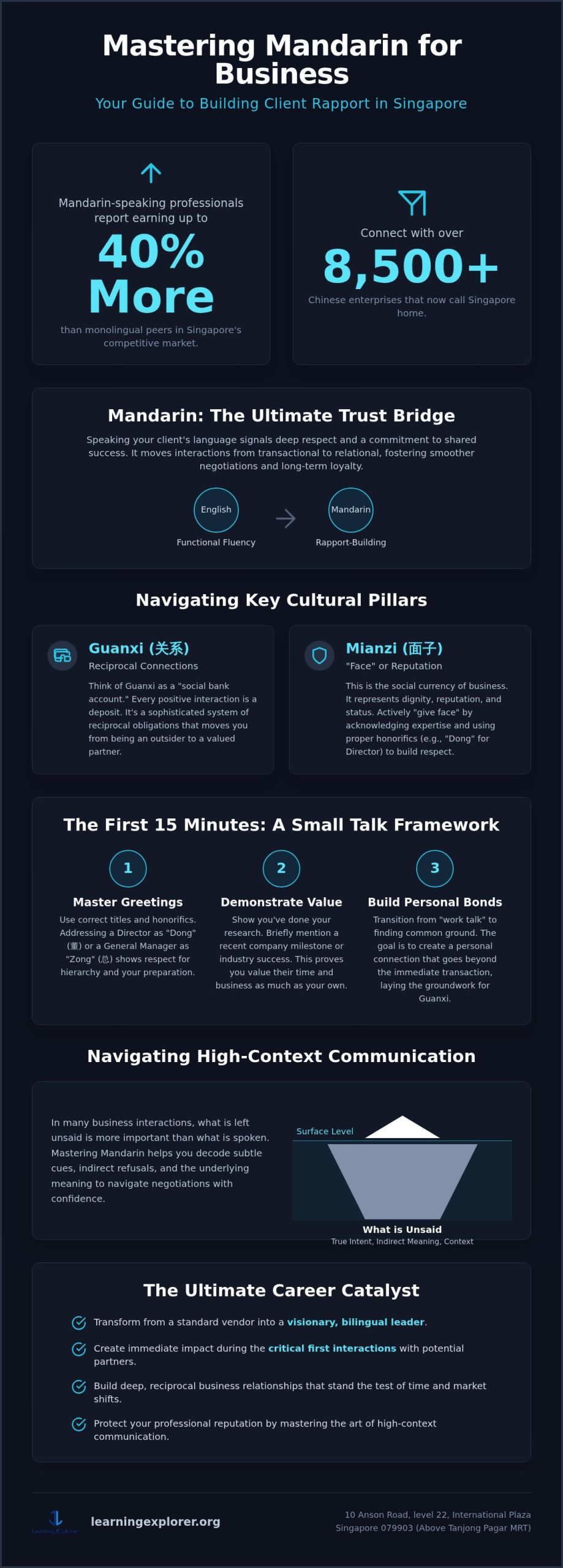
Did you know that Mandarin-speaking professionals in Singapore report earning up to 40% more than their monolingual peers as of 2026? This isn’t just about basic translation; it’s about the immense value of using mandarin for building client rapport in a landscape where over 8,500 Chinese enterprises now call Singapore home. You’ve probably felt that wave of anxiety during a business dinner, fearing a cultural slip-up might cause a client to lose face or cost you a vital connection.
We recognize how taxing it is to manage these high-stakes interactions while worrying about the invisible rules of Guanxi. This guide will help you master the subtle art of using Mandarin to build deep trust and navigate cultural nuances with your Chinese business partners. We’ll preview essential phrases for 2026, explain the mechanics of “face” in modern negotiations, and show you how to turn small talk into big opportunities. By leading with cultural intelligence, you can transform from a standard vendor into a visionary, bilingual leader within Singapore’s competitive financial district.
Key Takeaways
- Learn how Mandarin serves as a “trust bridge” that facilitates smoother negotiations and fosters long-term loyalty in Singapore’s competitive regional hub.
- Explore the modern definitions of Guanxi and Mianzi to protect your professional reputation and build deep, reciprocal business relationships.
- Implement a strategic small talk framework that goes beyond basic greetings to create an immediate impact during the critical first 15 minutes of interaction.
- Master the art of high-context communication to decode what is left unsaid and navigate the complexities of indirect refusals with confidence.
- Understand why mastering mandarin for building client rapport is the ultimate career catalyst for professionals operating in Singapore’s 2026 business landscape.
The Strategic Power of Mandarin for Building Client Rapport in 2026
Rapport acts as a trust bridge that facilitates smoother negotiations and fosters long-term loyalty. In 2026, Singapore’s status as a regional hub means that Mandarin has transitioned from a useful elective to an essential soft skill. Using mandarin for building client rapport isn’t just about the words spoken; it’s about signaling a deep respect for the partnership and a commitment to shared success.
To better understand the nuances of professional communication, watch this helpful video on business basics:
There’s a critical distinction between functional fluency and rapport-building Mandarin. While the former helps you navigate basic logistics, the latter allows you to connect on an emotional level. By utilizing targeted phrases, you demonstrate a cultural effort that reduces the perceived distance between a Singaporean professional and a Chinese partner.
Why Language is the Foundation of Trust
Hearing one’s native tongue in a foreign business setting has a profound psychological impact. It signals safety and familiarity, which are the prerequisites for any relational business model. Understanding Cultural Pillars: Guanxi and Mianzi is the first step in this journey. When you bridge the linguistic gap, you’re actively investing in the social capital required for high-stakes deal-making in the current year.
The Singapore CBD Context: Standing Out in Tanjong Pagar
In the competitive landscape of Raffles Place and Tanjong Pagar, masterfully building rapport is a key differentiator. While most executives rely solely on English, those who master Mandarin can navigate informal networking sessions with ease. Our training center is situated directly above Tanjong Pagar MRT, offering a supportive environment for CBD professionals to refine their skills during lunch hours or after work without leaving the financial heart of the city.
Understanding Cultural Pillars: Guanxi and Mianzi in Business
In 2026, Guanxi has evolved beyond the simple concept of “networking.” It’s now a sophisticated system of reciprocal obligations and digital responsiveness that defines professional standing in a Chinese context. Think of Guanxi as a social bank account where every interaction serves as a deposit or a withdrawal. Utilizing mandarin for building client rapport allows you to move past the surface level of a transaction and into the inner circle of trust. Without this foundation, you remain an outsider; with it, you become a valued partner whose opinions carry weight.
Mianzi, or “face,” is the social currency that accompanies Guanxi. It’s a non-negotiable element of every professional interaction in Singapore’s regional landscape. In business, face represents a person’s reputation, dignity, and perceived status. If you cause a client to lose face, the damage to the relationship is often permanent. This frequently occurs when professionals are too direct in their criticisms or accidentally challenge a senior executive’s authority in front of their team. Preserving face requires a high degree of emotional intelligence and linguistic tact.
The Art of Giving Face (Mianzi)
Giving face is a proactive strategy that involves publicly acknowledging a client’s expertise or their organization’s success. You can do this effectively by using correct titles and honorifics. Instead of just using a name, address a director as “Dong” or a general manager as “Zong.” These small linguistic choices signal that you respect the hierarchy and have taken the time to understand their corporate structure. Preparation is another way to give face. Arriving with a deep understanding of their recent company milestones shows that you value their time and status as much as your own.
Building Guanxi Beyond the Meeting Room
The real work of building Guanxi often happens after the formal meeting concludes. Social dining isn’t a distraction from business; it’s a core business function where the “Reciprocity Loop” begins. This is where you transition from “work talk” to building a personal bond. Navigating High-Context Communication during these meals means paying attention to the layers of meaning beneath the conversation. If a client mentions a personal hobby or a family detail, make a mental note. Following up on these details in your next interaction shows that you view the relationship as a long-term investment rather than a quick win.
Mastering these cultural pillars is a journey that requires practice and expert guidance. Our Business Mandarin Course is designed to help you navigate these complexities with confidence, ensuring you lead every meeting with cultural intelligence and professional poise.
The First 15 Minutes: A Mandarin Small Talk Framework
The first 15 minutes of any meeting are the most critical for establishing a “trust bridge.” This “Ice-Breaker” phase often dictates the emotional temperature of the entire negotiation. Using mandarin for building client rapport during this window is a game changer. It signals that you aren’t just there for a transaction; you’ve invested time in understanding their culture. The Strategic Advantage of Mandarin in Business is most visible here, where a few warm phrases can dissolve the professional “otherness” that often lingers in cross-border meetings.
Don’t feel pressured to maintain a Mandarin-only conversation. The goal is a natural flow, often referred to as a conversational mandarin singapore approach. You can start in Mandarin to show respect, transition to English for technical details, and return to Mandarin for the closing rapport. This flexibility shows you’re a modern, adaptable professional.
Step 1: The Warm Greeting and Professional Introduction
The correct way to introduce yourself is to state your name followed by your company and title: “Wo shi [Name], [Company] de [Title].” This structure respects the hierarchy that is central to Chinese business culture. Depending on the formality of the room, you can use these three variations of “It’s a pleasure to meet you”:
- Standard: “Hen gaoxing renshi nin.” (Very happy to meet you.)
- Formal/Respectful: “Jiu yang, jiu yang.” (I’ve long looked forward to meeting you.)
- High Respect: “Renshi nin shi wo de rongxing.” (Meeting you is my honor.)
Remember the “Two-Handed” rule during the business card (Mingshi) exchange. Always offer and receive cards with both hands, making sure the text is facing the recipient. As you do this, say “Qing duo zhi jiao,” which translates to “Please kindly guide me.”
Step 2: Safe and Effective Small Talk Topics
Stick to safe topics that build warmth without crossing personal boundaries. If they’ve just arrived in Singapore, ask about their journey: “Xinjiapo de tianqi hen re ba? Yi lu xinku le.” (Singapore’s weather is hot, right? You must be tired from the journey.) Food is another excellent bridge. Compliment their hometown’s cuisine or ask, “Nin xihuan xinjiapo de food ma?” (Do you like Singaporean food?) Always avoid sensitive topics like politics or personal wealth during this initial phase.
Step 3: Complimenting the Client’s Progress
Praising a client’s company shows you’ve done your homework. Use phrases like “Guigongsi de fazhan feichang bang” (Your company’s development is excellent) or “Guigongsi de sheng yu hen hao” (Your company has a great reputation). If they compliment your Mandarin, don’t just say thank you. Use the “Modesty Response”: “Nali, nali, wo hai zai xuexi.” (Not at all, I’m still learning.) This humble approach is deeply appreciated and further strengthens the rapport you’ve built.
You can practice these frameworks with our native-speaking trainers at 10 Anson Road, level 22, International Plaza, Singapore 079903, located directly above Tanjong Pagar MRT. We’re here to help you turn these scripts into natural professional habits.
Navigating High-Context Communication and Digital Rapport
High-context communication is the art of reading the air. In a Chinese business setting, what’s left unsaid often carries as much weight as the spoken word. This style of interaction relies on shared understanding and the strength of the relationship rather than literal definitions. For Singaporean professionals, using mandarin for building client rapport requires a shift from direct, logic-based arguments to a more intuitive, relationship-first approach. You must learn to listen for the intent behind the language.
Identifying the “Art of Indirect Refusal” is a critical survival skill. Because preserving face is paramount, a direct “no” is rarely heard. Instead, you might encounter phrases like Wo men zai yan jiu yan jiu (We’ll study it further) or Bu tai fang bian (It’s not very convenient). These aren’t invitations to follow up with more data. They are polite signals of hesitation. Recognizing these subtle cues prevents you from pushing too hard and damaging the Guanxi you’ve worked so hard to build.
Reading Between the Lines in Meetings
Listening for “hedging” words is essential during negotiations. If a client uses terms like hai hao (it’s okay/mediocre) or hai xing (it’ll do), they’re likely expressing a lack of enthusiasm. When you encounter this, don’t press for an immediate answer. Instead, use clarifying questions that allow the client to elaborate without feeling cornered. Ask something like, “Do you have any specific concerns we should address?” in Mandarin. This gives them the space to provide feedback while keeping their professional dignity intact.
Silence is also a powerful tool in high-context discussions. In many Western cultures, silence feels awkward and needs to be filled. In a Mandarin-speaking business environment, a pause often indicates deep reflection or respect for the topic. Don’t rush to break the silence. Allow the moment to breathe; it shows you’re comfortable with the pace of the relationship and value their thoughtful consideration.
Modern Rapport: WeChat Etiquette for Professionals
By 2026, WeChat (Weixin) has become the digital pulse of professional relationship maintenance. It’s no longer just an app; it’s where Guanxi lives between meetings. Mastering mandarin for building client rapport involves digital agility. Use the “Moments” feature strategically. Liking or leaving a brief, respectful comment on a client’s professional post shows you’re paying attention to their success outside the boardroom. It’s a low-pressure way to stay top-of-mind.
Digital messaging has its own set of rules. Responsiveness is a proxy for respect. Aim to reply to business inquiries within a few hours to signal that the partnership is a priority. Keep your language professional but slightly more accessible than a formal email. Use polite closing phrases like Xie xie nin de pei he (Thank you for your cooperation) to maintain a helpful tone. Avoid overusing casual emojis; stick to neutral ones that convey warmth without sacrificing your professional standing.
Ready to master these subtle communication layers? Enroll in our Business Mandarin Course today to gain the cultural and linguistic tools needed to lead with confidence in the CBD.
Accelerating Your Professional Growth with Business Mandarin
Mastering Mandarin is a strategic career pivot. In a city where Mandarin proficiency is now a prerequisite for a vast majority of regional leadership roles, standing still is the same as falling behind. A structured business mandarin for beginners sg course transforms you from a spectator into a key player in high-stakes negotiations. By focusing on mandarin for building client rapport, you don’t just learn to speak; you learn to lead. Our curriculum is built for the practitioner, ensuring every lesson translates directly to your next boardroom presentation or client lunch.
Learning Mandarin shouldn’t feel like another administrative burden. We’ve designed our interactive sessions to be the creative catalyst for your professional success. You’ll engage in real-world simulations that replace the labor of seeking the right words with the satisfaction of genuine discovery. Our native-speaker instructors are also bilingual. This means they can explain the “why” behind cultural nuances, bridging the gap between Singaporean business norms and mainland Chinese expectations. You’ll gain the confidence to handle everything from formal introductions to the complexities of digital rapport. If you find your progress stalling at an intermediate level, understanding the strategies for overcoming the Mandarin learning plateau can help you break through to the advanced fluency that high-stakes client interactions demand.
Why Learning Explorer is the Ally of CBD Professionals
Efficiency is the core of our philosophy. We recognize that your time is your most valuable asset. That’s why our training center is located in the heart of the CBD at International Plaza, situated directly above Tanjong Pagar MRT. This prime location allows you to step out of your office and into a high-quality learning environment in minutes. Whether you prefer private one-to-one coaching, collaborative group courses, or intensive workshops, we offer flexible formats that respect your busy schedule. You can easily fit a session into your lunch hour or immediately after work without the stress of a long commute.
Your Path to Becoming a Bilingual Leader
Credibility in the international market requires a curriculum that aligns with global standards. We focus on practical, industry-specific Mandarin that enhances your professional impact. You won’t just memorize vocabulary; you’ll master the art of the modesty response and the nuances of Guanxi. This expertise positions you as a reliable ally to your Chinese partners. The journey begins with a clear understanding of your current skills. We encourage you to book a diagnostic session with our expert trainers to assess your level and create a roadmap for your growth. Take the first step toward reducing communication friction and increasing your influence in the region by enrolling in our Business Mandarin Course today.
Elevate Your Professional Impact in the CBD
Mastering the nuances of Guanxi and high-context communication isn’t just about language; it’s about becoming a visionary leader in Singapore’s 2026 landscape. You now understand how the first 15 minutes of a meeting can set the stage for long-term loyalty and why digital rapport on WeChat is a non-negotiable skill for modern executives. By focusing on mandarin for building client rapport, you position yourself as a partner who truly respects the pillars of face and mutual benefit.
Our certified native-speaker instructors act as your knowledgeable guides, providing tailored training for Singapore professionals right in the heart of the city. We understand the taxing nature of your daily schedule, so we’ve made our interactive classes as efficient as possible. Visit us at 10 Anson Road, level 22, International Plaza, Singapore 079903, directly above Tanjong Pagar MRT, to start your transformation.
Professionals looking to go beyond rapport-building and develop a comprehensive command of boardroom conduct will benefit from exploring business mandarin for professional etiquette singapore, which covers the full spectrum of cultural intelligence required for regional leadership in 2026.
Master Business Mandarin and Build Better Client Rapport Today! You have the potential to bridge any cultural gap and lead with confidence. We’re here to support every step of your journey toward bilingual excellence.
Frequently Asked Questions
Is it better to speak basic Mandarin or stick to English if I’m not fluent?
Using basic Mandarin is generally better because it demonstrates significant cultural effort. Even if you aren’t fluent, showing respect for the client’s heritage builds immediate trust. It signals that you’re willing to step out of your comfort zone to foster the relationship. Most clients appreciate the gesture and will often switch back to English for technical details once the initial rapport is established.
What are the most important Mandarin phrases for a first-time meeting with a Chinese client?
Start with formal greetings that show respect for hierarchy. Using specific mandarin for building client rapport in these early moments helps establish a positive emotional tone. Essential phrases include:
- Hen gaoxing renshi nin (Very happy to meet you)
- Qing duo zhi jiao (Please kindly guide me)
- Nin xinku le (You have worked hard; used to acknowledge their travel)
These gestures signal humility and cultural effort immediately.
How do I avoid accidentally offending a client due to a cultural misunderstanding?
Focus on preserving Mianzi, or face, by avoiding any public criticism of the client or their team. Use indirect language when you disagree and pay close attention to non-verbal cues. Researching cultural pillars like Guanxi before the meeting helps you navigate these interactions safely. If you make a mistake, a humble apology in Mandarin often goes a long way in showing your sincerity and commitment.
How long does it take for a beginner to learn enough Mandarin for basic business rapport?
A beginner can typically learn enough Mandarin for basic rapport within 10 to 15 hours of structured training. This timeframe allows you to master greetings, business card etiquette, and simple small talk topics like weather or travel. While full fluency takes longer, the cultural effort phase happens quickly. Consistency is key, and focusing on industry-specific phrases will help you see immediate results in your professional interactions.
What is the best way to maintain rapport with a client after the meeting is over?
Use digital tools like WeChat to send a polite follow-up message within a few hours. Mention a specific detail discussed during small talk to show you were paying attention. Liking a client’s professional social posts also keeps you top-of-mind. This consistent, low-pressure engagement strengthens the Guanxi loop and ensures the relationship continues to grow long after the formal discussion has concluded.
Can I learn Business Mandarin if I have zero prior experience with the language?
Yes, you can definitely learn Business Mandarin with zero prior experience. Our courses are specifically designed for adult learners who are starting from scratch. We focus on high-frequency phrases and practical scenarios that you can use immediately in the boardroom. By concentrating on relationship-building basics rather than complex grammar, beginners quickly gain the confidence needed to navigate professional social settings effectively.
What are the key differences between conversational Mandarin and Mandarin for building client rapport?
While conversational Mandarin focuses on daily survival tasks like ordering food, using mandarin for building client rapport emphasizes hierarchy, respect, and cultural nuances. It includes specific honorifics, the art of indirect refusal, and the strategic use of modesty. These specialized skills are what differentiate a standard vendor from a trusted business partner in the competitive Singaporean landscape, ensuring you navigate professional interactions with tact.
How does Learning Explorer’s location in the CBD benefit busy professionals?
Situated directly above Tanjong Pagar MRT, the center offers unparalleled convenience for busy executives. This location at International Plaza allows you to attend classes during your lunch hour or immediately after work without a long commute. Being in the heart of the financial district means you can upgrade your skills while staying connected to your professional hub, effectively reducing the administrative burden of travel.