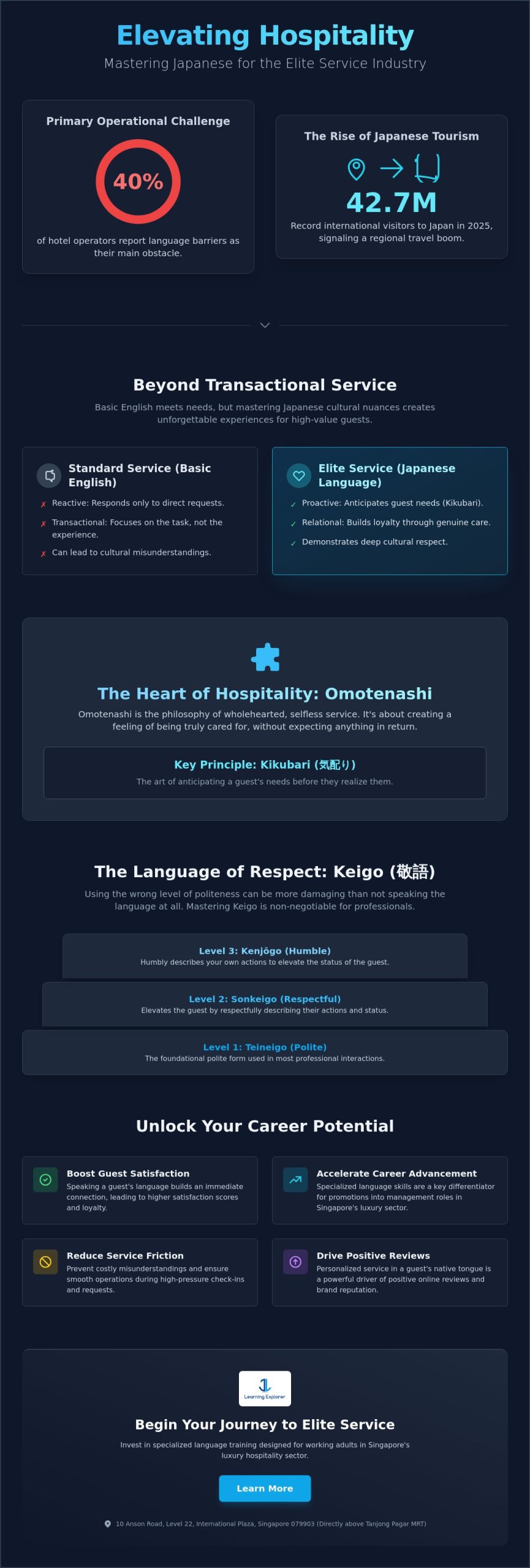
40% of hotel operators report that language barriers are their primary operational challenge, even as Japan welcomed a record 42.7 million visitors in 2025. If you work in a high-end environment, you’ve likely felt the pressure to perform while worrying about using incorrect honorifics. Mastering japanese for hospitality industry is no longer just a bonus skill. It’s the key to providing the seamless, respectful service that elite travelers expect in 2026. Professionals who bridge this communication gap find themselves at a significant advantage in Singapore’s luxury landscape.
We understand that your schedule is demanding and you don’t have years to spend on general language courses. You need practical tools that work during a busy check-in or a complex dining request. This article will show you how to master the linguistic and cultural nuances of Japanese hospitality to elevate your service standards and your career prospects. We will explore how to handle guest requests with confidence, decode the expectations of modern travelers, and use the philosophy of Omotenashi to stand out in a competitive market.
Key Takeaways
- Analyze the shifting tourism trends of 2026 and why basic English often falls short for discerning, high-net-worth Japanese travelers.
- Discover the core philosophy of Omotenashi and how this selfless approach to service differs from typical transactional hospitality.
- Master the three essential levels of Keigo to ensure you always use the correct honorifics when practicing japanese for hospitality industry.
- Learn high-impact phrases for greetings and check-in procedures that demonstrate professional grace and anticipate guest needs.
- Understand how specialized language training for working adults can accelerate your career advancement within Singapore’s luxury hospitality sector.
The Growing Importance of Japanese for the Hospitality Industry in 2026
Singapore is witnessing a sharp resurgence in Japanese arrivals this year. By the end of 2025, Japan saw a record 42.7 million international visitors, and that momentum has increased travel throughout the region. In March 2026 alone, international visitor arrivals to Japan jumped by 3.5% compared to the previous year, signaling a robust return of the high-net-worth traveler. For professionals in Singapore’s elite service sectors, mastering japanese for hospitality industry is no longer a luxury. It’s a critical tool for career growth.
While basic English might suffice for standard transactions, it often fails to meet the expectations of discerning guests who value cultural alignment. These travelers look for more than just a room; they seek a specific level of care rooted in deep tradition. To understand the depth of this expectation, one must explore What is Omotenashi?, the Japanese philosophy of wholehearted service. When you speak the language, you demonstrate a commitment to this philosophy that English alone cannot convey. This cultural bridge directly correlates with higher guest satisfaction scores, as guests feel seen and respected.
To better understand how these linguistic skills apply to real-world guest interactions, watch this helpful video:
Singapore as a Hub for Japanese Business and Leisure
The Central Business District remains a powerhouse for Japanese corporate activity. Many major Japanese headquarters are concentrated in the Tanjong Pagar area, making the surrounding luxury properties the first choice for visiting executives. Guests staying at these properties expect staff to navigate the complexities of corporate etiquette with ease. Our training center is situated directly above Tanjong Pagar MRT, placing our students at the very heart of this activity. Being able to greet a CEO with the appropriate level of respect builds long-term loyalty that secures future corporate bookings.
The ROI of Language Training for Hospitality Teams
Language skills act as a vital lubricant that reduces service friction and prevents costly misunderstandings during high-pressure shifts. Beyond avoiding errors, personalized service in a guest’s native tongue drives positive online reviews and strengthens your brand’s reputation. 40% of hotel operators currently cite language barriers as their primary operational challenge. By closing this gap, you don’t just improve the guest experience; you also accelerate your own career path. Upskilling with japanese for hospitality industry often leads to faster promotions into management roles within Singapore’s luxury circuits.
What is Omotenashi? The Philosophy Behind the Language
Omotenashi is often translated simply as hospitality, but it goes much deeper than standard customer service. It represents the act of entertaining guests wholeheartedly without expecting anything in return. While Western service is frequently a transactional exchange where the guest pays for a specific outcome, Omotenashi focuses on the invisible labor that makes a guest feel truly cared for. This philosophy is the foundation of any successful career in japanese for hospitality industry. It requires a shift from being reactive to being proactive, a concept known as Kikubari.
Kikubari involves anticipating a guest’s needs before they even realize they have them. If a guest looks slightly cold, a staff member practicing Kikubari brings a pashmina without being asked. This level of care is deeply embedded in the Japanese language. The grammar and vocabulary are designed to place the guest on a pedestal while the provider remains humble. By learning the language, you aren’t just memorizing sounds; you’re adopting a way of thinking that prioritizes the guest’s comfort above all else.
The Three Pillars of Omotenashi
To master this philosophy, you must understand its three core components. First is Shitsurai, which refers to the physical environment. This isn’t just about cleanliness; it’s about the thoughtful preparation of the space to welcome a specific guest. Second is Furumai, the behavior and conduct of the staff. This includes everything from your posture to the speed of your movements. Finally, there is Kotoba, or the specific choice of words. In japanese for hospitality industry, the words you choose act as a verbal bow, signaling your respect and dedication.
Applying Omotenashi in a Modern Singaporean Context
Adapting these values to the fast paced Singapore service industry requires balance. You don’t need to slow down your service; you simply need to change your approach. Omotenashi is a mindset, not just a set of rules. In a busy hotel lobby, it might mean noticing a guest struggling with a map and stepping in with a local recommendation before they reach the concierge desk. In a restaurant, it could be refilling a tea cup the moment it hits the one third mark.
If you want to deepen your understanding of these nuances, you might consider a specialized language program that focuses on these cultural layers. By integrating these practices, you move beyond being a service provider and become a true host. This distinction is what separates a standard dining experience from a memorable one that guests will talk about for months.
Keigo vs. Conversational Japanese: What Professionals Need
Excelling in japanese for hospitality industry requires you to move far beyond the basics of everyday speech. While a standard textbook might teach you “Tabemasu” for eating, using this with a high-net-worth guest at a five-star property can sound surprisingly casual. Professionals must master Keigo, the complex system of honorific language that defines social hierarchy and respect. In a luxury environment, Keigo isn’t just a preference; it’s the mandatory language of the job. Failing to use it correctly can make even the most well-intentioned service feel unfinished or even rude.
Keigo functions as a linguistic toolkit with three distinct levels. Teineigo is the standard polite form using “-desu” and “-masu” endings. While safe for general interactions, it lacks the depth required for premium service. Sonkeigo, or respectful language, is used to elevate the guest’s actions. Conversely, Kenjougo, or humble language, is used to lower your own status. Mastering the balance between these two creates the professional distance and respect that Japanese travelers expect. You must also stay alert for “Baito-keigo,” which are common but grammatically incorrect phrases often used by part-time workers. Using these “convenience store” phrases in a fine dining or hotel setting can undermine your professional image instantly.
When to Use Sonkeigo vs. Kenjougo
Understanding the “direction” of respect is vital for smooth service. When a guest arrives or makes a choice, you use Sonkeigo to honor their presence. When you perform an action for them, such as bringing the bill or taking a coat, you switch to Kenjougo. Our curriculum focuses specifically on these directional shifts to ensure your speech flows naturally during a high-pressure shift in the CBD.
| Standard Verb | Sonkeigo (Guest’s Action) | Kenjougo (Your Action) |
|---|---|---|
| Iru (To be/stay) | Irassharu | Oru |
| Taberu (To eat) | Meshiagaru | Itadaku |
| Miru (To see) | Goran ni naru | Haiken suru |
The Limitations of General Japanese Courses
A standard learn japanese language course often prioritizes grammar for daily life, such as shopping or asking for directions. However, these courses rarely cover the specific jargon used in a hotel lobby or a Michelin-starred restaurant. Hospitality Japanese has different priorities than Business Japanese. While a business course might focus on email etiquette and negotiation, japanese for hospitality industry focuses on real-time comfort and immediate honorifics. You need role-playing scenarios that mimic a busy check-in or a complex dietary request rather than just repetitive grammar drills. This targeted approach ensures you can handle high-pressure moments without losing your linguistic composure.
Essential Japanese Phrases for Every Hospitality Scenario
While many beginners believe “Irasshaimase” is the only greeting needed, luxury service requires a more personalized touch. In 2026, discerning guests expect you to recognize their arrival as an anticipated event. Using “O-machi shite orimashita” (We have been waiting for you) immediately elevates the interaction from a generic welcome to a dedicated experience. This shift in vocabulary is a hallmark of professional japanese for hospitality industry training. It signals to the guest that they are not just another booking, but a valued individual whose presence was expected and prepared for.
Managing the logistics of a check-in requires linguistic precision to maintain a sense of grace. When you ask for a passport or a credit card, your phrasing must reflect the high value placed on the guest’s belongings. Avoid direct commands. Instead, use humble forms to request these items, ensuring the guest feels respected throughout the administrative process. If a problem arises, a standard apology won’t suffice. “Moushiwake gozaimasen” is the necessary phrase for sincere, professional regret. It acknowledges the inconvenience without making excuses, which is vital for maintaining trust when service doesn’t go as planned.
The Concierge and Front Desk Workflow
Concierge staff often act as the primary guides for international visitors. You must be able to provide directions, recommend local dining, and book taxis using language that feels both helpful and authoritative. When you need to ask for personal details to complete a booking, use “Sashitsukae nakereba” (If it’s not an inconvenience) to soften the inquiry. Always remember that addressing a guest correctly with the suffix “-sama” attached to their family name is a non-negotiable standard for professional respect.
F&B and Fine Dining Excellence
In a dining environment, your words should be as refined as the cuisine. When presenting the bill, use Kenjougo to lower your own status while processing the payment with efficiency. You should also be prepared to describe ingredients using respectful vocabulary that honors the effort of the chef and the quality of the produce. As guests depart, the art of the Japanese “parting gift” comes into play. Send them off with a warm “O-ki wo tsukete” (Please take care), ensuring their last impression of your service is one of genuine concern for their well-being.
With 75% of hotel workers reporting an increased workload due to labor shortages, being able to communicate clearly and correctly the first time is a massive operational advantage. If you are ready to master these high-impact interactions, sign up for our Conversational Japanese Course today to sharpen your professional edge.
Elevate Your Career with Professional Japanese Training
Mastering the nuances of japanese for hospitality industry requires more than just a dictionary. It demands an immersive approach that combines linguistic precision with a deep understanding of service culture. At Learning Explorer, we specialize in bridging this gap for professionals who need immediate, practical results. Our native speaker instructors don’t just teach grammar; they share the subtle cues and cultural expectations that define elite hospitality. By learning from experts who understand the high pressure environment of a luxury hotel or a fine dining establishment, you gain the confidence to handle any guest interaction with poise.
We designed our Learn Japanese Language Course specifically for working adults in the service sector. We know your time is valuable and your schedule is often unpredictable. That’s why our training center is located at 10 Anson Road, level 22, International Plaza, Singapore 079903, situated directly above Tanjong Pagar MRT. This central location makes it easy to attend sessions before or after your shift in the CBD. Our curriculum focuses on the specific scenarios you face daily, ensuring that every hour you spend in the classroom translates directly to better service on the floor.
Customized Corporate Solutions for Hotels and Restaurants
For organizations looking to upskill their entire team, we offer tailored corporate training programs. We work closely with management to align our curriculum with your specific brand standards and service protocols. Whether you need your front desk team to master check in etiquette or your sommeliers to describe vintages in Keigo, we can build a program that fits. Our training is flexible; we can conduct sessions on site at your property or at our professional center. We focus on interactive learning that sticks, using role play and real world simulations to reduce the administrative burden of traditional training while increasing staff engagement.
Join the Best Language School in Singapore
Choosing the right partner for your professional development is essential for long term success. Learning Explorer has earned a reputation as the best language school singapore for those seeking practical, career oriented skills. We move beyond rote memorization to help you embody the spirit of Omotenashi in every word you speak. Don’t let language barriers limit your potential in Singapore’s thriving luxury market. Visit us at International Plaza to see how we can help you transform your service from good to truly unforgettable. Your journey toward mastering japanese for hospitality industry starts with a single, purposeful step toward professional excellence.
Step Into the Future of Luxury Service
The landscape of guest expectations is shifting rapidly in 2026. Mastering japanese for hospitality industry is no longer just a professional asset; it’s a transformative skill that bridges the gap between standard service and true Omotenashi. You’ve seen how the right honorifics and a proactive mindset can turn a routine check-in into a memorable experience. By focusing on the nuances of Keigo and the art of anticipating needs, you position yourself as an indispensable leader in the luxury market.
Our team is here to support your growth through native-speaker instructors with deep bilingual expertise. We provide customized corporate training for Singapore’s leading hospitality brands and offer a convenient CBD location at International Plaza above Tanjong Pagar MRT. This accessibility ensures you can balance professional development with your busy shift schedule. Don’t let language barriers hold back your career potential or guest satisfaction scores.
Start your journey to hospitality mastery with our Japanese courses today! We look forward to helping you create unforgettable moments for every guest you welcome.
Frequently Asked Questions
Is Japanese difficult to learn for someone working in hospitality?
Learning japanese for hospitality industry is highly achievable because it focuses on specific, recurring guest interactions. While the grammar differs from English, you don’t need to learn every word in the language to be effective. By mastering a set of core professional phrases and honorific structures, you can handle most front-desk or dining scenarios with confidence and grace.
How long does it take to learn basic hospitality Japanese?
You can typically gain basic proficiency in 10 to 12 weeks of consistent study. This timeframe allows you to master essential greetings, check-in procedures, and basic dining requests. While full fluency takes longer, focusing on the specific vocabulary used in your daily shift ensures you see immediate results in guest satisfaction and communication efficiency during your busy workdays.
What is the difference between regular Japanese and hospitality Japanese?
Regular Japanese often uses casual or standard polite forms, whereas hospitality Japanese relies heavily on Keigo. This honorific language is designed to show maximum respect through specific verb changes and prefixes. In a luxury setting, using standard conversational Japanese can actually sound unprofessional or overly familiar to a Japanese traveler who expects a certain level of formal distance and humility.
Do I need to know Kanji for a hospitality job?
Speaking and listening skills are far more critical than Kanji for most front-line hospitality roles. While being able to recognize some characters on a menu or a reservation list is helpful, your primary goal is verbal communication. Most professional training programs prioritize the spoken nuances of Omotenashi, allowing you to engage with guests immediately without the burden of memorizing thousands of characters.
What is the most important phrase in Japanese hospitality?
While many point to “Irasshaimase,” the most impactful phrase is often “O-machi shite orimashita.” This tells the guest you’ve been waiting specifically for them, which perfectly embodies the spirit of Omotenashi. Using this phrase instead of a generic welcome signals that your service is proactive and personalized, setting a high standard for the guest’s entire stay or meal experience.
Can my company arrange group Japanese training in Singapore?
Yes, we provide flexible corporate training solutions that can be delivered directly at your hotel or restaurant. Our instructors can tailor the curriculum to match your specific brand standards and service protocols. This approach ensures your entire team is aligned in their linguistic and cultural approach, creating a consistent and high-quality experience for every Japanese guest who visits your property.
Where is Learning Explorer located for Japanese classes?
Our training center is located at 10 Anson Road, level 22, International Plaza, Singapore 079903. This prime CBD location is situated directly above Tanjong Pagar MRT, making it incredibly convenient for staff working in nearby luxury hotels and restaurants. You can easily attend a class before your shift or during a break without a long commute.
Are the Japanese instructors at Learning Explorer native speakers?
Every instructor at Learning Explorer is a native Japanese speaker with extensive experience in professional education. They possess the bilingual expertise needed to explain complex cultural nuances in English while ensuring your pronunciation is accurate. This native insight is vital for mastering japanese for hospitality industry, as it helps you understand the emotional intent behind the honorific language.