Mastering a new tongue isn’t just a hobby; it’s a strategic career move that can increase your professional marketability by up to 20% in Singapore’s competitive 2026 job market. You’ve likely felt the frustration of staring at three distinct writing systems while wondering how you’ll ever find the time to learn japanese language basics between back-to-back meetings. It’s natural to feel overwhelmed or fear mispronunciation when you don’t have a native guide. We understand the grit it takes to balance work with personal growth, and we’re here to provide the spark you need to succeed.
This guide empowers you with a structured roadmap designed specifically for busy professionals and students. You’ll discover how to achieve conversational fluency and pass the JLPT for career advancement while utilizing available professional development funding like WSQ and NTUC UTAP. We’ll simplify the process by showing you how to transition from searching for resources to finding curated excellence. Join us at Learning Explorer’s training centre at 137 Cecil Street, Level 7, Cecil Building, Singapore 069537, as we explore the most efficient path to your linguistic transformation.
Key Takeaways
- Discover the strategic career advantages of mastering Japanese for Singapore-Japan trade relations and how cultural etiquette can transform your professional connections.
- Simplify the complex writing system by building a solid phonetic foundation in Hiragana and Katakana, the essential first steps for every beginner.
- Understand why structured classroom environments at our Tanjong Pagar MRT location are the most effective way to learn japanese language nuances that apps often overlook.
- Streamline your progress with a proven, step-by-step roadmap designed to help you master a core vocabulary of 500+ essential daily words with confidence.
- Empower your professional development by utilizing WSQ and NTUC UTAP funding to significantly reduce your course fees at our International Plaza training center.
Why Learn the Japanese Language in Singapore Today?
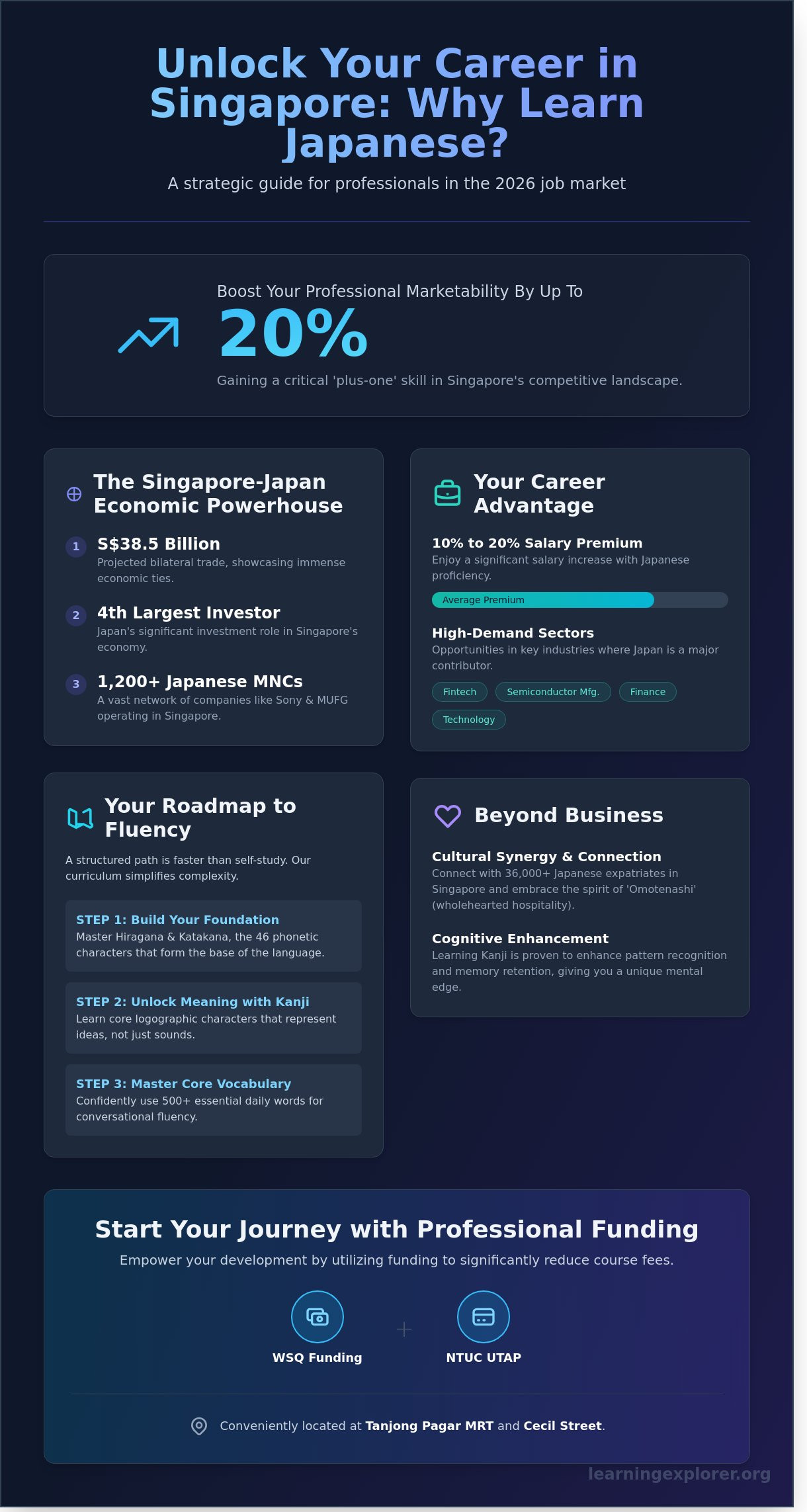
Choosing to learn japanese language in 2026 places you at the intersection of high-growth trade and deep cultural connection. Japan currently stands as Singapore’s fourth largest investor; bilateral trade figures are projected to hit S$38.5 billion by the end of the year. This economic tie creates a massive demand for professionals who can bridge the gap between local operations and Tokyo headquarters. Mastering the language opens doors to the nuanced world of Japanese business etiquette, where a single bow or the correct honorific can seal a multi-million dollar deal.
To better understand the path to proficiency, watch this helpful video:
The cognitive shift required to understand the Japanese writing system provides a unique mental edge. Research from 2024 suggests that learning logographic scripts like Kanji enhances pattern recognition and memory retention more effectively than Latin-based languages. It’s a transformative experience that reshapes how you process information. In Singapore, you can access this high-quality native instruction right in the heart of the city. Our training centre is located at 10 Anson Road, level 22, International Plaza, Singapore 079903. It’s conveniently situated right above Tanjong Pagar MRT, making it easy to fit lessons into a busy workday.
Career Opportunities for Japanese Speakers in SG
Singapore hosts over 1,200 Japanese MNCs, ranging from financial giants like MUFG to tech leaders like Sony. Proficiency in Japanese is a high-value asset in sectors like semiconductor manufacturing and fintech, where Japanese firms contribute to 15% of local industrial output. Holding this ‘plus-one’ skill often leads to a 10% to 20% salary premium. You can also leverage WSQ and NTUC UTAP funding to offset your training costs, ensuring your professional development is both affordable and impactful.
Cultural Synergy Between Singapore and Japan
The bond between our two nations goes deeper than trade. We share core values of discipline and the spirit of ‘Omotenashi,’ or wholehearted hospitality. By choosing to learn japanese language, you build a bridge for authentic travel experiences and deeper social connections with the 36,000 Japanese expatriates living in Singapore. This cultural fluency allows you to navigate networking events at the Japan Association or local izakayas with genuine confidence. It’s about finding the spark in every conversation and applying your language skills in real-world scenarios, making your learning truly come alive. If you’re also thinking about your children’s linguistic future, exploring kids language classes in Singapore can give your child the same early advantage in Japanese or other languages.
Decoding the Japanese Writing System: Hiragana, Katakana, and Kanji
When you decide to learn japanese language, the first thing you’ll notice is the visual diversity of the text. It isn’t just one alphabet; it’s three distinct systems working in harmony to create meaning. Think of Hiragana as the glue. These 46 phonetic characters represent every sound in the language. You’ll use them for grammar particles, verb endings, and words that don’t have a specific character assigned to them. It’s the essential starting point for every beginner.
Katakana is your secret weapon. It uses the same sounds as Hiragana but with sharper, more angular strokes. This script is primarily used for foreign loanwords, names, and onomatopoeia. If you see “ko-hi-” or “re-su-to-ran,” you’re actually reading “coffee” and “restaurant.” For English speakers in Singapore, this provides an immediate boost in vocabulary because you already know the root words. It’s a bridge between your native tongue and your new skill.
Kanji represents ideas rather than just sounds. These logographic characters originated in China and provide the “meat” of the sentence. While Hiragana tells you how to conjugate a word, Kanji tells you what the word actually is. In a single sentence like “I eat bread,” you’ll see all three systems working together: Kanji for “I” and “eat,” Hiragana for the grammar particles, and Katakana for “bread” (pan). This combination makes Japanese one of the most efficient writing systems to read once you understand the logic. Many Singaporeans find that their existing familiarity with Chinese characters through chinese lessons in Singapore gives them a meaningful head start when tackling Kanji recognition.
The Roadmap to Reading and Writing
Master Hiragana within your first seven days of study. This foundational step eliminates the need for Romaji, the English alphabet representation of Japanese sounds, which can often hinder your pronunciation and slow your progress. As you advance, you’ll encounter Furigana. These are tiny Hiragana characters written above Kanji to help you read words you haven’t memorized yet. It’s like having training wheels for your eyes. You can track your reading milestones by preparing for the Japanese-Language Proficiency Test (JLPT), which categorizes characters by difficulty level. Your journey moves from mastering individual sounds to recognizing complex concepts through a logical progression of Kana to Kanji.
Common Myths About Japanese Characters
Don’t let the 2,136 standard-use Kanji intimidate you. You don’t need to know thousands of characters to start speaking or even to navigate daily life. There’s a vital difference between “reading” and “recognizing” characters. Many students find they can recognize 500 characters well enough to understand a menu or a train sign long before they can write them perfectly from memory. Modern technology has also simplified this, as typing Japanese only requires you to know the phonetic reading.
Empower yourself by focusing on radicals. These are smaller components within a Kanji that provide clues to its meaning or sound. Once you see the patterns, the writing system becomes a series of logical puzzles rather than a wall of symbols. If you’re looking for a supportive environment to start this journey, visit our training center at 10 Anson Road, level 22, International Plaza, Singapore 079903. We’re located right above Tanjong Pagar MRT, making it easy to drop by after work to discover our introductory modules. Our curriculum is designed to reduce administrative stress for teachers and deliver lessons your students will love.
Structured Classes vs. Self-Study: Which Path is Faster?
Deciding to learn japanese language skills usually starts with a mobile app. It’s convenient and low-pressure. However, apps often miss the subtle cultural cues and grammar nuances that make Japanese a living language. Data from 2025 suggests that 85% of self-taught learners struggle with “pitch accent,” a critical component where the wrong tone changes a word’s meaning entirely. Without a professional guide, these small errors become permanent habits that are difficult to unlearn later. If you’re serious about moving beyond the limitations of self-study, exploring a structured learn Japanese language course in Singapore can make all the difference in your progress. The same principle applies to other Asian languages popular in Singapore; learners who move from apps to a professional korean language school singapore consistently report faster breakthroughs and more authentic conversational confidence.
Structured classes provide a clear roadmap that streamlines your progress. While an app might give you a list of nouns, a physical classroom teaches you the “why” behind sentence structures. You get to interact with certified native-speaker instructors who offer curated excellence. They simplify complex topics like keigo (honorific speech) into manageable steps. This transition from “searching” for words to “finding” the right expression instantly is what separates a hobbyist from a fluent speaker.
Professional instruction also opens doors to financial support. Many learners in Singapore utilize NTUC UTAP or WSQ-supported frameworks to offset their tuition fees. You can explore SkillsFuture funding for Japanese courses to see how these government-backed initiatives make high-quality education more affordable. This financial support ensures you receive expert guidance without the full out-of-pocket cost, providing a seamless path to mastery.
The Power of Interactive Learning
Role-playing is the spark that transforms passive knowledge into active conversational confidence. In a classroom, you aren’t just memorizing; you’re performing. You might practice ordering at a Tokyo cafe or negotiating a business deal with a peer. These scenarios provide lessons your students will love because they feel real. When you use an “unnatural” phrase, your instructor provides immediate correction. This real-time feedback loop ensures you sound like a local, not a textbook. Learning alongside fellow Singaporeans also creates a supportive community that keeps your motivation high during the tougher modules.
Why Location Matters for Busy Professionals
Finding time to study is the biggest hurdle for most working adults in 2026. That’s why our training centre is located at 10 Anson Road, level 22, International Plaza, Singapore 079903. It’s positioned right above Tanjong Pagar MRT, making it incredibly easy to pop in for a session. You can schedule your classes during lunch hours or immediately after work without a long commute. This convenience helps you maintain a consistent rhythm, which is vital for language retention.
Stepping into a dedicated learning space also offers a psychological edge. It separates your “work brain” from your “study brain.” Away from the distractions of home or the office, you can focus entirely on your Japanese goals. This dedicated environment empowers you to absorb information faster and more effectively. By combining digital tools for vocabulary drill at home with professional sessions at International Plaza, you create a balanced approach that delivers results. You’ll find that the grit of daily practice becomes much easier when you have a knowledgeable guide and a convenient location supporting your journey.
Your Step-by-Step Journey to Japanese Fluency
Mastering a new tongue requires a roadmap that transforms complexity into clear, actionable milestones. When you decide to learn japanese language skills in Singapore, you aren’t just memorizing symbols; you’re opening doors to new professional and personal horizons. Follow this structured five-step path to move from a total beginner to a confident communicator. Experience lessons you will love while building a skill for life.
- Step 1: Build Your Phonetic Foundation. Begin by mastering Hiragana and Katakana. These two scripts consist of 46 basic characters each. They form the bedrock of Japanese pronunciation and reading. Don’t rely on Romaji for too long, as it can hinder your accent and reading speed later.
- Step 2: Curate Your Core Vocabulary. Focus on acquiring 500 essential daily words. This specific number allows you to understand approximately 60% of common daily interactions. Use curated lists that prioritize high-frequency nouns and verbs to streamline your progress and reduce cognitive load.
- Step 3: Master the SOV Sentence Structure. Japanese follows a Subject-Object-Verb (SOV) pattern. This differs significantly from the English Subject-Verb-Object (SVO) sequence. Practice placing the verb at the end of every sentence to rewire your linguistic habits and simplify complex thoughts.
- Step 4: Conquer the JLPT N5 Milestone. Set a concrete goal to pass the N5 level of the Japanese Language Proficiency Test. This provides a clear syllabus and a sense of achievement. It validates your basic grammar and listening skills against a global standard recognized by employers.
- Step 5: Engage with the Local Community. Join Japanese conversation groups right here in Singapore. Practicing with native speakers and fellow learners helps bridge the gap between textbook theory and real-world application. It turns passive knowledge into active fluency.
Understanding the JLPT Framework
The Japanese Language Proficiency Test (JLPT) is divided into five levels, ranging from N5 (basic) to N1 (advanced). In the Singaporean job market, an N2 or N1 certification is the gold standard for your CV. These qualifications can increase salary offers by 15% to 20% at Japanese MNCs. Our structured courses align with these global standards to ensure your learning is efficient. You can even offset costs using WSQ or NTUC UTAP funding to make your professional development more affordable.
Overcoming the ‘Intermediate Plateau’
Many learners feel stuck after the initial excitement fades. To push through, lean on curated excellence in your study materials. Instead of drowning in the noise of random internet resources, use high-quality, structured learning objects that challenge you without causing overwhelm. Transition from rigid textbooks to natural conversation by visiting our training centre. We are conveniently located at 10 Anson Road, level 22, International Plaza, Singapore 079903. Our facility sits right above Tanjong Pagar MRT, making it easy to learn japanese language skills after your workday ends.
Ready to transform your career and deliver results with a new language skill? Discover our professional Japanese courses and start your journey today.
Start Your Japanese Journey with Professional Development Funding
Investing in your education shouldn’t feel like a financial burden. In 2026, Singapore continues to prioritize lifelong growth, making it easier than ever to manage the costs of your training. You can significantly lower your out-of-pocket expenses by tapping into national training frameworks. When you choose to learn japanese language through courses aligned with WSQ standards, you aren’t just saving money; you’re ensuring the curriculum meets rigorous national benchmarks for quality and relevance. These subsidies empower you to focus on mastering kanji and grammar rather than worrying about the invoice. Before enrolling, it’s worth reviewing current language course prices in Singapore so you can budget accurately and identify the best value for your investment.
The process for claiming your professional development subsidies is straightforward and designed for busy adults. Most students qualify for substantial fee offsets that are applied directly at the point of registration. For those using individual funding accounts, the balance is typically deducted from your total bill, leaving you to pay only the remaining portion. Choosing a school that adheres to these recognized training standards means you benefit from a structured syllabus. You won’t waste time on outdated materials. Instead, you’ll engage with curated content that delivers measurable progress in every session.
Quality assurance is the cornerstone of our Japanese programs. We understand that educators and professionals have limited time, so we’ve streamlined our administrative processes to reduce your stress. By maintaining high standards, we ensure that every dollar of your funding is used effectively. Our instructors are trained to deliver high-impact lessons that bridge the gap between classroom theory and real-world conversation. You’ll gain the confidence to speak, read, and write Japanese in a supportive environment that values your professional growth.
Maximizing Your Training Budget in Singapore
If you’re an NTUC union member, you can stretch your budget even further through the UTAP (Union Training Assistance Programme). This scheme allows members to claim 50% of their unfunded course fees, with a cap of S$250 per year for those under 40. Older workers can often access up to S$500 in annual support. This is a separate pool of funding that works alongside other subsidies, providing an extra layer of financial relief for your language studies. It’s a powerful tool for anyone looking to upskill without overextending their personal finances.
Companies also play a vital role in employee development. Many Singaporean firms sponsor staff to learn japanese language skills to facilitate expansion into Japanese markets. If your employer is footing the bill, they can often claim training grants for courses that follow the WSQ framework. This creates a win-win situation where the company gains a more capable workforce and you gain a valuable new skill set. Before you sign up, check with your HR department to see if you’re eligible for corporate sponsorship or internal training credits. Families looking to build multilingual households from an early age may also want to explore kids language classes in Singapore to give younger family members a head start alongside your own studies.
To ensure a seamless registration experience, please prepare the following items for your first visit:
- Your NRIC or valid FIN card for identity verification.
- Your NTUC membership details if you plan to claim UTAP funding.
- A copy of your company’s sponsorship letter if your employer is paying.
- Your digital login credentials to access funding portals on-site.
Visit Us at International Plaza
Our training centre is situated in the heart of the Central Business District, making it the perfect pitstop for working professionals. You’ll find us at 10 Anson Road, level 22, International Plaza, Singapore 079903. The location is incredibly convenient; we’re located right above Tanjong Pagar MRT station. You can walk from the train gantry to our classroom in less than three minutes without ever worrying about the rain. This accessibility ensures you can attend evening classes immediately after work without a long commute.
We invite you to step into our community and see how we transform the learning experience. Our modern facilities are designed to inspire, providing a quiet sanctuary away from the hustle of the city. We believe that the right environment is crucial for language acquisition. Don’t just take our word for it. Experience “Lessons your students will love” by booking a trial session today. Our knowledgeable guides are ready to help you map out a learning path that fits your career goals and your budget. Join us at International Plaza and start your Japanese journey with confidence.
Take Your First Step Toward Japanese Fluency Today
Mastering a new tongue requires more than just memorizing vocabulary; it demands a clear strategy and the right support. You’ve explored how to navigate Hiragana, Katakana, and Kanji while identifying why structured guidance beats the slow pace of self-study. Choosing to learn japanese language skills in 2026 is a powerful move for your personal and professional growth. Our programs focus on practical, conversational results that you can use immediately in real-world situations.
At Learning Explorer, we simplify your path to success. Our sessions are led by certified native-speaker instructors at our centre located at 10 Anson Road, level 22, International Plaza, Singapore 079903. Since we’re right above Tanjong Pagar MRT, you won’t waste time on a long commute. We also ensure your education is affordable by supporting WSQ and NTUC UTAP funding options for eligible learners. This commitment to your development removes the financial barriers often associated with high-quality training. For professionals who struggle with language anxiety in Singapore’s competitive environment, we understand that building confidence in any new language requires addressing fear of speaking English alongside developing Japanese skills.
Discover our Conversational Japanese Courses at International Plaza to start your transformation. We’re here to provide the spark that turns your curiosity into confident communication. You’ve got the drive, and we’ve got the tools to help you succeed.
Frequently Asked Questions
How long does it take to learn basic conversational Japanese?
You can achieve basic conversational proficiency within 150 to 200 hours of structured study. This typically spans 6 to 9 months for most adult learners in Singapore who attend weekly sessions. Our curriculum streamlines this process by focusing on high frequency vocabulary and essential grammar. You’ll gain the confidence to handle daily interactions and travel scenarios with ease.
Is Japanese harder to learn than Mandarin for Singaporeans?
Japanese is often considered more accessible for Singaporeans due to its phonetic simplicity compared to the four tones of Mandarin. While the grammar structure differs from English, the shared use of Chinese characters gives local learners a 30% head start in reading comprehension. Our lessons empower you to bridge these linguistic gaps quickly and effectively through curated excellence. If you’re also looking to strengthen your Mandarin alongside Japanese, exploring structured chinese lessons in Singapore can help you build on that shared character knowledge for dual-language proficiency.
Can I use professional development funding for Japanese courses?
You can significantly reduce your out of pocket costs by utilizing WSQ and NTUC UTAP funding for our language programs. Eligible NTUC members can claim up to S$250 or S$500 annually to offset their course fees. This financial support makes it easier to learn japanese language skills for career growth. We handle the paperwork to simplify your enrollment and maximize your savings.
Do I need to learn Kanji right away to speak Japanese?
You don’t need to master Kanji immediately to start speaking Japanese fluently. Beginners focus on Hiragana and Katakana during the first 20 hours of instruction to build a solid phonetic foundation. We introduce Kanji gradually to ensure you aren’t overwhelmed by complex strokes. This staged approach keeps your learning journey organized and inspires steady progress in every session.
What is the difference between private and group Japanese classes?
Private classes offer a 100% customized curriculum tailored to your specific pace and schedule. Group classes provide a social environment where 6 to 10 students learn together through interactive role play. Both options deliver the high quality instruction needed to learn japanese language nuances. Choose the format that fits your lifestyle to ensure a seamless and productive learning experience.
Are the teachers at Learning Explorer native speakers?
Every instructor at our centre is a native Japanese speaker with at least 5 years of professional teaching experience. They bring authentic cultural insights and precise pronunciation to every lesson. These knowledgeable guides understand the grit required to master a new language. They provide the spark needed to deliver lessons your students will love, ensuring every learner stays engaged. Many of our students find that working with native speakers helps them overcome language barriers that often contribute to fear of speaking English in professional settings.
How do I register for the JLPT exam in Singapore?
Register for the Japanese Language Proficiency Test through the Japanese Cultural Society website during the two annual application windows. These exams typically take place on the first Sunday of July and December each year. We provide specific preparatory modules to ensure you’re ready for the 180 minute challenge. Our goal is to streamline your path to official certification and success.
Is the International Plaza branch easy to find from the MRT?
Our training centre is conveniently located at 10 Anson Road, level 22, International Plaza, Singapore 079903. You’ll find us directly above Tanjong Pagar MRT station at Exit C. This central location eliminates travel stress and makes it simple to attend classes after work. It’s a professional space designed to inspire focus and deliver the best possible learning outcomes for every student.