What if the safest choice for your Japanese language journey is actually the one that feels the most intimidating? Many learners in Singapore find themselves frozen at the registration screen, unsure if they should settle for a basic certification or push for a higher grade. Deciding between the jlpt n5 vs n4 is a significant hurdle, especially when you are balancing a demanding career near our training center at 137 Cecil Street, Level 7, Cecil Building, Singapore 069537, conveniently located in the CBD.
We know you’ve put in the hard work, yet the fear of failing and losing your registration fees can be paralyzing. It’s tough to gauge your readiness when study time is limited to your commute or lunch breaks in the CBD. This guide will help you eliminate that uncertainty by breaking down the jump from 800 vocabulary words to the 1,500 needed for the next level. You’ll discover the key differences between these exams to choose the right path for your goals in 2026. We’ve mapped out a clear, structured route to fluency that respects your schedule and turns your ambition into a tangible achievement.
Key Takeaways
- Compare the technical requirements of jlpt n5 vs n4 to identify which milestone aligns with your current Kanji and grammar knowledge.
- Uncover the psychological shift required to move from basic character recognition to understanding nuanced Japanese context and faster listening speeds.
- Evaluate whether to build a foundation at the N5 level or skip directly to N4 using a strategic self-assessment guide tailored for learners in Singapore.
- Discover how native-speaker instructors at our center at 10 Anson Road, International Plaza, located right above Tanjong Pagar MRT, simplify complex N4 grammar.
- Master a clear roadmap for your 2026 language goals, transforming elementary challenges into manageable lessons that enhance your proficiency.
Understanding the JLPT Foundation in Singapore (2026)
Singapore’s economic ties with Japan are stronger than ever. By 2026, over 1,100 Japanese companies operate within our borders, creating a high demand for bilingual talent in finance, tech, and hospitality. The Japanese-Language Proficiency Test (JLPT) provides the standardized proof of skill these employers require. When you begin your journey, the debate often centers on jlpt n5 vs n4. These levels represent the “Introductory” and “Elementary” stages of the five-tier system. They align with the Common European Framework of Reference for Languages (CEFR) levels A1 and A2. This alignment ensures your progress meets international standards recognized by global recruiters.
To better understand the specific differences between these two levels, watch this helpful video:
Our training center, located at 10 Anson Road, level 22, International Plaza, Singapore 079903, sits right above Tanjong Pagar MRT. We help you bridge the gap between simple memorization and active communication. Choosing the right starting point saves you months of study time and builds the confidence needed for higher-level certifications. Whether you’re a professional seeking a career edge or a student planning a move to Tokyo, understanding these milestones is essential.
What is JLPT N5? The First Milestone
N5 is your gateway to the Japanese language. It focuses on the absolute basics of grammar and vocabulary. You’ll master Hiragana and Katakana while learning approximately 100 essential Kanji. The listening portion requires you to follow short, slow-paced conversations found in daily life, such as basic greetings or classroom instructions. It’s the perfect choice if you’re starting from zero and want to validate your initial progress with a formal certificate.
What is JLPT N4? Stepping Toward Fluency
N4 moves you toward functional daily communication. The difficulty jump in jlpt n5 vs n4 is noticeable in the vocabulary count and speaking speed. You’ll need to recognize about 300 Kanji and read passages about familiar daily topics with confidence. Listening tasks involve conversations spoken at a near-natural speed. Achieving N4 shows employers you can handle basic interactions in a Japanese-speaking environment. It’s a significant milestone for anyone looking to work in Singapore’s thriving tourism sector or coordinate with Japanese partners. Alongside your language skills, understanding japanese culture etiquette will help you make a strong impression when working with Japanese colleagues or clients.
JLPT N5 vs N4: The Technical Comparison
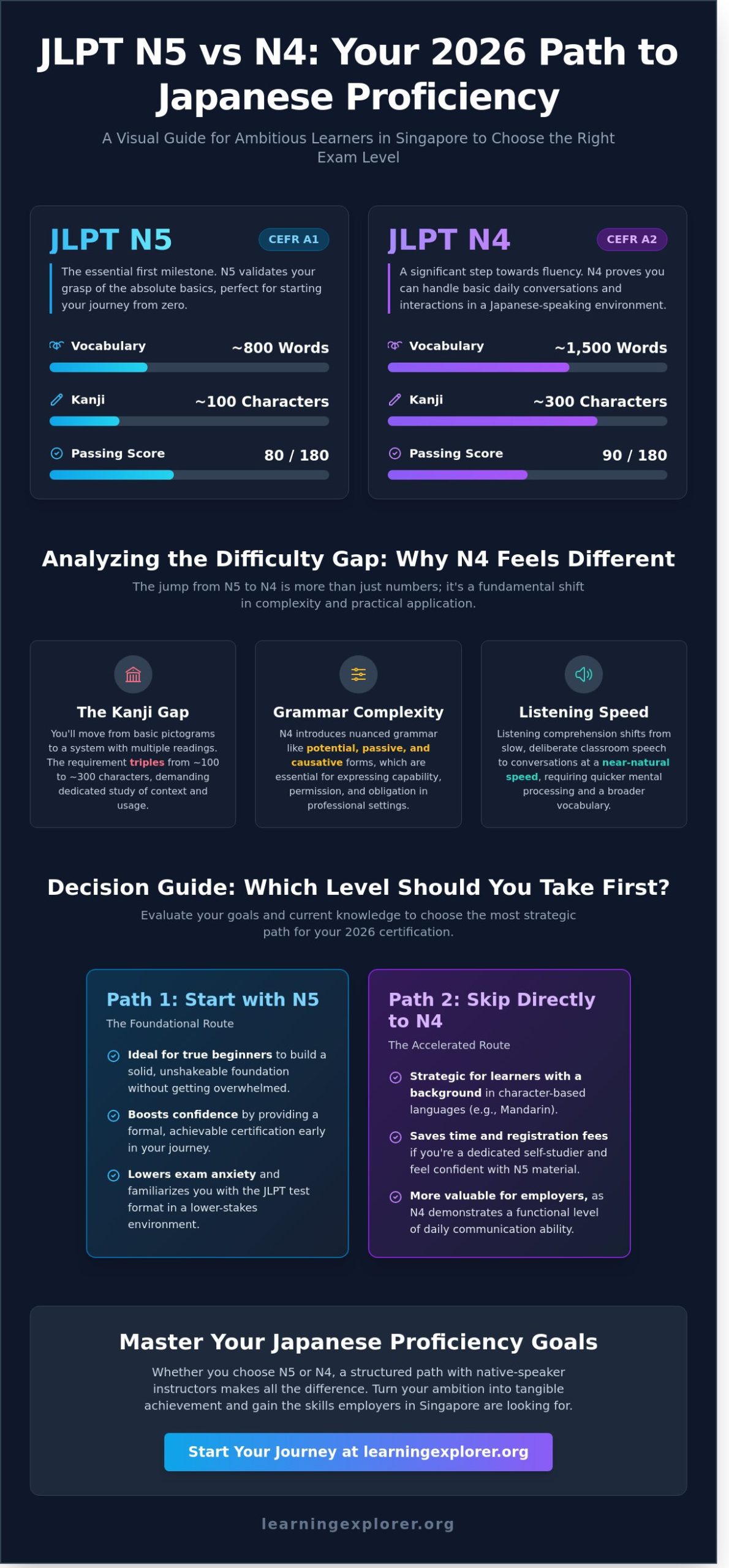
Understanding the technical leap between these two levels helps you plan your study schedule effectively. The ‘Kanji Gap’ represents the primary technical hurdle where learners must move from recognizing basic pictograms to mastering a complex system of multiple readings and contextual usage. While both exams test your reading and listening skills, the official JLPT level summary highlights that N4 requires a significantly higher grasp of daily life topics. Both exams use a scaled scoring system to ensure fairness. For N5, you need a total of 80/180 points to pass, while N4 raises the bar to 90/180 points.
Vocabulary and Kanji: The Numbers Game
The jump in volume is the most immediate difference in the jlpt n5 vs n4 comparison. N5 requires approximately 100 Kanji and 800 vocabulary words. N4 triples the Kanji requirement to roughly 300 characters and expands your vocabulary to 1,500 words. This tripling of Kanji is often the biggest challenge for Singaporean students. Even with a background in Mandarin, the unique Japanese readings and stroke orders require dedicated effort to master. If you want to build a strong foundation before tackling these requirements, our guide on kanji vs kana explains the logic behind the Japanese writing system and helps you approach character study with confidence. You’ll transition from simple nouns like “book” or “water” to more abstract verbs and compound words used in workplace environments.
Grammar Complexity: Beyond the Basics
N5 grammar covers the absolute essentials. You’ll master basic particles, the polite Masu-form, and simple sentence structures. It’s about survival Japanese. N4 takes you much further by introducing potential, passive, and causative forms. These structures are vital for professional settings because they allow you to express nuances like permission, obligation, and capability. Instead of just stating facts, you begin to describe relationships and intentions. This level of grammar empowers you to handle more complex social interactions with confidence.
Bridging this gap typically requires an additional 150 to 250 hours of study time. If you want to accelerate your progress, consider joining our Japanese language classes to get expert guidance. Our training center is conveniently located at 10 Anson Road, level 22, International Plaza, Singapore 079903, right above Tanjong Pagar MRT. We focus on streamlining your study process so you can move from N5 to N4 without feeling overwhelmed by the technical shift.
- N5 Focus: Basic particles (wa, ga, ni), Masu-form, and daily greetings.
- N4 Focus: Potential form (can do), Passive form (was done), and Causative form (make someone do).
- Time Investment: N4 requires roughly double the total study hours of N5.
- Practical Use: N4 is often the minimum level requested by Japanese companies for basic office communication.
Analyze your current strengths before choosing. If you can already read basic children’s stories, you might be ready to tackle the N4. If you still struggle with basic verb conjugations, N5 provides the solid foundation you need to succeed later. Choosing the right level in the jlpt n5 vs n4 debate ensures you stay motivated and see tangible progress in your language journey.
Analyzing the Difficulty Gap: Why N4 Feels Different
Moving from N5 to N4 represents the first real leap in your Japanese journey. While N5 focuses on the basic mechanics of the language, N4 demands that you apply those mechanics to real-world scenarios. Many students find the jlpt n5 vs n4 transition challenging because it moves beyond simple identification. You aren’t just picking out words anymore; you are interpreting intent and nuance. This psychological shift from learning characters to understanding context is where many learners feel the most pressure.
Listening Speed and Natural Flow
N5 listening tracks often feel artificial. The speakers are slow, the pauses are generous, and the vocabulary is strictly controlled. N4 shatters this comfort zone. It introduces natural pauses, fillers, and a conversational pace that mimics daily life in Tokyo. To bridge this gap, engage with authentic media available in Singapore. Stream Japanese news or listen to beginner-friendly podcasts during your commute on the East-West line. This daily exposure helps your brain process the language at a faster cadence, preparing you for the 28-minute listening section that requires sustained focus. Complementing this with structured opportunities to practice Japanese speaking in Singapore will accelerate your ability to process natural conversational speed.
Reading Stamina and Contextual Clues
The reading section evolves from short, three-sentence snippets to full paragraphs and narratives. You must track the subject through multiple sentences, even when the subject is omitted, a common feature of natural Japanese. This skill is vital if you are looking into language proficiency for visas, as official documents and work environments require high contextual awareness. You can find more structured advice on building this stamina in our Learn Japanese Language in Singapore: The 2026 Beginner’s Guide.
Singaporean learners often face specific hurdles during this transition. Those with a background in Mandarin might breeze through the 300 Kanji required for N4 but often struggle with complex grammar particles like “ni,” “de,” and “wo.” Others rely too heavily on English translations, which becomes a liability as sentences grow longer. Our training center at 10 Anson Road, level 22, International Plaza, Singapore 079903, located right above Tanjong Pagar MRT, helps students overcome these plateaus through targeted drills. We focus on the grit of grammar so you can find the spark in your conversations. Understanding the jlpt n5 vs n4 gap is the first step toward mastering the language with confidence.
Decision Guide: Which Level Should You Take First?
Choosing between the jlpt n5 vs n4 often feels like a high-stakes choice for learners in Singapore. Your decision should align with your 2026 career goals and your current study pace. If you’re visiting us at 10 Anson Road, level 22, International Plaza, Singapore 079903, located right above Tanjong Pagar MRT, you’ll find that many students face this exact dilemma. While N5 is the foundation, N4 is often the minimum requirement for Singapore-based Japanese MNCs looking for basic administrative support or customer service staff.
Skipping N5 is a strategic move to maximize your time efficiency. The JLPT is only held twice a year locally, so jumping straight to N4 can save you six months of waiting. This approach increases your learning ROI by focusing your financial resources on a certificate that holds more weight on a resume. In the Singapore job market, companies like Panasonic or Rakuten value the discipline it takes to pass these exams. While N5 is a great personal win, N4 shows a commitment to basic workplace Japanese. If you can score above 60% on a mock N4 test, you’re likely ready to bypass the introductory level.
Financially, skipping N5 saves you roughly S$100 in registration fees. It also streamlines your curriculum management, allowing you to focus on the 1,500 vocabulary words required for N4. This efficiency is vital for busy professionals balancing work and study. By evaluating the jlpt n5 vs n4 requirements early, you can plan a study schedule that delivers results without unnecessary administrative delays.
Should You Skip N5? A Checklist
Review these points to see if you can leapfrog the first level comfortably:
- Can you read Hiragana and Katakana fluently without any hesitation?
- Do you already know more than 150 Kanji and 800 vocabulary words?
- Are you currently enrolled in a Learn Japanese Language Course that covers N4 material?
- Can you follow basic, slow-paced Japanese conversations about daily life?
The Value of N5 as a Confidence Builder
Don’t ignore N5 if you feel anxious about formal testing. It’s a perfect environment to test your ‘exam nerves’ before you reach higher stakes levels like N3 or N2. Passing N5 provides a concrete milestone that fuels personal motivation. This ‘spark’ often leads to better classroom experiences, as you’ll feel more empowered to participate in discussions. It transforms the grit of daily practice into a visible achievement. Discover your potential by starting with a solid foundation that supports your long-term fluency.
Ready to accelerate your Japanese journey? Plan your path to success with our expert-led programs today.
Mastering Japanese Proficiency at Learning Explorer Singapore
Deciding between the jlpt n5 vs n4 is a significant milestone in your language journey. Our certified native-speaker instructors focus on simplifying complex N4 grammar structures that often confuse self-taught learners. We transform these challenges into manageable learning objects that make sense in a real-world context. Our strategic exam preparation is specifically tailored for busy professionals working in the CBD. We understand the daily grit required to balance a demanding career with language goals; therefore, we provide a streamlined path to success.
Our teaching philosophy goes beyond standard textbooks. We create interactive, fun learning experiences that inspire confidence from the very first lesson. By using power verbs and practical scenarios, we help you deliver excellence in your Japanese communication. You’ll find that our curriculum management focuses on the transition from searching for answers to finding them with ease. We’re here to provide the spark for a better learning experience every day, ensuring you feel empowered rather than overwhelmed.
Personalized Coaching for JLPT Success
We maintain small group sizes to ensure every student receives ample speaking and listening practice. This intimate setting allows our instructors to provide personalized feedback that larger schools simply cannot match. Our approach relies on curated excellence. We filter out the noise of the open internet to focus strictly on high-yield exam topics. This saves you valuable time and reduces the administrative stress of planning your own study schedule. To further reinforce your exam preparation, explore the most effective ways to practice Japanese speaking in Singapore outside the classroom and build the conversational confidence that complements your JLPT studies.
Accessibility is a priority for our students. You can visit our center at 10 Anson Road, level 22, International Plaza, Singapore 079903, located right above Tanjong Pagar MRT. This prime location allows you to transition seamlessly from the office to the classroom without a long commute. Our mission-driven atmosphere ensures you stay motivated throughout your preparation for the jlpt n5 vs n4 exams. We position ourselves as your reliable educational ally, helping you master the Japanese language with precision.
Why Choose Our Japanese Language School?
Our bilingual native teachers possess a deep empathy for the unique challenges Singaporean learners face. They bridge the gap between Japanese culture and the local context effectively, making difficult concepts accessible. Pairing your language studies with a solid understanding of japanese culture etiquette for Singaporeans ensures you communicate not just correctly, but appropriately in any professional or social setting. We offer flexible private and group formats to suit your 2026 schedule, ensuring your learning journey fits your lifestyle perfectly. Our school acts as a knowledgeable guide, leading you through every standard-aligned lesson with expertise and kindness.
We believe that high-quality instruction should empower students to reach their full potential. Our goal is to reduce your stress while increasing engagement through lessons your students will love. We invite you to experience our supportive environment firsthand and see why so many professionals choose us. Discover the Japanese course your students will love, book a trial at Learning Explorer today!
Take the Next Step Toward Japanese Fluency
Choosing the right path between jlpt n5 vs n4 marks a significant milestone in your language learning journey. The N5 level establishes your basic survival Japanese, while the N4 level empowers you to handle more complex daily interactions. Both exams require a structured approach to master the specific Kanji and grammar patterns required for the 2026 testing cycle. By identifying your current proficiency early, you streamline your study plan and avoid the stress of being underprepared on exam day.
Our certified native-speaker instructors at Learning Explorer provide the expert guidance needed to bridge these difficulty gaps. We’ve built an interactive and fun learning environment designed to increase student engagement and deliver results you’ll be proud of. You can find our modern training center conveniently located at 10 Anson Road, level 22, International Plaza, Singapore 079903, situated right above Tanjong Pagar MRT. We’re dedicated to helping you move from searching for answers to finding true confidence in your speaking and listening abilities.
Start your journey to Japanese mastery with a trial class at Learning Explorer today. We’re ready to provide the spark that turns your goals into a rewarding reality.
Frequently Asked Questions
Is JLPT N5 or N4 required for a work visa in Japan?
N4 is the minimum requirement for the Specified Skilled Worker (SSW) visa category in Japan. While N5 demonstrates basic knowledge, it doesn’t meet the legal threshold for most professional work permits. Aiming for N4 empowers you with the credentials needed for legal employment. It simplifies your transition from a student to a professional in the Japanese workforce.
How many hours of study are needed to pass JLPT N4 compared to N5?
When comparing jlpt n5 vs n4, study time is a major factor. N5 requires 300 to 600 hours of dedicated study for those starting from scratch. Moving to N4 requires an additional 300 hours, bringing the total to 900 hours. This investment helps you streamline your learning path as you move from basic phrases to understanding daily conversational topics.
Can I take both N5 and N4 exams on the same day in Singapore?
You cannot take both exams on the same day because the Japanese Cultural Society of Singapore schedules all levels simultaneously. This policy means you must choose the level that best fits your current proficiency. Focus your energy on one specific goal to deliver your best performance on exam day. This approach reduces stress and helps you achieve the results your students will love.
What is the passing score for JLPT N5 and N4?
To pass the N5, you need a total score of 80 out of 180 points. The N4 requires a slightly higher passing mark of 90 out of 180 points. You must also meet minimum sectional thresholds for vocabulary, grammar, and listening sections. This structure ensures you possess well rounded language skills and prevents you from relying only on one specific area of strength.
Where are the JLPT exam venues usually located in Singapore?
Exams are typically held at local schools or institutions like the Japanese Cultural Society. If you’re preparing for your test, our training center is at 10 Anson Road, level 22, International Plaza, Singapore 079903, located right above Tanjong Pagar MRT. This central location makes it easy to plan your study sessions and simplifies your commute during your busy work week.
Is N5 too easy to be worth the registration fee?
Deciding between jlpt n5 vs n4 depends on your personal learning goals. While some find N5 basic, it provides the spark many students need to build early confidence. It validates your progress and reduces administrative stress before you tackle the more complex N4 curriculum. Think of it as a curated milestone that celebrates your excellence in the Japanese language.
How often is the JLPT held in Singapore each year?
The JLPT takes place twice every year in Singapore, specifically on the first Sunday of July and December. Registration usually opens 3 to 4 months before the test date through the Japanese Cultural Society. Mark these dates on your calendar to inspire a consistent study rhythm. Following a structured timeline ensures you’re ready to deliver great results when the exam day arrives.
Does the JLPT certificate expire?
Your JLPT certificate never expires and remains valid for your entire life. Once you earn this qualification, it serves as a permanent testament to your hard work and dedication. This lifelong credential helps you discover new career opportunities in Japan without the stress of retaking exams. It’s a professional asset that continues to provide value throughout your educational and career journey.