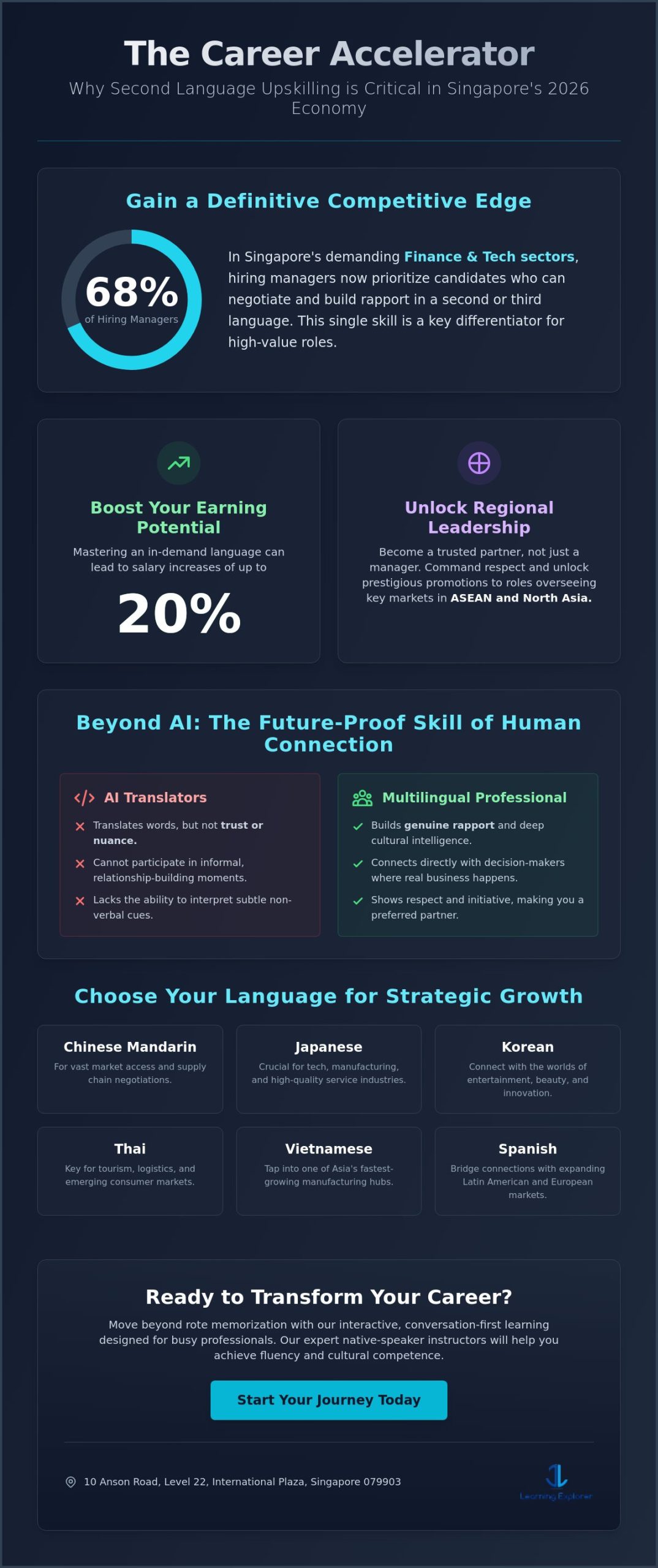
Did you know that 68% of hiring managers in Singapore’s finance and tech sectors now prioritize candidates who can negotiate in a second or third language? In a city that serves as the gateway to Asia, simply being good at your job isn’t always enough to stand out anymore. You might feel stagnant in a competitive market or worry that AI translation tools will eventually replace the need for human speech. However, upskilling with a second language in singapore is about more than just words. It’s about developing the deep cultural intelligence that algorithms simply cannot replicate.
We understand how taxing it feels to manage regional stakeholders when you can’t speak their tongue. Our mission is to help you bridge that gap and regain your professional momentum. This 2026 guide reveals how mastering a language can lead to salary increases of up to 20% and unlock promotions to prestigious regional roles. You’ll discover how to build genuine rapport with international clients and improve your cognitive agility. Whether you visit our training center at 10 Anson Road, level 22, International Plaza, Singapore 079903, or study remotely, we’re here to turn your career goals into reality.
Key Takeaways
- Understand why upskilling with a second language in singapore is a critical strategic asset for navigating regional leadership in the 2026 economy.
- Learn how multilingualism correlates with higher salary increments and enhanced problem-solving abilities through improved cognitive reserve.
- Discover a practical framework for choosing between Mandarin, Japanese, or Korean based on specific industry growth trends across ASEAN and North Asia.
- Explore how to transition from exhausting rote memorization to interactive, conversation-first learning designed for the high-pressure Singapore CBD lifestyle.
- Identify how expert native-speaker instructors can help you bridge cultural gaps and build genuine rapport with international stakeholders.
Why Second Language Upskilling is Critical in Singapore’s 2026 Economy
In the 2026 economic landscape, technical proficiency alone is no longer the primary differentiator it used to be. Singapore has solidified its position as the central gateway to ASEAN and North Asian markets. This means your career trajectory is now tied to your regional reach and cultural adaptability. While English remains one of the official languages of Singapore, relying solely on it can leave you sidelined during high-stakes negotiations in Jakarta, Bangkok, or Seoul. Professionals are finding that upskilling with a second language in singapore is the most direct path to staying relevant. It’s about moving beyond basic fluency and achieving professional-grade competence that commands respect in any boardroom.
To better understand how bilingualism shapes our professional identity and the challenges we face, watch this helpful video from CNA Insider:
The Shift Toward Regional Leadership
Singapore-based firms are aggressively expanding into markets like Vietnam, Thailand, and Indonesia. This growth creates a massive demand for leaders who don’t just understand the business, but also understand the people. If you’re a manager overseeing a team in Ho Chi Minh City or Jakarta, being able to speak the local language transforms you from an outsider into a trusted partner. You’ll navigate local business etiquette with ease and build a level of loyalty that a digital translator simply cannot facilitate. Language upskilling is the bridge between technical expertise and regional influence. It turns a standard resume into a strategic asset for any firm looking to scale across borders and reduce administrative friction in foreign operations.
Beyond AI: The Value of Human Connection
Many professionals worry that AI translation tools might make learning a new language redundant. However, 2026 has shown us that while AI can translate words, it cannot translate trust. High-stakes meetings often rely on nuance, shared humor, and the ability to read subtle non-verbal cues. In many Asian business cultures, the real decisions are made during the informal moments of a dinner or a coffee break. AI can’t participate in those human connections or show the respect that comes with attempting to speak a client’s native tongue. By committing to upskilling with a second language in singapore, you’re developing a future-proof capability that technology cannot replicate. If you’re ready to start this journey, our center at 10 Anson Road, level 22, International Plaza, Singapore 079903, provides the supportive environment you need to grow your influence.
Professional Benefits: How Multilingualism Accelerates Your Career
Investing time in upskilling with a second language in singapore isn’t just a personal hobby; it’s a calculated financial strategy. In our competitive market, the ability to converse fluently with regional partners sets a clear ceiling on your earning potential. According to the Reeracoen Singapore Salary Guide 2025–2026, professionals who acquire in-demand skills can command salary increases of 10% to 20% when changing roles. This economic reality is echoed in SkillsFuture Singapore’s Skills Demand for the Future Economy report, which highlights how cross-functional skills drive career resilience. When you speak a client’s native tongue, you aren’t just moving information. You’re building a network of trust and showing a level of respect that English-only speakers simply cannot match.
Enhanced Cross-Cultural Negotiation
Negotiation is rarely about the words alone. It’s about reading the subtext. In many North Asian business cultures, the most important information is often left unsaid. For instance, understanding the “hidden” meanings in Japanese or Mandarin contexts can prevent costly misunderstandings during contract talks. Language training teaches you to de-escalate tension by using culturally appropriate honorifics and tones. This process builds deep empathy, a core leadership trait that helps you manage diverse teams with greater sensitivity. You’ll find yourself becoming a more effective mediator who can bridge the gap between local headquarters and regional offices.
Cognitive Agility in the Workplace
Think of language learning as a “brain gym” for your executive functions. Research published in the journal Nature Aging suggests that multilingual environments improve the brain’s ability to switch tasks and focus amidst distractions. This cognitive agility is vital for the fast-paced Singaporean professional environment. By training your brain to navigate different grammatical structures, you’re actually improving your problem-solving skills and your ability to design creative workflows. Many professionals find that their mother-tongue communication also becomes more precise as they gain a deeper awareness of linguistic nuances. If you want to experience these benefits firsthand, starting a Conversational Mandarin Course or another regional language is a powerful way to invest in your future self.
Choosing the Right Language for Your Career Path
Selecting the right language requires looking beyond personal interest and focusing on economic utility. In 2026, the job market rewards those who align their skills with the city-state’s regional ambitions. This strategic approach to upskilling with a second language in singapore ensures that every hour spent studying translates into tangible career leverage. This focus on multilingualism has long been a cornerstone of Singapore’s language policy, and today it serves as a professional compass for ambitious adults navigating a complex global economy.
Industry-Language Mapping
Your choice should reflect where your industry is heading. For those in finance, trade, and logistics, mastering conversational mandarin singapore remains the gold standard. It’s the primary tool for engaging with the Greater China market, which continues to be a major driver of local trade. If you’re in the technology, luxury goods, or precision engineering sectors, you might choose to learn japanese language. Japan’s role as a leader in high-end manufacturing and R&D makes it a vital partner for Singaporean firms. Similarly, Korean is essential for those in the entertainment, gaming, and semiconductor industries. Meanwhile, the rapid industrialization of Vietnam and Thailand has turned Vietnamese and Thai into “power languages” for supply chain and manufacturing managers. If you’re planning to visit or work with Vietnamese partners, brushing up on Vietnamese for travel as a Singapore-based professional is an excellent way to build immediate rapport on the ground.
Don’t overlook the global reach of Spanish if your company eyes European or Latin American markets. Spanish is often easier for English speakers to pick up quickly, providing a faster return on investment for those needing to operate in international trade hubs. Each language offers a unique set of keys to different regional boardrooms, allowing you to choose the path that best matches your professional trajectory.
Assessing Difficulty vs. Reward
Be realistic about your time and the commitment required for different language families. Learning Mandarin or Japanese involves mastering character systems, which requires a consistent, long-term focus. However, the professional payoff is often significantly higher due to the depth of connection it builds. If you need immediate results for upcoming business travel, focusing on conversational Thai or Spanish can provide “quick wins.” You can learn basic greetings, business etiquette, and essential negotiation phrases in a matter of months.
Set achievable goals for the year. Start by aiming for basic conversational proficiency rather than total native-level fluency. This approach reduces the administrative burden of learning and keeps your motivation high. Many students find that joining a structured program helps them stay on track through social learning and expert guidance. By focusing on high-frequency business vocabulary, you’ll see a faster impact on your daily professional interactions and regional influence.
Overcoming Barriers: Language Learning for Busy Professionals
Upskilling with a second language in singapore shouldn’t feel like another exhausting task on your to-do list. The high-pressure environment of the Singapore CBD often leaves professionals feeling time-starved; you’re likely balancing tight deadlines with back-to-back meetings. This intensity makes the idea of adding a language class feel overwhelming. However, the secret lies in changing how you learn. We’ve moved beyond the days of traditional academic rote learning where you’d spend hours memorizing dry grammar rules. Instead, modern training focuses on interactive, fun experiences that mimic real-world business scenarios, making the process both engaging and effective.
Logistics play a huge role in your success. Our training center is situated directly above Tanjong Pagar MRT, making it incredibly accessible for busy executives. This central location means you can transition from your office to the classroom in minutes. Whether you prefer the social energy of small group sessions or the targeted focus of private 1-on-1 coaching, we provide the environment you need to thrive. Executives often choose 1-on-1 sessions to focus on specific industry terminology, while small groups are excellent for practicing conversational flow with peers.
Flexible Learning Formats
We offer intensive crash courses designed for those who have a business trip on the horizon. If you can’t commit to a full semester, lunch-hour sessions or evening classes provide the flexibility to learn without disrupting your workday. Many of our students also benefit from a blended approach, integrating digital materials with physical classroom interaction. This ensures you can review your lessons even when you aren’t at our center. Our goal is to reduce your administrative burden by providing structured, vetted content that fits into the gaps of your schedule.
Building a Consistent Habit
Consistency is the foundation of fluency. Integrating upskilling with a second language in singapore into your daily routine is easier than you think. Use micro-learning strategies for the daily commute; five minutes on a mobile app or listening to a podcast can make a big difference. Try to create an immersive environment at home by switching your phone’s language or watching regional news. Many professionals struggle with a fear of speaking, worrying about making mistakes in front of clients. Our professional instructors are experts at building your confidence, providing a safe space to practice until your speech becomes natural. Beyond regional languages, professionals who want to sharpen their executive communication should also explore spoken english classes near me to ensure their English-language presence in the boardroom is equally compelling. By mastering these habits, you’ll increase your learning efficiency while simultaneously enhancing your professional impact across the region. If you’re ready to break through these barriers, find the right program at our language school and start your journey today.
Strategic Language Learning at Learning Explorer
Learning Explorer stands as the premier language school for professionals seeking to elevate their regional influence. We recognize that upskilling with a second language in singapore is a strategic move to reduce your administrative burden and increase your engagement with global stakeholders. Our team consists of certified native-speaker instructors who are also bilingual, ensuring they understand the unique challenges of the Singaporean workplace. From a Conversational Thai Course to a Business English Course, we provide high-quality training that empowers you to lead with confidence.
Our training center is conveniently located in International Plaza. This central location allows you to transition seamlessly from your office to the classroom. We offer a comprehensive range of programs, including Conversational Vietnamese and Business Mandarin, designed to help you navigate the complexities of the 2026 economy. We’re here to act as your reliable ally, providing the creative catalyst for better career outcomes.
The Learning Explorer Methodology
Our curriculum aligns with global standards to provide measurable results for every student. We emphasize the use of high-quality, vetted materials that distinguish our programs from the unorganized nature of external sources. Every lesson is crafted to facilitate the transition from the labor of seeking to the satisfaction of linguistic discovery. This approach respects your limited time while simultaneously enhancing your professional impact across the region.
Customized Solutions for Individuals and Firms
We offer corporate training contracts for organizations aiming to upskill their teams for regional expansion. For individuals, our private classes are tailored to specific industry vocabulary and business etiquette. Whether you’re preparing for a high-stakes negotiation in Bangkok or a client meeting in Seoul, we have the expertise to guide you. Visit our center at International Plaza to begin your journey toward linguistic mastery today.
Unlock Your Regional Potential in 2026
The job market has never been more competitive, but your path to growth is clear. By committing to upskilling with a second language in singapore, you’re doing more than just learning new vocabulary. You’re building the cultural intelligence and cognitive agility needed to lead across ASEAN and North Asian markets. You’ve seen how these skills command higher salaries and foster the kind of trust that digital tools simply can’t replicate. It’s about becoming a future-proof professional in an increasingly connected world.
At Learning Explorer, we make this professional transition seamless. Our certified native-speaker instructors provide an interactive and fun learning environment that fits into your busy schedule. You don’t have to struggle with unorganized materials or long commutes. Our convenient CBD location above Tanjong Pagar MRT ensures that your education is as efficient as it is inspiring. It’s time to move from the labor of seeking to the satisfaction of discovery and regional influence.
Explore our 2026 Language Courses and Start Upskilling Today
Your journey toward becoming a truly global professional starts with a single conversation. We’re here to be your reliable ally every step of the way. Take the first step toward your promotion and start your linguistic discovery today.
Frequently Asked Questions
Is learning a second language still useful with the rise of AI translation?
Human language skills remain essential because AI translation cannot replicate the deep rapport, humor, and cultural nuance required in high-stakes business negotiations. While machines handle literal word-for-word exchanges, they fail to pick up on subtle non-verbal cues or local etiquette. Upskilling with a second language in singapore ensures you can build genuine trust with regional partners. This trust is the foundation of any successful long-term collaboration in the Asian professional environment.
How long does it typically take a working adult to become conversational?
Most working adults achieve basic conversational proficiency within 6 to 12 months of consistent, weekly training. Your individual progress depends on the language’s complexity and your level of weekly immersion. For example, learning Spanish might feel faster for English speakers, while Mandarin or Japanese requires more time to master character sets. We focus on high-frequency vocabulary to help you start speaking from your very first lesson, ensuring your time is spent efficiently.
Which language is currently most in demand for jobs in Singapore?
Mandarin, Japanese, and Korean remain the top three languages in demand due to Singapore’s strong trade ties with North Asia. However, 2026 has seen a surge in demand for Thai and Vietnamese as manufacturing hubs shift across ASEAN. Choosing a language depends on your specific industry trajectory. Finance professionals often prioritize Mandarin, while those in tech or luxury sectors frequently choose Japanese to better engage with regional stakeholders and international clients.
Can I learn a new language if I was not good at them in school?
You can absolutely learn a new language as an adult even if you struggled in school. Traditional academic methods often focus on rote memorization and exams, which can be discouraging for many students. Our professional courses prioritize interactive, conversation-first learning that mimics real-world scenarios. This modern approach makes the process of upskilling with a second language in singapore both enjoyable and rewarding. We create a supportive environment where you can practice speaking without pressure.
What is the difference between conversational and business language courses?
Conversational courses are designed to help you navigate social situations, travel, and daily interactions with native speakers. In contrast, business courses focus on professional etiquette, formal negotiation tactics, and industry-specific terminology. If you need to lead meetings or present to clients, a business course is more suitable. Many professionals start with a conversational foundation before moving into specialized business modules to ensure they have a well-rounded and versatile linguistic ability.
Are there flexible class timings for professionals working in the CBD?
We provide flexible scheduling specifically designed for the time-starved Singaporean workforce. You can choose from lunch-hour sessions or evening classes that fit naturally into your workday. Our center is situated directly above Tanjong Pagar MRT, making it easy to drop in for a session before or after your office hours without a long commute. These bite-sized learning opportunities ensure you can maintain a consistent habit despite a high-pressure professional schedule.
Do I need prior knowledge before joining a beginner course?
You don’t need any prior knowledge or experience to join our beginner-level language programs. We design our introductory courses for absolute beginners, starting with basic phonetics and essential greetings. Our native-speaker instructors guide you through the foundations step-by-step, ensuring you feel confident before moving to more complex structures. We provide all the high-quality, vetted materials you need, so you can focus entirely on the satisfaction of learning your new language from scratch.
How do I choose between a group class and private tuition?
Group classes are ideal if you enjoy learning alongside peers and practicing conversation in a social setting. They’re often more cost-effective and provide diverse perspectives from other professionals. Private tuition is better if you have a specific deadline or need to focus on niche industry vocabulary. One-on-one coaching allows the instructor to tailor every lesson to your personal learning speed and specific professional goals, maximizing your efficiency and overall results.